
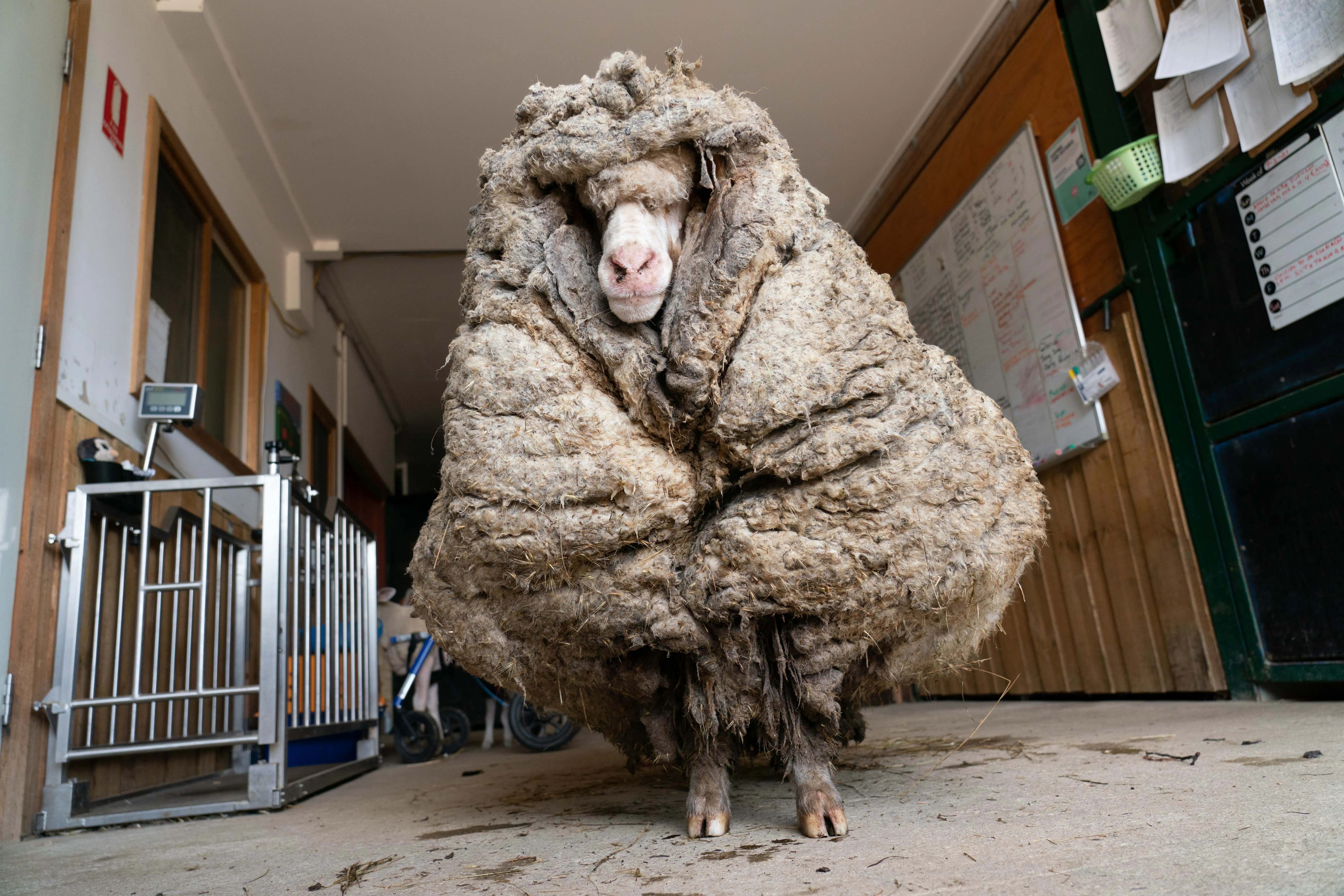
In 2021, a sheep named Baarack was found wandering alone in the wilderness of Australia with more than 75 pounds of fleece weighing it down. A property maintenance worker spotted Baarack in the forest that adjoined the property where he was working. He contacted an animal rescue crew and they were able to take care of the animal.
They determined that Baarack once had an owner because it looked as if he had an ear-tag that had been torn out by the thick matted fleece near his face. Sheep need to be sheared at least once a year to keep their coats light enough — but clearly Baarack hadn’t been given a haircut in several years.
After they rescued him, they quickly gave him a shearing and his fleece weighed in at a whopping 78 pounds. The wool around his face had severely impaired his vision and he was also dangerously underweight — probably due to the fact that all of the extra weight limited his mobility. Evidently, the extra weight and the vision problems meant that Baarack was only able to eke out an existence eating small shoots of grass.
Thankfully, the story has a happy ending. After receiving the care he needed, Baarack made a full recovery.
Baarack’s story illustrates something that is true for ALL sheep: sheep need a shepherd — they need someone to care for them.
- I think back to the things Jim Flowers shared with us in his communion comments a few months ago. Last year, Jim and Kerrie became the owners of three English baby doll ewe lambs named Wynonna, Shania, and Dolly.
- As Jim mentioned they had to build a fence for the sheep to keep them safe; they built a sheep palace for the sheep so they would have a place to sleep. Jim and Kerrie know this better than most people: sheep need a shepherd.
- Sheep like to graze, so they need access to plenty of grass to eat. An adult sheep will drink a gallon or two of water each day. They need to be sheared at least once a year, sometimes more often. They also need to have their hooves trimmed regularly.
Sheep are a lot of work. They need someone to care for them.
- Baarack needed a shepherd to keep him from wandering off into the wilderness.
- When he was found, he needed someone to care for him, to nurture him and to shear off that fleece. He couldn’t do that for himself — the sheep needed outside help.
Sheep need a shepherd.
We are in the midst of a study right now called Knowing Jesus. We are taking a look at the different names and titles that are used to describe Jesus in the Bible.
- We’ve talked about the name “Jesus” and the fact that it means “God saves.” His name itself is a signal that Jesus is our Savior. He came to rescue us from our sins.
- Last week, we talked about the title “Lord.” You can’t have Jesus as your Savior without also making Him the Lord of your life. Yes, He came to rescue, but He also came to rule.
- And now today, we look at another of these titles, one that Jesus uses Himself. Sheep need a shepherd; that’s why it’s so important when Jesus says, I am the GOOD shepherd.
You find this statement over in John 10.
John 10:11
I am the good shepherd. The good shepherd lays down his life for the sheep.
- The Bible often refers to us as sheep:
- Psalm 100:3, Know that the Lord, He is God! It is he who made us, and we are his; we are his people, and the sheep of his pasture.
- Psalm 119:176, I have gone astray like a lost sheep…
- Today if you say that a group of people are like sheep, it’s usually meant as an insult. But that’s not what’s going on here. God doesn’t include these verses in the Bible to insult us.
- Ancient readers of these verses understood that sheep need a shepherd. And if the Bible repeatedly refers to us as “sheep,” then the implicit point is that we, too, need a shepherd.
- We need someone who will care for us, someone who will watch over us and protect us.
- We need someone to ease the heavy burden we are carrying — the “fleece” of our sin and our shame and our guilt. Just as Baarack could not shear himself to get rid of this heavy burden, neither can we remove the weight of our sin — not on our own. We need someone else to come along and help with this problem.
- That’s why it’s really good news for Jesus to say, “I am the good shepherd.”
One of the most enduring stories Jesus ever told was about a son who was “lost” — a son who had wandered away from the care and protection of his home. And just before telling that story, Jesus talked about a sheep that had also gone astray. I think the connection between those two stories is obvious.
The Bible makes it clear that Jesus wants to be the shepherd of our souls.
There are three points I want to make about Jesus as the Good Shepherd.
- The Good Shepherd has compassion for lost sheep.
Matthew 9:36
When he saw the crowds, he had compassion on them, because they were harassed and helpless, like sheep without a shepherd.
Jesus looks out on the crowd and He sees lost sheep. The Jewish people at that time were being led astray by their leaders. The Pharisees were supposed to be shepherds over the people, teaching them God’s Word and helping them to know God in a deep and meaningful way. But these religious leaders neglected their responsibilities. This was anticipated back in the day of Ezekiel. In Ezekiel 34, God says that when those who are called to shepherd the flock neglect their duties, God says I myself will be the shepherd of my sheep (Ezekiel 34:15).
So Jesus looks out on the crowd and he sees an entire flock of Baaracks. He sees men and women who have been burdened by the man-made traditions and “laws” of the Pharisees. These people are lost — so far from God because their leaders have been derelict in their duties.
The people were harassed and helpless — other translations use words like “confused” and “bewildered.” In their confusion, they have wandered away from the fold, wandered away from God. For some, this might have been a willful decision on their part. For others, it might have been more like a slow drift. Either way, these people are lost.
And Jesus’s response is to have compassion for them. Something stirs within His heart when He sees these lost sheep. He is the Good Shepherd because He wants something better for His sheep.
The parable of the lost son (prodigal son) shows us that even when we go astray, God sees us the same way. He sees us as lost sheep — and He has compassion for us. This seems to be His natural response to us whenever we are lost. He longs for us to repent and turn back to Him. He wants His lost sheep to come home where they will be safe once again.
Simon Peter talks about this in 1 Peter 2:25, For you were straying like sheep, but have now returned to the Shepherd and Overseer of your souls.
If anyone knows about sheep going astray, it’s Simon Peter. That’s his story. But he also knows about returning, being restored, looking to Jesus as the Shepherd of our souls. The Good Shepherd has compassion on His lost sheep.
Some of you who are here today — or some of you who might be listening to this message — you’re like Baarack. You’re carrying around such a heavy burden. You carry the guilt of your mistakes, the shame of your sin. You willfully left the fold and you’re wondering how God feels about you.
- If you can relate to that, I hope you hear the Word of God today: the Good Shepherd has compassion for all of His lost sheep.
- In fact, that compassion is what drives Him to do what He does.
- The Good Shepherd lays down His life for the sheep.
Jesus explains what it means for Him to be the “good” shepherd. It means that He lays down His life for the sheep. His compassion is what drove Him to His crucifixion.
John 10:11-12
I am the good shepherd. The good shepherd lays down his life for the sheep. He who is a hired hand and not a shepherd, who does not own the sheep, sees the wolf coming and leaves the sheep and flees, and the wolf snatches them and scatters them.
The good shepherd is aware that there is a wolf — an enemy — who wants to destroy and scatter His sheep. Jesus says a hired hand just views shepherding as a job. It’s a way to make a living. But the good shepherd is personally concerned with the welfare of the sheep — so much so that He lays down His life for them.
In this same teaching, Jesus talks about being the door or the gate for the sheep.
- Ancient sheep pens looked like this. Not exactly a sheep palace, but it’s enough to keep them corralled.
- In this sheep pen, there was a gap for them to get in and out.
- The shepherd would literally put his own body in the gap. Nothing gets in, nothing gets out.
- Literally, “over my dead body.”
That’s what makes Jesus the GOOD shepherd. No other shepherd can do this for us. We have an enemy who wants to steal, who wants to kill and destroy; Jesus mentions him in this same teaching (John 10:10). But Jesus lays down His own life to keep the enemy from harming us. He literally puts His body between the sheep and the enemy — that’s a good way for us to think about the cross.
Because Jesus is the GOOD shepherd.
- The Good Shepherd gives us everything we need.
I want to close today by looking at Psalm 23. It is one of the most beloved passages in God’s Word. I’ve read this passage at every funeral I’ve ever preached. But make no mistake: this is a passage for the living. It tells us that when we make the Lord our shepherd, He gives us everything we need.
Psalm 23:1-6
The Lord is my shepherd; I shall not want. He makes me lie down in green pastures.
He leads me beside still waters.
He restores my soul.
He leads me in paths of righteousness for his name’s sake.
Even though I walk through the valley of the shadow of death, I will fear no evil.
For you are with me, your rod and your staff, they comfort me.
You prepare a table before me in the presence of my enemies;
you anoint my head with oil; my cup overflows.
Surely goodness and mercy shall follow me all the days of my life,
and I will dwell in the house of the Lord forever.
This is a picture of total provision. As my shepherd, the Lord supplies my every need.
When the Lord is my shepherd…
- I shall not want. I won’t lack for anything — not really. I’ll have everything I need because of His provision. This is what the “green pastures” are all about. For a sheep like Baarak, green pastures would be a sign of abundance. What else do we need besides the things God has provided? 2 Peter 1:3, His divine power has granted to us all things that pertain to life and godliness through our knowledge of Jesus, the Good Shepherd.
- I experience peace. We can draw this from the picture of “still waters” in v2 — not choppy, not turbulent. There’s a peace and calm that comes from submitting your life to God. I can rest when I know that Jesus is the One “standing in the gap.” He is the door to the sheep pen. He protects me from the enemy.
- He restores my soul. This is the promise of eternal life for your soul on the other side. Our souls will be restored in a land where there is no more sin.
- He leads me. When the Lord is my shepherd, He leads me in paths of righteousness. I don’t have to be in charge all the time — which is exhausting, honestly. It’s exhausting to always ben in charge — because we weren’t made for that. Instead, you can follow the voice of the good shepherd, let him direct you where you need to go.
- I need not fear any evil — because He is with me. Even when you walk through the darkest valley, He promises to guide you. He won’t abandon you or forsake you. If the Lord is your shepherd, you never have to be alone — even in death. What a comforting thought!
- I am comforted — His rod and staff bring us comfort. These are signs of His presence and His protection. The rod was used to fend off the wild beasts and the staff was used to guide the sheep. These are comforting images. He is the God of all comfort as it says in the Bible.
- A table is prepared for me — The Jewish idea of heaven was a great banquet feast, an eternal Thanksgiving meal. They pictured this huge table full of food and there was laughter and rejoicing and God Himself would preside over it. And He has a place waiting for me.
- My cup overflows — He gives me the abundant life in Jesus. He is not stingy in doling out His blessings. When the Lord is my shepherd, I receive every spiritual blessing in the heavenly realms (Eph. 1:3).
- Goodness and mercy follow me all the days of my life. While we are here on earth, we feel his goodness and mercy — and we have a responsibility to share that with others.
- And I will dwell in the house of the Lord forever — this is the promise of an eternal home with Him. In His house. Sheep need shelter. And Jesus says that the Father’s house has many rooms. Room for you, room for me.
Would you make the Lord your shepherd?
If you have already confessed Jesus as the Good Shepherd, I hope this message is a reminder of the benefits that come from this decision.
If you haven’t made the Lord your shepherd, I wish you would.
Invitation:
In the name of Jesus Christ, the Sovereign Lord who makes all things new, he who has ears let him hear.
Discussion Questions:
- Today’s message focuses on Jesus as “the Good Shepherd.” Sheep need the care of a shepherd, someone who can tend to their needs. In your opinion, what qualities make for a good shepherd?
- Read John 10:1-15. What stands out to you about this passage? What is the primary point Jesus is making here?
- In verse 11, how does Jesus define this idea of being “the good shepherd?”
- Jason explained that ancient sheep pens had a gap / opening and the shepherd would often position his body in this gap, even sleeping here in order to keep predators away from the sheep. How does this image explain Jesus’s role as the good shepherd?
- Read Matthew 9:36. How does Jesus feel about lost sheep? (For further reading, consult Luke 15.)
- Sheep are prone to wander off without proper guidance. Can you think back to a time when you willfully wandered away from God? If you’re comfortable doing so, share your story with the group. How did God / Jesus pursue you when you were a lost sheep? Sharing this part of your story could be extremely helpful to someone else in your group who might be going through something similar. Sharing this story could also be God’s way of preparing you for an evangelism moment with a non-believer, so please don’t be bashful in sharing.
- Read Psalm 23:1-6. Of all the benefits of making the Lord your shepherd, which one means the most to you today?
- Look at 1 Peter 2:25 where Jesus is referred to as both “shepherd” and “overseer.” How do these two terms compliment one another? How are these terms different? How does this impact our understanding of Jesus?
- Close with some prayer time, thanking God for the fact that Jesus is the shepherd of our souls.
 already & not yet