
As we continue our Knowing Jesus series this morning, let me ask you to consider this statement: Christianity is an inclusive religion with an exclusive claim.
- Christianity is inclusive in the sense that it is open to anyone who responds in faith.
- No matter who you are or where you come from, anyone can come to know Jesus.
- John 3:16 is the most beloved passage of Scripture for many believers and it speaks of God’s great concern for the entire world and all of her inhabitants: For God so loved the world…
- So in this sense, the Christian faith is inclusive — the Gospel is for everyone.
- And yet our faith is predicated upon an exclusive claim: that Jesus is the way, the truth, and the life.
- These words come directly from the lips of Jesus Himself.
- We find this statement in John 14.
John 14:6
Jesus said to him, “I am the way, the truth, and the life. No one comes to the Father except through Me.”
Jesus spoke these words to His disciples at the Last Supper before His death. He says, In my Father’s house are many rooms. Thomas said, “Lord, we don’t know where you’re going? How can we know the way to the Father’s house?” And that’s when Jesus makes this statement: I am the way and the truth and the life.
Jesus tells His followers that He is the way of truth that leads to life.
- He is the Way — the path linking us with God the Father. According to Acts 9, Acts 19, and Acts 24, the early church was referred to as “The Way.”
- He is the Truth — Truth corresponds to reality. Ultimate truth is perfectly represented in Jesus.
- He is the Life — He is the true God and eternal life. (1 John 5:20)
And then Jesus says, No one comes to the Father except through Me.
- There is no way but Jesus
- No truth other than Jesus
- No life outside of Jesus
Plenty of people today find this to be offensive. It’s popular in our day to claim that all paths are equal. We’re not accustomed to this kind of exclusive claim. The modern person prefers softer, gentler ideas that sound more open-minded and tolerant. Many people today believe that there’s more than one way to eternal life. Many believe that there are infinite paths leading to the same place. Just find what works for you — but don’t try to impose that on someone else, because what’s true for you might not be true for someone else. But it’s no big deal because all religious paths lead to the same place.
That may sound appealing but it’s a view that is impossible to reconcile with the words of Jesus. And the exclusive claim about Jesus is the consistent testimony throughout the New Testament.
1 Timothy 2:5-6
For there is one God and one Mediator between God and men, the man Christ Jesus, who gave Himself a ransom for all.
1 Corinthians 3:11
For no other foundation can anyone lay than that which is laid, which is Jesus Christ.
Acts 4:12
…for there is no other name under heaven given among men by which we must be saved.
Each of these statements flows out of this statement that Jesus made to His followers just before His crucifixion: I am the way and the truth and the life. No one comes to the Father except through Me.
I read an excellent book on apologetics last year. The author is Neil Shenvi, Why Believe?: A Reasoned Approach to Christianity. I want to share a few excerpts from this book that speak to this idea of Jesus as the way, the truth, and the life:
“My claim is that the gospel presents us with two truths all of us must face as human beings: that we are all moral failures and that we all need a Savior. Of all the major world religions, only Christianity insists that we are radically morally corrupt people who are consequently alienated from a perfectly good God. And only Christianity insists that what we primarily need is not moral improvement but rescue. If these claims about the human condition turn out to be true, then they are compelling evidence for the truth of Christianity, which is unique in its assessment of the human condition.”
“Christianity is either true or false. If it is true, then its truth explains its unique ability to diagnose [our] spiritual condition. But if it is false, then it is an incredible coincidence that Christianity uniquely explains two deep, existential realities entirely by accident. . . . Christianity affirms both that human beings are radically sinful and that we need a rescuer.”
Shenvi uses a helpful chart to summarize the key problems and solutions offered by each of the world’s major religions.
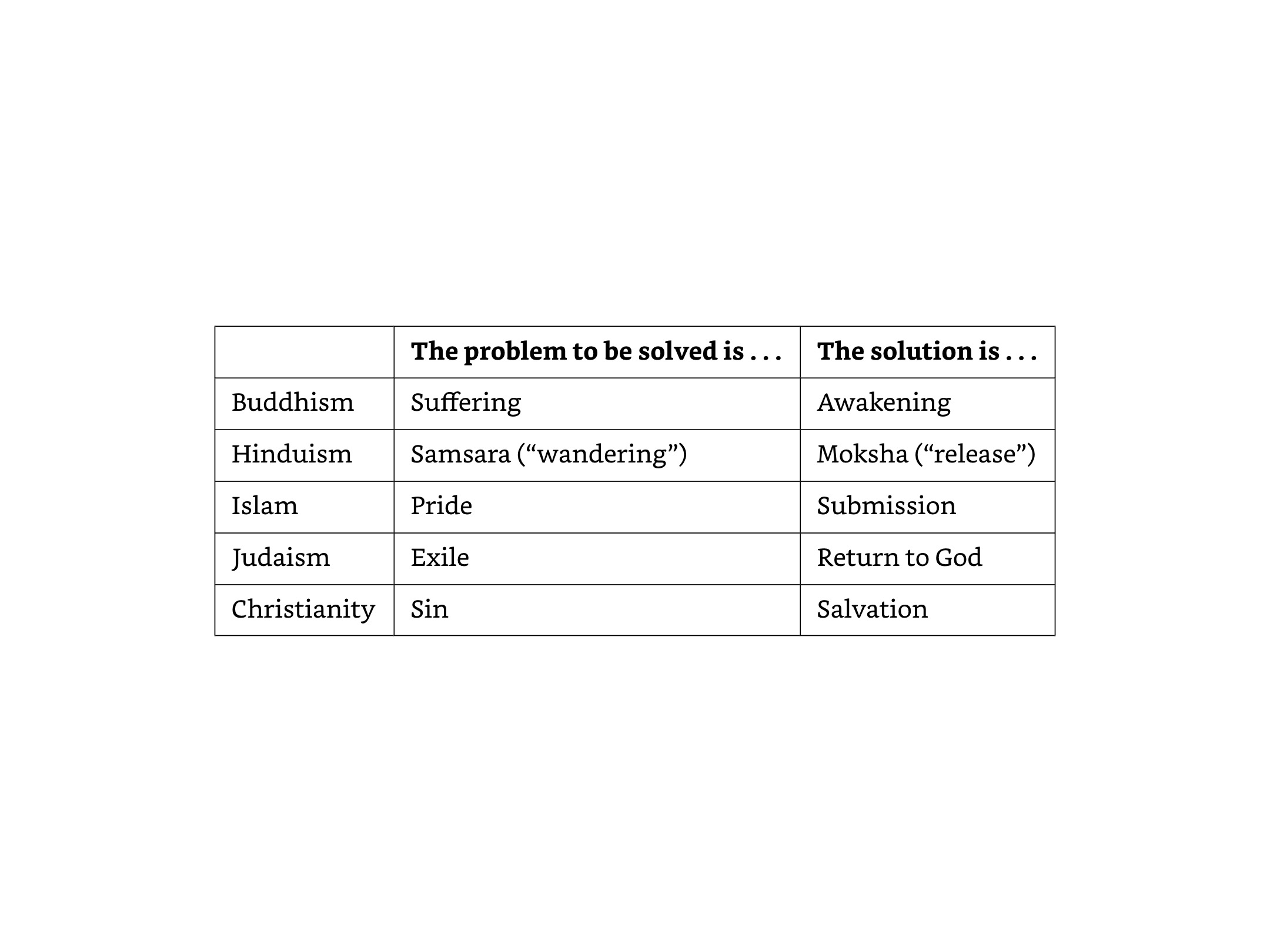
It’s nonsense to claim that each of these paths lead to the same place because each religion holds a distinct worldview with different problems to be solved. These first two — Buddhism and Hiduism — are not even monotheistic religions, meaning they deny the presence of One Creator God. They are polytheistic, teaching that there are instead many gods.
According to Buddhism, the central problem of human existence is not sin but suffering. One of the core teachings of the Buddha is known as “The Four Noble Truths,” which states:
- To live is to suffer.
- Suffering is caused by attachment.
- To eliminate suffering one must eliminate attachment.
- One can eliminate attachment by following the eight-fold path.
Buddhism avoids the idea that we are radically sinful and alienated from God and therefore in need of a Savior. In fact, some strands of Buddhism are nontheistic (claiming there is no God at all). Buddhism is essentially a religion of self-help, which might explain it’s growing popularity in the world today. It’s about self effort, trying harder, and learning to do without. With enough striving, a Buddhist could achieve nirvana on her own, without the need of a savior.
In Hinduism, the fundamental problem that must be overcome is this ongoing cycle of reincarnation, called samsara. Bad actions in the present results in bad karma, which then leads to suffering in your next reincarnation. Of course, good actions lead to a better reincarnation. The final goal here is called moshka, breaking free from this cycle, although different strands of Hinduism disagree on what happens when you achieve this state. But it’s something along the lines of achieving transcendence by starving your ego. Hinduism is an extremely works based religion: do good, move up the chain in your next life; do bad, move down the chain. But there is no sense of forgiveness for your sins or failings — only the flat payout for what you’ve done.
Islam is closer to Christianity than Buddhism or Hinduism in that it is a monotheistic religion. It is based on the idea that there is one God who is the Creator of the universe. Islam also recognizes that to sin against this God is to provoke His wrath and makes us liable to judgment. But one of the major differences between Christianity and Islam is the understanding of sin. According to Islam, sin isn’t really the problem; it’s self-sufficiency. And the solution offered in Islam is to simply return to God’s path. You don’t need to be saved from your sins, you just need to make better choices. If only it were that easy. Christianity teaches that we cannot put ourselves back on the path because we bear guilt. We need redemption, atonement, someone to intercede on our behalf — all of which is missing from the teachings of Islam. According to Dr. Stephen Prothero, a professor of religion at Boston University, “Sin is not the problem Islam addresses. Neither is there any need for salvation from sin.” Instead of redemption, Islam teaches that submission and discipline are what we need most. This is the way to overcome the problem of self-sufficiency. But if the problem is the self, how can the self also be the solution? That’s one of the philosophical shortcomings of Islam.
Comparing Judaism to Christianity is complicated by the fact that Judaism is both a religion and an ethnicity. Someone could identify as ethnically Jewish and hold very few Jewish religious beliefs. Because of this, Shenvi focuses on rabbinic Judaism for his analysis. He notes that the Jewish emphasis is not so much on the problem of sin but the problem of exile. In the Jewish Scriptures, the people are exiled over and over: from the Garden of Eden in the beginning; from the land of Canaan while they’re held as captives in Egypt and later Assyria and Babylon. And although there are plenty of OT passages that speak of God’s forgiving nature, the rabbis have historically argued that obedience is the key to returning back to God, our true home. While that sounds good, it boils down to following the law — something we are incapable of doing, according to the New Testament, because of the presence of sin.
This is just a brief overview and there’s so much more that could be said as we try to compare the ways these religions differ. But even this brief summary shows how foolish it is to say that all religions are the same, they all lead to the same place, etc. And the Christian scriptures tell a much different story.
- Faith centered around Jesus is about salvation from our sins.
- Each of these major religions agree that there is a problem to be solved. But Christianity is unique in that the solution it offers is not self-help, not trying harder. The solution is God’s free gift of grace — the atonement for sin in the death of Jesus.
- We need help from outside of ourselves in order to be saved.
- Salvation is found by trying harder — most of you have tried as hard as you can.
- And salvation isn’t found by looking into your heart — not a heart that’s been changed by sin.
- No, the solution to our problem can’t come from within ourselves. It must come from beyond.
- And the Good News — the Christian gospel — is that Jesus is God’s response to our sin.
It all comes back to Christ crucified and resurrected, as Paul notes in 1 Corinthians 15. Paul says “This is the Gospel, the Gospel that I received (meaning it came from beyond, came from Jesus) and have passed on to you.” He says these are matters of first importance:
1 Corinthians 15:1-5
Now I would remind you, brothers, of the gospel I preached to you, which you received, in which you stand, and by which you are being saved, if you hold fast to the word I preached to you — unless you believed in vain.
For I delivered to you as of first importance what I also received: that Christ died for our sins in accordance with the Scriptures, that he was buried, that he was raised on the third day in accordance with the Scriptures, and that he appeared to Cephas, then to the twelve.
So Christianity is an inclusive religion built upon an exclusive claim that Jesus is the Way, the Truth, and the Life. And no one comes to the Father except through Him. Jesus is willing to risk offending us to tell us this truth — because to love someone is to tell them the truth. Truth-telling is an act of love — at least it is for Jesus, the One who is the living embodiment of truth. Paul is right when he says these are matters of first importance.
Nothing is more important than knowing Jesus.
Do you know Jesus?
Do you know Him as the Way to the Father’s house?
Do you know Him as the Truth upon which all reality hinges?
Do you know Him as the Life, everlasting, eternal life?
Invitation:
In the name of Jesus Christ, the Sovereign Lord who makes all things new, he who has ears let him hear.
Discussion Questions:
- Jason began today’s sermon by saying, “Christianity is an inclusive religion with an exclusive claim.” What does this mean? How is Christianity inclusive? And what is the exclusive claim at the heart of the Christian faith?
- Read John 14:1-6. Based on what Jesus says in v1, what is the key to an untroubled heart?
- Just prior to His arrest and crucifixion, Jesus spends time talking with His disciples about His Father’s house (John 14:2-4). In your opinion, why does Jesus do this? What comfort do you take from this particular teaching?
- In John 14:6, Jesus says, “I am the way, the truth, and the life. No one comes to the Father except through Me.” What does Jesus mean by this? How is Jesus “the way?” What does it mean to say that Jesus is “the truth?” In what way is Jesus “the life?” And how are these three ideas connected?
- How do you think most non-believers today hear these kinds of exclusive claims? Are they indifferent or would the non-Christians you know perhaps be offended by these words? What would you say to someone who was bothered by these words from Jesus?
- Jason spent a few minutes comparing the Christian faith to the other major religions. (See the attached chart.) In your opinion, what sets Christianity apart from these other religions? What makes the Christian faith unique?
- Read 1 Timothy 2:5-6. What does it mean for Jesus to be a mediator?
- In the sermon, Jason said that to love someone is to tell them the truth. Do you agree or disagree? Is it a loving thing to do to tell someone the truth?
- Close by praying together, specifically thanking God for Jesus, the One who is the way of truth that leads to life.
 already & not yet