
If I had to pick one word to capture the heart of the gospel, I don’t think I could do any better than the word “sacrifice.” Sacrifice encapsulates the whole of the biblical story: from the call of Abraham to the law of Moses, from the death of Jesus on the cross to the cruciform life we are called to live as His followers.
But sacrifice requires selflessness. It requires surrender and submission and dying to self.
And this runs contrary to the way of the world.
The world preaches a gospel of selfishness that’s all about your rights and your entitlements, getting what you want and what you deserve. The self has become our highest ideal, our highest pursuit, our highest priority, and the controlling mechanism behind our every decision. And the evangelists of this gospel proclaim the good news of self-actualization and self-gratification and self-love.
It’s hard to imagine Jesus preaching this kind of good news. It’s hard to picture Jesus prioritizing the “self” in this way. That’s because Jesus lived a life of utter selflessness. He freely surrenders the pursuit of selfish desires when He says, The Son of Man came not to be served but to serve and to give His life as a ransom for many. He preached — and more importantly, He lived — a gospel of sacrifice, a gospel of DYING to self rather than LIVING for it.
And that kind of Gospel has always been at odds with the way of the world.
The writers of the gospels tell of the time when James and John, two of Christ’s closest followers, asked to sit at His right hand and His left hand when He entered into His Kingdom (Mark 10:35-45). At one level, this is a statement of faith. I mean, you don’t ask this unless you truly believe Jesus is the Messiah and that He has a Kingdom. But it is a failure because it shows that they don’t truly understand what kind of Messiah He will be. Their expectation – like many of the Jews of their day – seems to have been that Jesus would eventually march into Jerusalem, be crowned as Israel’s Messiah King, and then get about the business of purging Israel of Roman occupation. And James and John jockey for positions in His administration. They want high-ranking cabinet positions on that day.
In this way, James and John are proxies for all of us because they have an inordinate attachment to a particular view of power and success. Death – especially death on a cross – doesn’t exactly look like victory. Sitting with Jesus in glory on His inauguration day? Now THAT looks like victory! And in worldly fashion, James and John default into thinking selfishly.
Which is why Jesus scolds them so harshly. “After all this time with me,” He says, “you still don’t get it.” He reprimands them for thinking as the Gentiles think. The word for “Gentiles” means “the nations.” We also translate it as “the world.” Jesus is literally saying, “This is worldly thinking! You’re being selfish! This may be the way of this world, but it is not the way of My Kingdom!”
The implication is clear. Here are two different gospels about two different Kingdoms with two different ways of being. Which one will you choose?
In the early centuries of Christianity, the desert fathers and mothers left what they considered to be a godless society full of selfish passions to go and live solitary lives in the wilderness. But even there, selfishness proved to be the ultimate temptation.
The story is told of one of these younger brothers who had been insulted by another hermit. The younger brother came to one of the older Desert Fathers who was his mentor and he told of how he had been insulted. The young man said, “I am set to avenge myself, Father.” The old man begged him to leave vengeance to the Lord, but the young man said, “I will not stop until I have avenged myself!” So the old man said, “Well, let’s at least pray about it before you go and get your revenge.” And he got up and prayed, “Lord, we just wanted to let you know that you are no longer necessary to us, so you don’t have to worry about us any longer. For as this brother has said, we know better than you do. We are willing and able to avenge ourselves. Amen.” And when the younger man heard this, he fell at the old man’s feet and asked him to pray once again, asking that God would forgive him for his selfishness and his arrogance. And he contended no more with the man who had insulted him.
The way of the world says you’d better get even. Fight fire with fire.
But the way of Jesus says it is better to forgive. This is the kind of sacrifice Jesus asks us to make in remembrance of Him, the One who prayed from the cross, Father, forgive them, for they know not what they are doing.
Jesus lived His whole life in sacrificial submission to the will of the Father. It was never about Him and always about the will of God. The 17th century writer Madame Guyon pointed out that Jesus was just as faithful on the Mount of Calvary as He was on the Mount of Transfiguration. Whether in the glory of the Transfiguration or the agony of the cross, Jesus never wavered in His submission to the will of the Father. Jesus was just as submissive to the will of God on the mountain of agony and suffering as He was on the mountain of exaltation and glory.
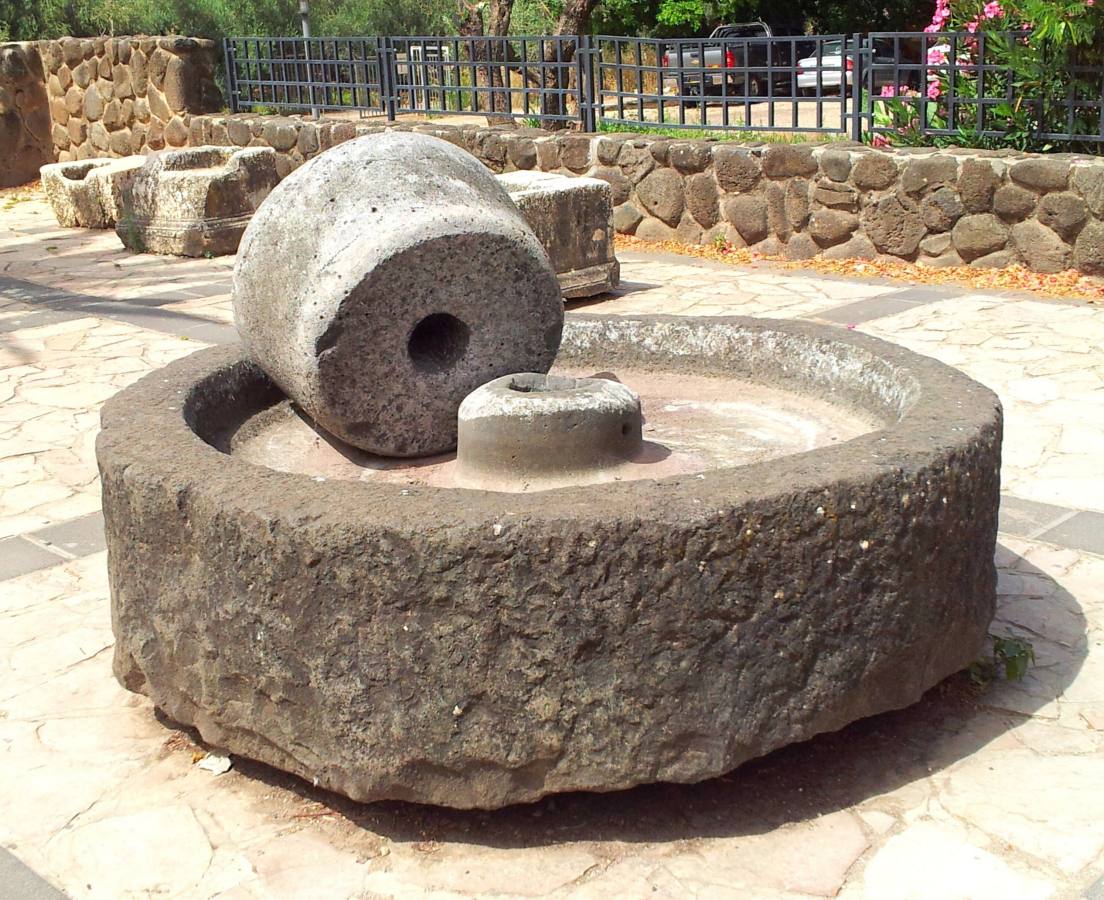
In season 4 of The Chosen, Jesus witnesses some of His followers working an oil press (Season 4, Episode 4). This is, of course, a fictionalized part of the story. We don’t have a biblical record of Zebedee and Mary Magdalene operating an oil press as the scene depicts. But it’s a realistic way to introduce something that would have been commonplace in Jesus’s day. These kinds of olive presses were used throughout the land of Israel in the first century. And it serves a purpose in the story of The Chosen. It foreshadows what must happen to Jesus. It points to His sacrifice.
Olives must be pressed in order for oil to be produced. This oil was used for cooking, but also for anointing the body, for medicinal purposes, and as a source of light used in the oil lamps at night. Oil was essential for many things in Jewish life of the first century. But in order for the oil to be produced, the olives had to be repeatedly crushed and pressed.
This foreshadows the way in which Jesus will be “pressed.” His blood will be shed under the weight of our sin at the cross – and just as this oil was essential for life in Israel, His blood will be essential in order for us to have eternal life.
And this scene points to what will happen in the Garden of Gethsemane, which is located on the Mount of Olives. You may not know this, but the word “Gethsemane” means “oil press.”
Jesus literally goes to the “oil press” and prays, “Not my will, but Yours be done, Father.”
Does that speak to your heart? Do you see what kind of selflessness Jesus embodied? Do you feel the weight of that sacrifice?
This is the heart of the gospel: Jesus sacrificed Himself so that we might have life.
 already & not yet