
Weeping may last for a night, but joy comes in the morning.
Psalm 30:5
Martyn-Lloyd Jones was a famous preacher in Great Britain during the 20th century. As he was dying of cancer, a physician friend tried to offer him a sedative to make him more comfortable. But Lloyd-Jones, who by this time was too feeble to speak, simply shook his head “no.” He wanted nothing that would dull his mind or his senses. The doctor commented that it really grieved him to see his friend so “weary, worn, and sad,” quoting a line from an old gospel hymn. That was too much for Lloyd-Jones, who mustered all of his strength to whisper an adamant protest: “Not sad!” he said. “Not sad.”
A few hours later, just before his death, he scribbled out a note to his wife and children. It said, “Do not pray for healing. Do not hold me back from glory.”
This is someone who understood the gospel truth that weeping may last for a night, but joy comes in the morning. He understood the promise of Jesus when He says, I am the resurrection and the life.
John 11:1-4
Now a man named Lazarus was sick. He was from Bethany, the village of Mary and her sister Martha. (This Mary, whose brother Lazarus now lay sick, was the same one who poured perfume on the Lord and wiped his feet with her hair.) So the sisters sent word to Jesus, “Lord, the one you love is sick.”
When he heard this, Jesus said, “This sickness will not end in death. No, it is for God’s glory so that God’s Son may be glorified through it.”
According to Jesus, Lazarus’s sickness will not end in death. Rather, it will end in glory. Keep that word in mind.
Before Jesus can make it to Bethany, Lazarus passes away.
John 11:17-27
On his arrival, Jesus found that Lazarus had already been in the tomb for four days. Now Bethany was less than two miles from Jerusalem, and many Jews had come to Martha and Mary to comfort them in the loss of their brother. When Martha heard that Jesus was coming, she went out to meet him, but Mary stayed at home.
“Lord,” Martha said to Jesus, “if you had been here, my brother would not have died. But I know that even now God will give you whatever you ask.”
Jesus said to her, “Your brother will rise again.”
Martha answered, “I know he will rise again in the resurrection at the last day.”
Jesus said to her, “I am the resurrection and the life. The one who believes in me will live, even though they die; and whoever lives by believing in me will never die. Do you believe this?”
“Yes, Lord,” she replied, “I believe that you are the Messiah, the Son of God, who is to come into the world.”
Jesus claims to be the resurrection and the life for those who believe, for those who have faith. But as language scholars have pointed out, the noun form of the word “faith” doesn’t occur in the original Greek of John’s Gospel. John uses the verb form of the word, which means hat according to John’s Gospel, faith is not something you have; faith is something you do.
This meaning is conveyed if we were to paraphrase these verses this way:
Jesus said to her, “I am the resurrection and the life. The one who faiths in me will live, even though they die; and whoever lives by faithing in me will never die. Do you faith this?”
And Martha replied, “Yes, Lord, I faith that you are the Messiah, the Son of God.”
Faith is the way to the resurrection life of Jesus. Faith is the way to glory.
John 11:38-44
Jesus, once more deeply moved, came to the tomb. It was a cave with a stone laid across the entrance. “Take away the stone,” he said.
“But, Lord,” said Martha, the sister of the dead man, “by this time there is a bad odor, for he has been there four days.”
Then Jesus said, “Did I not tell you that if you believe [if you faith], you will see the glory of God?”
So they took away the stone. Then Jesus looked up and said, “Father, I thank you that you have heard me. I knew that you always hear me, but I said this for the benefit of the people standing here, that they may believe [that they may faith] that you sent me.”
When he had said this, Jesus called in a loud voice, “Lazarus, come out!” The dead man came out, his hands and feet wrapped with strips of linen, and a cloth around his face.
Jesus said to them, “Take off the grave clothes and let him go.”
Weeping may last for a night, but joy comes in the morning.
Can you imagine the shouts of joy from the crowd when Lazarus comes walking out of that tomb? It’s the dawning of a new day, as new life takes the place of death. It is as David goes on to say in Psalm 30:11, You turned my wailing into dancing; you removed my sackcloth and clothed me with joy.”
And I love that Jesus calls him by name: “Lazarus, come out!” With these words, Jesus commands a powerful moment of new creation — God’s glorious future breaking into the present.
Jesus says, “Did I not tell you that if you faith, you will see the glory of God?”
When Jesus says, I am the resurrection and the life, He is pointing beyond the raising of Lazarus to His own resurrection when God the Father will call Him back from death and breathe the breath of life into His battered body once more. This statement anticipates the fact that God will choose a graveyard to be the location of His greatest miracle. On that beautiful resurrection Sunday, Jesus will rise victorious over sin and death and the devil himself. His heart will start beating again, never to stop. He lives to this day and He is calling your name just as He called the name of Lazarus.
And by faithing in Him, we participate in this same glorious resurrection life. We become new creations. In the place of our failures, Jesus reigns victorious. Death becomes the place for new life as darkness gives way to His light.
According to God’s promises, it all ends in glory. The story of God ends in the glory of God for the people of God. For those who faith, it all ends in glory.
Weeping may last for a night, but joy comes in the morning.
Jesus says, “Take off the grave clothes.” A living person shouldn’t be wrapped in a shroud. Grave clothes won’t do — not when you’ve been raised from the dead. Not when you’re in the presence of the One who says, I am the resurrection and the life.
Take off the grave clothes. When He says this to you, what does He mean?
- Is He talking about the grave clothes of some kind of sin? Could He be talking about the grave clothes of lust or anger or greed? Could He be talking about some secret sin you’re keeping to yourself, that secret no one knows?
- Is He talking about your pride? Your inability to humble yourself and accept responsibility for your decisions? Maybe your grave clothes are the clothes of your own success. Isn’t that ironic?
- Maybe you’re wrapped up in the grave clothes of self-loathing. Maybe it’s been so long since anyone believed in you that you don’t even believe in yourself — and Jesus is begging you to take off that cloak of self-judgment.
- Maybe it’s something like bitterness or resentment. You’ve been holding on to that grievance for so long that you don’t even realize how much it’s weighing you down. But the stench is unmistakable — it’s nothing but reeking death.
- Maybe the grave clothes for you would be some old way of life that you want to leave behind.
If you’re clothed in Christ’s resurrection victory, there’s no room for grave clothes. That person doesn’t exist any more. You’re a new creation!
Do you hear him calling you by name today? What grave clothes need to be removed in order for you to be clothed in His resurrection victory?
A few years ago, our family took a trip to Israel. While we were there, we visited the Church of the Resurrection in the village of Abu Ghosh. This church is over a thousand years old, built in a predominantly Muslim community that is one of the possible locations for the biblical village of Emmaus. I had a powerful experience in the lower level of this church. Our group was upstairs in the main chapel and we were taking in the history of this beautiful place. I noticed some steps leading downstairs so I decided to slip away from the group to see what was down there. Little did I know I was actually entering a crypt. The lower level of the church functioned as a crypt for many years.

Isn’t that the way death operates? We slip into its arms gradually and slowly, often without warning. The enemy is the master of lulling us into death, all the while letting us think we’re pursuing life.
After going downstairs, I was immediately aware that this place was probably supposed to be off limits. But I figured I was already down there, I might as well look around. The downstairs area was almost completely dark, but as my eyes adjusted, I was able to notice a few things.
The church was built on top of an old Roman cistern, so when you go downstairs into the crypt, you’re actually in the area of the original pool that would have served the garrison stationed here until the 3rd century. In the middle of the floor, I saw a rectangular water tank the Romans built to collect water from the nearby spring. After the Romans abandoned this garrison, the church was eventually built on top of it. But the spring continues to fill the cistern with water to this day.
I thought to myself, “What an odd thing to find in a crypt. Water is a source of life — and here it is in this place of death.” And Jesus said, Whoever believes in me [faiths in me] … out of his heart will flow rivers of living water, John 7:38.
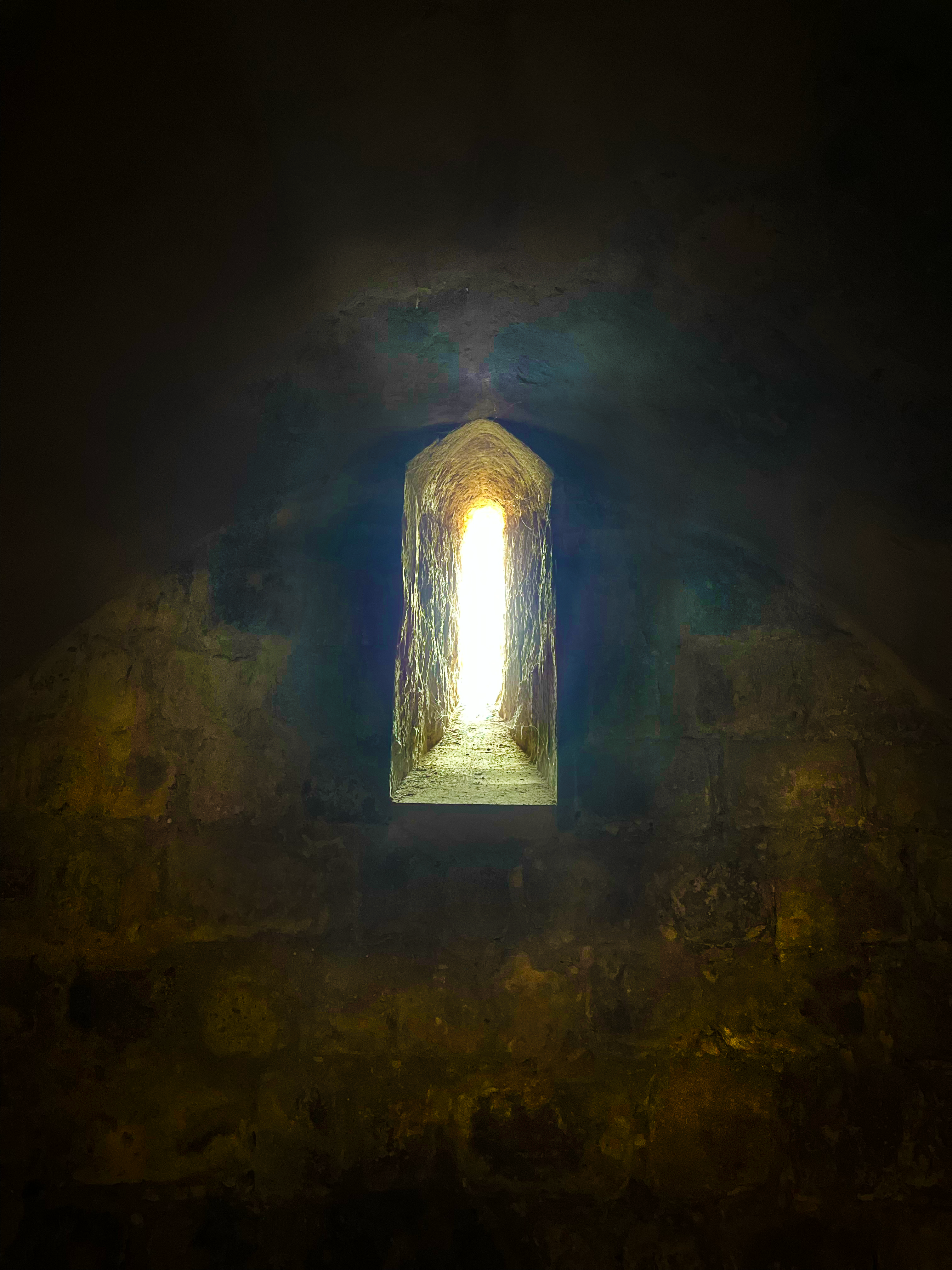
There is also a small window cut out that allows a sliver of light to flow into the crypt. It struck me as so powerful that I had to take a picture of it. Here I was, enveloped in darkness, in this place of death — and yet, I was drawn to this beacon of light and life. I was overwhelmed with a feeling of connection with Jesus. There in that tomb, looking at the glorious light pouring into the darkness, I had a deeper appreciation for the resurrection of Christ. Like Lazarus, I felt the Lord calling to me. It was the most worshipful experience I had in my entire time in the Holy Land — and it occurred in the darkness of a tomb. As our group was upstairs, singing praises in the beautiful chapel above, I was below in the crypt, weeping and giving thanks.
In all my time in Israel, this was where I most fully experienced the hope of glory, the Risen One.
My prayer for you on this Easter Sunday is that you would have your own experience of the hope of glory. I hope that you will find Him in your own darkness, in whatever tomb might have taken you in at the moment.
The empty tomb declares to us that it all ends in glory — the story of God ends in the glory of God for the people of God. Remember: we’re talking about a God who raised a dead man back to life. Wouldn’t you like to have that same resurrection power at work in your life?
Do you hear him calling your name today?
He’s saying, “Take off the grave clothes, my child.”
Become a new creation. Be raised to walk in newness of life by being washed in the living water of Jesus!
Weeping may last for a night, but joy comes in the morning.
In the name of Jesus Christ, the Sovereign Lord who makes all things new, he who has ears, let him hear.
 already & not yet