
Over the course of his long career, Johnny Cash performed more than thirty different “prison concerts” for inmates both in this country and around the world. He played these shows as a way of advocating for prison reform but also because he believed that as a Christian, he had a responsibility to encourage the downtrodden and to give hope to the hopeless. He once told a story about performing at a maximum-security prison where he decided to play the song “Amazing Grace.” Cash said he was absolutely blown away at the way these prisoners sang this old gospel hymn with all of their hearts and all of their souls and all of their voices! When the song was over, Cash paused the show and asked the men, “What does this song mean to you?”
One man who was serving time for attempted murder said, “You know, I was a deacon in the church for years but I didn’t really know what grace was until I ended up here.” It was only after undergoing the humbling experience of going to prison that this man came to repentance. He came to know the grace of God in a personal way after this.
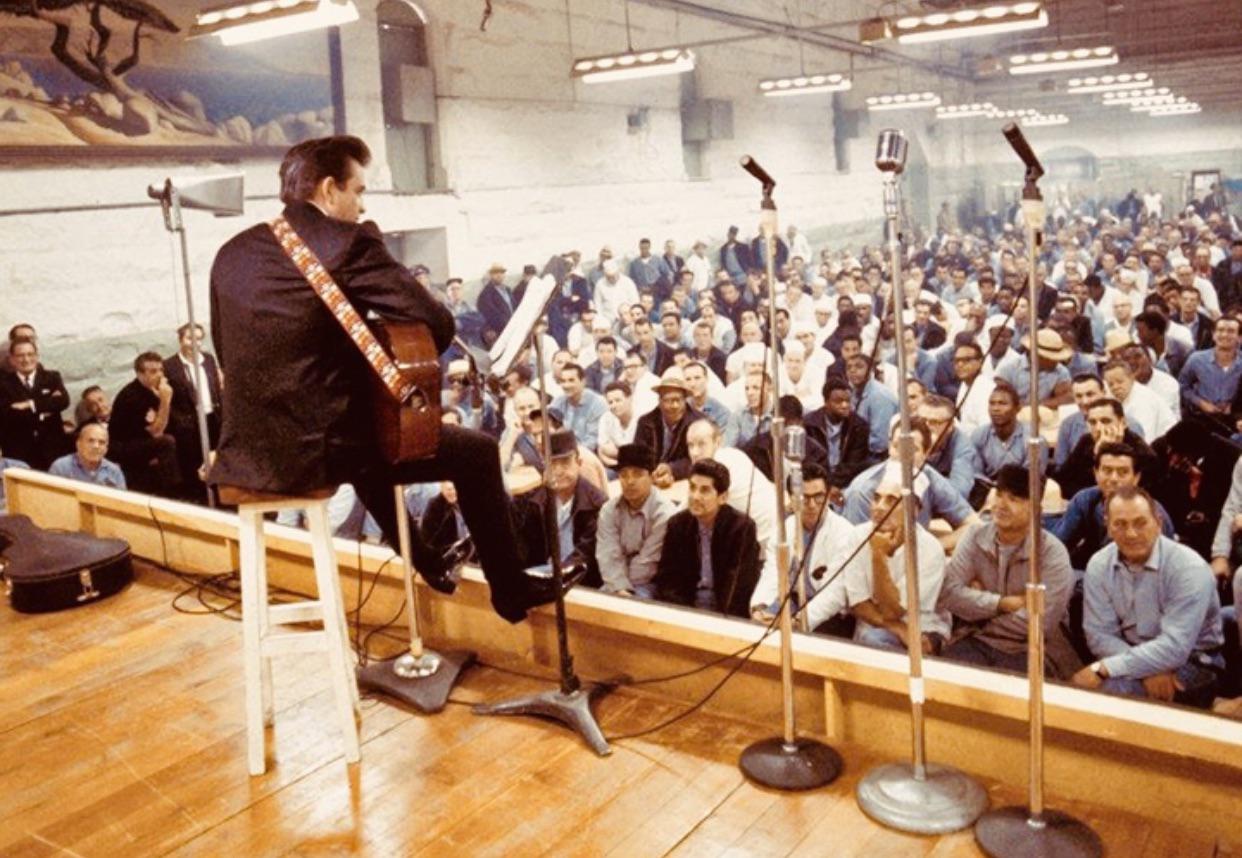
I guess you could say that this man had to be put behind bars in order to find true freedom.
God often works in the most unexpected ways to do the most extraordinary things.
I’m working through a holiday series entitled Herald: Good News, Great Joy. I’m looking at the four angelic announcements recorded in the Gospels of Matthew and Luke heralding the birth of the Messiah. And in our text for today, we will see God working in a most unexpected place and in a most unexpected way to bring about the good news of great joy for the entire world.

In the sixth month the angel Gabriel was sent from God to a city of Galilee named Nazareth, to a virgin betrothed to a man whose name was Joseph, of the house of David. And the virgin’s name was Mary. And he came to her and said, “Greetings, O favored one, the Lord is with you!” But she was greatly troubled at the saying, and tried to discern what sort of greeting this might be. And the angel said to her, “Do not be afraid, Mary, for you have found favor with God. And behold, you will conceive in your womb and bear a son, and you shall call his name Jesus. He will be great and will be called the Son of the Most High. And the Lord God will give to him the throne of his father David, and he will reign over the house of Jacob forever, and of his kingdom there will be no end.”
And Mary said to the angel, “How will this be, since I am a virgin?”
And the angel answered her, “The Holy Spirit will come upon you, and the power of the Most High will overshadow you; therefore the child to be born will be called holy — the Son of God. And behold, your relative Elizabeth in her old age has also conceived a son, and this is the sixth month with her who was called barren. For nothing will be impossible with God.”
And Mary said, “Behold, I am the servant of the Lord; let it be to me according to your word.” And the angel departed from her.
Luke 1:26-38
This is Gabriel’s second special assignment in the Gospel of Luke. In our last post, we looked at the message he delivered to Zechariah and Elizabeth: that they would have a son even though they were well past their childbearing years. We know this child as John the Baptist, the forerunner of the Messiah. In Hebrew, the root of the name John means “grace.” With John’s birth, God is announcing the dawn of a new age, an age of grace. Now, six months later, Gabriel appears to a young woman named Mary who is betrothed to Joseph. And Gabriel has a similar message for Mary: she, too, will bear a son.
Before we get into the specifics of the announcement, let’s talk about the Jewish practice of betrothal. In ancient Israel, the marriage custom had two stages: first the betrothal and then the wedding itself. Parents would often choose a spouse for their child during the early teenage years. This would involve a prenuptial agreement between the families, which was ratified by witnesses, and also the exchanging of a dowry. At this stage, the couple was considered to be legally married — but it’s important to note that the couple did not live together as husband and wife until after the wedding ceremony, usually about a year after they were officially betrothed. It was during this period of betrothal when Gabriel appears to Mary. Luke makes this clear by saying Mary was betrothed to Joseph at the time — but he emphasizes this point by referring to Mary as a “virgin” three different times.
So as Luke tells it, the story of Jesus begins with these two women and two impossible pregnancies: Elizabeth, the older woman, well beyond her childbearing years; Mary, the young virgin, betrothed but not yet married. And yet, against all expectation, both of them will bear sons. These miraculous pregnancies are a signal that God is at work. Yes, these may be “impossible” pregnancies, but as Gabriel himself says in v37, “Nothing is impossible with God.” The older woman’s son will bring an end to the old era while the young woman’s son will usher in the new.
These two women and their sons belong to on story. The way Luke tells these two stories makes this abundantly clear. Look at the parallels in these two birth announcements in Luke 1:
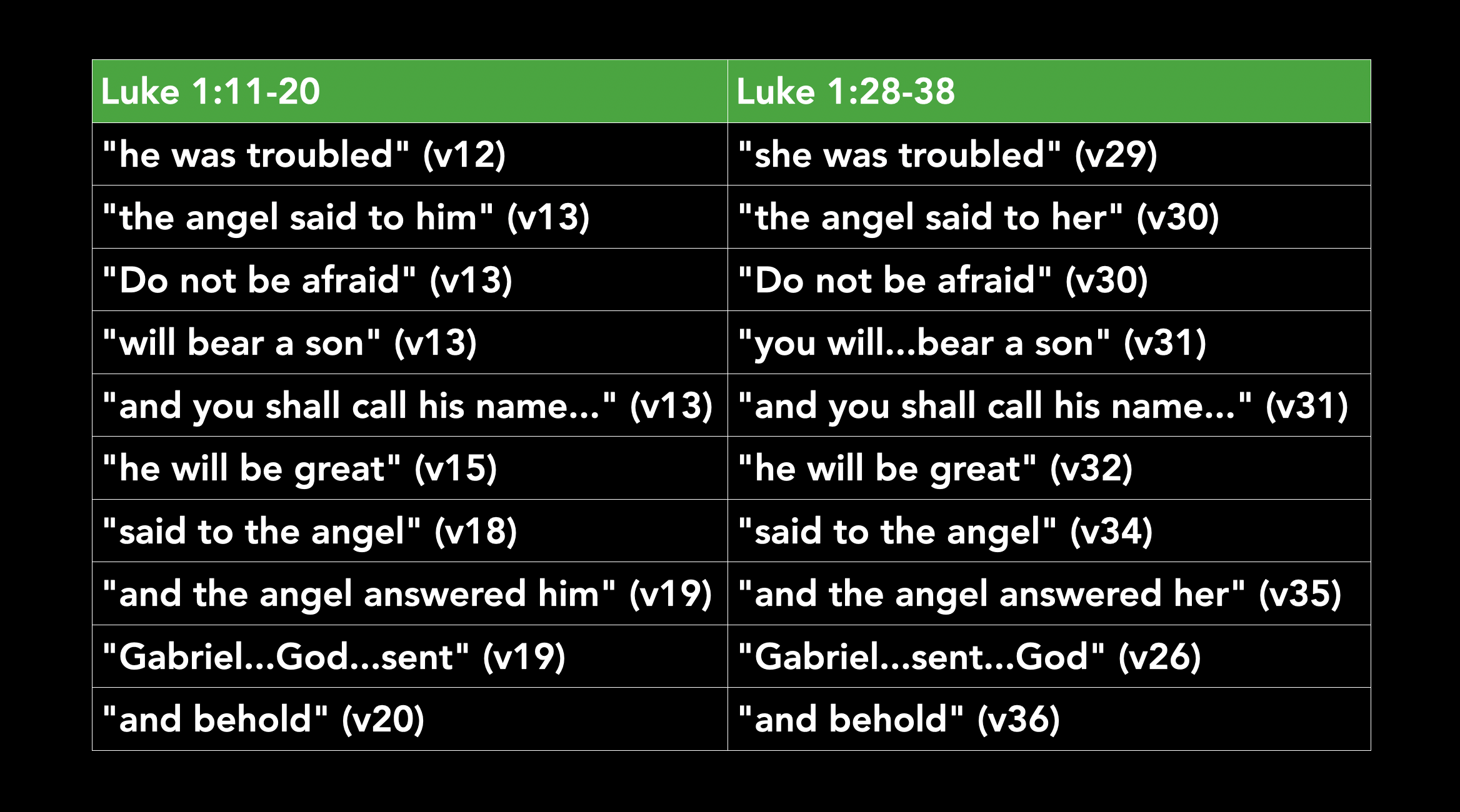
And yet, there are significant differences in these two stories, too.
As we noticed previously, Zechariah and Elizabeth are hailed as righteous and blameless. He’s a priest and she’s a descendant of Aaron, which means she comes from a long line of godly servants. Zechariah is in Jerusalem, serving in the temple, the center of the Jewish world. When Gabriel appears, Zechariah is at the altar of incense in the Holy Place, with only a curtain separating him from the presence of God’s glory.
Mary, on the other hand, is miles away in Galilee, in the obscure village of Nazareth, with an estimated population of no more than 1,500 people at the time, putting it on par with such bustling metropolises as Hackleburg, Alabama and Fleming-Neon, Kentucky. Nazareth was so insignificant that it’s never mentioned in the Old Testament, in the rabbinic literature, or in the writings of Josephus. This is a NOWHERE town. And Mary certainly doesn’t have the credentials of Zechariah and Elizabeth. There is no commendation of her character here. Unlike Zechariah and Elizabeth, Mary hasn’t been praying for a child. She’s just a teenage girl waiting for her wedding day. Gabriel’s proclamation to her is completely unexpected.
But as we said, God often works in unexpected places and in unexpected ways to do the most extraordinary things. We probably should expect nothing less from a God who says that His thoughts are not our thoughts and His ways are not our ways (Isaiah 55:8).
When Gabriel speaks to Mary, he literally says something along the lines of “Rejoice, favored one.” What does “favored one” mean?
Well, for starters, it doesn’t mean “favorite one.” Because God doesn’t play favorites.
This phrase literally means “one who has received grace.” The root word here is used throughout the New Testament to signify God’s grace, His blessing, His kindness. And this must be an important idea because it’s repeated twice: Mary, you are the favored one; you have found favor with God. We should note that Mary has done nothing to earn or deserve this favor. That’s not the way grace works. This is simply the unmerited, unexpected favor of God.
And how do you respond when you’ve received the favor of God, the grace of God? The most natural response is to rejoice.
Do you find your joy waning a bit these days?
Is joy an ever-present part of your life or does it seem a bit elusive?
If you’re struggling to feel joy right now, consider how gracious God has been to you. Think about a time when you were begging God for forgiveness; a time when you didn’t receive the punishment you deserved, but instead God gave you the grace you needed. Remember a time when God was really kind to you, really gracious with you.
If you reflect on these things long enough, you’ll start to feel joy again.
Because when you come to see yourself as God’s favored one, rejoicing will become second nature.
Gabriel says to Mary, “The Lord is with you.” But Mary is troubled by this. Literally, she is confused, perplexed. She’s probably thinking, Why should God be with me? Mary has no social standing, no economic power, no status which would merit this kind of visitation. She’s an unknown girl in an insignificant town, a nobody from nowhere. But Mary is precisely the kind of person God favors. And God seems to work in the most unexpected ways to do the most extraordinary things. This small town teenager receives the most unexpected news of all: God is enabling her, through His gracious favor, to be the mother of the Messiah.
It is fitting that the birth of Jesus should come as an act of unmerited favor because we understand his death in the same way. At the cross, Jesus will atone for our sins, granting us grace we could never earn or merit or deserve. God’s gracious favor toward us is so unexpected that it must arrive in the world in the most unique and unexpected way: a virgin birth. Both His birth and His death are properly understood as acts of unmerited favor.
With Gabriel’s announcement, Mary’s life takes an unexpected turn. Prior to this, I imagine Mary was preparing for her wedding, preparing for her life as a young bride. But those plans change when she hears what God has in store for her. Instead of picking out flowers for her bouquet, she has to start putting together a nursery. Instead of well wishes and congratulations from everyone in her small town, she’s going to receive a lot of sideways glances and judgmental looks. I’m sure she will have some individuals who will continue to stand by her side, but she’ll also have quite a few former friends who won’t have much to do with her anymore. That’s just the messy reality she faces when she hears Gabriel’s announcement.
When God does a most unexpected thing and Mary’s life takes this most unexpected turn, she has a decision to make. How will she react? How do you and I react when life doesn’t go the way we expected?
This young woman is a good example for us to follow. Her response is recorded in v38: “I am the Lord’s servant. May your word to me be fulfilled.”
I think it’s important to note that nothing happens here without Mary’s consent. Gabriel announces God’s plan, but it seems Mary is granted the agency to consent. The birth of Jesus — the One who is both fully God AND fully man — comes through the partnership between the humans and the divine. So Mary agrees to partner with God in this holy endeavor.
In the song, Joy to the World, we sing the line, “Let earth receive her King.” But before this could happen, there’s another line from the song that describes Mary’s situation. It’s the next line of the song: “let ev’ry heart prepare Him room.” Before the earth could receive her King and heaven and nature sing, Mary had to “prepare Him room” — in her heart, yes; but also in her body.
Mary’s consent to God’s will is evidence of her trust in the Lord. She totally submits herself to God’s direction, but also to His protection. Under the Mosaic Law, if a betrothed woman was found to be pregnant, the penalty she faced was execution by stoning. Mary would have to trust that God would protect her from such a fate. And then there’s the matter of Joseph. When he learns that she’s pregnant, he’s well within his rights to terminate the marriage contract. By trusting in God’s will for her, Mary is also trusting that God would work out the details in her relationship with her fiancé, too. When your life takes an unexpected turn, this is an opportunity to grow in trust, to grow in your dependence upon the Lord. This is one of the lessons we can learn from the example of Mary. Her trust in God’s will for her life has “trickle down” impact across the rest of her life, too. She trusts that if God has called her to this, then God will also provide for her. God’s calling and God’s provision are always intertwined.
Luke’s Gospel begins with the stories of these two women — Elizabeth and Mary — and their impossible pregnancies. And the wombs of these women foreshadow the tomb where Jesus will be laid at the end of Luke’s Gospel, after His crucifixion.
- Elizabeth, the elderly woman well past her childbearing years.
- Mary, the young virgin, betrothed but not yet married.
- And the tomb of Jesus, a place of darkness and death.
You don’t expect to find life in any of these places. But as Gabriel reminds us, nothing is impossible with God. The miraculous pregnancies of Elizabeth and Mary are a prelude to that glorious Resurrection Sunday when the light of new creation would dawn once and for all. On that day, Jesus emerges from the womb of that grave as the first fruit of God’s resurrection power. He rises victorious over sin and death and the devil himself. Eternal life for God’s people is now guaranteed because He lives — to this day, He lives.
God chose a graveyard, of all places, as the backdrop for His greatest miracle of all — a place where we would never expect to find life.
And God’s eternal plan unfolds in a backwater, nowhere town in the middle of Galilee and it centers on the willingness of an unmarried teenager as the recipient of His unmerited favor.
Indeed, God works in the most unexpected ways to do the most extraordinary things. Nothing is impossible with God.
 already & not yet