Every year, our crew makes picks throughout the NFL Playoffs. Here are our picks from last week’s opening round of games:
Sunny’s picks: Seahawks over the 49ers; Jaguars over the Chargers; Bills over the Dolphins; Giants over the Vikings; Bengals over the Ravens; Bucs over the Cowboys.
Joshua’s picks: 49ers over the Seahawks; Chargers over Jaguars; Bills over Dolphins; Vikings over Giants; Bengals over Ravens; Bucs over the Cowboys.
My picks: 49ers over the Seahawks; Jags over Chargers; Bills over Dolphins; Vikings over Giants; Bengals over Ravens; Cowboys over Bucs.
That puts Sunny at 4-2; Joshua at 3-3; and my record is 5-1.
And here are the picks for this week’s slate of games:
Sunny’s picks: Chiefs over the Jaguars; Giants over the Eagles; Bills over the Bengals; 49ers over the Cowboys.
Joshua’s picks: Chiefs over the Jaguars; Eagles over Giants; Bengals over the Bills; Cowboys over the 49ers.
My picks: Chiefs over the Jags; the Eagles over the Giants; Bills top the Bengals; and the 49ers over the Cowboys.
A few days ago, it was reported that Amy Grant and Vince Gill were going to host a same-sex wedding for a family member on their farm. I came across this news on Twitter when Franklin Graham made the following post:
Graham, the president of Samaritan’s Purse (an international Christian relief organization) and the son of the evangelist Billy Graham, went on to make the following comments:
To be clear, these are NOT inflammatory comments. Graham simply makes the point that to conflate Christ’s command to love others with a wholehearted acceptance of sinful behavior is to ignore the same Christ who commands obedience. Graham never attacks anyone with his comments. He simply maintains the traditional biblical perspective that homosexuality is a sin. Moreover, his follow up comment is hardly an angry diatribe directed at the homosexual community. Rather, it seems to me that his aim is to simply remind the church to bear witness to the authority of God’s Word. He even prefaces his statement with a “for me” — meaning that he’s stating his perspective on what it means to truly love someone.
Of course, the response to this on Twitter was swift. Immediately, Graham was accused of being judgmental, for failing to show the love of Christ, for participating in shameful and self-serving PR from which he (somehow) benefits financially. I know, I know … Twitter comments are typically the lowest form of human communication. But still. The guy was absolutely TORCHED for taking the position that a conscientious Christian might have reasonable and faithful reasons to NOT host a same-sex marriage for a family member.
In the days since coming across this, I think it’s indicative of where our culture is headed. Anything short of a complete endorsement of a person’s way of life is deemed hateful and bigoted. Period. It’s the fast track for being labeled a “fill-in-the-blank-phobe” (in Graham’s case, a homophobe). And when a Christian voices this kind of objection, the immediate response is something along the lines of, “You hypocrite. Jesus said ‘love others’ but you’re full of hate.” In this way, this controversy is, to borrow a biblical phrae, a sign of the times.
I’m sure Franklin Graham knew all of that before he made his post. And, in fairness, many commenters were incredulous that Graham could condemn Amy Grant’s actions after he has been so enthusiastic in his support of President Trump — a man who doesn’t embody anything even closely resembling Christian morality. That’s a fair point. But that aside, I appreciate Graham’s willingness to take an unpopular position on such a lightning rod issue. Whatever his personal politics might be, I appreciate Graham’s boldness for the sake of biblical truth.
To conflate Christ’s command to love others with a wholehearted acceptance of sinful behavior is to ignore the same Christ who commands obedience.
I think we have a few problems.
For starters, we have a very limited way of thinking of love. Our culture has defined love as wholesale acceptance of someone, including their lifestyle choices. If you fail to affirm everything about me, you don’t love me. That would be bad enough. But in our extremist culture, we’ll assign the motive of “hate” to such a person. It’s as if we don’t even have a category for the kind of love where two people might have a difference of opinion or see things a bit differently. And that’s a problem.
And then there’s the problem with a Jesus who “commands” us to do certain things and NOT do other things. It seems that many people — Christian or otherwise — don’t have a category for a Jesus who would dare to tell us how we ought to live. But the Jesus in the Gospels does this sort of thing all the time. His teachings repeatedly emphasize this. And so our problem is a failure to see Jesus in His fullness. We see Him merely as Savior — as the One who lovingly died to give us life. But we don’t see the fullness of this if we fail to see that Jesus died to save us from our sins. And then there’s another failure: failing to see Jesus as Lord — as the One who calls the shots, the One who bids us to leave our life of sin behind and to follow Him into a life of holiness. Generally speaking, I think we fail to see Jesus this way.
And that brings up another problem: our problem with the whole idea of obedience. There was a time when the Christian gospel emphasized obedience — maybe even over-emphasized it. But today, you could spend a decade in church without hearing the word. But as Graham reminds us with his tweet, Jesus equates obedience with love. John 14:15, If you love me, you will keep my commandments. And for people like Graham (and myself), obedience is an important part of following Jesus. Sure, we won’t obey perfectly. But part of spiritual maturity is growing in obedience. It’s leaning into the resources God has given us to aid in our obedience: His Word, the church, the Holy Spirit. These contribute to the great work of sanctification, which is produced in us in real time as we continually submit ourselves to the indwelling Spirit. The fruit we bear in keeping with repentance comes through obedience.
This sign of the times has me thinking quite a bit about all of this.
This time of year, I always post about the best books I’ve read over the last twelve months. I set myself a goal to read 52 books a year — one per week. It’s an ambitious goal and I rarely hit the mark. By the time I finish my current read, I’ll be at 43 books read in 2022. (If you’re interested in seeing my year-to-year list of Best Books dating back to 2006, you can find it here.)
Even though I continue to aim for one book per week, over the last few years I’ve tried to focus even more energy on quality over quantity. I’ve read some really great books this year. As you can tell from the list, I’ve been pretty much focused on non-fiction this year and I continue to dive deeper into works that emphasize Christian apologetics, primarily due to my desire to understand some of the cultural changes we’re living through today. As always, my interest is in a thoroughly biblical and theological way of interpreting things, so this year’s list leans in that direction more than other years. But if these types of issues are of interest to you, I highly recommend the following works.
These are the 10 best books I’ve read this year, with a few honorable mentions as well.
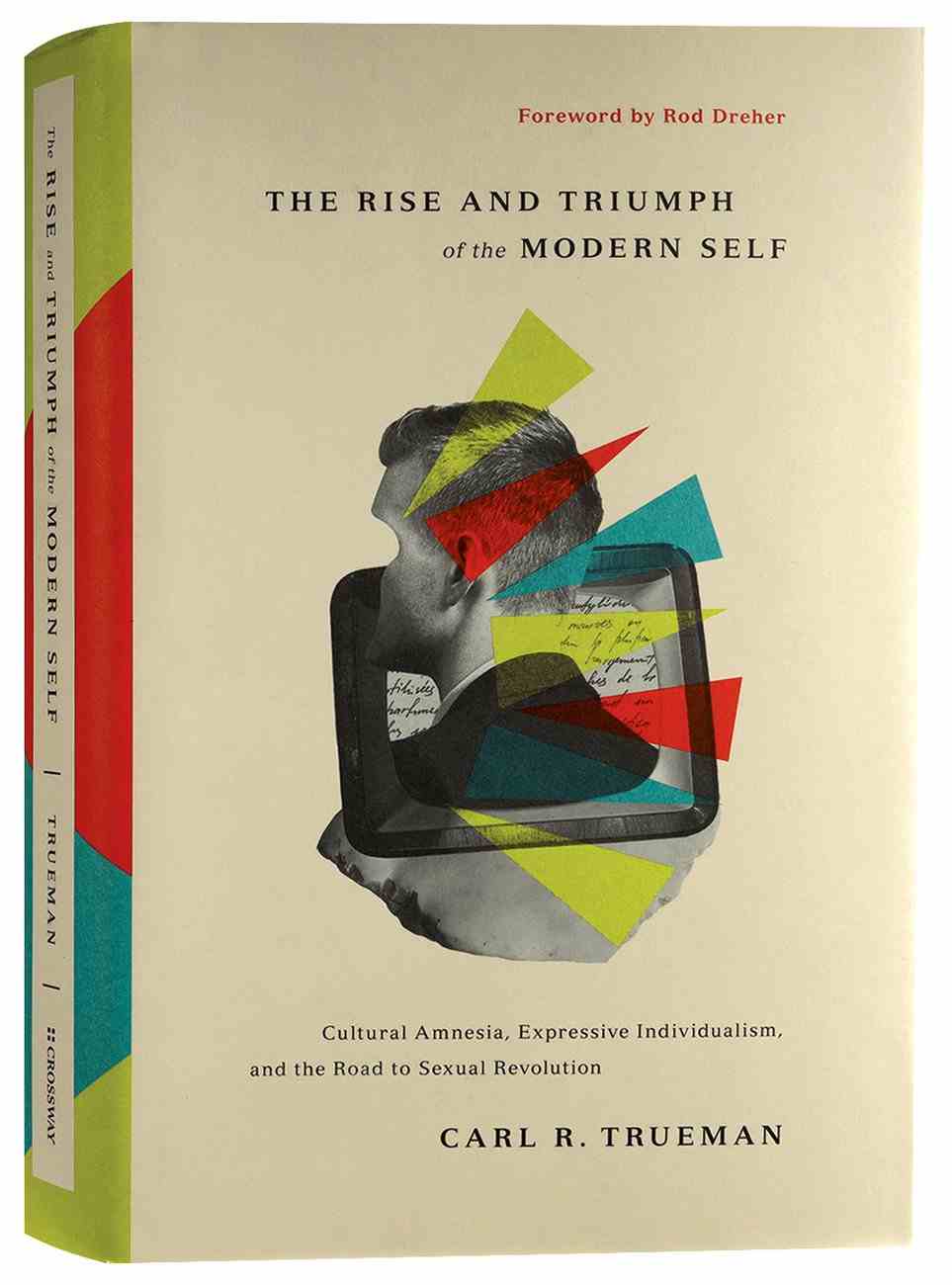
The Rise and Triumph of the Modern Self: Cultural Amnesia, Expressive Individualism, and the Road to Sexual Revolution by Carl R. Trueman. This is one of the most important and insightful books I’ve read in the last few years. Based on the biblical narrative, you could argue that humanity’s besetting sin has always been an idolatrous exaltation of the self. And yet, we find ourselves in a unique moment in which the pursuit of one’s “true” identity has taken a radical turn toward expressive individualism. Descartes got it all wrong. Rather than, “I think; therefore, I am,” the mantra of our current cultural moment is, “I feel; therefore, I am.” Trueman traces a line back to the sexual revolution of the 1960s and the philosophical underpinnings of Roussea, Nietzsche, Marx, and Darwin to explain out shift toward a self-defined morality based on one’s self-actualization. To be “authentic” is the cardinal virtue of our day. Conversely, to deny someone’s felt identity is our cardinal sin. That’s how we arrive at the statement, “I am a woman trapped in a man’s body,” an inscrutable assertion just years ago but increasingly common today. But this is the inevitable outcome when personhood is detached from its historical mooring in the biblical story. I have to tell you: this book is not for the faint of heart. For starters, it’s long, as in more than 400 pages long. Also, it’s dense. You’ll probably have to reach for your thesaurus a time or two while reading. But if you stick with him, Trueman will pay off this patience. (Remember what I said about quality over quantity?) I think it’s vitally important for Christians to understand how we ended up here: for our sake, for the sake of imparting the faith to the next generation, and for the sake of faithful Christian witness. Personally, I hope Trueman will follow up with a more accessible volume that distills his core arguments for a mainstream audience. But until then, The Rise and Triumph of the Modern Self is required reading, a landmark volume of cultural analysis from a Christian perspective.
Telling a Better Story: How to Talk About God in a Skeptical Age by Josh Chatraw. Apologetics have always been vital to the Christian story, but it has taken on even greater urgency as we live through tremendous shifts in our culture. This book caught my eye when it was named Christianity Today’s Apologetics / Evangelism Book of the Year in 2020. Chatraw repeatedly argues that the Christian story as revealed in the Bible offers a more compelling vision of meaning, self, and reason than the limited scope of so many secular metanarratives. The Christian gospel is the better story, Chatraw claims, because it offers the most satisfactorily systematic answers to our most pressing philosophical questions. His “inside out” approach to apologetics is at once generous, winsome, and engaging. I think every Christian would benefit greatly from reading this book. (You can find my full review here.)
Cynical Theories: How Activist Scholarship Made Everything about Race, Gender, and Identity — and Why This Harms Everybody by Helen Pluckrose and James A. Lindsay. About eighteen months ago, I began a deep dive into an idea that was fairly new to me: critical race theory. That led me to explore the even broader field of critical theory, which in turn led me to this text. Pluckrose and Lindsay are liberal in the classic “pre-woke” sense of the term and they argue that bad ideas about who we are seem to be unquestionably accepted across the board. Although their approach is fairly academic and they do not seem to be writing from a Judeo-Christian perspective, they nevertheless provide a thorough explanation of the new religion of social justice, rooted as it is in postmodernism. The essential idea of critical theory boils down to one of power and oppression. Dominant power groups have created systems to consolidate their power, thereby oppressing those in minority groups. These ideas are proliferate today, at least to those who are awakened to their presence (thus, “woke”). The manifestations of this include postcolonial theory, queer theory, critical race theory, intersectionality, transgenderism, feminism, disability studies, and fat studies. Exhausting as all of this might seem, proponents of these movements continue to distort reality toward extremism. As you read, you’ll feel as if you’re auditing a grad school course, but you’ll also come away with a better understanding of our present cultural moment in all its postmodern flavor.
Live Your Truth and Other Lies: Exposing Popular Deceptions That Make Us Anxious, Exhausted and Self-Obsessed by Alisa Childers. Childers is another important voice in the apologetics discussion right now. I loved this book so much that I couldn’t put it down, reading it in one day. Childers has a knack for presenting throughly biblical critiques of culture in a firm and loving way. If you’d like an introduction to her thoughts, you should also check out her podcast.
Live No Lies: Recognize and Resist the Three Enemies That Sabotage Your Peace by John Mark Comer. Comer is also writing a critique of our cultural moment, but he couches his discussion in the context of spiritual warfare. There are three enemies of the soul: the world, the flesh, and the devil. He uses this consistent framework throughout: Deceptive ideas (the devil) play to our disordered desires (the flesh) before being normalized in a sinful society (the world). Comer follows by arguing for the importance of spiritual formation and discipleship in this ongoing spiritual struggle.
Trains, Jesus, and Murder: The Gospel According to Johnny Cash by Richard Beck. A theological reading of Cash’s recording career and singular life. You know I’m going to be all over something like this. I heard Beck talk about this book a few years ago and I had been wanting to read it ever since.
The Nineties: A Book by Chuck Klosterman. The 90s were a formative time for me: high school, the death of my mother, a re-conversion back to my Christian faith, college, a call into ministry and getting my first “real” job at a church in East Tennessee. Klosterman walks his readers through the highs and lows of that particular decade, using the lenses of pop culture and politics and sports. A great read.
QB: My Life Behind the Spiral by Steve Young. I always appreciated Young’s greatness as a Super Bowl-winning quarterback. But I had no idea that he was such a man of character. This biography was equal parts football and faith.
Another Gospel: A Lifelong Christian Seeks Truth in Response to Progressive Christianity by Alisa Childers. This is Childers’ first book, describing her turbulent journey out of progressive Christianity.
K: A History of Baseball in Ten Pitches by Tyler Kepner. If you’re a baseball fan, you’ll appreciate this book. And if you have a son who pitches (as I do), you’ll really love this book. Joshua and I listened to this together while we were driving to all of his summer ball tournaments this year. He even picked up a few pointers along the way!
And here are the honorable mentions I promised:
The Dynasty by Jeff Benedict. Benedict’s chronicle of the dominant era of Brady, Belichick, and Kraft. I don’t claim to be a Patriots fan, but I found myself rooting for them based on Benedict’s masterful storytelling and reporting.
Atomic Habits: An Easy and Proven Way to Build Good Habits and Break Bad Ones by James Clear. An easy read. But Clear’s advice could actually change your life.
From Strength to Strength: Finding Success, Happiness, and Deep Purpose in the Second Half of Life by Arthur C. Brooks. I’ve been a Brooks fan since hearing him keynote the National Prayer Breakfast in February 2020, just a month before COVID upended everything.
Surrender: 40 Songs, One Story by Bono. Probably could’ve been trimmed by about a hundred pages. But if you’re a superfan, this is a must read.
Fault Lines: The Social Justice Movement and Evangelicalism’s Looming Catastrophe by Voddie T. Baucham. Another solid entry in the social justice studying I’ve been doing.
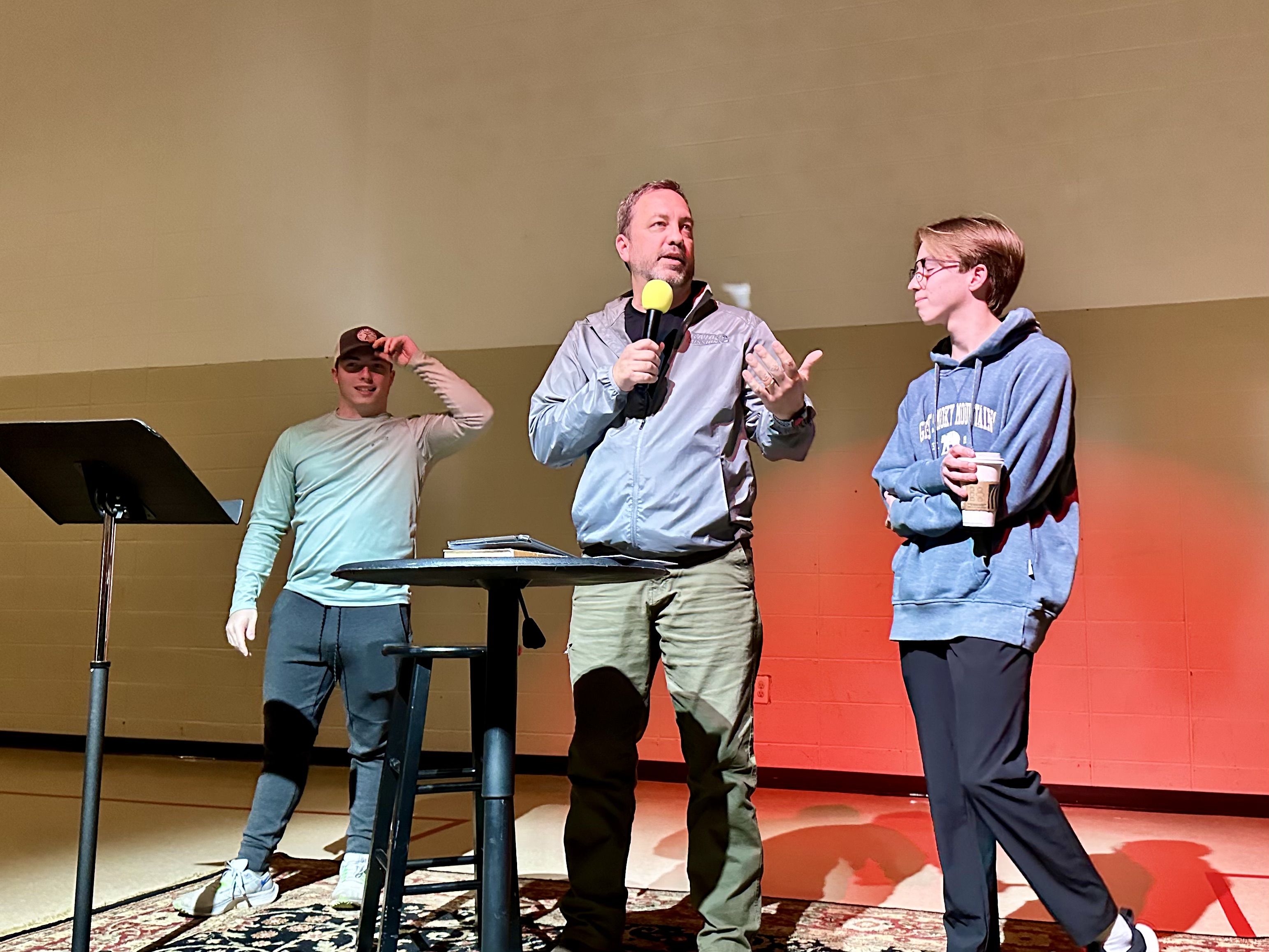
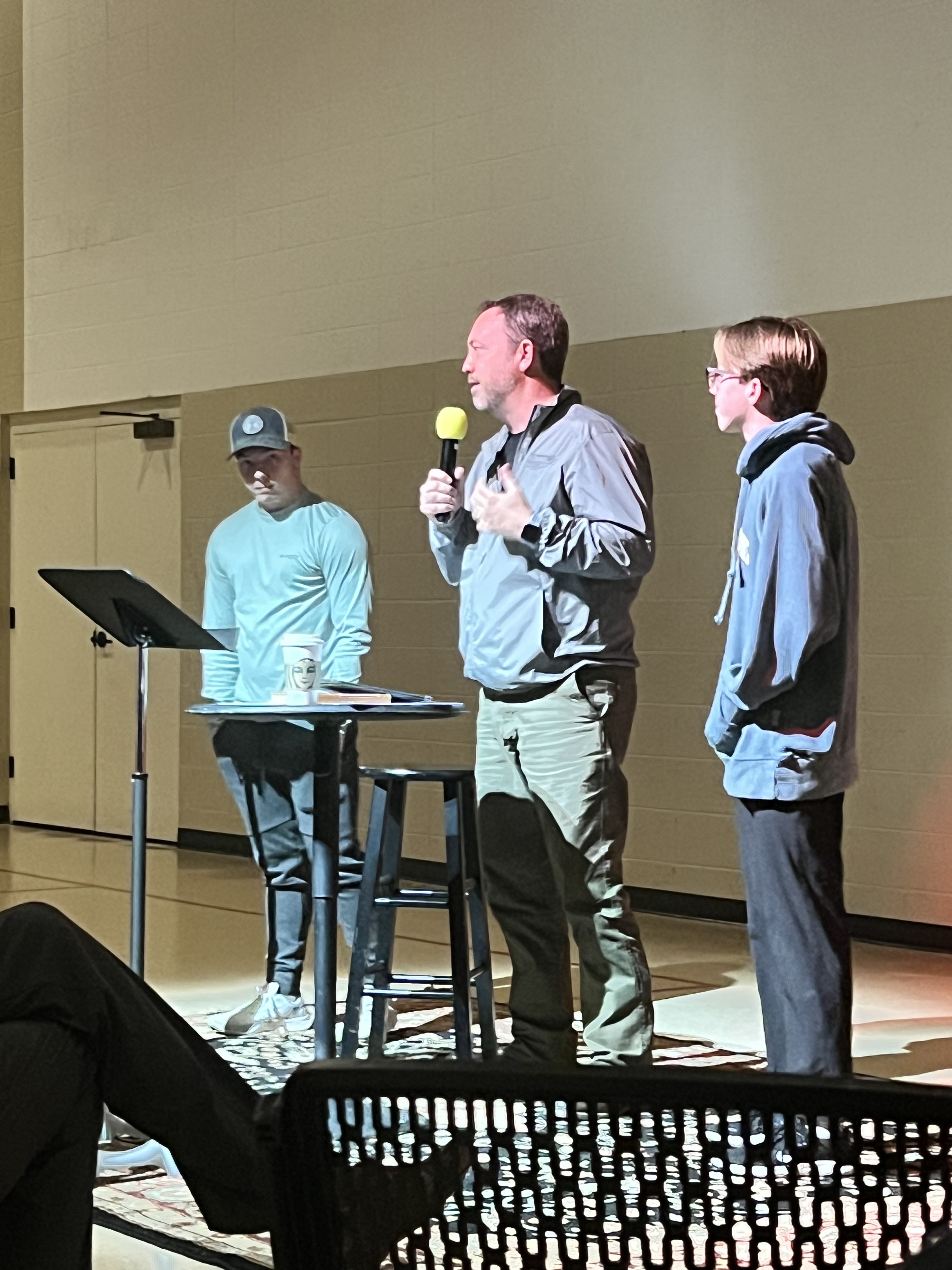
Last night was a special night as I shared some teaching time with two of my favorite people: my sons Jackson and Joshua. We had a special class at church last night, led by some of our fathers and sons. The three of us presented on the topic of peace: Jackson discussed some of the inhibitors of our peace; Joshua shared how he’s learned to rely on the Holy Spirit to produce peace in our lives; and I talked about how the birth of Jesus was hailed as the coming of “peace on earth,” but that Christ’s work of making peace culminated in His death upon the cross (Colossians 1:19-20).
A few good friends snapped some pictures of us while we were teaching. Grateful to be able to share this time with my boys.
Time for my annual post of my favorite albums released over the last twelve months. Each December, I look back over the music of that particular year and identify my favorite albums. (If you want to look back over my previous rankings, you can find them here or you can work through the archives located on the sidebar.)
If you look back over those lists, you’ll get a feel for the music I love the most: my tastes typically run between indie / alternative rock and country. The list will tell you that I’m a big fan of Radiohead, Dwight Yoakam, Johnny Cash and anything released by The War on Drugs. But sometimes I’ll come across an instrumental album that really grabs me; Khruangbin’s 2018 release, Con Todo El Mundo, for instance, or Sigur Ros’s 1999 masterpiece, Agaetis Byrjun. This is one of those “instrumental” years thanks to Jackson Bybee’s moving release, evergreen. Despite some strong opposition from fellow Huntsville native Matthew Houck’s The Full Moon Project and Jackson Dean’s stellar Greenbroke, evergreen stands out to me as the most emotionally affecting recording of 2022.
Here’s the full list, complete with some of my comments.
Jackson Bybee, evergreen. After the release of his second album, wildflower, earlier in the spring, I doubt anyone expected Jackson to release yet another album this calendar year. But after pouring his heart and soul into this batch of new songs, he surprise-released it almost one month ago to near-universal acclaim. I would argue that this overwhelming response is evidence of Jackson’s growth as an artist. Pat McRight, a good family friend and a collaborator on many of these songs, described this growth as a shift “from loops to layers.” Sonically, this move is evident in evergreen’s key-work, which evokes a warmer ambience than any of Jackson’s earlier music. In my interview with him prior to evergreen’s release, Jackson mentioned his intentional focus on the connections we experience with people and places. These are what make up the seasons of our lives. Album openers “walden” and “acadia” situate this recording in an autumnal landscape, the unhurried pace reminiscent of a leisurely walk through the woods. This same vibe is felt on the closing title track, as “evergreen” has the listener marveling at the evergreen’s persistence in the face of dawning winter. (I love that image of hope.) But in between these tracks are copious references and homages to the people in our lives, and this is where evergreen truly flies. “i love you always” is an ode to Jackson’s mother, Sunny, and the melody perfectly encapsulates both her sweetness as well as her playfulness. I loved it the first time I heard it. “mimi” is an elegant ode to Jackson’s great-grandmother, Cyclister Shates, who lived with us for a period of time several years ago. This stately piano piece perfectly captures the spirit of this strong but refined woman of grace. (Fun fact: we’ve decided it can also double as a Christmas song!) My favorite track, though, has to be cash and I doubt I’ll be able to fully express what this song means to me. Jackson’s middle name is “Cash” which is a word with many different meanings, one of which is “peace.” But more than that, the name points to my Dad and one of his heroes, Johnny Cash. Cash was something of an outsider, an advocate for the neglected, the overlooked, the forgotten. That resonated with my Dad and it resonates with me to this day. And then there’s the music. Some of my fondest childhood memories are those moments with my Dad, his guitar propped on his knee, singing Folsom Prison Blues and I Walk the Line. These songs served as the soundtrack for my childhood and my relationship with my Dad. When it came time to name Jackson, the idea of “Cash” as a middle name seemed appropriate for the kind of relationship I hoped to have with my youngest son. So you can imagine how excited I was to see a song titled “cash” on the evergreen track listing. Jackson had been digging back into our family line on the Bybee side and he found some poetry: some written by my grandmother; some written by my father (which hangs on the wall in my office); and some written by me. Of course, Jackson had been writing his own poetry / lyrics for quite some time, so there was special resonance to this, prompting him to think of the line “a poet with power, in every generation.” He wrote “cash” as his way of honoring these forebears on the Bybee side — including some lines of poetry recited by my grandmother, Hilda Bybee at the beginning and end. But my favorite moment is the crescendo at 3:07 as the synth solo comes in to accompany the other layered instruments in this beautiful melody. Jackson says that those keys represent his entrance in this long line of creatives from whence he’s come. He’s never met my Dad and my grandmother, yet he honors them so well while also making this work distinctly his own. It brings a smile to my face every time. It is safe to say that no song released this year has carried as much emotional weight for me as this one. And there are so many other pieces I love: the swelling guitar solo in “living proof”; the beauty-from-chaos of “closure”; the quieter and more reflective tone of “flume.” It’s truly a great recording and I’ve loved having such an up close look at the creative process from start to finish. Jackson Bybee’s evergreen is hands down my 2022 Album of the Year.
Phosophorescent, The Full Moon Project. I think this is a cool idea for an album: one song released each full moon for an entire calendar year. That’s the approach Matthew Houck took for the latest release for his Americana / indie project Phosphorescent. I’ve really enjoyed this collection of covers, ranging from Fleetwood Mac’s “Storms” to the Bee Gee’s “To Love Somebody” to late-era Bob Dylan on “Tryin’ to Get to Heaven.” I think the measured, patient approach really paid off, as I would rate this as the best Phosphorescent album yet.
Jackson Dean, Greenbroke. Six months ago, I had never heard of Jackson Dean. But somehow I came across his most recent release and I immediately fell in love with a lot of these songs. “Don’t Take Much” is one of my most played tracks this year. I also love “Wings” and “Superstitious.” I expect to see Jackson Dean’s name sprinkled across these lists for years to come.
Michael McDermott, St. Paul’s Boulevard. I’ve followed McDermott for over 20 years now. His 1995 self-titled album still stands as an absolute masterpiece in my opinion. He has put out some really good music in the last few years, but St. Paul’s Boulevard is a standout of singer-songwriter craftsmanship. The heart of the record contains a trifecta of five-star songs: “The Arsonist,” “New Year’s Day,” and “Meet Me Halfway.” If you’re not familiar with McDermott, do yourself a favor and take 15 minutes to listen to these three songs.
First Aid Kit, Palomino. These ladies deserve to be Americana legends. Love their sound, especially on this new record. It sounds like they’re having the time of their lives on “Out of My Head.”
A few honorable mentions:
Jackson Bybee, wildflower. It’s a good year for the “Jacksons” that I follow on Spotify, apparently. I have probably listened to this album more than any other this year. It still has some of my favorite songs that Jackson has ever recorded.
Hermanos Gutierrez, El Bueno Y El Malo. Great study music.
Ian Noe, River Fools & Mountain Saints. Really love the “Road May Flood / It’s a Heartache” mashup.
Vieux Farka Toure & Khruangbin, Ali. Khruangbin joins forces with a legendary West African guitarist. Jam music ensues.
The Smile, A Light for Attracting Attention. So I’m a huge Radiohead fan, so it should follow that I would love this record. But I don’t love it. It’s just okay.
Here’s a little video of Jackson receiving his award for “Most Improved Varsity Runner” at this year’s Cross Country Banquet. I am so proud of this guy and the way he works to achieve his goals. And I’m excited to see how he continues to progress in the years to come. Great job, Jackson!
The kitchen is still warm from Sunny’s hours of food prep. The meal has been made and consumed; the mess has been cleaned up; and the leftovers are in the fridge. The football game is on in the background while everyone rests — even the dogs.
Today is Thanksgiving Day, my favorite holiday.
And today, I have so much gratitude in my heart.
I’m grateful to be surrounded by my family today. I know there will likely be years when it won’t work out for all five of us to be together on Thanksgiving Day. But that knowledge actually makes this blessing that much sweeter. So grateful to be able to spend this day in my home with my people.
I’m grateful for the life I get to live with Sunny. She is absolutely the best and I thank God for her.
Eight days out from surgery, I’m thankful for the care I have received from doctors and nurses. Two weeks ago, I woke up at 3am to abdominal and back pain. After a trip to the ER, I found out that I have gallstones and surgery was scheduled for a few days later. I feel great now — in fact, I don’t think I realized how bad I was feeling until having this surgery.
I’m also grateful for the care and concern we’ve received from our church family at Mayfair. We’ve had so many people calling and texting to check on us after my surgery. I’m so grateful for these relationships that we have as a part of this tremendous church family. Mayfair, your support of us is one of the great blessings of our lives.
Today I’m celebrating with a heart full of gratitude. I am thankful for my family, my friends, my health, my church, all the blessings that God has so freely given to us.
Every good gift and perfect gift is from above, coming down from the Father of lights with whom there is no variation or shadow due to change.
Beginning this Sunday at Mayfair, a new sermon series entitled The Greatest Gifts of All. Join us for worship at 9am in Jones Valley or online at www.mayfair.org.
Joshua started playing baseball at the age of 3 at the YMCA. And it was definitely love at first “swing” for him! Since that first season of tee ball 15 years ago, this game has been his passion. And it has been so much fun to watch him grow as both a player and a person through playing this game.
We’ve learned a lot of lessons along the way. I guess that’s to be expected when baseball is described as “a game of failure.” Even the best hitters to ever play the game fail 70% of the time when they go to the plate. You can do everything right, barrel up a ball and hit it right at a defender who makes a great catch. You can execute your pitch, put it right where you want it, only to have it dribble through the infield for a base hit. So, yeah, we’ve learned some lessons.
At the top of the list, Joshua has learned the importance of hard work. I think his mantra has always been “extra.” Just a few more swings, Dad. A few extra throws. Hit me a few more grounders. This game has taught him the importance of “extra” and the difference it can make. Baseball also teaches you how to deal with adversity. We’ve seen him battle through bases loaded, nobody out, as he learned the lesson of perseverance. He’s learned how to lose — and believe me, our teams have lost plenty. One year, his travel team won ONE game all season. But I wouldn’t trade those days for anything, because they made the winning that much sweeter. He’s learned how to be a good teammate because he’s had so many good teammates model this back to him. He’s learned to be coachable because he’s had so many good coaches love him enough to tell him the truth. And yes, he’s learned how to be a winner, how to carry success and humility hand in hand. He’s learned so much that it’s really a misnomer to call this a “game” — baseball has been his classroom.
And Mom and Dad have learned quite a bit as well. We’ve learned discernment. There are moments when your player needs to know what you’re seeing, so you talk about his swing, the hitch in his pitching mechanics, his fielding technique. And there are other times when he just needs a hug. It’s taken us 15 years, but we’ve finally figured it out. The car ride home after a loss is a time for encouragement (often in the form of a Culver’s cheeseburger) and rarely is it the time for chastising. Maybe the most important lesson we’ve learned: always keep your outdoor propane heater on hand until at least mid-April. And don’t forget those extra green canisters. They’re lifesavers.
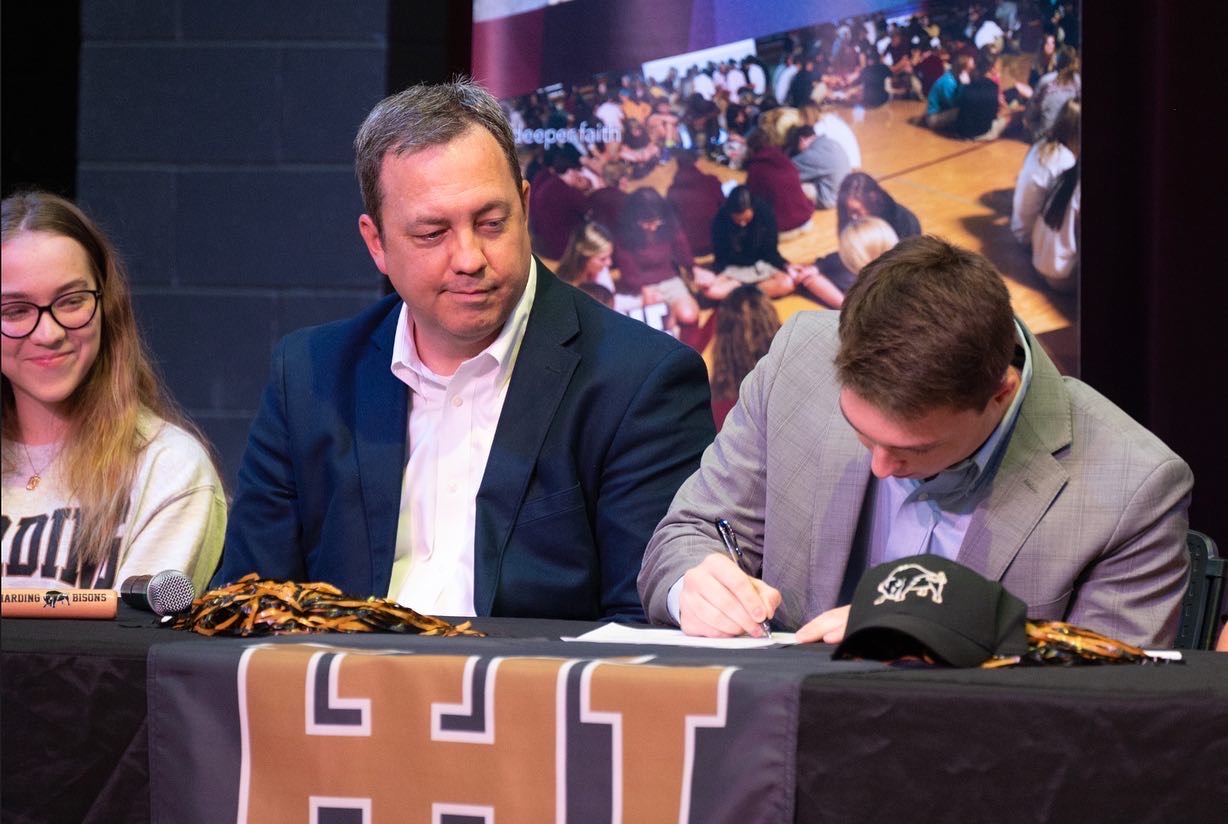
And today all the lessons came full circle as Joshua signed to play baseball for Harding University. If the goal was simply “play college baseball,” there were several opportunities for him to explore. But years ago, a wise coach told Joshua not to select a college simply based on the baseball program. “You need to make sure that it’s the school you want to attend. And you need to consider a lot of factors other than baseball.” Thankfully Joshua listened and he made up his mind that Harding was where he wanted to be — wait, there’s a better way to say it. Joshua became convicted that Harding was where God wanted him to be. So he made a wise and God-honoring choice: if baseball is there for me at Harding, great; but even if it’s not, that’s where I’m going.
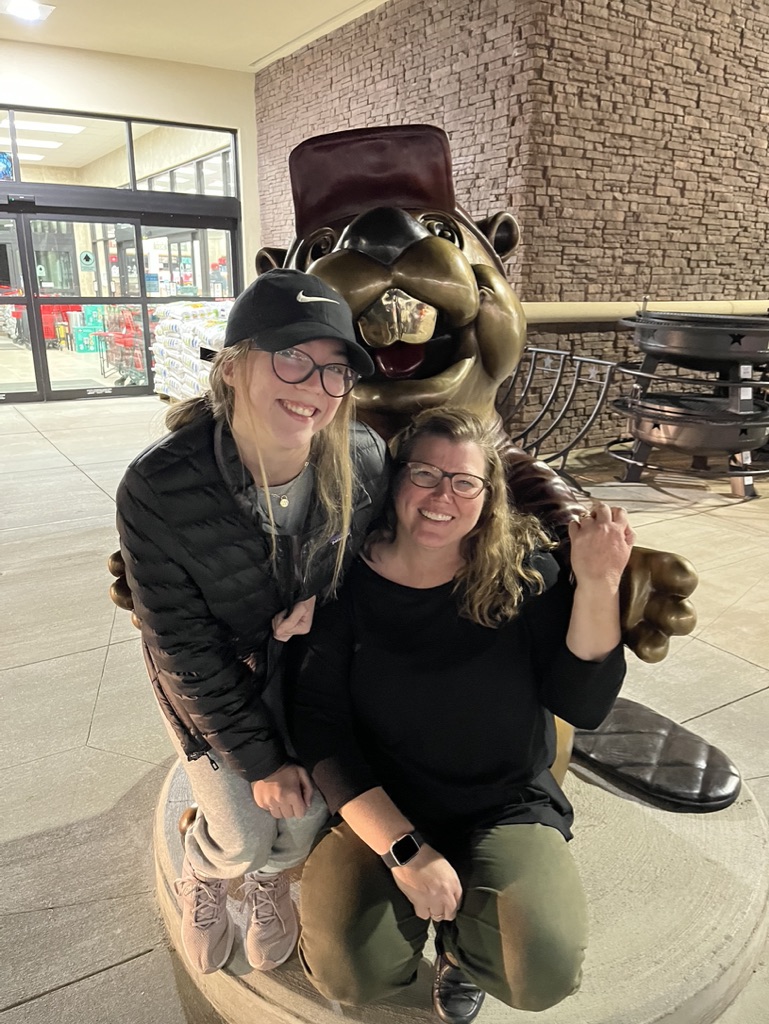
And I believe God honored this decision by opening the door for Joshua to become a Bison.
So today, as Joshua signed his National Letter of Intent, I saw this as the work of God, affirming the greatest lesson it seems my boy has learned: to trust in the Lord with all of your heart and He will make your path straight. I couldn’t be prouder of you, son. Thank you for the lessons you’ve taught me.









 already & not yet