What comes to mind when you hear the word “ransom?”
I think of a kidnapping or a hostage situation. In the movies, the kidnapper leaves a ransom note behind, releasing the hostages only after payment has been made.
This is essentially the way the word is used in Mark 10. Jesus says that He came to serve — specifically, to offer Himself up as a ransom for many.
What lengths would you go to in order to pay the ransom if someone had kidnapped one of your loved ones? I suspect you’d empty every account and borrow money from all of your friends if it meant securing the safety of your loved one. And that “do whatever it takes” feeling we get when we think about this is what prompted Jesus to give up His own life.
In ancient Greek — the language of Mark’s Gospel — the word “ransom” was often used in reference to purchasing the freedom of a slave or a prisoner of war. This fits in with our discussion last week. We noted that one way of thinking of the cross is in terms of spiritual warfare. As we said repeatedly last week, Jesus came to earth to pick a fight, to win a war. So along the same line, we see that Jesus offers Himself as a ransom to set us free — because we are spiritual prisoners of war, held captive by the devil.
So back to our original idea of a bad trade. Picture Satan with all humanity held captive by sin. And along comes Jesus — the holy, eternal Son of God. And He offers to take our place. He says, “I will pay the cost for their freedom.” This looks like a bad trade for God, doesn’t it? Jesus giving His life as a ransom for ours. But it turns out to be the best thing that’s ever happened to us, because Jesus is strong enough to break the shackles once and for all, to deal a deathblow to Death itself.
The more Satan can entice us toward sin, the further he draws us into his domain. And with each step, we become more fully enslaved to Sin.
Have you ever committed a sin and felt really, really guilty about it afterward? Of course. But then one day you realize that you’ve gone back to that sin so many times that you no longer feel much guilt. You’ve kind of gone numb to the sinful action. Isn’t it odd that we’re never satisfied with the same level of sin? We always have to have more and more and more. That’s what we’re talking about here. We become further entrenched, further enslaved in the realm of sin. Satan wants us to be caught up in his web of sin because he knows that’s his best way of enslaving us. And this is why we need to be ransomed out of the grip of Sin and Death and Satan.
Although he doesn’t use the word “ransom,” the writer of Hebrews expands this idea in Hebrews 2.
Since the children have flesh and blood, he too shared in their humanity so that by his death he might break the power of him who holds the power of death — that is, the devil — and free those who all their lives were held in slavery by their fear of death. For surely it is not angels he helps, but Abraham’s descendants. For this reason, he had to be made like them, fully human in every way, in order that he might become a merciful and faithful high priest in service to God, and that he might make atonement for the sins of the people. Because he himself suffered when he was tempted, he is able to help those who are being tempted.
Hebrews 2:14-18
Three key points from this text:
Jesus shares in our humanity, even sharing in human temptation and death itself.
But He does this in order to break Satan’s power and to free us from the fear of death.
In light of this, He is able to help those who are being tempted today.
Even though the word “ransom” doesn’t appear in this text, the writer of Hebrews gives us a clear picture of the ransoming mission of Jesus. Jesus came to pick a fight — specifically, to break the power of the one that holds the power of death, the devil himself. At the cross, Jesus sets us free from the fear of death.
When Jesus says that He has come to give His life as a ransom for many, I believe He wants us to hear those words at a personal level. You and I are among the many. Look at the cost of our salvation:
You know that you were ransomed from the futile ways inherited from your ancestors, not with perishable things like silver or gold, but with the precious blood of Christ, like that of a lamb without defect or blemish.
1 Peter 1:18-19
Our deliverance comes at a great cost. Jesus Himself is the price of our redemption. He ransomed us with His precious blood. That seems like a bad trade at first — but it turned out to be the best thing in the world.
Sports history is filled with some pretty lopsided trades. Hall of Famers such as Wayne Gretzky, Bill Russell, Babe Ruth, and Brett Favre were all traded early in their careers and went on to win championships for their new teams.
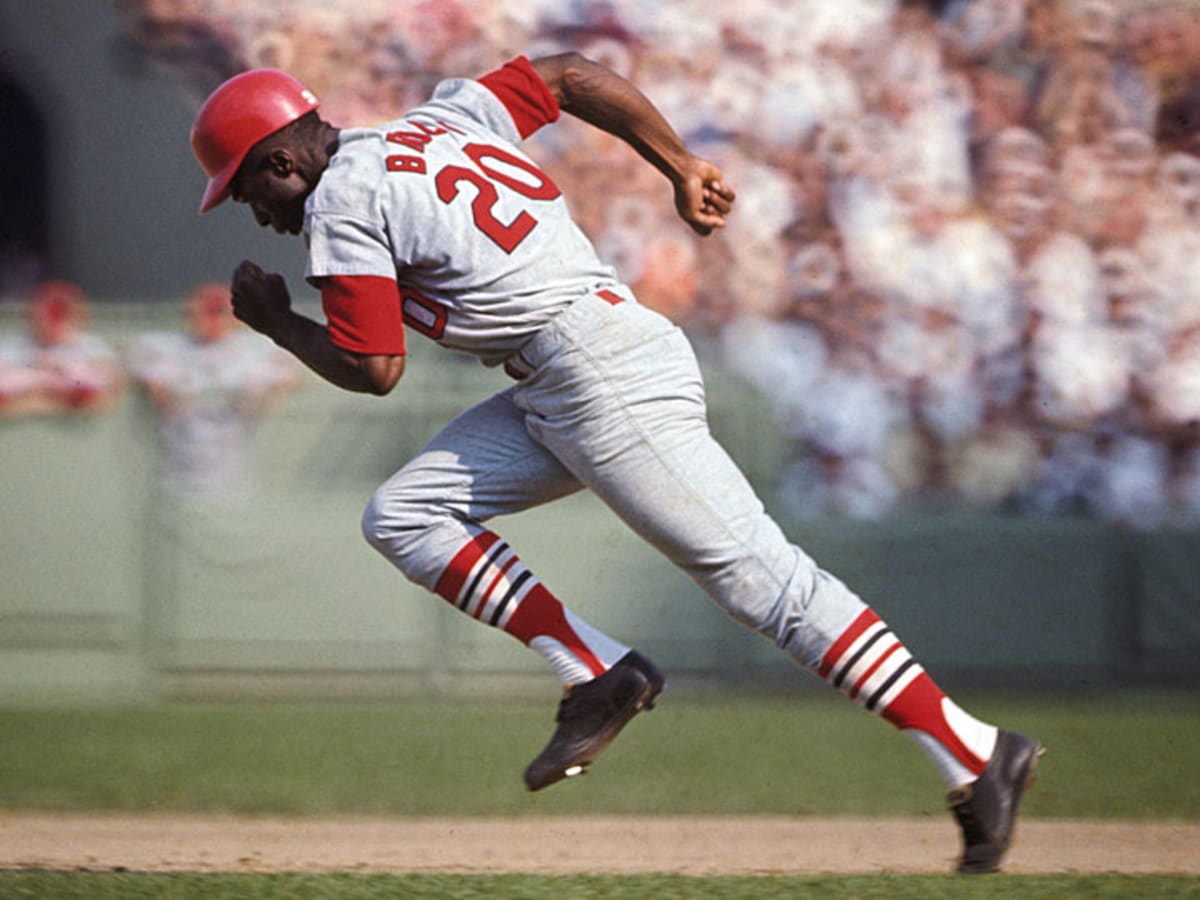
But my favorite lopsided trade occurred in 1964 when the Chicago Cubs and St. Louis Cardinals made a six-player deal. The Cardinals sent a pitcher named Ernie Broglio to the Cubs; at the time, Broglio was one of the best pitchers in the league. In return, the Cardinals received a young outfielder named Lou Brock, who was hitting .251 at the time. The general consensus was that the Cubs had fleeced the Cardinals. When the trade was completed, Bob Smith of the Chicago Daily News wrote in his column, “Thank you, thank you, oh, you lovely St. Louis Cardinals. Nice doing business with you. Please call again any time.”
The trade turned out to be a historically bad one — but not in the way that Bob Smith predicted. Ernie Broglio would win a total of seven more games in his career while the to St. Louis was the best thing that ever happened to Lou Brock. He would go on to collect over 3,000 base hits while setting the all-time record for stolen bases and helping the Cardinals win two World Series titles.
This idea of a bad trade is helpful for us as we continue our series on the cross. For all the world, the death of Jesus looked like a bad trade. But that “bad trade” turned out to be the best thing that ever happened to us.
Over the course of this series, we’ve looked at several passages of Scripture as we’ve studied the meaning of the cross. This week, I’d like for us examine some words recorded in the Gospel of Mark. These are the words of Jesus as He talks about the meaning of His death.
And James and John, the sons of Zebedee, came up to him and said to him, “Teacher, we want you to do for us whatever we ask of you.” And he said to them, “What do you want me to do for you?” And they said to him, “Grant us to sit, one at your right hand and one at your left, in your glory.”
Jesus said to them, “You do not know what you are asking. Are you able to drink the cup that I drink, or to be baptized with the baptism with which I am baptized?” And they said to him, “We are able.” And Jesus said to them, “The cup that I drink you will drink, and with the baptism with which I am baptized, you will be baptized, but to sit at my right hand or at my left is not mine to grant, but it is for those for whom it has been prepared.”
And when the ten heard it, they began to be indignant at James and John. And Jesus called them to him and said to them, “You know that those who are considered rulers of the Gentiles lord it over them, and their great ones exercise authority over them. But it shall not be so among you. But whoever would be great among you must be your servant, and whoever would be first among you must be slave of all. For even the Son of Man came not to be served but to serve, and to give his life as a ransom for many.”
Mark 10:35-45
James and John seem to be envisioning a moment when Jesus validates His “messiahship” by marching into Jerusalem to overthrow the Romans. When such a moment comes, they want to be positioned at his right and left hand. Basically, they are openly asking for prominent cabinet appointments. Matthew adds the detail that their mother came with them and also spoke on their behalf. Her name was Salome, and it is possible that she was the sister of Mary, the mother of Jesus. If that’s true, that would mean that James and John were Jesus’s first cousins. Maybe they were hoping that their family connection would grease the tracks for them to receive these prominent positions.
Jesus rebukes James and John for desiring glory for themselves. Naturally, the other disciples are upset when they hear about this and an argument breaks out. But in masterly fashion, Jesus uses this to teach the disciples about humility and servanthood and the nature of His mission. Jesus says, “Gentile rulers lord over and dominate their subjects. They exploit them and use them, but that’s not the way it works in the Kingdom of God. Instead, whoever would be great among you must be your servant.“
This is where James and John got it wrong. And we can understand, because we often get this wrong, too.
We often associate greatness with power or wealth or talent or positional authority. We think the greatest must be the flashiest, the loudest, the funniest, the one with the most toys or the most money or the most athletic kids or the most fashionable shoes or a million other silly things.
But Jesus says the greatest will be the one who serves. In the Kingdom of God, true greatness is found in servanthood.
And then He delivers this mission statement line: For the Son of Man came not to be served, but to serve, and to give his life as a ransom for many. We like to be served, to have somebody come along and meet our needs. And sometimes it’s not even our needs; like James and John, we just want people to do whatever we tell them to do. But Jesus says that’s not why He came to earth.
He came to serve and to give His life as a ransom for many.
I saw a Lamb standing, as though it had been slain …
Revelation 5:6
And when the Lamb takes the scroll, all of heaven sings a new song:
“Worthy are you to take the scroll and to open its seals, for you were slain, and by your blood you ransomed people for God from every tribe and language and people and nation, and you have made them a kingdom and priests to our God and they shall reign on the earth.”
Revelation 5:9-10
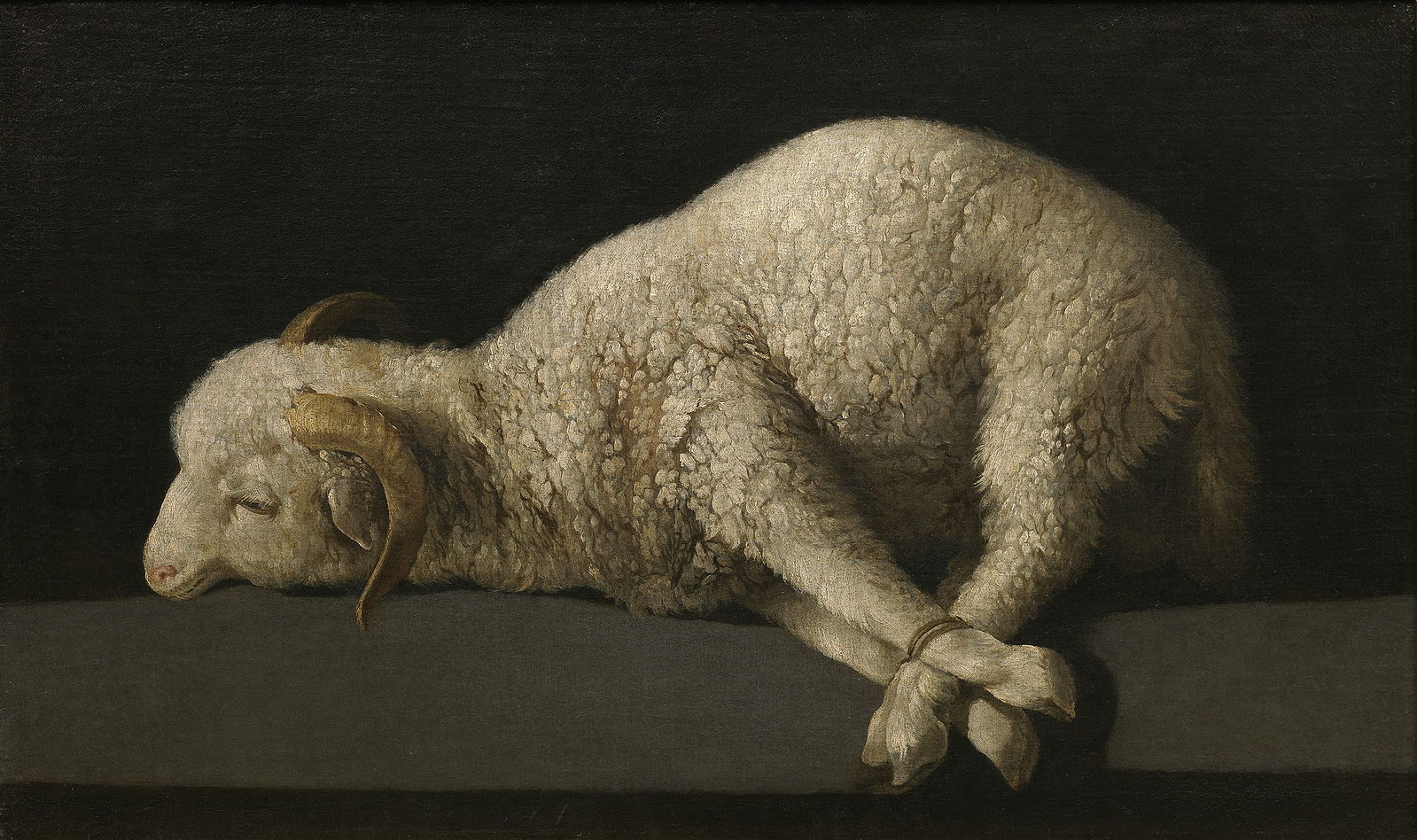
So John turns around expecting to see the victorious Lion of Judah. The lion, of course, is known as a ferocious figure, the king of the jungle and all of that. But when John looks, he doesn’t see a lion at all; he sees a lamb. And this lamb looks as if it has been slain. A back-from-the-dead lamb.
When we put all of this together, we see that the Lion of Judah is actually the Lamb of God.
In some Jewish apocalyptic literature, there appears a figure of a heroic lamb who would come and destroy evil. In various Jewish stories, he fights bulls and treads his enemies underfoot. So in some ways, John’s vision taps into that tradition.
But then again, this image of a slain lamb is radically different. This picture takes us back to the idea of the Passover lamb, which we talked about a few weeks ago. In the book of Exodus, the death of the Passover lamb signaled deliverance from Egyptian bondage. And with His death, Jesus has brought about a New Exodus, as He sets us free from the captivity of Sin.
I like the way N.T. Wright puts it. He says the cross is an exorcism. Jesus came to earth to cast out the evil one, to cast out the demons from our world and to reconcile it back to God once again. And that’s true.
At the temptation of Jesus in Matthew 4, Satan offers Jesus the kingdoms of the world. It seems like a legitimate offer, as if they’re really Satan’s to offer up. But by the end of Matthew’s Gospel, Jesus will say that all authority in heaven and on earth now belongs to Him (Matthew 28:18). Something has happened to dethrone the evil one and to enthrone Jesus.
What happens between Matthew 4 and Matthew 28? The death and resurrection of Jesus.
The evil one is an enemy too powerful for us to defeat. We simply cannot overcome him on our own. We need outside help.
I watched Tombstone the other day; it’s one of my favorite movies. There’s a scene toward the end where Doc Holliday stands in for Wyatt Earp in the showdown vs. the gunslinger Johnny Ringo. And Holliday does this because he knows Wyatt isn’t a fast enough draw to take down Ringo. So he stands in for his friend because he knows the enemy is too great for him.
And this is what Jesus has done for us. He knows that our foe is too great for us, so He goes before us, standing in for us and winning the victory on our behalf. If we’re not careful, we’ll only tell half of the story when it comes to the cross. We’ll confess that Jesus stood in for us and took the penalty in our place — which is 100% true. But He also wins a victory for us in place of all our failures. We need the Lion of Judah to take on the enemy who continues to defeat us over and over again.
But it’s also important to point out that even though Jesus is triumphant, His triumph takes the form of a lamb being slain. To put it another way, Jesus wins a victory, but the only blood that was shed was His own. That’s the kind of Savior we have. He’s the hero who makes the sacrifice.
Jesus infiltrates enemy-occupied territory to bring redemption from the inside-out. Some say He even descended into hell after His death to experience the full weight of sin. I don’t know if that’s true or not, but it sure seems like a possibility. Where else would He be in between His death and His resurrection?
Praise be to the triumphant Lion of Judah, who is actually the slain Lamb of God.
As we continue our series on the cross and the atoning work of Jesus, we turn our attention to the picture of Jesus as the worthy champion. This is called the Christus Victor view of atonement, the idea that in His death and resurrection, Jesus has triumphed over the evil powers of the world. In the early centuries of Christianity, this spiritual warfare understanding of the cross stood head and shoulders above all others.
Jesus came to earth to pick a fight, to win a war.
We have reason to believe that our world is on the brink of war. Tension is rising as Russia continues to send troops to the Ukrainian border. We are reminded of what Jesus said: you shall hear of wars and rumors of war. So we pray for peace. But these headlines also remind us of another war, one that has been waged for a long time. It is a spiritual struggle between good and evil, between the will of God and the will of Satan.
And the decisive figure in this battle is Jesus.
As we’ve said for a few weeks now, the cross is God’s answer to two problems: the problem of sin and the problem of evil. We stand in need of forgiveness, therefore Jesus dies in our place to atone for our sins. (We discussed this in depth last week.) But there is also this: the enemy has taken us captive and we need to be set free. That’s one of the reasons Jesus casts out demons in the Gospel accounts. He invades hostile territory to do battle. In His birth, God the Son goes behind enemy lines to overthrow Satan and his evil forces that are holding us captive. On three different occasions in John’s Gospel, Jesus refers to Satan as “the ruler of this world.” But at the cross, God makes a move to get His world back.
Let’s think about this as we read what John writes in Revelation 5.
Then I saw in the right hand of him who was seated on the throne a scroll written within and on the back, sealed with seven seals. And I saw a strong angel proclaiming with a loud voice, “Who is worthy to open the scroll and break its seals?” And no one in heaven or on earth or under the earth was able to open the scroll or look into it, and I began to weep loudly because no one was found worthy to open the scroll or to look into it.
And one of the elders said to me, “Weep no more; behold, the Lion of the tribe of Judah, the Root of David, has conquered, so that he can open the scroll and its seven seals.”
Revelation 5:1-5
John is given a vision of the throne-room of heaven and he sees God holding a scroll. It has writing on both sides, which would have been unique in the ancient world. And it is sealed with seven seals. In Roman law, a testament sealed with seven seals was legally binding. Additionally, the number seven represents the number of completion, perfection. So this scroll represents the perfect, complete will of God.
And John sees this angel who cries out, Who is worthy to open the scroll? But there is no champion, no one who is worthy to execute the perfect will of God. At this, John begins to weep loudly because it seems as if all hope is lost.
But then one of the elders says to John, Don’t cry! Behold, the Lion of Judah, the Root of David! He has conquered! He can open the seals! We have a champion after all! Jesus steps forward as the new David. We remember the story of the young David courageously facing off against Goliath. Only this time, instead of a physical giant, the enemy is a spiritual one. The enemy is the evil one, Satan, the great adversary.
Satan often attacks us by enticing us to sin. We see him doing this throughout the Bible but we also deal with his temptations in our individual lives. Sin stains us; it makes us guilty before God. And through Sin, Satan has actually weaponized the Law, which was holy and good but now it is used to condemn us. And the more sins we commit, the more deeply we become entrenched in the domain of Sin.
In Romans 6:14, Paul talks about how sin has dominion over us. Literally, he says sin “lords over” us. But the work of Jesus is to set us free from the lordship of sin. We confess that He is the true Lord! He is the mighty Lion of Judah, the one who is worthy to open the scroll. He is our conquering hero!
Some will say, “How is this just?” This is yet another critique of the cross. Some want to point at the substitutionary death of Jesus as evidence that God is not just. Otherwise, they argue, how could He allow an innocent person to suffer like this?
Such a view ignores the Trinitarian view of the cross we have been arguing for throughout this series. God doesn’t subject a random innocent person to the full weight of His wrath at the cross. No, God absorbs this weight into Himself in the second person of the Godhead. A Trinitarian understanding of the cross points us to God’s self-sacrificial nature and avoids humanistic objections such as this one.
The answer to this critique is also found by looking at the character of God as revealed in the Scriptures. the cross is an expression of God’s justice and righteousness, which we discussed a few weeks ago when we examined Romans 3:25-26. But we should be quick to note that the cross is not justice at the expense of love. Rather, it is justice motivated by love (John 3:16).
The cross is just in that it satisfies the wrath of God against sin. But as Fleming Rutledge says, it is wrath wrapped in love, wrath wrapped in mercy.
I would put it this way: Sacrifice is the place where the justice of God and the love of God meet.
The wrath of God falls upon God himself, by God’s own choice, out of God’s own love. God in Christ on the cross has become one with those who are despised and outcast in the world. No other mode of execution that the world has ever known could have established this so conclusively.
Fleming Rutledge, The Crucifixion
I read an interview recently where Stephen Colbert was talking about the death of his mother. Colbert told the interviewer how much he had to rely on his faith during that time. He said, “In my tradition, that’s the great gift of the sacrifice of Christ — is that God does it, too … that you’re really not alone. God does it, too.”
By standing in our place, Jesus not only suffers for us; but He is also suffering with us. That’s the story of the cross.
All of this leads us to the cross, God’s answer to our predicament. And it is a gracious answer, a mysterious and profound answer. In Jesus, God decides to suffer the wages of sin Himself. God the Son willfully and freely agreed with God the Father to align Himself with sinful humanity and to suffer God’s wrath against sin by dying on the cross. Remember, God’s wrath is not some heavenly temper tantrum but rather it is His indignation against Sin. God’s wrath is His opposition to anything that undermines His good purposes. Those who seek to divorce God’s wrath from the biblical story are fashioning a God in their own image, a God whose willingness to ignore sin and its consequences would actually make him more of a cosmic enabler than the holy God of the Scriptures.
So Jesus accepts the punishment for sin in our place. All of our best stories come back to this kind of substitutionary sacrifice:
Katniss Everdeen taking the place of her sister, Prim
Aslan giving himself up for Edmund
Belle begging the Beast to imprison her instead of her father
There’s something deeply heroic about this idea. It seems to resonate deeply within us.
The fact that God would provide a substitute for humanity is foreshadowed in much of the Old Testament.
The Lord called Moses and spoke to him from the tent of meeting, saying, “When any one of you brings an offering to the Lord, you shall bring your offering of livestock from the herd or from the flock. If his offering is a burnt offering from the herd, he shall offer a male without blemish. He shall bring it to the entrance of the tent of meeting, that he may be accepted before the Lord. He shall lay his hand on the head of the burnt offering, and it shall be accepted for him to make atonement for him.”
Leviticus 1:1-4
The writer of Hebrews says that the blood of goats and bulls was intended to teach us that without the shedding of blood, there can be no forgiveness of sins (Heb. 9:22). And all of this was to be taken even further, pointing us to Jesus, whose blood brings ultimate forgiveness.
At the cross, Jesus died the death of a condemned man. But He did more than bear the condemnation of Barabbas; He bore our condemnation as well. He died for my sin, for your sin.
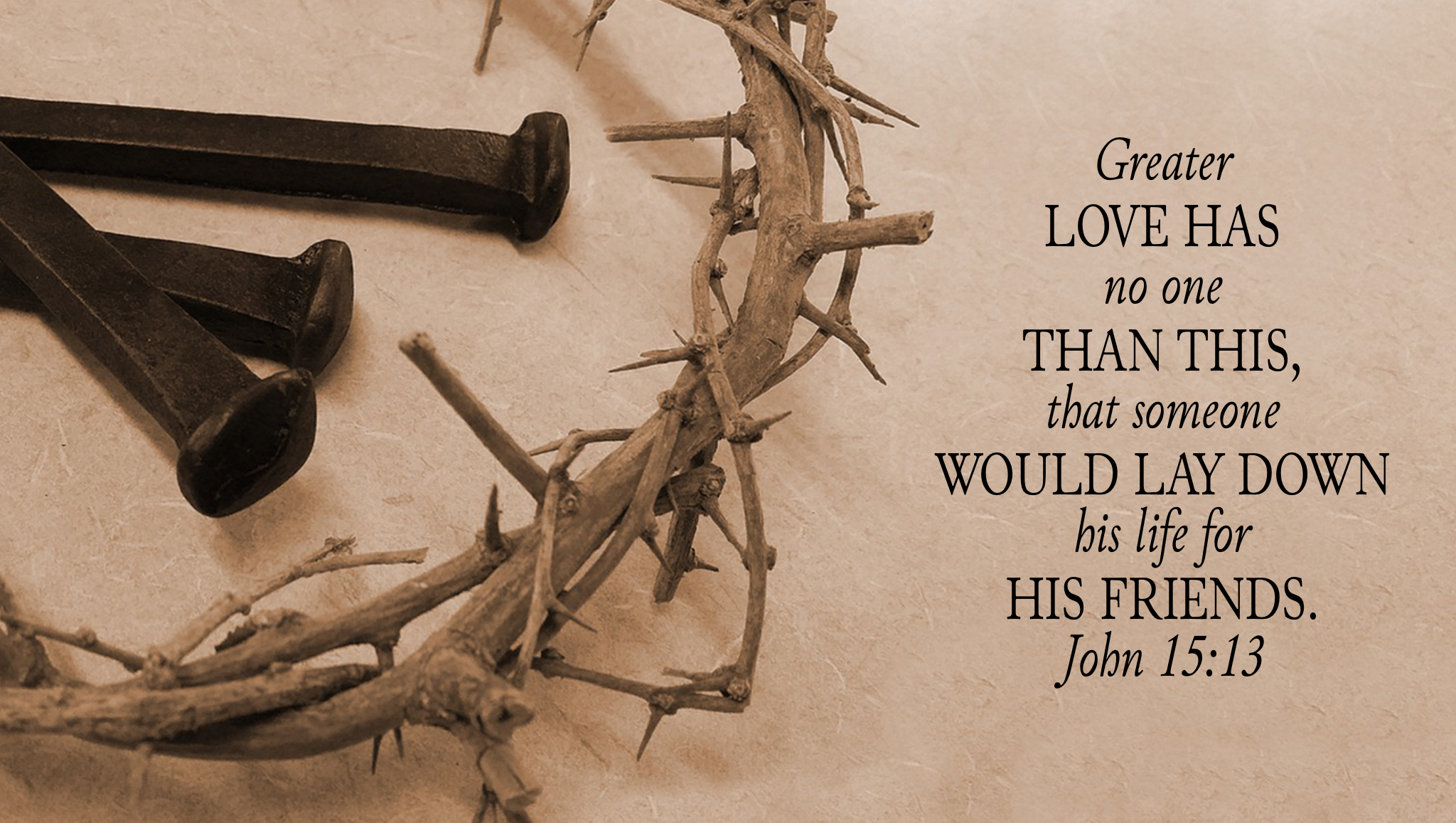
What would motivate Jesus to do this? This is what Jesus said to His disciples just before His death:
We just celebrated Valentine’s Day, the day our culture celebrates romantic love with all the teddy bears and hearts and chocolate. And there’s quite a bit of feeling associated with this picture of romantic love, which is understandable. But in the ultimate picture of love — Jesus on the cross — we find a whole lot more going on. More than feelings. More than emotion. Jesus helps us understand love as concrete action — not just something you feel, but something you do.
The cross is the ultimate example of what love will prompt someone to do. Real love, by its very nature, is sacrificial. As it says in 1 Corinthians 13, love bears all things, endures all things. So Jesus loves Barabbas enough to stand in His place, to take the full penalty reserved for a rebel. He bears this, even endures this, for the sake of love. And the Bible is clear that Jesus also does this for you and for me.
His death accomplishes God’s great rescue plan. We can now be reconciled back to God — forgiven of our sins and also liberated from the dominion of Sin. Like Barabbas, our slate has been wiped clean AND we are able to walk away from the shackles of our cells.
The Gospel writers tell us that Barabbas was a murderer. He was imprisoned for inciting rebellion and he was awaiting execution. In most every way, he was as good as dead. When the guards came and unlocked his cell, I’m sure he thought his life was over. But instead of marching him away to be crucified, they took the chains off his wrists and said, “You can go.” I wonder if he might’ve thought the guards were playing some cruel joke on him. But then maybe one of them spoke up and said, “No, it’s true. Someone else is going to die in your place. His name is Jesus of Nazareth.”
And I’ve always wondered what Barabbas did with that knowledge. The innocent Son of God died in the place of a rebel and a murderer.
And the rest of the Bible declares that what Jesus did for Barabbas, He also did for us. He died in our place as a result of our rebellion.
This understanding of the cross — called the substitutionary theory of atonement — is the predominant view for most Christians today. To use our golf club analogy from a couple of weeks ago, this is the largest club in the bag. Without a doubt, the idea of Jesus dying in our place is one of the most important things we can say about the cross.
In fact, we could say that this idea is really at the heart of the entire biblical story.
Sin: The Human Problem
According to the Scriptures, every human being is under the power of sin. No one can claim to be righteous (Romans 3:9-12). Although human beings are part of God’s originally good creation, sin has corrupted that goodness. We are now under Sin’s condemnation.
The Bible defines “sin” in a few meaningful ways. One way of understanding sin is to think of it as “missing the mark.” Imagine a target whose bullseye represents God’s good purposes for humanity. After all, we were made in the very image and likeness of God (Genesis 1:26-27). But sin causes us to fall short of this target (Romans 3:23). Weakened by sin, we will never be able to pull the bow back far enough to hit the mark on our own.
Sin is also described as living in the passion of the flesh (Ephesians 2:1-3). As a result, we were children of wrath, incurring the just punishment for our sin. Taking things even further in Ephesians 2, Paul says that apart from Christ, dwelling under Sin’s dominion, we are dead in our sins.
So because of sin, God has this dilemma. He loves us with a perfect love; but God is also perfectly holy and He simply cannot have anything to do with sin. God’s wrath is His opposition to sin — because sin always undermines God’s good purposes. Whereas God created us for life and glory, sin only creates death and corruption. That’s what we read at Romans 6:23, “The wages of sin is death.” After their sin, Adam and Eve must leave the garden (God’s place of life) and enter into a new, corrupted world (the dominion of sin, the place of death). Likewise, we incur the same penalty of death when it comes to our own sins.
So as we’ve said for a couple of weeks now, our human predicament is twofold:
We are guilty of our sins and we need to be forgiven.
We are also enslaved to Sin and we need to be delivered from its power.
Our guilt continually accrues with each individual sin we commit. It grows more and more every time we sin. But there’s also this: with each sin we commit, Sin (as a Power, as a cosmic, spiritual force) increases its hold on us. We become more and more enslaved to Sin as we’re drawn further into its dark realm.
Sin wants us to be guilty before God; but it also wants to enslave us. That’s the great danger of watching pornography or lying or drunkenness or gossip — or any sin. Yes, those individual sins stain us, standing against us and declaring our guilt. But each time we commit them, we’re also entrenching ourselves even further in the enslaving realm of Sin. This is what the writer of Proverbs was referring to when he said, Like a dog that returns to his vomit is a fool who repeats his folly (Proverbs 26:11). The fact that we keep returning to the same sins over and over is evidence of the enslaving nature of Sin.
During the Passover, in every home not marked by the blood of the lamb, the firstborn son passed away. Exodus 12:29 tells us that even Pharaoh’s son died that night.
That means the son of the king died at Passover.
We’ve been focusing on the death of Jesus and how it corresponds to the death of the Passover Lamb. But in a shocking twist, we also see how the death of Jesus corresponds to another figure: Pharaoh’s son. The son of the king died at Passover yet again — only this time, the king was God Himself. God assumes the penalty associated with failing to apply the blood in order to make that life-saving blood available to all who would apply it by faith today.
The Son of the King died at Passover.
Have you identified with the blood of the Lamb? Are you washed in the blood? He has made it possible for us to experience salvation — freedom from sin and guilt. Apply the blood in repentance. Put your trust in Jesus, the Passover lamb whose blood was shed for us. Confess His lordship in baptism and let Him passover your sins once and for all.
In the words of the old hymn, there is indeed power in the blood of Jesus.
In the name of Jesus Christ, the Sovereign Lord who makes all things new, he who has ears, let him hear.
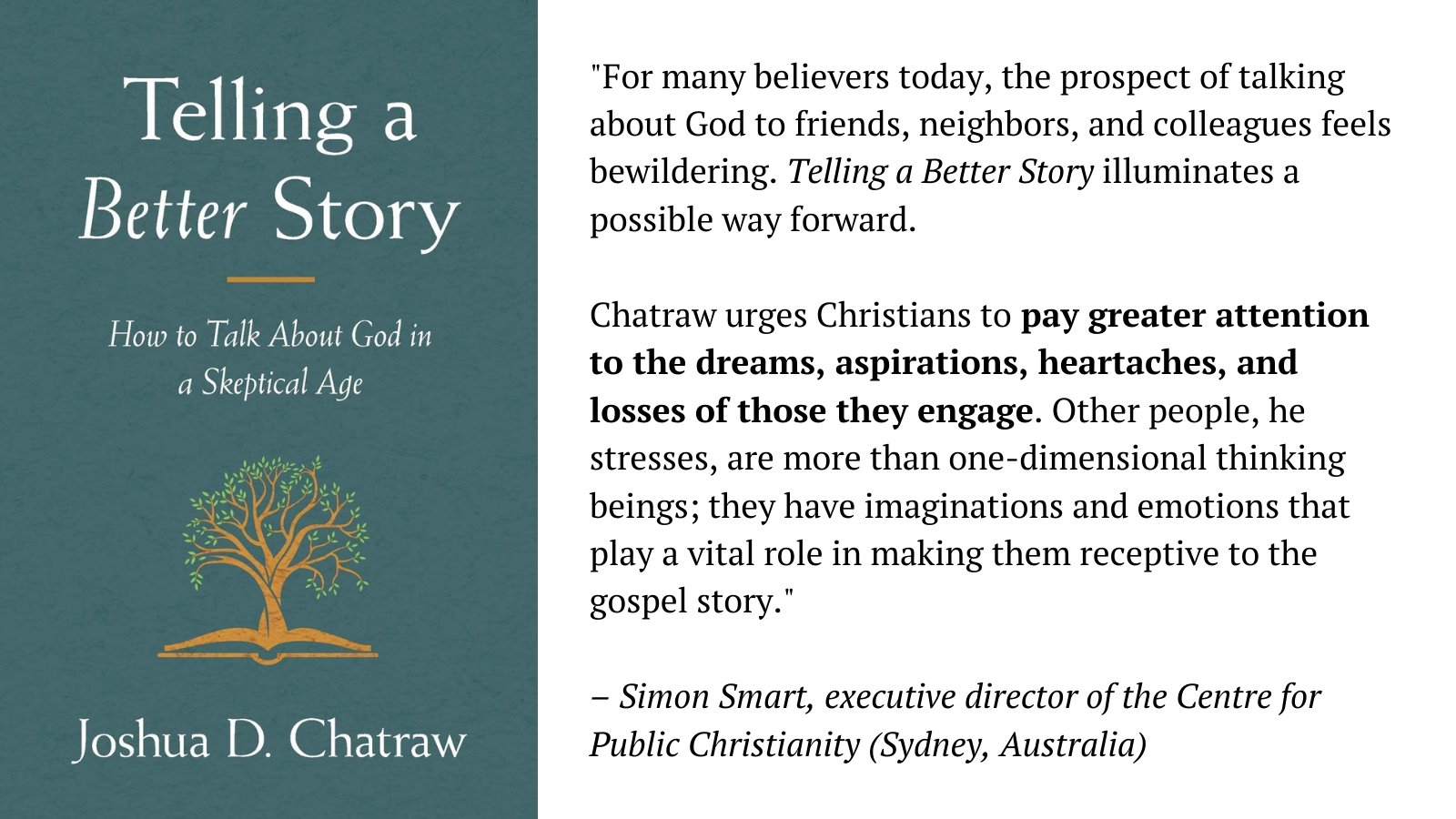
I just finished reading an excellent book by Joshua D. Chatraw entitled, Telling a Better Story: How to Talk About God in a Skeptical Age. Chatraw is the executive director for the Center for Public Christianity and the theologian in residence at Holy Trinity Anglican Church in Raleigh, North Carolina. He has written several other books on apologetics; this particular text caught my eye when it was named Christianity Today’s 2020 Apologetics / Evangelism Book of the Year.
Chatraw repeatedly argues that the Christian story — as revealed in the Bible — offers a more compelling vision of meaning, self, and reason than the limited scope of so many secular metanarratives. The Christian gospel is the better story, Chatraw claims, because it offers the most satisfactorily systemic answers to our most pressing philosophical questions.
But I also appreciated the generosity and hospitality of his “inside out” approach to apologetics. Whereas so many contemporary apologetical claims can come across as arrogant and off-putting, Chatraw encourages a more empathetic, engaged model of listening to Christianity’s skeptics. Less monologue, more dialogue.
Maybe the best thing I can say about Telling a Better Story is that it immediately goes on the pile of books on my desk that I plan to re-read for either a second or third time. (The short list includes Smith’s On the Road with Saint Augustine and my Mark Thibodeaux collection.) I think every Christian would benefit greatly from reading this book.





 already & not yet