Faith Under Fire: Faithful Witness

“John saw many strange monsters in his vision, but he never saw a monster half as crazy as one of his commentators.” — G. K. Chesterton

Over the next few weeks, I’ll be posting about a series I’m preaching from the book of Revelation. Revelation is one of the areas in the Scriptures we tend to avoid, mainly because we don’t know what to do with so many of the confusing images, the debates about the millennium, etc. But my goal in this series is to get some of that scaffolding out of the way and for us to hear a powerfully relevant word from King Jesus. I believe this word has the power to be transformative for us, both individually and corporately.

Let’s begin with the title: Faith Under Fire. Does that resonate with you? Is faith under fire today? The first century Christians certainly faced enormous persecution in a world where Caesar was universally hailed as a divine figure. But twenty centuries later, Christians around the world continue to be ostracized and mistreated as a result of their faith. According to the World WatchList produced by Open Doors USA, in many places around the world — North Korea, Somalia, Afghanistan, and Pakistan — even claiming to be a Christian brings about extreme forms of persecution today. And even in our own country, we are witnessing an accelerated erosion of religious faith, aided by the onset of secularism and a swirling debate over religious liberty. Now, as ever, faith is under fire.

But this is precisely why we need to hear the message of the book of Revelation, a timeless message of triumph. Faith is under fire today, just as it has always been under fire. But this final word in our Bibles points to the complete victory of Jesus and fits us with a victorious mindset. Though faith may be under fire, we participate in the victory of the Sovereign One who is presently seated on the throne! And this knowledge helps us to stand, for we are standing on the victory of King Jesus!

I’m excited about this study. Let’s dive right in.

Revelation 1:1-8

The revelation of Jesus Christ, which God gave him to show his servants what must soon take place. He made it known by sending his angel to his servant John, who testifies to everything he saw — that is, the word of God and the testimony of Jesus Christ. Blessed is the one who reads the words of this prophecy, and blessed are those who hear it and take to heart what is written in it, because the time is near. 

John,

To the seven churches in the province of Asia:

Grace and peace to you from him who is, and who was, and who is to come, and from the sevenfold Spirit before his throne, and from Jesus Christ, who is thefaithfulwitness, the firstborn from the dead, and the ruler of the kings of the earth. 

To him who loves us and has freed us from our sins by his blood, and has made us to be a kingdom and priests to serve his God and Father — to him be glory and power for ever and ever! Amen.

Look, he is coming with the clouds, and every eye will see him, even those who pierced him; and all the peoples of the earth will mourn because of him. So shall it be! Amen. 

“I am the Alpha and the Omega,” says the Lord God, “who is, and who was, and who is to come, the Almighty.”

Revelation is a word about Jesus, but it is also a word from Jesus. Eugene Peterson says, “Jesus Christ is both the content of the revelation and the agent of the revelation.”

And Jesus has a word for us: he is the Alpha and Omega, the beginning and end. From A to Z, it’s all about Jesus. He is the timeless one of history — he is (present tense), he was (past tense), and he is to come (future tense). All history centers on him and is centered in him.

This sense of past and present appears in verse 5 also: To him who loves us (present tense) and has freed us (past tense) from our sins by his blood…. The love of Jesus is a present reality — may we never doubt that Jesus loves his church. And there is this: he has freed us — literally the word is “loosed” us. He has loosed us from our sins. We have been untethered from them, cut off from our sins because of his blood. So here is a strong word for the church: Jesus loves us and he has loosed us.

But earlier in verse 5, we find three titles given to Jesus. These three titles reduce the Gospel message down to three essential pieces:

  • Jesus is the faithful witness — he stood faithful before Satan in the temptation narrative, just as he stood faithfully when he was falsely accused by the Pharisees, Pilate. His entire life bore witness to God.
  • Jesus is the firstborn from the dead — he was found to be victorious over death and sin through the glory of his resurrection.
  • Jesus is the ruler of the kings of the earth — he has ascended to heaven and he now reigns with sovereign authority.

As we begin this series today, I want to talk about one of these titles in particular: the idea of Jesus as “faithful witness.” The Greek word for witness is martys, from which we get our English word “martyr.” When we hear that word, we think of one who has died for their faith. But it was later when that term began to carry that meaning. In the first century, it meant to bear witness.

The word is used in Acts 1:8 where Jesus says, You will be my witnesses in Jerusalem, and in all Judea and Samaria, and to the ends of the earth. He’s not commissioning them to go out and get themselves killed. Rather, these disciples are called to bear witness to Jesus in such a way that threatens the status quo. Just like Jesus, these disciples are going to be such a threat that the powers are going to attempt to remove them.

This is important because the same language is used in the next chapter to describe the fate of one of our brothers in Christ. His name is Antipas and he is mentioned in the letter to the church in Pergamum.

Revelation 2:12-13

To the angel of the church in Pergamum write:

These are the words of him who has the sharp, double-edged sword. I know where you live — where Satan has his throne. Yet you remain true to my name. You did not renounce your faith in me, even in the days of Antipas, my faithful witness, who was put to death in your city — where Satan lives. 

Pergamum was a large city with a population of approximately 100,000 and it was known for several impressive temples, including the great altar to Zeus as well as a temple dedicated to Caesar. Pergamum was a center of idolatry in the first century and to declare oneself a Christian who worships the one true God and Savior Jesus Christ would certainly provoke hostility. Therefore, Jesus refers to Pergamum as the place “where Satan has his throne” and “where Satan lives.”

Yet, here is the picture of Antipas, faithfully bearing witness in the city of Satan’s throne. According to scholars, his name means “against all.” We don’t know anything else about Antipas, other than the fact that he lost his life for his testimony about Jesus. He faithfully modeled the way of Jesus — the faithful witness of chapter 1.

And we can see in this that Antipas is true to his name. He stands against all other claims of lordship. Antipas knows that the true lord isn’t Zeus or Caesar — it’s Jesus. And Jesus refers to Antipas as his faithful witness.

Now, as ever, faith is under fire — around the globe, but also here in our nation. Our culture has shifted dramatically in a very short amount of time. It is not uncommon to hear terms like “postmodern” and “post-Christian” to describe our culture. There was a time when you could safely assume that the majority of people in this country held a Judeo-Christian worldview. But that is no longer true. The most recent research indicates that over 50 million Americans self-identify as atheist, agnostic, or no particular religious conviction. And that number is growing.

But we are called to be a subversive people. We don’t live by the world’s standards or values. We live by the standards and values of the Kingdom of God. And the most subversive thing we can do to undermine the value system of the world is to love and to do all that love requires. To be faithful witnesses.

Christianity is eccentric — literally, it is living “off center” or “outside the center” of the prevailing culture. We don’t conform to public doctrine. Instead, Christianity is lived from the margins of secular culture. That’s the way it was for Antipas and the Christians in Pergamum. That’s the way it was for John, writing down these visions while he’s exiled on the island of Patmos. And increasingly, that’s the way it is for us as we find ourselves operating from the margins of our culture. But let’s not forget that Christianity has always thrived from the margins. This is simply a new opportunity for us to be faithful witnesses for Jesus Christ.

I am strengthened by this quote from Alan Hirsch: “The church, when true to its real calling…is by far and away the most potent force for transformational change the world has ever seen.” Hirsch speaks of the latent missional potencies of the church, noting that the church was God’s vessel for changing the world in the first few centuries AD.

AD 100 — estimated that there were as few as 25,000 Christians

AD 300 — estimated that there were as many as 20,000,000 Christians.

How did this happen? How did the early church grow from a small movement to become the most significant religious force in the Roman Empire in two centuries? And here are a couple of other complicating factors during this period of time:

  • Christianity was an illegal religion throughout this period. At best, the Christians throughout the empire were tolerated; at worst, they were severely persecuted.
  • The church did not yet have church buildings as we know them. Archaeologists have discovered chapels dating from this period, but it seems these were exceptions to the rule, and they tended to be small converted houses.
  • The church did not yet have the complete New Testament. The earliest Christians had access to some universally accepted texts (Gospels, Paul’s writings, etc.), but the canon as we know it wasn’t formally ratified until later.
  • The church was not yet institutionalized. There were no paid ministers, no seminaries, no seeker-sensitive services, no youth group lock-ins, no Vacation Bible School, etc.
  • Joining was not easy. By the late second century, aspiring converts had to go through a significant period of instruction and discipling before they were deemed ready for baptism.
So, again, how did the early church grow so much in such a short period of time?

I believe the early church grew at such an incredible rate because of the faithful witness of those earliest Christians. They weren’t afraid to stand at the margins and bear witness to Jesus. They bore faithful witness to the one who taught love the Lord your God with all your heart, soul, mind, and strength. They bore faithful witness to the one who taught love your neighbor as yourself. They bore faithful witness to the one who was the faithful witness, the one who loved us and loosed us and gave himself up on our account.

Does Satan live in our communities today?

Absolutely.

So here is the question: Will we live as faithful witnesses in this city?

One of the central questions Revelation poses is a question of compromise:  Will the church be a faithful witness to Jesus? Will the church accommodate to her surroundings? Or will she stand, even from the margins, and declare the lordship of Jesus Christ. The book of Revelation is a stark reminder that we are citizens of a different country, another kingdom.

Here is a question to wrestle with this week: What does it look like for us to live as faithful witnesses in these present circumstances, in 2018?

This is the question we should be wrestling with as we see the revelation of Jesus in this text.

Posted in Church, Culture, Discipleship, Faith, God, Gospel, Jesus, Kingdom Values, Missiology, Scripture, Theology | Tagged , | Leave a comment

A Theological Interpretation of The Greatest Showman: “From Now On”

Spoiler alert: If you haven’t seen “The Greatest Showman”, you’ll want to stop reading. But if you haven’t seen “The Greatest Showman”, you should just drop what you’re doing and head to the theater right now.

“The Greatest Showman” is billed as a musical-drama inspired by the story of P.T. Barnum and the creation of the Barnum & Bailey Circus. Though the film received mixed reviews early on (critics gave the film a Rotten Tomatoes score of 55), strong word of mouth and a killer soundtrack have propelled the film to nearly $300 million at the box office worldwide.

At its core, the film is a parable about belonging. Hugh Jackman shines as Barnum, whose character journeys from orphaned pauper to upstart entrepreneur to media magnate to wizened family man. For much of the film, Barnum nobly seeks security and prosperity for the sake of his wife and daughters, only to succumb to the siren song of fame. This may be a familiar trope, but Jackman’s performance draws you in. And there are also the songs. The soundtrack is a #1 smash on both the U.S. and U.K. charts.

Barnum’s ploy for commercial success involves the marketing of a group of misfits and oddities into a “freakshow” of sorts, complete with trapeze artists, giants, albinos, a bearded lady and General Tom Thumb. Barnum helps turn these grotesqueries into showbiz stars, but he also builds a financial empire in the process. In the film, Barnum’s true genius is his monetizing the human fascination with the strange.

When a newspaper critic dubs him a hack, Barnum develops an obsession with being recognized as a legitimate entertainer, fueled in part by his insecurity about his humble beginnings. Inevitably, Barnum’s quest for critical adulation leads him to neglect the gang of misfits upon which he built his earlier fortune and very nearly costs him his family.

In the film’s most pivotal scene, Barnum is reeling from a devastating fire that has destroyed his circus building when he finds himself surrounded by his family of fellow performers. Estranged from his wife and children, it is the encouragement of these “misfits” that brings clarity to Barnum. He finally sees himself fully and truly as a fellow outsider, and in embracing this reality, Barnum resolves to give up the chase for praise from the masses and moves to reconcile with his family. And the scene is carried by this song, “From Now On”:

It is a prodigal moment, an epiphany of pure repentance that paves the way not only for the film’s final scenes, but more importantly, for the true belonging we all desire. “From Now On” is a mantra of resolve and transformation.

From now on
These eyes will not be blinded by the lights
From now on
What’s waited till tomorrow starts tonight
Tonight
Let this promise in me start
Like an anthem in my heart
From now on
From now on

And the rousing ensemble finish gives voice to our universal longing: a place to belong, a home to which we can return.

And we will come back home
Home, again!
And we will come back home
Home, again!
And we will come back home
Home, again!

The central message of “The Greatest Showman” hits like a flash of Good News. We will come back home! Theologians speak of this as eschatological hope — our longing for eternity that was set in our hearts long ago (Ecclesiastes 3:11). This isn’t typically the stuff of Hollywood musicals, I’ll grant you. But this is the substance of our deepest hopes. Everyone wants to go home. And I suspect that one of the primary reasons for the success of the film and the soundtrack is the resonance of this core message. As the ensemble quietly fades out, this “someday vision” lingers as a whispered hope, the reality toward which we are oriented.

“The Greatest Showman” points to a “someday reunion”, an in-gathering of universal belonging that is the hope of misfits, oddballs, and grotesqueries.

And, as it turns out…me, too.

Posted in Eschatology, Gospel, Movies, Music, Scripture, Video | Tagged , , | 2 Comments

Daily Bible: Leviticus 9-10

Sorry it’s been several days since my last post. It’s just been a super busy couple of days.

Lev. 9:4, …and an ox and a ram for peace offerings, to sacrifice before ADONAI; also a grain offering mixed with olive oil — because today ADONAI is going to appear to you. (CJB)

Priestly service is a work of mediation: mediating the Presence to the people and mediating on behalf of the people before the Presence. And there was a clear sense of God’s nearness — today ADONAI is going to appear to you. Imagine going through your day with this kind of awareness, attuned to reality of God’s appearance and presence. Too many of us go through our lives with virtually no expectation of God’s appearance. We relegate his promises to history, as if their currency extended only to ancient Israelites in the wilderness thousands of years ago. But all this reading for history and information misses the history of the present and the work of formation brought about by this word. Eyes to see, ears to hear.

Lev. 9:23-24, Moshe and Aharon entered the tent of meeting, came out and blessed the people. Then the glory of ADONAI appeared to all the people! Fire came forth from the presence of ADONAI, consuming the burnt offering and the fat on the altar. When all the people saw it, they shouted and fell on their faces. (CJB)

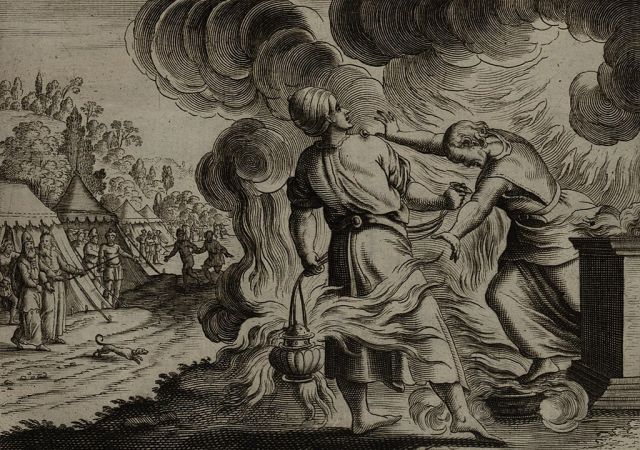
God’s presence was additionally mediated through sacrifice. The miraculous fire is paralleled by another miraculous sacrifice to come, the ultimate expression of the glory of God. As Jesus himself said, all the Scriptures bear witness to him (John 5:39).

Nadab and Abihu’s “unauthorized fire”

But this glorious moment is quickly interrupted by the rebellion of Nadab and Abihu. Much has been written about this “unauthorized fire” — a mysterious phrase that is certainly open to interpretation. Some translations reference the fire as “foreign” but this is inaccurate. There is nothing in the text to indicate that the fire was “foreign,” simply “unfitting” or “unprescribed.” So, this really isn’t the prooftext against PowerPoint, motion backgrounds, or any of your worship pastor’s other “innovations.”

Amazingly, Jeroboam I (the first king of the northern kingdom of Israel) would later name two of his sons Nadab and Abihu/Abiyah/Abijah (1 Kings 14:1; 15:25), a bad omen that Israel had not learned the lesson of Leviticus 10. Unfortunately, both men in the Bible with children named Nadab and Abihu (Aaron and Jeroboam) would go on to make golden calves to lead the people into idolatry (Exodus 32; 1 Kings 12:28). Thus, no baby Abihus in our churches today.

The same words to describe the miraculous consumption of the ordination sacrifice of 9:24 are also used to describe the death of Nadab and Abihu. Their fate is a grim reminder of the penalty for failing to observe the proper boundaries when standing before the Holy One.

Posted in Devotional, Faith, God, Hard Sayings, Scripture, Theology | Tagged , | Leave a comment

My Hall of Fame Ballot: 2018 Edition

I don’t have a Hall of Fame vote. I should, but that’s another story.

If I did have a Hall of Fame vote, here’s what my ballot would look like:

  1. Vladimir Guerrero. Let’s start with last year’s most egregious oversight: Guerrero is unquestionably a Hall of Famer. These old school BBWAA guys love to withhold the “first ballot” designation from certain players, but thankfully these lunatics are slowly going the way of the brontosaurus. Vlad simply checks all the boxes: 9 All Star Game selections; 8 Silver Slugger awards; and an MVP Award in 2004 to go along with all the counting stats — 2590 hits, 449HR, and a lifetime .318 average / .553 slugging. In his second-year on the ballot, Guerrero is a lock for induction.
  2. Chipper Jones. I will brook no argument here. Chipper is a Hall of Famer. If he’s missing on anyone’s ballot, I might have an aneurysm. His numbers are eerily similar to Vlad’s: 2726 lifetime hits, 468HR, .303/.529 BA/SLG to go along with 8 All Star Game selections and an MVP trophy. I suppose you could tip the scales by including Chipper’s batting title and 1995 World Series ring, but no matter how you slice it, Chipper is a deserving first ballot guy. (I wonder how those writers will parse Chipper’s “first ballot” induction alongside Vlad’s snub last year. I find it laughable that race / culture doesn’t have something to do with that. But I digress.) The offensive catalyst of those great Braves teams deserves the Cooperstown welcome he’ll surely receive this summer.
  3. Trevor Hoffman. Smart baseball fans have long known the save is an overrated statistic, an antiquated metric that mistakenly values the ninth inning as a singular location of leverage in any given ballgame. Sure, sometimes the final three outs are the most difficult…but not usually. Plenty of games are decided in the 7th or 8th with lesser pitchers on the mound while the “closer” sits in the ‘pen. So, I get the bias against closers. I mean, Lee Smith was one of the filthiest closers of all-time, amassing 478 career saves, yet he never garnered more than 50% of the BBWAA vote (75% needed for induction). That being said, Trevor Hoffman was a truly great specialist. If your going to hold to traditional closer usage, you want a guy like Hoffman, who converted 88% of his opportunities. And I’m compelled by the guy’s story, too: drafted as an infielder; converts to pitching; left unprotected in the 1992 expansion draft; injured his shoulder in a freak beach accident; developed a changeup that became his signature pitch; retired as the all-time saves leader. This is his third year on the ballot and after just missing out last year, I think he’s a lock this go around.
  4. Edgar Martinez. The bias against Martinez is similar to Hoffman — he’s regarded by some as a “specialist” for spending the majority of his career as a designated hitter. And by the purist’s standards, he only played “half the game.” I’m been sympathetic to that argument for a long time but I’ve changed my mind about that for a few reasons. To begin with, the same standard is never used to diminish the work of starting pitchers who spend the bulk of their careers in the American League. Pedro spent his peak years playing in Boston and I didn’t hear anybody accuse him of only playing “half the game” when debating his candidacy. The DH isn’t going anywhere, no matter how you feel about it. In addition, David Ortiz is going into the Hall in a few years, so it’s time we start recognizing the greatness of those whose primary position is in the batter’s box. Edgar has long been touted as a HoFer by his peers and now, in his ninth year on the ballot, he might finally have a legitimate chance at induction.
  5. Mike Mussina. This is getting silly. Mussina is a Hall of Famer. Wins Above Replacement (or WAR) is a sabermetric reduction of a player’s value to a single statistic, measured against a replacement-level player. Mussina’s lifetime WAR of 82.7 is higher than that of Bob Gibson, Tom Glavine, Don Sutton, John Smoltz and Jim Palmer. He spent his entire career in the American League East, winning 270 games with a 3.68 ERA.
  6. Fred McGriff. I say this every year, but McGriff’s greatness is lost on us because he played in the steroid era. But there’s not a whiff of controversy attached to his name. You can feel confident that those 493 home runs were legit. He has no chance at induction, but I’d still vote my conscience here.

Those are the guys who would be getting my vote. Of course, there’s no way that all six are going to be inducted. Realistically, Vlad, Chipper, and Hoffman are slam dunks. I think Edgar makes it this year for an induction class of four.

Obviously, there are a few notable omissions from my ballot.

Barry Bonds and Roger Clemens. It will be interesting to see how these two fare on the ballot this year. I suspect the trend that began last year will continue as more young writers seem willing to overlook the PED scandal associated with Clemens and Bonds. But I could never vote for them. I know they were two of the greatest players I’ve ever seen. But numbers matter more in baseball than in any other sport. And their numbers are forever tainted because they artificially prolonged their playing careers with performance enhancing drugs.

Jim Thome. Thome seems like one of those guys who belongs in the “Hall of Very Good” but not quite the Hall of Fame. I think he’s a good player who stuck around long enough to amass some impressive numbers, namely 612 home runs and 1699 RBI. And with no PED-suspicion hovering over him, he’ll likely be enshrined someday, possibly even on the first ballot. But he’s the only member of the 600 HR club to never win an MVP. He led the league in HRs exactly once (or half as many times as Fred McGriff). Again, I think he’ll get in. But I don’t think I’d vote for him just yet.

Posted in Baseball, Sports | Tagged , , | Leave a comment

Daily Bible: Leviticus 7-8

Lev. 7:2, They are to slaughter the guilt offering in the place where they slaughter the burnt offering, and its blood is to be splashed against all sides of the altar. (CJB)

Leviticus is just plain bloody. The blood of the guilt offering plays a dual role here. It is to be splashed against all sides of the altar, just as our guilt splashes across every part of our lives. The blood serves as a messy reminder of the omni-presence of our guilt. But there is a redemptive word here that is just as universal in scope. For there is no area of life his blood cannot cover, no place where our guilt is beyond the reach of his cleansing. The blood is splashed on all sides of the altar as a forerunner of the one whose blood flows freely in every direction.

The blood is a reminder of the totality of our guilt and the totality of his redemption.

Lev. 7:19-20, Meat which touches something unclean is not to be eaten but burned up completely. As for the meat, everyone who is clean may eat it; but a person in a state of uncleanness who eats any meat from the sacrifice of peace offerings made to ADONAI will be cut off from his people. (CJB)

Repeatedly throughout this part of Leviticus, the punishment for uncleanness is announced: and he shall be cut off from his people. As beings created in and for community, this is the most severe punishment. An Israelite could know no greater shame than to be cut off from his people because of uncleanness. But there is an inversion to this as well: being cut off from one’s people can easily lead to uncleanness.

In the biblical story, it’s telling that the evil one approaches Eve to tempt her only when she is isolated. The same holds true of the temptation narratives in the Gospels. The tempter confronts Jesus in the wilderness, with no one else around. And we know this to be true in our lives as well. The evil one does his best work when he can cut us off from our own people.

Lev. 8:30, Moshe took some of the anointing oil and some of the blood which was on the altar and sprinkled it on Aharon and his clothing, and on his sons with him and their clothing, and consecrated Aharon and his clothing together with his sons and their clothing. (CJB)

The ordination ceremony for Aaron and his sons helps us appreciate the special role of Jesus as the mediator of our sins. At 8:10-13, Moses anoints Aaron and his sons with oil, consecrating them and setting them apart for ministry. This, of course, is paralleled in the life of Jesus, who was anointed with the Holy Spirit at his baptism. Much like the priests of old, this anointing serves as a consecration, an act of being “set apart” for service to YHWH.

But Aaron and his sons were later anointed again at 8:30, this time with both oil and blood. This shadows what will take place on the cross, as Jesus receives a crown of thorns and a striped back, nails through his hands and a spear to his side. This anointing by blood affirms what the writer of Hebrews would later say about Jesus as our Great High Priest (Heb. 4:14).

Posted in Devotional, God, Jesus, Scripture, Theology | Tagged , , | Leave a comment

Daily Bible: Leviticus 5-6

Lev. 5:11, But if his means are insufficient even for two doves or two young pigeons, then he is to bring as his offering for the sin he committed two quarts of fine flour for a sin offering…(CJB)

By now it has become clear that YHWH is greatly interested in accessibility. The mitzvot makes provision for both rich and poor. For the wealthy, the burnt offering is required. For those who are less resourced, doves and pigeons will suffice. (Luke 2:24 indicates that Joseph and Mary were part of the poor class, as evidenced by the pauper’s sacrifice of turtledoves and pigeons.) But even this is beyond the means of some in the sacrificing community. And thus, a gracious provision: two quarts of fine flour.

YHWH is truly no respecter of persons. Provision is made for both rich and poor, universal provision revealing the universal nature of sin. It is truly endemic to us all.

Guilt builds up even through inadvertent, accidental sin. How many times does the child cry, “But I didn’t mean to?” when being scolded for misbehavior? Leviticus is a hard word about how quickly, even innocently, our guilt can accrue.

Lev. 5:21-24, “If someone sins and acts perversely against Adonai by dealing falsely with his neighbor in regard to a deposit or security entrusted to him, by stealing from him, by extorting him, or by dealing falsely in regard to a lost object he has found, or by swearing to a lie — if a person commits any of these sins, then, if he sinned and is guilty, he is to restore whatever it was he stole or obtained by extortion, or whatever was deposited with him, or the lost object which he found, or anything about which he has sworn falsely. He is to restore it in full plus an additional one-fifth…(CJB)

Reparations are an important part of reconciliation. I write this on MLK weekend in 2018 as racial tension in my country continue to escalate in alarming ways. We are repeatedly reminded that for all of the progress of the King and the Civil Rights Movement, fifty years later we continue to be a nation deeply divided along racial lines. And much of the rhetoric today is devoid of humility and understanding, replaced with a cacophony of tweets and counter-tweets and an avowed hostility to political correctness, as if gracious speech was the real threat.

Leviticus calls for an a generous commitment to reconciliation, a forerunner to the call for “ministers of reconciliation” in the New Testament (2 Cor. 5). Under Mosaic law, this required the restoration of that which was stolen or extorted, plus an additional 20%. And while I suspect my Christian friends will be quick to point out that this particular command is found in the Old Testament, can we not affirm the importance of this generous commitment to making things right as “the fulfillment of the law” (Gal. 5:14)? Against such things there is no law (Gal. 5:23).

Lev. 6:11, “Whatever touches those offerings will become holy.” (CJB)

Holiness is the intrinsic quality of God; He alone is sinless, perfect, transcendently other. But it is his prerogative to impart holiness, to imbue us with his immutable character. Our sin — no matter how great — cannot sully his reputation or mar his beauty. His holiness is the cleansing agent, eradicating our sin and making us new, whole, alive where we had only known decay. In this word about the offering yielding holiness, we find seeds of the Gospel, for in the self-sacrifice of Jesus, a path to holiness emerges for us.

Hebrews 10:10, And by that will, we have been made holy through the sacrifice of the body of Jesus Christ once for all.

Posted in 2 Corinthians 5, Culture, Faith, God, Gospel, Jesus, Poverty, Race, Scripture, Social Issues | Tagged , | Leave a comment

Daily Bible: Leviticus 3-4

As I said in the last post, there is gracious provision supplied by God at the beginning of the “holiness code” we find in the book of Leviticus. A Christian reading of these texts is usually filtered through Paul (or, perhaps more precisely, a particular way of reading Paul) and often leads to easy reductions, such as, “The old covenant was all about law while the new covenant is about grace.” Of course, nothing could be further from the truth. Not only is that kind of statement wildly off base — it completely overlooks the tremendous grace God repeatedly extends to Israel, while also overlooking the harder teachings of Jesus relative to discipleship — it is actually theologically harmful. Perhaps I’ll write more about that sometime.

For now, it’s enough to note the merciful provision supplied by God. Again, as I noted in the post about chapters 1-2, you get the idea here that God can work with almost any sacrifice. A variety of different offerings are found throughout Leviticus and these offerings are “for” a variety of different purposes. But taken as a whole, they undoubtedly point to a gracious law-giver, one who provides detailed instructions for these offerings because he (1) takes sin very seriously but also (2) because he wants us to understand the lengths to which he is willing to go to remove the stain of sin.

To that end, a careful reading of Leviticus 3-4 leaves us with a great awareness of the power of blood. Our minds will rush to the old hymn, “There’s Power in the Blood” and rightly so — the sacrificial system prescribed in Leviticus ultimately points beyond itself to the atoning death of Christ, the Passover Lamb (1 Cor. 5:7). But Leviticus also affirms the blood’s power to restore community. Sin — failure to image God — not only impairs one’s relationship with God, but it also damages our relationships with one another. It has been well documented that the Ten Commandments are ordered along the lines of commands regarding right relationship with God (#1-4) and commands regarding right relationship with others (#5-10), in keeping with the great teaching of Jesus about love for God and love for others (Matt. 22). We should not forget that the command to love your neighbor as yourself was first found in Leviticus.

Sin is regarded as such a threat in the Scriptures because it disrupts the shalom of God’s creation. God decrees his creation to be “good” as everything dwells in right relationship. But sin mars this good creation, perverting it, warping it into a sub-standard world far removed from God’s original intention. By the end of Genesis 3, creation has been subjugated by humanity’s rebellion and the balance of the Scriptures delineate God’s mission to reconcile his creation back to himself.

The shalom of creation is restored through atonement, one of the primary themes of Leviticus. Thus shalom is restored between God and man in the redemptive work of Christ. Sin and its penalty have been removed by the blood of Jesus, which cleanses us of all sin (1 John 1:7). But the power of the blood extends to also restore shalom between you and me. Leviticus points to this with the provision of peace/fellowship offerings as well as offerings for sin. And Jesus reinforces this by calling us to be a forgiving, reconciling people (Matt. 6:14-15; 2 Cor. 5).

God is concerned about both the horizontal and vertical dimensions of our lives. This theme is found in Leviticus and repeated throughout the Scriptures. The commands help us live in right relationship, not only with God, but also with one another.

Posted in 2 Corinthians 5, God, Gospel, Jesus, Leviticus 19, Love God, Love Others, Scripture, Sermon on the Mount, Theology | Tagged , | Leave a comment

Daily Bible: Leviticus 1-2

I’ve decided to start this year by reading the book of Leviticus. For the past couple of years I’ve referred to Leviticus as “the daily Bible reading killer” and it’s mostly true: many a New Year’s resolution has been foiled by the tedious commands of Leviticus. I guess that’s what drew me to open up my Bible last night and begin in the very place where my own good intentions have so often run aground.

Leviticus has often been referred to as a holiness code, protocol for maintaining relationship with God. These commands (mitzvot, in Hebrew) are given to help Israel fulfill the call to image God in the world. But even more specifically, Leviticus is anti-assimilationist literature. It is a call for God’s people to be a contrast people, a display people, a wholly uncommon people pledged to YHWH in fidelity and obedience.

So I thought I’d blog my way through as I read Leviticus to start 2018. Here are some random thoughts on Leviticus 1-2:

Lev. 1:1, ADONAI called to Moshe and spoke to him from the tent of meeting. (CJB – The Complete Jewish Bible)

This truth belongs right up front: this is a word from the Lord. No matter how tedious or insignificant these commands might seem to us — and they surely seemed at least somewhat bizarre to ancient Israel, too, I’m guessing — they are rightly understood as emanating from God.

And this is worth remembering as we read. To my way of thinking, the specificity here is proof that these commands were divinely given. We wouldn’t care about all this business about burnt offerings and grain offerings and do this with the blood and do this with the guts and so on. But God seems to care greatly!

Lev. 1:4, He is to lay his hand upon the head of the burnt offering, and it will be accepted on his behalf to make atonement for him. (CJB)

How odd, to find grace even here, in the sacrificial system that we frequently appropriate merely as a contrast to what we experience in the New Covenant! And yet, there it is, in plain sight. God graciously gives step-by-step instructions in order that his people might experience atonement — a male without defect to foreshadow the Son without sin. And as we read, God seems to make allowances for all kinds of sacrifices: bulls, goats, birds, grains, drinks. Maybe the point is that almost any sacrifice works for God. Just bring him what you have and he’ll make it work. This is grace.

Lev. 2:13, You are to season every grain offering of yours with salt – do not omit from your grain offering the salt of the covenant with your God, but offer salt with all your offerings. (CJB)

Why? What’s the point of this command? Why must the grain offering be seasoned with salt? According to scholars, later Jewish thinkers distinguished between mishpatim (rationally derived rules governing behavior) and khukim (those mitzvot that may seem arbitrary or even irrational). Mishpatim make sense to everyone, like murder as being considered morally reprehensible. But khukim, like wearing tefillin or abstaining from certain foods, require greater faith. So perhaps this is one of those khukim rules that simply requires greater faith.

But I think the answer might be simpler. At the beginning of Leviticus 2, instructions are given for bringing a grain offering before ADONAI. As the grain offering is presented, the priest takes a handful of flour and throws it upon the altar as a reminder portion. “But the rest of the grain offering will belong to Aharon (Aaron) and his sons; it is an especially holy part of the offerings for ADONAI made by fire,” (Lev. 2:3).

I think this command is for the benefit of the priests.

The salt is to be added to the grain offering because the offering is eventually given to the priests to eat. Salt makes the grain offering taste better, plain and simple. God’s intention seems to extend beyond simply receiving an offer to appease himself. No, he requires that salt be included in the offering as a way of extending blessing to the priesthood.

In this, we see further affirmation of a deep biblical truth: God is the Creator of pleasure and enjoyment. Some Christians seem to believe that enjoyment is the playground of Satan. And to be fair, the kingdom of hell profits greatly by peddling pleasure. But God not only created us with pleasure receptors, he also created a world filled with delight for us to experience. So he commands his people to throw a little extra salt in the grain offerings for the benefit of his priests.

In a taste test, 9 out of 10 priests prefer salted to unsalted grain offerings.

And I like to think that our obedience to God functions the same way. God gives some command, some khukim, and our knee jerk response might be, “Why? What’s the point?” But is it possible that God simply intends for my obedience to bless someone else, just like the ancient Israelites blessed the priests by seasoning their grain offerings with salt? Isn’t that possible, even likely?

Posted in Devotional, Faith, God, Imago Dei, Kingdom Values, Love God, Love Others, Obedience, Scripture | Tagged , , | Leave a comment

Newness of Life

We were buried therefore with him by baptism into death, in order that, just as Christ was raised from the dead by the glory of the Father, we too might walk in newness of life.

My friend’s father, a longtime educator, says he would often begin each new semester by holding up his gradebook to show the class that it was empty. Of course, this motivational tactic drew attention to the uncharted territory of the semester ahead, the empty gradebook representative of each student’s fresh start. In essence, my friend’s Dad was asking his students, “Where do you want to go this semester?” Whether you were an “A” student or a “D” student, the blank gradebook was both a new opportunity and gospel microcosm. The old was gone; the new had come.

Today we embark on a fresh journey into a new year. It is the season for resolutions and goals and people posting about their “word for 2018.” And buried within each of these is gospel hope, the hope of true transformation, expressed by Paul as “newness of life” in his letter to the Romans (Rom. 6:4). This is the universal human hope for saints and sinners, losers and winners. No matter our station, we all want one thing: new life.

That’s why this is one of my favorite times of the year. Are you grateful for a fresh start? Were you glad to see 2017 slip away? Did you embrace 2018 with open arms and a glad heart? Even if last year was a banner year for you, you’re likely inspired by the fresh opportunity the new year represents. Whether it’s an empty gradebook or a new calendar, this is the season for imagining the uncharted territory for the year ahead. Where do you want to go in 2018?

Let me make an appeal for including some spiritual intentionality as you plan for the year ahead. What is your spiritual direction for 2018? How can you maximize your Kingdom impact over these next twelve months? Is there one Word — a Christian virtue? an aspect of the fruit of the Spirit? — that you’d like to be written upon your soul this year? Perhaps these kinds of questions could lead us into the new life for which we all seem to be yearning.

Here are a few simple suggestions for walking in newness of spiritual life in the year ahead:

  • Choose a new translation for your daily Bible reading. Most of my Bible reading over the years has come from one of two translations: the NIV and the ESV. And you probably have a preferred version as well. But preferences can breed unhelpful familiarity, at least when it comes to hearing a fresh word from God. I have a friend who chooses to read the entire Bible each year, with an important twist: each year, he chooses a different translation. One year, he’s reading the New American Standard; the next, he reads the Good News Translation. According to him, this is an invaluable practice for spiritual growth. Rather than glazing over the more familiar passages in his “preferred” translation, reading from a different translation allows the text to “speak” to him in a new way each year. And I’ve found this to be true in my own devotional life as well. If you tend toward a word-for-word translation (like the NASB or the ESV), try a more idiomatic rendering like the NLT or a paraphrase translation like The Message. Conversely, if you prefer the more contemporary translations like the NCB or the CEV, you’ll probably discover new treasures in the “regal” tones of the King James Version or the New Revised Standard Version. This year, I’ll be reading from The Complete Jewish Bible during my devotional time, a translation I’ve grown to appreciate in the last year or so.
  • Mix up your Bible reading. Let me say this up front: if you’re fired up about your chronological daily Bible reading, just move on to the next bullet point. Because I don’t want to do anything to discourage you. But I also know that more people have read the book of Genesis in the month of January than any other time of year…and likewise, most of those same people abandon their daily Bible reading somewhere in February as they try to slog through Exodus and Leviticus. So if you’ve read this far, let me propose that you begin your 2018 Bible reading not with Genesis, but with one of the Gospels. There are four Gospels for a reason; I suggest reading one each season. After you finish reading through one of the Gospels, then go back and read an Old Testament text. Try reading Exodus and Hebrews simultaneously. Read Psalms 96-98 and Daniel before reading Revelation. Spend a month working your way through the wisdom literature of Proverbs, Ecclesiastes, Song of Songs, and James. The point is…mix it up a little.
  • Commit to regular prayer journaling. A friend of mine convinced me of the importance of journaling a few years ago and in retrospect, I wish I’d started sooner. For starters, it helps me remember to pray. I’m much more likely to pray about things once I write them in my Moleskine, particularly the things other people ask me to be praying about. But the act of putting pen to paper is also an important part of the benefit in journaling. In our culture of busyness, physically writing in a journal is impossibly impractical. It’d be so much easier to just open up a digital file and type away, but that’s part of the point. Writing in a prayer journal is my daily act of resistance, my way of saying no to a culture that always demands more movement, more frenetic activity. Writing — not typing — forces me to slow down, to be still, and to recognize the limitations of my own mortality. This is the gift of journaling.
  • Commune with God holistically, wholeheartedly. What I mean is…don’t limit your spiritual life to Bible reading and bow-your-head-and-close-your-eyes praying. Get up and go for a walk and look for God. One of my favorite authors, Eugene Peterson, says, “We need the ‘Emmaus walks’ where our eyes can become opened,” (Luke 24:31). We are more than rational beings, so our commitment to God must include much more than Bible study. And we are more than simply relational beings, so our commitment to God must include much more than reciting to Him our prayer requests. Make time to meet God in the movement of your days, not simply in the more quiet, reflective moments. As we used to sing, our God, He is alive. So get up and get moving and spend time walking with the living God (Rom. 6:4).

These are just a few suggestions for experiencing “newness of life” in 2018. May the next twelve months bring us closer to God and closer to one another.

Posted in Devotional, Discipleship, Faith, Friends, God, Gospel, Prayer, Quotes, Scripture, Spiritual Disciplines, Theology | 2 Comments

Best Songs 2017

This year, instead of a list, I give you a playlist.

Posted in Music | Tagged | Leave a comment