Matthew 8

Reading for Wednesday, June 20: Matthew 8

Jesus’ power is on full display here in ch8. After 3 chapters of teaching, Matthew peppers us with stories of miraculous healing. We’re introduced to the leper who asks, “Lord, if you are willing, you can make me clean.” We meet the centurion who comes to Jesus and simply asks for His healing word to be spoken. “You don’t even need to come to my home, Lord. Just say the word.” Jesus commends this man for his faith: “I tell you the truth, I have not found anyone in Israel with such great faith,” (v10). Jesus heals Peter’s mother-in-law along with a host of others, including the demon-possessed men at the end of the chapter. In all of this, Jesus’ power to speak new realities of healing is highlighted. In these miracles, the Kingdom of God has come near to the leper, the outcast, the Gentile, the demon-wracked.

Sandwiched in the middle are some hard sayings about discipleship. “Foxes have holes and birds of the air have nests, but the Son of Man has no place to lay his head.” Also: “Follow me and let the dead bury their own dead.” The disciples learn a difficult lesson on the water as a “furious storm” — in Greek, a seismos or “seismic event” — blows up. They cry out to Jesus, “Lord, save us! We’re going to drown!” But Jesus calms the storm and allays their fear. They ask themselves, “What kind of man is this?”

This is the question of discipleship. The more we journey with Jesus, the more familiar He becomes. And yet, the more we journey with Him, the more we’re amazed at His person, His character, His power. We come to see Him as the most important figure in our lives, the only one who can make sense of our broken stories, our fractured experiences. He brings wholeness, completion, calm. It’s true: following Jesus will surely lead us to some unexpected places, situations where we, too, may have nowhere to lay our heads. But when the seismos of Jesus takes hold of us, nothing can ever be the same.

We’ve come to expect it from Him.
Posted in Discipleship, Faith, Jesus, Kingdom Values, Project 3:45, Scripture | Tagged | 2 Comments

Matthew 7

Reading for Tuesday, June 19, 2012: Matthew 7

“Judge not, that you not be judged.” This is probably the most mis-quoted passage in the New Testament. It’s used as a polemic against any kind of judgmental language that one finds to be particularly offensive. “Don’t judge me,” could be the mantra of our age. To be branded judgmental is the cardinal sin in our culture. Yet, in the same breath, Jesus warns against giving that which is holy to “dogs” and not casting pearls out for the “swine” and “pigs”. Sounds pretty judgmental, eh?

What’s lost on us is the Biblical principle of discernment. It’s true, the Bible condemns judgmental attitudes that aren’t mitigated by a redemptive impulse. But the Bible also calls us to speak the truth, even when it hurts, always in love. The call here is not for zero ethical discernment. The New Testament is full of examples of individuals who unabashedly confront sin. The soft line of not judging others by simply leaving them in their sin is an easy out and it betrays authentic love. When the holy is profaned, followers of Jesus exercise discernment.

But Jesus does call us to exercise the same level of discernment and examination with regard to our own spiritual lives. “Why do you see the speck that is in your brother’s eye, but do not notice the log that is in your own eye?” If you’re going to take up the task of being the community watchdog, you’d better begin at home.

Jesus encourages the crowd to “ask, seek, knock” in prayer. These aren’t three different actions. All three are Jewish expressions for prayer. Jesus sees prayer as an integral component of the Kingdom life, as we discussed at length in our study of Luke. He grounds His teaching in the character of God: “If you then, who are evil, know how to give good gifts to your children, how much more will your Father who is in heaven give good things to those who ask him!” (v11). Confidence in prayer isn’t based on our verbiage or flowery language, as if God is somehow compelled by eloquence. Instead, our confidence comes from God’s character as the Loving Father, the One who knows what we need even before we ask.

As He closes His sermon, Jesus gives the crowd a flurry of choices: they must choose between two gates (v13-14), two types of prophets (v15ff), two kinds of disciples (v21ff), and two kinds of foundations (v24ff). As with all good sermons, the Sermon on the Mount concludes with a summons to action, a crisis of decision for the audience. As Jesus finished, the crowds are amazed “for he was teaching them as one who had authority, and not as their scribes,” (v29). This is no ordinary sermon and this is certainly no ordinary preacher.

Posted in Discipleship, Faith, God, Jesus, Project 3:45, Scripture, Sermon on the Mount | Tagged , | Leave a comment

Matthew 6

Reading for Monday, June 18: Matthew 6

Upon careful reading, you realize the assumptions Jesus makes in the Sermon on the Mount. “When you give to the needy,” (v2); “when you pray,” (v5); “when you fast,” (v16). Jesus assumes that His followers are a disciplined people, a people committed to generosity, prayer, and fasting. These disciplines help us to treasure the proper things in life. Rather than laying up treasure on earth, these practices show us the way to real life — a counter-cultural resolution to give away rather than hoard, to pray rather than plan, to fast rather than consume.

I just read an article that said North America, despite being home to less than 10% of the world’s population, accounts for one-third of the world populations’ body weight. Quite literally, we are consuming ourselves to death. I don’t claim to be an expert when it comes to fasting, but I’ve practiced it enough to appreciate the lessons we learn when we fast. We learn how food is interwoven into so many different parts of our day. We learn how privileged we are that we assume we should have access to meat 14 or even 21 times a week. We experience solidarity with our fellow citizens of the planet, many of whom live on less than $2 a day. Most importantly, we learn how faithful God is to supply our needs, even as we hunger physically. Fasting is, in my opinion, a severely under-utilized spiritual resource in our day and age.

Generosity functions in much the same way. Again, I’m still growing here, but recently I learned the liberating trust that comes through giving. I decided a few months ago to try and give away about 40% of my clothing. I was convicted that I didn’t need all the clothes I had in my closet and that these resources would be better used if they were deployed among the poor and the needy. Since I gave them away, I haven’t missed a single article of clothing. In fact, I can hardly even remember what they looked like in my closet. Again, I’m hardly a spiritual giant when it comes to this, but what I’m saying is this: Jesus is right! There is a treasure that is ours in giving, a treasure that runs deeper than silver and gold. God intends for us to experience the liberating renunciation of possessions that we might take up the Kingdom of God as our Ultimate Possession. Or, more precisely, that God’s Kingdom might possess us. This is the mystery of the Kingdom that Jesus alludes to in the Sermon on the Mount.

All of this is expressed so beautifully in the Lord’s Prayer. We pray for the coming Kingdom, that God’s reign would be manifest on earth just as surely as it is in heaven. We hasten the day of its arrival by trusting in God’s provision, seeking daily the bread (manna) that only He provides. And as we consume, partaking of the bounty of heaven, we also dispense forgiveness to those who are in need.

“For yours is the kingdom and the power and the glory, forever. Amen.”

Posted in Faith, Gospel, Jesus, Kingdom Values, Prayer, Project 3:45, Scripture, Sermon on the Mount, Social Issues, Spiritual Disciplines, Stewardship, Theology | Tagged | Leave a comment

Matthew 5

Reading for Friday, June 15: Matthew 5

Now we turn to the Sermon on the Mount, Jesus’ invitation into the Kingdom of God. In these powerful words, Jesus gives us insight into what a life of repentance looks like in light of God’s Kingdom presence (4:17). I hope you’ll find time to read over this sermon in depth over the next week…it really deserves so much more of a treatment than we can give it here in this limited space. (I’ve written extensively on this site about the Sermon on the Mount. If you’d like to read what I’ve written, click here and check out the Sermon on the Mount series I’m working on.)

Jesus begins with the Beatitudes and right off the bat, we have to clarify what’s going on here. In our individualistic society, we tend to compartmentalize readings like this; we think Jesus is addressing different people groups here, first the poor in spirit, then moving on to those who are mourning, then to the meek, etc. This kind of reading is dangerous because it’s an attempt to negate portions of the text that don’t really apply to me. “You know, I’m not a particularly peaceful person, so Jesus must be talking to somebody else here.” So we look for the one we can latch on to and that becomes “our” Beatitude. (We do the same thing with the fruit of the Spirit, talking about them as individual “fruits” rather than recognizing that they represent the collective work of God’s Spirit in the life of the believer.)

We also tend to do something else with the Beatitudes. We internalize them, claiming that Jesus is giving us a description of the “attitudes” that are befitting the Kingdom of God. But a “beatitude” has nothing to do with one’s “attitude” or “disposition” — it is a reorientation of one’s entire being, a recognition of one’s position of blessing even amid life’s difficulties. This is why Jesus is able to speak of the blessings of God toward those who mourn or those who are persecuted for the sake of righteousness. He has much more in mind than simply our “attitudes” — as if Jesus came to earth in order to make us “nice”. Hardly. He came to give us life.

I believe what Jesus is doing is addressing the progressive nature of the Kingdom. The Kingdom of God only comes to those who are first able to humble themselves, acknowledging their own fallibility. These “poor in spirit” certainly contrast with the perceived notions of spirituality in Jesus’ day, particularly our understanding of the Pharisees and their predilection for showmanship piety. The Kingdom is reserved for the poor in spirit, these who humbly receive what God mediates to them through Christ.

Therefore, the Sermon on the Mount is a transformative experience for those who would so humble themselves. The life of blessing is recognized in a variety of ways. God’s mission for His people is explained in metaphor: He wills that we should be salt (5:13) — distinct, counter-cultural — and light (5:14) — illuminating our dark world with God’s gracious promises. The Kingdom is found in obedience to God’s Word — “Do not think I have come to abolish the Law or the Prophets; I have not come to abolish them but to fulfill them, (5:17). The way of the Kingdom is to experience transformation in relationship: we relinquish our anger (5:21ff) and lust (5:27ff) in service to a higher calling. We understand marriage as an expression of God’s covenantal love, therefore a holy and sacred relationship (5:31ff). Our impulses to swear, take oaths, and retaliate are all governed by a new identity, an identity rooted in the eternal love of God. Everything gets turned on its head by these words of Jesus. Our lives are never the same. In short, we are transformed. And these words aim at no other outcome.

Posted in Faith, Gospel, Jesus, Kingdom Values, Project 3:45, Repentance, Scripture, Sermon on the Mount | Tagged , | Leave a comment

Matthew 4

Reading for Thursday, June 14: Matthew 4

In the desert, Jesus experiences temptation. The imagery is familiar: the wilderness provided the context for Israel’s great temptation with idolatry during the Exodus. But where Israel fails, Jesus will succeed, relying on God’s Torah for sustenance.

Satan’s temptation is better read “Since you are the Son of God…”. The evil one surely recognizes the identity of Jesus, just as the demons will. Instead, what’s at stake is WHAT KIND of Messiah Jesus will be: a welfare king, a slick wonder-worker, an imperial ruler? To each of these, Jesus replies in the way of faith. His Messiahship will be characterized by faithfulness to God in all circumstances. At the conclusion of this temptation, God’s ministering servants come to Jesus as a source of refreshing.

After this temptation, Jesus begins his public ministry in Galilee. Matthew reminds us of Isaiah’s words, interpreted anew in the ministry of Christ: “A people living in darkness have seen a great light.” Jesus preaches Good News and the powers of hell recede in His wake. At that time, Matthew says, Jesus unfurls the central tenet of his teaching: “Repent, for the kingdom of heaven is near,” (v17).

I think v17 is one of the most important passages in the NT. From this flows our understanding of Christ’s ministry. The miraculous signs that accompany Jesus are declarations that something is changing. The sick are healed, the demon-possessed are exorcised, the lame are restored. These represent God’s in-breaking Kingdom reign, foretastes of the glory to come. His teaching, especially the Sermon on the Mount, is best understood as a summons to repent as Jesus demonstrates the Way to True Life (John 14.6). This life of repentance is tangibly represented by his disciples, those who will leave fishing boats and tax collecting booths behind for the sake of this call. Matthew gives us these snapshots into the life of repentance, hoping that we, too, will respond in faith to the most challenging words in the Bible: “Come, follow me.”

Posted in Discipleship, God, Gospel, Jesus, Kingdom Values, Project 3:45, Repentance, Scripture | Tagged | Leave a comment

Matthew 3

Reading for Wednesday, June 13: Matthew 3

In Matthew 3, Matthew introduces us to the ministry of John the Baptist, who calls Israel to repentance in light of the Kingdom’s nearness. John emerges as a wild figure, with camel’s hair clothes and the smell of the desert in his hair. The call to repentance usually comes to us in similar fashion: unexpectedly, violently, disturbing our normal rhythms of malaise with a turbulent call to reorient our lives around God’s call. John’s message is an ethical one: “Get your lives right as a sign of God’s Kingdom rule!” Though he’s long since passed on to glory, John’s message still echoes on the desert wind. Will we repent? Or will we continue to go our own way, seeking to live life on our own terms?

Baptism is the expression of this inward repentance. The Pharisees and Sadducees of John’s day denied their need for repentance, treasuring their status as Abraham’s children. But John attacks this spiritual haughtiness: “I tell you that out of these stones God can raise up children for Abraham,” (v9). What God desires is humility and repentance. “I desire mercy, not sacrifice…” (Hosea 6:6).

Jesus presents Himself to John for baptism, which has always confused us. Surely Jesus doesn’t need to repent. Yet, He willfully chooses to identify with humanity. Jesus himself tells us that he does this to fulfill all righteousness. By identifying with humanity, Jesus will make the righteousness of God available to us. In this scene, all three members of the Trinitarian God are present — Father, Son, and Spirit — signifying the importance of the moment. The Father echoes the coronation song of Psalm 2: “This is my Son, whom I love; with him I am well pleased.” Jesus, now anointed for his ministry, will journey into the desert for his temptation.

Posted in God, Jesus, Kingdom Values, Project 3:45, Repentance, Scripture | Tagged , , | Leave a comment

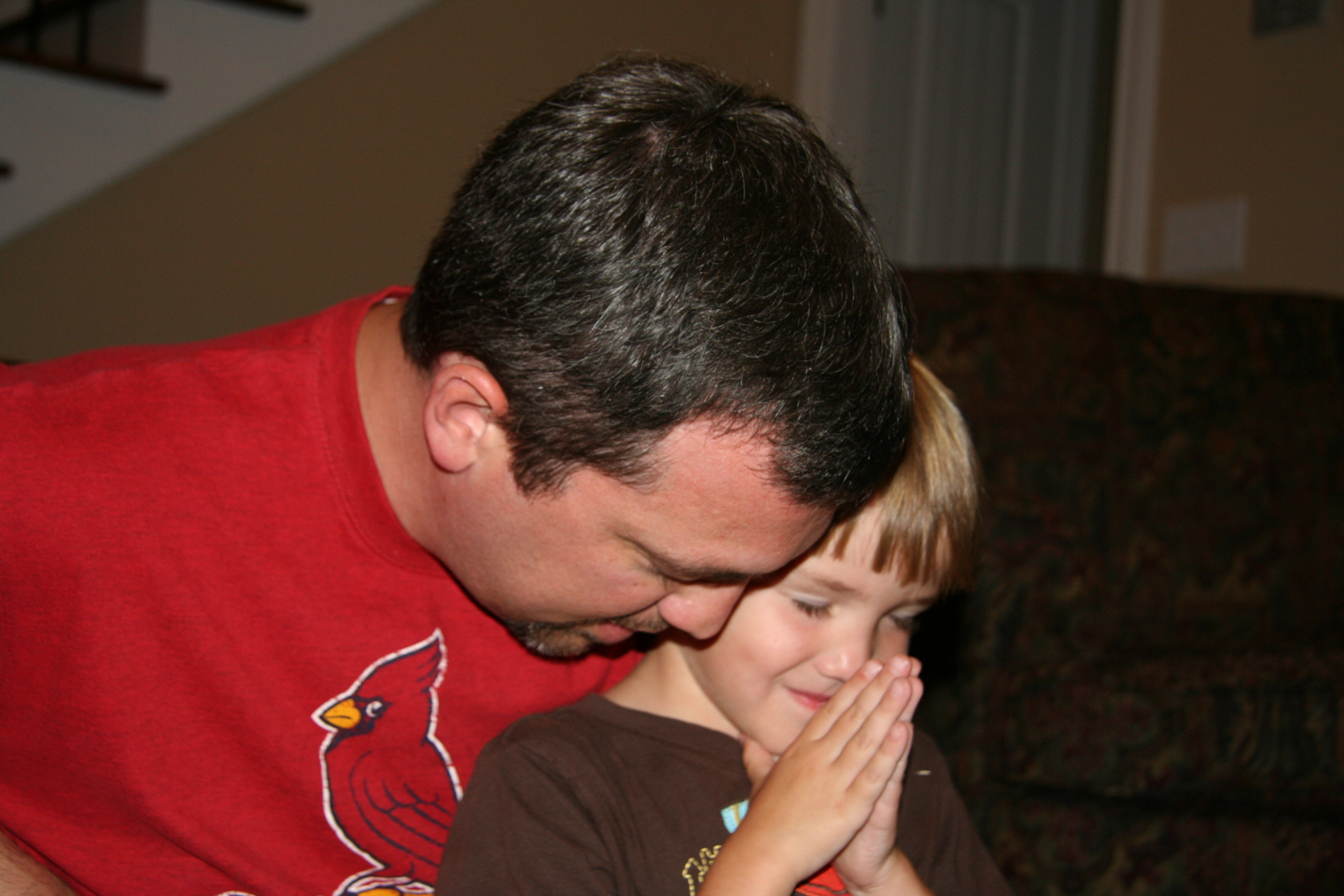
My New Favorite Picture

Jackson Cash says his prayers

Posted in Blessings, Family, Prayer | Leave a comment

Matthew 2

Reading for Tuesday, June 12: Matthew 2

In Matthew’s Gospel account, he frames the story in such way as to parallel Jesus’ early life with the story of Israel, particularly the Exodus story. Jesus’ birth draws the attention of Herod, leading to the massacre of male children; the same setting is found in the opening scene of Exodus. Jesus will go down to Egypt and return; the story of Exodus from Egypt focuses on a similar journey. Just as Israel was delivered as they passed through the waters, Jesus will identify with this experience as he receives his own baptism at the hand of John. Whereas Israel failed miserably in her desert trials, Jesus demonstrates faithfulness as he relies on God’s Word to fend off temptation. Finally, Moses ascends Mt. Sinai to receive the command of God, just as Jesus climbs the mountain to deliver his “Sermon on the Mount”, a reorientation of this Law, translated into the ethic of God’s Kingdom reign. “You have heard it said….but I say unto you…” — this is the language Jesus will use to speak this new Kingdom reality into existence. As such, Jesus is the fulfillment of Israel’s story, the culmination of God’s covenantal promises.

In Matthew’s birth narrative, there are no shepherds, no manger, no “Silent Night” imagery. Instead, the attention is focused on the courtroom of Herod. We look at this earthly king, yet we know the irony. The real king doesn’t reside here. The real king’s location is something of a mystery to these Magi, these wise men. It’s a subtle point, but it’s one worth making: the wisdom of these men rests not in their education or street-smarts, but in their desire for Jesus. This is the quest of wisdom, for Christ alone makes sense of our lives.

Posted in Faith, Jesus, Kingdom Values, Project 3:45, Scripture | Tagged | Leave a comment

Matthew 1

Reading for Monday, June 11: Matthew 1

Matthew’s Gospel begins with the birth of Jesus, preceded by a typical Ancient Near-Eastern genealogy. While we’re tempted to skip through this list of names, this would’ve been very important in Matthew’s time (or else he wouldn’t have included it in his writing). He identifies Jesus as “the son of David, the son of Abraham” (v1), locating Jesus within the stream of Jewish history. For Matthew, it is impossible to dissociate Jesus from his particular Jewish heritage. This is important for modern readers to remember. Jesus isn’t an American; he isn’t an Anglo-Saxon; he isn’t middle class, he doesn’t live in the suburbs, he doesn’t drive an SUV. He’s the Jewish Messiah. Matthew won’t let us lose sight of this important detail. Jesus has a legal claim to the throne of Messiah by right of his lineage from David. He has a promissory claim to the people of faith by right of his lineage from Abraham. This is the kind of Messiah Matthew writes about in his Gospel.

What is striking about the genealogy Matthew records is the inclusion of five women. This was not a common practice; genealogies were typically reserved for the names of the patriarchs, the prominent men in a person’s family line. But these inclusion of these women in the genealogy of Jesus indicate a deeply significant theological point rife with Gospel. We find Tamar (v3), the daughter-in-law of Judah who takes matters into her own hands in one of the most scandalous passages in the Old Testament (Genesis 38). We find Rahab (v5), the Canaanite prostitute. We find Ruth (v5), the faithful widow redeemed by Boaz. We find Bathsheeba, listed only as “the wife of Uriah” (v6), in yet another scandalous moment from Hebrew history. Finally, we see Mary, the virgin, the improbable mother of Jesus (v16). In the stories of these women, we find some of the best and worst of humanity. We see women who have been forgotten and mistreated, objectified by the men in their lives. We find women of questionable character, taking great risks to secure their position, even their very lives at times. And we find women of great faith, women who look beyond their circumstances to a God of covenantal loyalty and abiding promises. No, the inclusion of these women’s names in the genealogy of Jesus says something about the kind of Messiah that is to come in the story. Jesus enters into human history — a history fraught with messiness and desperation and frailty and sin. These are precisely the kinds of conditions Jesus enters into on our behalf. He enters into OUR stories to render the possibility of salvation for the world. It is only by acknowledging this checkered and messy past that Jesus could possibly be Immanuel, God with us, God for us in spite of our brokenness. This is the foundational identity of Jesus that Matthew portrays in the opening credits of his Gospel.

A word is in order with regard to Joseph, Jesus’ earthly father. The text says he was a “just man” (v19). The Hebrew word is “tzedakah”, meaning a righteous man, a man of integrity, committed to God as revealed in Torah. Joseph emerges as this kind of man, contrasting him with Judah and David and Solomon — men known for some of the more sordid episodes in the life of Israel. As a just man, Joseph seeks not to shame Mary, even though she has shamed him with what he believes to be an illegitimate pregnancy. This man of character and integrity is chosen as God’s steward for the life of his Son. As a father, I can’t imagine not being there for my children one day. It brings me great pain to think of someone else raising them in my stead. Yet, God carefully chooses Joseph, this “tzedakah”, as His proxy, a faithful steward over this most precious gift. Many often look to Mary and her significance in the life of Jesus. But we should also acknowledge the importance of Joseph as God’s righteous man, an embodiment of paternal love and mercy in the life of Jesus.

Posted in Faith, Family, God, Gospel, Jesus, Project 3:45, Scripture | Tagged | Leave a comment

God Has Been Gracious

5 years ago, I had no idea what God was about to do.

Sure, I knew we were about to go to the hospital and that we’d be welcoming our youngest child, a son, into the world. But I had no way of knowing at that time just how God was intending to bless our lives with little Jackson Cash Bybee.

Sunny and I really wrestled with what to name our little guy. At first, we weren’t going to find out the sex of our child. Since we’d already received a little boy and a little girl from Him, we thought we’d be “surprised” with what we were pretty sure would be our final pregnancy. Some complications along the way pressed that decision and when the time came, we couldn’t resist. When the doctor told us that we were going to have a son, we started going through all of the names that we’d always kicked around. For a while, we thought we had a name picked out: Jacob. And in the early months, that’s what we called him. But after a while, we changed our minds and started exploring some other options. We were drawn to the Gospels as source material — primarily because we’d received “good news” with regard to an in-utero health scare with the baby. My favorite Gospel is Luke — I love his emphasis on Jesus’ reception of the outsider. So for a while, we talked about “Baby Luke” as well. And though the thought of being able to speak the famous Darth Vader line with integrity was compelling — “Luke, I am your father!” — in the end, we decided that wasn’t the direction we want to go, either.

A few weeks before delivery, my grandfather passed away. William Bybee was one of my heroes in the faith and one of the supreme honors of my life was the opportunity to preach his funeral. (I recorded my eulogy in its entirety here.) Sunny and I gave serious consideration to naming our son after Grandaddy. But in the end, we decided to go a different route.

Jackson Cash Bybee

One of the meanings of the name Jackson is “God has been gracious”. And this is the best expression of what this little guy means to me. He is pure grace, a rambunctious ball of energy and motion and blond hair. His smile lights up the room. You see his heart in all its purity when he prays. He is fiercely stubborn, fiercely determined, fully my son through and through. It takes a self-differentiated individual to grow up as the younger sibling of twins: the other two always have inside jokes, always have shared experiences to draw on. But Jack goes his own way, always quick to play along when he wants, but completely comfortable in his own skin, too. And he’s mischievous, no mistake about it. He comes by that pretty naturally, too. But more than anything, he is God’s unmerited favor to us. And I can do nothing but love him for it.

Jackson’s middle name is Cash, on the surface an homage to Johnny Cash. There’s a family resonance with Cash’s music that’s difficult for me to explain to those who don’t know me well…especially those who never knew my father. Suffice it to say, Cash has been the Bybee family bard for as long as I can remember. Sometimes I wonder how Jack will feel about his name when he gets older. Will he like it? Will he think it’s weird? But when it comes to etymology, the word itself means “peace”. There was a sense of completion, of wholeness, that Jackson’s birth signified in our home. This, too, was only the work of God. And that is what the child’s name means, what it represents. Jackson Cash, God’s gracious gift of peace and wholeness.

Jack, you’re turning five years old in just a few moments. I am thankful to be God’s steward of your precious life. You bring me such joy and you make me so proud. I’m proud of you in all your uniqueness. I’m proud of your intellect, your compassion, your daring character and your sense of identity. But I’m most proud to call you my son. May you never forget how special you are. God has only just begun His work in you, my special gift of grace and goodness.

I love you.

Dad

June 5, 2012

Posted in Blessings, Family, God, Granddaddy, Kids | Leave a comment