Knowing Jesus: Immanuel

Some of the most painful times in our lives come about whenever we feel a strong sense of separation.

  • The grief we feel at the death of a loved one is the most extreme separation we experience.
  • But it’s more than that. We hurt whenever a friend takes a new job and moves to another city. We dread the thought of being separated by all those miles.
  • Even a good thing like sending your kids off to college brings some strong feelings of separation — for parent as well as child. That’s been the big adjustment in our family over the last six months.
  • And being estranged from your family members is a category all by itself. It’s really heartbreaking to hear the stories of parents, children, husbands, wives who for one reason or another are now alienated from one another.
  • You probably know what it feels like to experience at least a few of these separations.

But I don’t say any of this to make you feel sad. I simply bring this up as a point of contrast to the next name / title for Jesus that we’ve come to in our Knowing Jesus series. Today we will be looking at what it means when the Bible refers to Jesus as “Immanuel” — a name which means, “God with us.” And we’ll begin this morning by returning to a passage we looked at a few weeks ago: Matthew 1.

Matthew 1:18-23

Now the birth of Jesus Christ took place in this way. When his mother Mary had been betrothed to Joseph, before they came together she was found to be with child from the Holy Spirit. And her husband Joseph, being a just man and unwilling to put her to shame, resolved to divorce her quietly.

But as he considered these things, behold, an angel of the Lord appeared to him in a dream, saying, “Joseph, son of David, do not fear to take Mary as your wife, for that which is conceived in her is from the Holy Spirit. She will bear a son, and you shall call his name Jesus, for he will save his people from their sins.”

All this took place to fulfill what the Lord had spoken by the prophet: “Behold, the virgin shall conceive and bear a son, and they shall call his name Immanuel” (which means, God with us).

We looked at part of this passage a few weeks ago when we began this series. But in that first message, we were simply focusing on the name “Jesus” and its significance — which is explained here in this passage. But as you can see, Matthew also gives us another name by which we might know Jesus: He is Immanuel.

Matthew tells us that the birth of Jesus fulfills a prophecy from Isaiah — Isaiah 7:14. Approximately seven hundred years before the birth of Jesus, Isaiah predicts that a virgin will conceive and give birth to a son. And this child will be known as Immanuel — His arrival will be a sign that God is with His people. And Isaiah makes this prediction seven hundred years before it is fulfilled. Just for a point of reference, that would be kind of like Leonardo da Vinci’s great-grandfather predicting the winner of the Super Bowl tonight. It is only through the power of God that Isaiah is able to make this prophecy.

And Matthew says this prophecy is fulfilled in the virgin birth of Jesus. The big idea here is that His unique birth parallels His unique death. He’s born of a virgin — definitely a unique birth — and He will die on the cross for the sins of the world — certainly a unique death. This unique birth is a signal of what is to come. Everything about Jesus is unique.

In addition to all of this, His unique birth is a signal, a sign, that God is with His people.


The word “with” is a really small word but it is also a life-changing word. It simply means, “to be accompanied by another person.” And sometimes that knowledge can be enough to change your life — just knowing that someone is with you.

  • When you’re the new kid at school and someone invites you to join in with their group, to sit at their lunch table.
  • When you’re grieving and your best friend drives all through the night just to hold your hand and join in your pain.
  • When your friends and family gather around to celebrate a birthday or an anniversary and you know, “These are my people.”

These moments are powerful because someone chooses to be with you.

When my children were younger and they had to do something they didn’t want to do, they’d often ask, “Dad, will you go with me?” And even as we grow older, we continue to find comfort in being with our people in those key moments of our lives.

So it’s only natural that we would bring this same idea into our relationship with God. You can hear this in the way we pray: At the heart of so many of our prayers, we ask God to be with the people we love.

  • I think I’ve prayed the same prayer at every funeral I’ve done over the last 25 years: “God, please be with this family in their hour of grief.”
  • And I’ve prayed a version of this same prayer at every wedding ceremony, too: “God, please be with this couple and this new family that begins here today.”

Whether in grief or in joy, the most comforting thought we can imagine is God being with us.

And in Jesus, God says, “I’m right here…I’m with you.”


The most repeated promise in the Bible is God saying to His people, “I will be with you.” It’s as if we have this universal desire to know that we’re not alone — and God seems to have this overwhelming desire to let us know that He is always with His people:

When God spoke to Moses out of the midst of a burning bush, He called Moses to return to Egypt.

  • This was the place of Moses’s greatest moral failure, the place where he killed a man and fled as a fugitive. God says to Moses, “I want you to go back there. I have work for you to do.”
  • But Moses balks at this idea. He says, “Who am I that I should go to Pharaoh and bring the children of Israel out of Egypt? God, I’m a nobody. Worse than that, I’m a wanted man — I’m a murderer. If I go back to Egypt, I’ll never get out of there alive.”
  • Exodus 3:12, God says, “But I will be with you…” He says, essentially, “Don’t worry. I’m with you. I’ve got this. You just follow me and I will take care of the rest.
  • God’s presence — His with-ness, if we can invent a word here — is great enough to overcome our shame, our failures, our greatest mistakes. God says to Moses, “I’m with you and I’m going to help you do this.”

And God repeats this same promise to Moses’s successor, Joshua:

  • Years later, Joshua stood on the brink of the Promised Land. He’s about to enter a place he’s never been before; and he will be going up against new enemies and he will be facing new challenges. And he’ll be doing all of this without Moses, who had been leading these people for forty years. That’s a lot of change, a lot of transition — and Joshua was feeling what a lot of us feel whenever we go through times of transition: fear.
  • But God says to Joshua in Joshua 1:9, “Be strong and courageous. Do not be frightened, and do not be dismayed, for the Lord your God is with you wherever you go.”
  • God promises that He will give the Israelites every place where they set foot in the land of Israel. All Joshua needs to do is remember that God is with him. God’s presence will help Joshua navigate through this uncertainty.

And it goes on and on from there throughout the Bible. The people and places may change, but God’s promise is steadfast: He says over and over, I am with you.

And in Jesus, God is saying to us, “I am with you.”

  • Like Moses, so many of us are crippled by shame. We have mistakes in our past, things we’ve said and done that still haunt us. And those feelings of regret and shame weigh so heavily upon us, to the point that we say, like Moses, “I’m nothing. I’m worthless.”
    • But God’s response to all of that is to say, “Don’t worry. I am with you.” God offers the power of His presence as a counter to that narrative of negativity. God says, “I am with you” because He knows that His presence is transformative. Like we said, just knowing someone is with you can change your life.
  • And just like Joshua, many of us are facing challenges that seem overwhelming. We’re spread thin at work, we’re dealing with challenges in our personal lives. Like Joshua, we’re fighting our fears.
    • But that’s right where God shows up — in the story of Joshua, but also in our own lives. And He says, “I will be with you, wherever you go.”
  • God must love saying this, because He says it all the time in the Bible. And He says it once and for all in Jesus.

The picture of Jesus as God with us is a strong counter to some of the false understandings people have about God. Misunderstandings such as:

God doesn’t care about me. This is the idea that I’m insignificant in God’s eyes, that He overlooks me or ignores me.

  • Our world is home to over 8 billion people. So some people adopt this view of God as detached, far removed from our lives. They think, “How could He possibly care for me? I’m just one of 8 billion other people on the planet.”
  • But this comes from a skewed understanding of humility. If we think that God somehow loses sight of us because of all the other people in the world, our view of God is too small.
  • When He promises to be with us, He does so because He cares.

God is against me. This is the idea that God opposes me, that God is seeking to punish me.

  • It’s a picture of God as the cosmic enforcer. He’s just waiting for you to step out of line so He can zap you into oblivion, to nuke you for your mistakes.
  • This comes from a skewed view of God’s role as judge. Is God going to judge each one of us in the end? Yes, we will talk about that in a few weeks. There IS a day of judgment awaiting us.
  • But Jesus comes to be with us in order to save us from condemnation. 1 Thess. 1:10, … Jesus who delivers us from the wrath to come. When He promises to be with us, it’s because He wants to save us, not punish us.

God has forsaken me. This is the idea that God has abandoned me, that God is somehow not trustworthy.

  • This usually comes from a skewed view of our pain — our pain is all we can see, so we turn to God and blame Him for everything. This is usually because someone has hurt us — we put our trust in someone and they let us down. So we just assume that God is the same way. But God won’t do this to us.
  • Now, God will let you hurt sometimes. He’ll let you hurt but He will never harm you. God will let you hurt for a little while because sometimes He has a redemptive purpose for some of that pain. I mean, pain is a great catalyst for change — so there are times when God will let you hurt, at least for a moment. But here’s the thing: He will never harm you. You’re safe with Him. Prov. 29:25, those who trust in the Lord are safe. If He is with you, then He won’t let anything ultimately harm you.

Jesus as Immanuel is evidence of God’s faithfulness. All of His promises come to fruition. He is light; in Him, there is no darkness. The story of the Bible is the story of God’s faithfulness to us throughout the ages. And Jesus is the ultimate sign of that faithfulness.

All three of these views of God are proven to be false whenever we see Jesus as Immanuel, as evidence that God is indeed with us.


Do you know the first verse of the Bible? A lot of people can recite it from memory: Genesis 1:1, In the beginning, God created the heavens and the earth. This is a foundational statement that grounds everything that follows in the Scriptures.

But do you know the last verse of the Bible? That one probably doesn’t come to mind as quickly, does it? But the last verse of the Bible contains a foundational truth as well: Revelation 22:21 (NKJV), The grace of our Lord Jesus Christ be with you all. Amen.

  • The Bible begins with this epic scene: God speaks the heavens and the earth into existence. It’s this huge, wide-angle scene with the creation of the sun and the moon and life here on earth.
  • But the Bible closes with these simple words of hope: may the grace of Jesus be with His people. The entire Gospel is bound up in that one little word: “with.”
  • That word carries all of our hopes and dreams, our deepest desires — to be with God someday. And Jesus has come to be with us to give us what we need more than anything else: the grace that leads to eternal life.
  • It’s as if God wants to say this one more time before we close our Bibles: I am with you. If My Son is with you, then My grace is with you. God promises to be with those who put their trust in Him.

Are you in need of His grace today? Are you in need of His presence? Maybe you have everything you’ve ever wanted, and yet it still seems like something is missing. That’s because you were made for more than what this life can offer. You were made for eternal union with God — and your soul remains restless until it finds rest in Him. His grace is extended to any who would respond today in faith. Would you receive the Lord Jesus in baptism, confessing Him as both Lord and Savior today?

He is Immanuel, He is God with us. May His grace be with us all.

Invitation:

In the name of Jesus Christ, the Sovereign Lord who makes all things new, he who has ears let him hear.


Discussion Questions:

  1. Think back to a time when you experienced the pain of separation. Maybe it was the passing of a loved one or moving away from home for the first time. Why is separation so painful? It is universal; everyone experiences, no matter their age, culture, background, etc. What spiritual lesson can we learn from the fact that separation is a universal human experience? What do you think this says about God’s universal desire to restore?
  2. Today’s message emphasized the idea of Jesus as “Immanuel” which means “God with us.” Read Matthew 1:18-23. What stands out to you about this passage? What encouragement do you receive from the idea that God promises to be with His people?
  3. Spend some time talking about the practical implications of this. How does the idea of God being “with” us change the way we live?
  4. Read Exodus 3:1-12. When God asks Moses to go back to Egypt, how does Moses respond? Shame is a powerful force and it can paralyze us at times. How does God counter Moses’s shame in this passage?
  5. Read Joshua 1:1-9. Based on the fact that God tells Joshua three times to be strong and courageous, is it fair to assume that Joshua was NOT feeling especially strong or courageous in this moment? How does God’s promise to be with us give us greater strength? Greater courage?
  6. Jason noted that the idea of God being with us helps to counter three common misunderstandings about God: God doesn’t care about me; God is against me; and God has forsaken me. Can you think back to a time in your life when you held one of those misunderstandings about God? Which of those three has been the greatest challenge for you in your spiritual journey?
  7. Read Revelation 21:3 and Revelation 22:21. What comfort do you draw from the fact that the final words in the Bible are God’s promise to be with us?
  8. Close with some time in prayer together.
Posted in Devotional, Faith, God, Gospel, Jesus, Scripture, Theology | Tagged , , , , | Leave a comment

Knowing Jesus: The Sympathetic High Priest

In our Knowing Jesus series so far, we have heard some powerful testimonies from our brothers and sisters about how they’ve come to know Jesus. And over the last few weeks, we have considered several different aspects of Jesus’s identity:

  • We talked about how He is both Lord and Savior — you can’t have one without the other.
  • We took note of the passages where Jesus is called the Good Shepherd who lays down His life for us.
  • Last week, we looked at John 14:6, where Jesus declares, I am the way, the truth, and the life. The idea of Jesus as “the truth” really speaks to our minds and we looked at some of the philosophical differences between the Christian faith and other religious movements.
  • Today I want to focus on a picture of Jesus that speaks more to our hearts. It’s the picture of Jesus as the sympathetic high priest found in the book of Hebrews. The Bible tells us that Jesus sympathizes with us in our weaknesses and our temptations. What a comforting thought!

One way to think about the role of a priest is to compare it to the role of the prophet.

  • The prophet is God’s mouthpiece to the people. In biblical times, the prophet would hear a word from God and then share it with the people. “Thus sayeth the Lord…” that kind of thing. The prophet’s ministry would be facing the people, speaking on behalf of God.
  • But the priest works in the other direction. The priest represents the people before God. Priests would serve in the tabernacle or the temple and they would oversee the sacrifices before the Lord. The priest’s ministry would be facing God, mediating sin on behalf of the people.

You see Jesus fulfilling both of these roles in the Scriptures. And the writer of Hebrews really focuses on Jesus as our priest, “a great high priest.”

  • The role of the high priest was to enter into the Most Holy Place once a year on the Day of Atonement for the sins of the people.
  • That was the one time each year that God required the Israelites to participate in fasting. All the other festivals of Judaism were feasts. But the Day of Atonement was a day of fasting and weeping, a day for remembering your sin.
  • And even though the priest played a key role in this day of hard reflection, look at what Hebrews 5 says about the high priest:

Hebrews 5:1-3

Every high priest is selected from among men and is appointed to represent them in matters related to God, to offer gifts and sacrifices for sins. He is able to deal gently with those who are ignorant and are going astray, since he himself is subject to weakness. This is why he has to offer sacrifices for his own sins, as well as for the sins of the people.

I love what it says in v2: he deals gently with the people as he mediates on their behalf. A good high priest is aware of his own weakness, his own struggles. He has to make a sacrifice for his own sins before he can make a sacrifice for the sins of the people. But in all of this, he deals gently with people who are going astray, because he understands temptation. He knows what it’s like.

When you’re going through a difficult time, would you rather talk with someone who has been through a similar experience? Does it help you to talk with someone who knows what you’re going through? I think most people are this way. I’d sure rather hear from someone who knows what it’s like as opposed to someone who hasn’t ever been through this before.

The writer of Hebrews is saying that a good high priest understands how to mediate the sins of the people because he hasn’t forgotten his own sin, his own weakness. And the writer of Hebrews sees a picture of Jesus in this priestly role. Jesus certainly remembers what it’s like to face temptation.

But there is one big difference between Jesus and every other high priest: Jesus is without sin. Look with me at the previous chapter, Hebrews 4.

Hebrews 4:14-16

Therefore, since we have a great high priest who has gone through the heavens, Jesus the Son of God, let us hold firmly to the faith we profess. For we do not have a high priest who is unable to sympathize with our weaknesses, but we have one who has been tempted in every way, just as we are — yet was without sin. Let us then approach the throne of grace with confidence, so that we may receive mercy and find grace to help us in our time of need.

A good high priest deals gently with the people because he is aware of his own temptations. But what about Jesus? As it says here, Jesus is the perfect, sinless Son of God. And yet He still remembers what it’s like to be tempted.

  • Some might think, “Well, sure, a human high priest can deal gently with us because he remembers his own sin. But Jesus didn’t have sin, so does that mean He’ll be harsh in dealing with us?”
  • And the Hebrew writer addresses that with an emphatic, “No!” Jesus is sympathetic toward us. That’s a heart word. Yes, He is without sin, but He still sympathizes with our weaknesses. Something stirs in His heart when He sees our weaknesses.

Two school officials at Vanderbilt University were suspended last year after a controversial email came from their office. After the shooting at Michigan State University last February, two officials at Vanderbilt sent an all-campus email addressing the tragedy and emphasizing the importance of taking care of one another, demonstrating compassion and empathy to one another. But the email sparked outrage because some of the text was credited as having been written by ChatGPT, the popular AI writing tool. These words fell flat because they were supposed to convey legitimate, heartfelt sympathy — yet they were produced by artificial intelligence! One Vanderbilt student commented, “There is a sick and twisted irony to making a computer write your message about community and togetherness because you can’t be bothered to reflect on it yourself.”

Legitimate sympathy comes from a caring heart. And the Bible says that Jesus truly sympathizes with us in our weaknesses because He has been tempted in every way, just like us, yet He was without sin:

  • This is one of the most important teachings in the entire Bible. Hebrews 4:15 is a verse I wish you would underline and memorize.
  • It tells me that Jesus is victorious where I have failed. Sin has defeated each one of us, just as it has defeated every person who has ever lived — with the exception of Jesus. And when I come to Him in faith, I get to participate in His victory. Where I am weak, He is strong; His victory now covers my failures.
  • And this also means that He understands. When it says that Jesus sympathizes with us, that’s a “feeling” word. He’s not detached; there’s not this fabricated, ChatGPT “sympathy” when it comes to Jesus. It’s the real thing. This is what He feels in His heart for us.
  • And this is the basis of our confidence. Let us then approach the throne of grace with confidence — because we have this knowledge that Jesus understands, that He sympathizes.
  • When we do this, we find mercy and grace to help us in our time of need.

Closely related to this is the way Jesus is also referred to as the man of sorrows (Isa. 53:3). It’s telling that this is another one of the biblical titles for Jesus. This is another sign of His compassion for us. He can sympathize with us in our grief. He knows what it’s like to lose someone:

  • When Lazarus died, it says that Jesus wept with his sisters, Mary and Martha.
  • John 11:35, known as the shortest verse in the Bible. It may be the shortest verse but you won’t find one that runs deeper.
  • Jesus sympathizes with these women; He knows what it’s like to lose someone.
  • In those times when I’m feeling a lot of sorrow and grief, I’ll pray this prayer: Man of sorrows, weep with me. And it’s comforting to know that He’s the Man of Sorrows who will come and join me in my great pain. He weeps with those who weep because He sympathizes with us.

This is what it means when Jesus is referred to in the Scriptures as “the Great High Priest.”


Joseph Damien was a priest who was originally from Belgium. In 1873, he was sent to minister to a leper colony in Hawaii. He tried to befriend these lonely and ostracized people on the island of Molokai. But the people resisted his efforts. Sunday after Sunday, he preached to only a handful of people. And after working in this environment for a dozen years, he finally decided that it was time to head back home to Belgium. But as the story goes, while he was standing on the pier to board the ship that was supposed to take him home, he noticed some white spots on his hands. And he immediately knew what that meant: he had contracted leprosy.

Instead of boarding his ship, he went back to the leper colony. And that’s where he lived for the next five years until he finally passed away. But something changed for Joseph Damien. In his sermons, he stopped making references to “you lepers.” Instead, he started saying, “we lepers.” Any sense of detachment from the plight of the people was gone. He wasn’t preaching at the people anymore. He was preaching with them. Those with leprosy began to be drawn to Joseph Damien in a way that they hadn’t all those years prior. He was able to do more good in those final few years than in the previous twelve years combined. As one writer puts it, “He had taken on their leprous flesh and had become one with them.” And that made all the difference.


This is what Jesus has done for us. He took on flesh and blood — and in so doing, he took on our disease. Not a disease of the flesh, but the disease of sin. And He did this because He is a merciful and faithful high priest.

What’s truly amazing about the story of Jesus is that the One who mediates on our behalf before God is the same One who personally paid the price for our sins. The Great High Priest is also the Passover Lamb. He brings our sin before God and then sacrifices Himself on our behalf.

2 Corinthians 5:21

God made him who had no sin to be sin for us, so that in him we might become the righteousness of God.

Jesus was sinless, perfect. But according to the Scriptures, He became sin for us.

What sin did Jesus become for you?

  • Has He become your pride? We need to personalize this: “Jesus has become MY sinful PRIDE.”
  • Has He become your LUST? Your ANGER?
  • Someone here might say, “He has become my GOSSIP.”
  • Someone else could say, “Jesus has become my GREED.”
  • Another would say, “He has become my BROKEN PROMISES.”
  • For others it would be PORNOGRAPHY or DRUNKENNESS or BITTERNESS.
  • It might be RACISM or SEXISM or MATERIALISM.
  • When we look into our hearts, it doesn’t take long to find a host of sinful desires.
  • But the gospel declares that Jesus has become those sins FOR US — HE TAKES THEM FROM US BY BECOMING SIN ITSELF — SO THAT WE COULD BECOME THE RIGHTEOUSNESS OF GOD!

Jesus, our Great High Priest, has become those sins so that we might not be defined by them anymore. He has a higher purpose for us. He desires that we should become the very righteousness of God.

Are you far from God? Has your sin come between you and the Lord? Do you wonder how God feels about you?

Hear again the word of the Lord: Jesus, our Great High Priest, sympathizes with us in our weakness. Let us then approach the throne of grace with confidence, so that we may receive mercy and grace in our time of need.

Invitation:

In the name of Jesus Christ, the Sovereign Lord who makes all things new, he who has ears, let him hear.


Discussion Questions:

  1. Today’s message focuses on Jesus as the Great High Priest. Read Hebrews 4:14-16. What stands out to you about this passage? What is the most hopeful part of this passage to you?
  2. When you are going through a difficult time, do you prefer to talk with someone who has been there before? Someone who can relate to what you’re going through?
  3. Based on Hebrews 4:14-16, how can Jesus relate to our struggles when He is 100% sinless?
  4. Jason pointed out the differences between the prophet and the priest. The prophet is God’s mouthpiece to the people, whereas the priest represents the people before God. The prophet is concerned with truth; he often cries, “Thus sayeth the Lord!” The priest is concerned with grace; he seeks to mediate forgiveness for the people’s sins. Another way of saying this is that the prophet seeks to afflict the comfortable while the priest seeks to comfort the afflicted. How does this play out when you think of Jesus? Is He more “prophet” or “priest?” Or is Jesus a pure balance of the two?
  5. Read Hebrews 2:17-18. What does the word “merciful” mean? What does it mean when it says that Jesus is a “merciful and faithful high priest?”
  6. Some people don’t like the idea of “sympathy” because they think it means coddling or babying someone. Is this what it means when it says that Jesus is able to sympathize with us in our weaknesses? How would you explain this idea?
  7. What does it mean for us to approach the throne of grace with confidence (Heb. 4:16)? How can we do that? How do you balance this kind of confidence with a sense of reverence for God?
  8. Read Hebrews 5:1-3. If the high priest was able to deal gently with the sins of the people of Israel, what are the implications for the way Jesus deals with us? How would you define the word “gently?”
  9. Hebrews 2:14 says that Jesus shares in our humanity. What does this mean?
  10. Close with some prayer time, thanking God for His Son, the Great High Priest.
Posted in Culture, Faith, God, Gospel, Jesus, Kingdom Values, Love of Christ, Missiology, Scripture, Theology | Tagged , , , , | Leave a comment

Knowing Jesus: The Way, the Truth, and the Life

As we continue our Knowing Jesus series this morning, let me ask you to consider this statement: Christianity is an inclusive religion with an exclusive claim.

  • Christianity is inclusive in the sense that it is open to anyone who responds in faith.
    • No matter who you are or where you come from, anyone can come to know Jesus.
    • John 3:16 is the most beloved passage of Scripture for many believers and it speaks of God’s great concern for the entire world and all of her inhabitants: For God so loved the world
    • So in this sense, the Christian faith is inclusive — the Gospel is for everyone.
  • And yet our faith is predicated upon an exclusive claim: that Jesus is the way, the truth, and the life.
    • These words come directly from the lips of Jesus Himself.
    • We find this statement in John 14.

John 14:6

Jesus said to him, “I am the way, the truth, and the life. No one comes to the Father except through Me.”

Jesus spoke these words to His disciples at the Last Supper before His death. He says, In my Father’s house are many rooms. Thomas said, “Lord, we don’t know where you’re going? How can we know the way to the Father’s house?” And that’s when Jesus makes this statement: I am the way and the truth and the life.

Jesus tells His followers that He is the way of truth that leads to life.

  • He is the Way — the path linking us with God the Father. According to Acts 9, Acts 19, and Acts 24, the early church was referred to as “The Way.”
  • He is the Truth — Truth corresponds to reality. Ultimate truth is perfectly represented in Jesus.
  • He is the LifeHe is the true God and eternal life. (1 John 5:20)

And then Jesus says, No one comes to the Father except through Me.

  • There is no way but Jesus
  • No truth other than Jesus
  • No life outside of Jesus

Plenty of people today find this to be offensive. It’s popular in our day to claim that all paths are equal. We’re not accustomed to this kind of exclusive claim. The modern person prefers softer, gentler ideas that sound more open-minded and tolerant. Many people today believe that there’s more than one way to eternal life. Many believe that there are infinite paths leading to the same place. Just find what works for you — but don’t try to impose that on someone else, because what’s true for you might not be true for someone else. But it’s no big deal because all religious paths lead to the same place.

That may sound appealing but it’s a view that is impossible to reconcile with the words of Jesus. And the exclusive claim about Jesus is the consistent testimony throughout the New Testament.

1 Timothy 2:5-6

For there is one God and one Mediator between God and men, the man Christ Jesus, who gave Himself a ransom for all.

1 Corinthians 3:11

For no other foundation can anyone lay than that which is laid, which is Jesus Christ.

Acts 4:12

…for there is no other name under heaven given among men by which we must be saved.

Each of these statements flows out of this statement that Jesus made to His followers just before His crucifixion: I am the way and the truth and the life. No one comes to the Father except through Me.


I read an excellent book on apologetics last year. The author is Neil Shenvi, Why Believe?: A Reasoned Approach to Christianity. I want to share a few excerpts from this book that speak to this idea of Jesus as the way, the truth, and the life:

“My claim is that the gospel presents us with two truths all of us must face as human beings: that we are all moral failures and that we all need a Savior. Of all the major world religions, only Christianity insists that we are radically morally corrupt people who are consequently alienated from a perfectly good God. And only Christianity insists that what we primarily need is not moral improvement but rescue. If these claims about the human condition turn out to be true, then they are compelling evidence for the truth of Christianity, which is unique in its assessment of the human condition.”

“Christianity is either true or false. If it is true, then its truth explains its unique ability to diagnose [our] spiritual condition. But if it is false, then it is an incredible coincidence that Christianity uniquely explains two deep, existential realities entirely by accident. . . . Christianity affirms both that human beings are radically sinful and that we need a rescuer.”

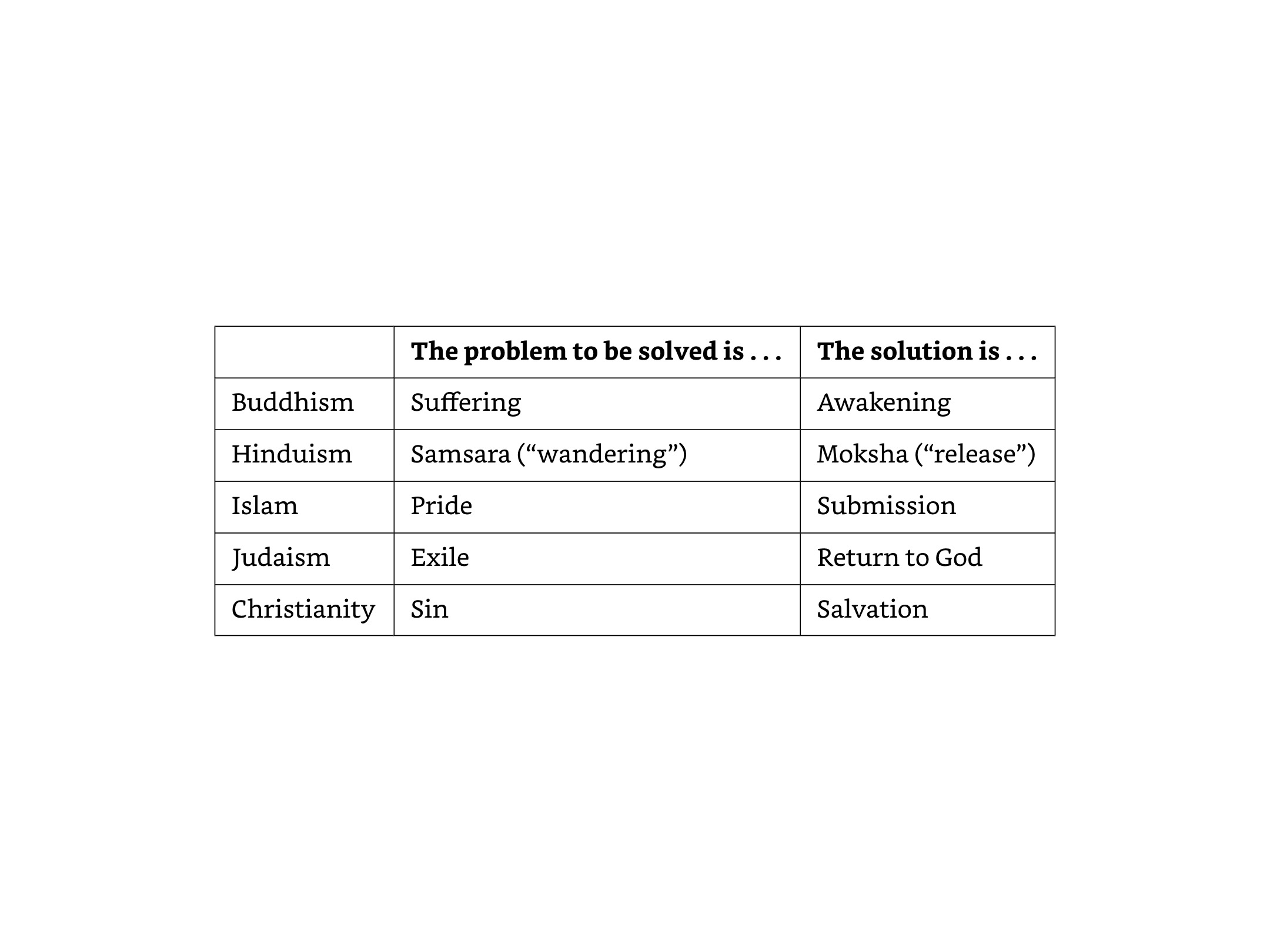
Shenvi uses a helpful chart to summarize the key problems and solutions offered by each of the world’s major religions.

It’s nonsense to claim that each of these paths lead to the same place because each religion holds a distinct worldview with different problems to be solved. These first two — Buddhism and Hiduism — are not even monotheistic religions, meaning they deny the presence of One Creator God. They are polytheistic, teaching that there are instead many gods.

According to Buddhism, the central problem of human existence is not sin but suffering. One of the core teachings of the Buddha is known as “The Four Noble Truths,” which states:

  1. To live is to suffer.
  2. Suffering is caused by attachment.
  3. To eliminate suffering one must eliminate attachment.
  4. One can eliminate attachment by following the eight-fold path.

Buddhism avoids the idea that we are radically sinful and alienated from God and therefore in need of a Savior. In fact, some strands of Buddhism are nontheistic (claiming there is no God at all). Buddhism is essentially a religion of self-help, which might explain it’s growing popularity in the world today. It’s about self effort, trying harder, and learning to do without. With enough striving, a Buddhist could achieve nirvana on her own, without the need of a savior.

In Hinduism, the fundamental problem that must be overcome is this ongoing cycle of reincarnation, called samsara. Bad actions in the present results in bad karma, which then leads to suffering in your next reincarnation. Of course, good actions lead to a better reincarnation. The final goal here is called moshka, breaking free from this cycle, although different strands of Hinduism disagree on what happens when you achieve this state. But it’s something along the lines of achieving transcendence by starving your ego. Hinduism is an extremely works based religion: do good, move up the chain in your next life; do bad, move down the chain. But there is no sense of forgiveness for your sins or failings — only the flat payout for what you’ve done.

Islam is closer to Christianity than Buddhism or Hinduism in that it is a monotheistic religion. It is based on the idea that there is one God who is the Creator of the universe. Islam also recognizes that to sin against this God is to provoke His wrath and makes us liable to judgment. But one of the major differences between Christianity and Islam is the understanding of sin. According to Islam, sin isn’t really the problem; it’s self-sufficiency. And the solution offered in Islam is to simply return to God’s path. You don’t need to be saved from your sins, you just need to make better choices. If only it were that easy. Christianity teaches that we cannot put ourselves back on the path because we bear guilt. We need redemption, atonement, someone to intercede on our behalf — all of which is missing from the teachings of Islam. According to Dr. Stephen Prothero, a professor of religion at Boston University, “Sin is not the problem Islam addresses. Neither is there any need for salvation from sin.” Instead of redemption, Islam teaches that submission and discipline are what we need most. This is the way to overcome the problem of self-sufficiency. But if the problem is the self, how can the self also be the solution? That’s one of the philosophical shortcomings of Islam.

Comparing Judaism to Christianity is complicated by the fact that Judaism is both a religion and an ethnicity. Someone could identify as ethnically Jewish and hold very few Jewish religious beliefs. Because of this, Shenvi focuses on rabbinic Judaism for his analysis. He notes that the Jewish emphasis is not so much on the problem of sin but the problem of exile. In the Jewish Scriptures, the people are exiled over and over: from the Garden of Eden in the beginning; from the land of Canaan while they’re held as captives in Egypt and later Assyria and Babylon. And although there are plenty of OT passages that speak of God’s forgiving nature, the rabbis have historically argued that obedience is the key to returning back to God, our true home. While that sounds good, it boils down to following the law — something we are incapable of doing, according to the New Testament, because of the presence of sin.

This is just a brief overview and there’s so much more that could be said as we try to compare the ways these religions differ. But even this brief summary shows how foolish it is to say that all religions are the same, they all lead to the same place, etc. And the Christian scriptures tell a much different story.

  • Faith centered around Jesus is about salvation from our sins.
  • Each of these major religions agree that there is a problem to be solved. But Christianity is unique in that the solution it offers is not self-help, not trying harder. The solution is God’s free gift of grace — the atonement for sin in the death of Jesus.
  • We need help from outside of ourselves in order to be saved.
    • Salvation is found by trying harder — most of you have tried as hard as you can.
    • And salvation isn’t found by looking into your heart — not a heart that’s been changed by sin.
    • No, the solution to our problem can’t come from within ourselves. It must come from beyond.
  • And the Good News — the Christian gospel — is that Jesus is God’s response to our sin.

It all comes back to Christ crucified and resurrected, as Paul notes in 1 Corinthians 15. Paul says “This is the Gospel, the Gospel that I received (meaning it came from beyond, came from Jesus) and have passed on to you.” He says these are matters of first importance:

1 Corinthians 15:1-5

Now I would remind you, brothers, of the gospel I preached to you, which you received, in which you stand, and by which you are being saved, if you hold fast to the word I preached to you — unless you believed in vain.

For I delivered to you as of first importance what I also received: that Christ died for our sins in accordance with the Scriptures, that he was buried, that he was raised on the third day in accordance with the Scriptures, and that he appeared to Cephas, then to the twelve.

So Christianity is an inclusive religion built upon an exclusive claim that Jesus is the Way, the Truth, and the Life. And no one comes to the Father except through Him. Jesus is willing to risk offending us to tell us this truth — because to love someone is to tell them the truth. Truth-telling is an act of love — at least it is for Jesus, the One who is the living embodiment of truth. Paul is right when he says these are matters of first importance.

Nothing is more important than knowing Jesus.

Do you know Jesus?

Do you know Him as the Way to the Father’s house?

Do you know Him as the Truth upon which all reality hinges?

Do you know Him as the Life, everlasting, eternal life?

Invitation:

In the name of Jesus Christ, the Sovereign Lord who makes all things new, he who has ears let him hear.


Discussion Questions:

  1. Jason began today’s sermon by saying, “Christianity is an inclusive religion with an exclusive claim.” What does this mean? How is Christianity inclusive? And what is the exclusive claim at the heart of the Christian faith?
  2. Read John 14:1-6. Based on what Jesus says in v1, what is the key to an untroubled heart?
  3. Just prior to His arrest and crucifixion, Jesus spends time talking with His disciples about His Father’s house (John 14:2-4). In your opinion, why does Jesus do this? What comfort do you take from this particular teaching?
  4. In John 14:6, Jesus says, “I am the way, the truth, and the life. No one comes to the Father except through Me.” What does Jesus mean by this? How is Jesus “the way?” What does it mean to say that Jesus is “the truth?” In what way is Jesus “the life?” And how are these three ideas connected?
  5. How do you think most non-believers today hear these kinds of exclusive claims? Are they indifferent or would the non-Christians you know perhaps be offended by these words? What would you say to someone who was bothered by these words from Jesus?
  6. Jason spent a few minutes comparing the Christian faith to the other major religions. (See the attached chart.) In your opinion, what sets Christianity apart from these other religions? What makes the Christian faith unique?
  7. Read 1 Timothy 2:5-6. What does it mean for Jesus to be a mediator?
  8. In the sermon, Jason said that to love someone is to tell them the truth. Do you agree or disagree? Is it a loving thing to do to tell someone the truth?
  9. Close by praying together, specifically thanking God for Jesus, the One who is the way of truth that leads to life.
Posted in Culture, Faith, God, Gospel, Jesus, Missiology, Philosophy, Scripture, Theology | Tagged , , , , | Leave a comment

A Winter Hike

Took a hike today at Monte Sano with my favorite adventurer.

Posted in Blessings, Exercise, Family, Huntsville, Kids | Leave a comment

Knowing Jesus: The Good Shepherd

In 2021, a sheep named Baarack was found wandering alone in the wilderness of Australia with more than 75 pounds of fleece weighing it down. A property maintenance worker spotted Baarack in the forest that adjoined the property where he was working. He contacted an animal rescue crew and they were able to take care of the animal.

They determined that Baarack once had an owner because it looked as if he had an ear-tag that had been torn out by the thick matted fleece near his face. Sheep need to be sheared at least once a year to keep their coats light enough — but clearly Baarack hadn’t been given a haircut in several years.

After they rescued him, they quickly gave him a shearing and his fleece weighed in at a whopping 78 pounds. The wool around his face had severely impaired his vision and he was also dangerously underweight — probably due to the fact that all of the extra weight limited his mobility. Evidently, the extra weight and the vision problems meant that Baarack was only able to eke out an existence eating small shoots of grass.

Thankfully, the story has a happy ending. After receiving the care he needed, Baarack made a full recovery.


Baarack’s story illustrates something that is true for ALL sheep: sheep need a shepherd — they need someone to care for them.

  • I think back to the things Jim Flowers shared with us in his communion comments a few months ago. Last year, Jim and Kerrie became the owners of three English baby doll ewe lambs named Wynonna, Shania, and Dolly.
  • As Jim mentioned they had to build a fence for the sheep to keep them safe; they built a sheep palace for the sheep so they would have a place to sleep. Jim and Kerrie know this better than most people: sheep need a shepherd.
  • Sheep like to graze, so they need access to plenty of grass to eat. An adult sheep will drink a gallon or two of water each day. They need to be sheared at least once a year, sometimes more often. They also need to have their hooves trimmed regularly.

Sheep are a lot of work. They need someone to care for them.

  • Baarack needed a shepherd to keep him from wandering off into the wilderness.
  • When he was found, he needed someone to care for him, to nurture him and to shear off that fleece. He couldn’t do that for himself — the sheep needed outside help.

Sheep need a shepherd.

We are in the midst of a study right now called Knowing Jesus. We are taking a look at the different names and titles that are used to describe Jesus in the Bible.

  • We’ve talked about the name “Jesus” and the fact that it means “God saves.” His name itself is a signal that Jesus is our Savior. He came to rescue us from our sins.
  • Last week, we talked about the title “Lord.” You can’t have Jesus as your Savior without also making Him the Lord of your life. Yes, He came to rescue, but He also came to rule.
  • And now today, we look at another of these titles, one that Jesus uses Himself. Sheep need a shepherd; that’s why it’s so important when Jesus says, I am the GOOD shepherd.

You find this statement over in John 10.

John 10:11

I am the good shepherd. The good shepherd lays down his life for the sheep.

  • The Bible often refers to us as sheep:
    • Psalm 100:3, Know that the Lord, He is God! It is he who made us, and we are his; we are his people, and the sheep of his pasture.
    • Psalm 119:176, I have gone astray like a lost sheep…
  • Today if you say that a group of people are like sheep, it’s usually meant as an insult. But that’s not what’s going on here. God doesn’t include these verses in the Bible to insult us.
  • Ancient readers of these verses understood that sheep need a shepherd. And if the Bible repeatedly refers to us as “sheep,” then the implicit point is that we, too, need a shepherd.
    • We need someone who will care for us, someone who will watch over us and protect us.
    • We need someone to ease the heavy burden we are carrying — the “fleece” of our sin and our shame and our guilt. Just as Baarack could not shear himself to get rid of this heavy burden, neither can we remove the weight of our sin — not on our own. We need someone else to come along and help with this problem. 
    • That’s why it’s really good news for Jesus to say, “I am the good shepherd.”

One of the most enduring stories Jesus ever told was about a son who was “lost” — a son who had wandered away from the care and protection of his home. And just before telling that story, Jesus talked about a sheep that had also gone astray. I think the connection between those two stories is obvious.

The Bible makes it clear that Jesus wants to be the shepherd of our souls.


There are three points I want to make about Jesus as the Good Shepherd.

  1. The Good Shepherd has compassion for lost sheep.

Matthew 9:36

When he saw the crowds, he had compassion on them, because they were harassed and helpless, like sheep without a shepherd.

Jesus looks out on the crowd and He sees lost sheep. The Jewish people at that time were being led astray by their leaders. The Pharisees were supposed to be shepherds over the people, teaching them God’s Word and helping them to know God in a deep and meaningful way. But these religious leaders neglected their responsibilities. This was anticipated back in the day of Ezekiel. In Ezekiel 34, God says that when those who are called to shepherd the flock neglect their duties, God says I myself will be the shepherd of my sheep (Ezekiel 34:15).

So Jesus looks out on the crowd and he sees an entire flock of Baaracks. He sees men and women who have been burdened by the man-made traditions and “laws” of the Pharisees. These people are lost — so far from God because their leaders have been derelict in their duties.

The people were harassed and helpless — other translations use words like “confused” and “bewildered.” In their confusion, they have wandered away from the fold, wandered away from God. For some, this might have been a willful decision on their part. For others, it might have been more like a slow drift. Either way, these people are lost.

And Jesus’s response is to have compassion for them. Something stirs within His heart when He sees these lost sheep. He is the Good Shepherd because He wants something better for His sheep.

The parable of the lost son (prodigal son) shows us that even when we go astray, God sees us the same way. He sees us as lost sheep — and He has compassion for us. This seems to be His natural response to us whenever we are lost. He longs for us to repent and turn back to Him. He wants His lost sheep to come home where they will be safe once again.

Simon Peter talks about this in 1 Peter 2:25, For you were straying like sheep, but have now returned to the Shepherd and Overseer of your souls.

If anyone knows about sheep going astray, it’s Simon Peter. That’s his story. But he also knows about returning, being restored, looking to Jesus as the Shepherd of our souls. The Good Shepherd has compassion on His lost sheep.

Some of you who are here today — or some of you who might be listening to this message — you’re like Baarack. You’re carrying around such a heavy burden. You carry the guilt of your mistakes, the shame of your sin. You willfully left the fold and you’re wondering how God feels about you.

  • If you can relate to that, I hope you hear the Word of God today: the Good Shepherd has compassion for all of His lost sheep.
  • In fact, that compassion is what drives Him to do what He does.
  1. The Good Shepherd lays down His life for the sheep.

Jesus explains what it means for Him to be the “good” shepherd. It means that He lays down His life for the sheep. His compassion is what drove Him to His crucifixion.

John 10:11-12

I am the good shepherd. The good shepherd lays down his life for the sheep. He who is a hired hand and not a shepherd, who does not own the sheep, sees the wolf coming and leaves the sheep and flees, and the wolf snatches them and scatters them.

The good shepherd is aware that there is a wolf — an enemy — who wants to destroy and scatter His sheep. Jesus says a hired hand just views shepherding as a job. It’s a way to make a living. But the good shepherd is personally concerned with the welfare of the sheep — so much so that He lays down His life for them.

In this same teaching, Jesus talks about being the door or the gate for the sheep.

  • Ancient sheep pens looked like this. Not exactly a sheep palace, but it’s enough to keep them corralled.
  • In this sheep pen, there was a gap for them to get in and out.
  • The shepherd would literally put his own body in the gap. Nothing gets in, nothing gets out.
  • Literally, “over my dead body.”

That’s what makes Jesus the GOOD shepherd. No other shepherd can do this for us. We have an enemy who wants to steal, who wants to kill and destroy; Jesus mentions him in this same teaching (John 10:10). But Jesus lays down His own life to keep the enemy from harming us. He literally puts His body between the sheep and the enemy — that’s a good way for us to think about the cross.

Because Jesus is the GOOD shepherd.

  1. The Good Shepherd gives us everything we need.

I want to close today by looking at Psalm 23. It is one of the most beloved passages in God’s Word. I’ve read this passage at every funeral I’ve ever preached. But make no mistake: this is a passage for the living. It tells us that when we make the Lord our shepherd, He gives us everything we need.

Psalm 23:1-6

The Lord is my shepherd; I shall not want. He makes me lie down in green pastures.

He leads me beside still waters.

He restores my soul.

He leads me in paths of righteousness for his name’s sake.

Even though I walk through the valley of the shadow of death, I will fear no evil.

For you are with me, your rod and your staff, they comfort me.

You prepare a table before me in the presence of my enemies;

you anoint my head with oil; my cup overflows.

Surely goodness and mercy shall follow me all the days of my life,

and I will dwell in the house of the Lord forever.

This is a picture of total provision. As my shepherd, the Lord supplies my every need.

When the Lord is my shepherd…

  1. I shall not want. I won’t lack for anything — not really. I’ll have everything I need because of His provision. This is what the “green pastures” are all about. For a sheep like Baarak, green pastures would be a sign of abundance. What else do we need besides the things God has provided? 2 Peter 1:3, His divine power has granted to us all things that pertain to life and godliness through our knowledge of Jesus, the Good Shepherd.
  2. I experience peace. We can draw this from the picture of “still waters” in v2 — not choppy, not turbulent. There’s a peace and calm that comes from submitting your life to God. I can rest when I know that Jesus is the One “standing in the gap.” He is the door to the sheep pen. He protects me from the enemy.
  3. He restores my soul. This is the promise of eternal life for your soul on the other side. Our souls will be restored in a land where there is no more sin.
  4. He leads me. When the Lord is my shepherd, He leads me in paths of righteousness. I don’t have to be in charge all the time — which is exhausting, honestly. It’s exhausting to always ben in charge — because we weren’t made for that. Instead, you can follow the voice of the good shepherd, let him direct you where you need to go.
  5. I need not fear any evil — because He is with me. Even when you walk through the darkest valley, He promises to guide you. He won’t abandon you or forsake you. If the Lord is your shepherd, you never have to be alone — even in death. What a comforting thought!
  6. I am comforted — His rod and staff bring us comfort. These are signs of His presence and His protection. The rod was used to fend off the wild beasts and the staff was used to guide the sheep. These are comforting images. He is the God of all comfort as it says in the Bible.
  7. A table is prepared for me — The Jewish idea of heaven was a great banquet feast, an eternal Thanksgiving meal. They pictured this huge table full of food and there was laughter and rejoicing and God Himself would preside over it. And He has a place waiting for me.
  8. My cup overflows — He gives me the abundant life in Jesus. He is not stingy in doling out His blessings. When the Lord is my shepherd, I receive every spiritual blessing in the heavenly realms (Eph. 1:3).
  9. Goodness and mercy follow me all the days of my life. While we are here on earth, we feel his goodness and mercy — and we have a responsibility to share that with others.
  10. And I will dwell in the house of the Lord forever — this is the promise of an eternal home with Him. In His house. Sheep need shelter. And Jesus says that the Father’s house has many rooms. Room for you, room for me.

Would you make the Lord your shepherd?

If you have already confessed Jesus as the Good Shepherd, I hope this message is a reminder of the benefits that come from this decision.

If you haven’t made the Lord your shepherd, I wish you would.

Invitation:

In the name of Jesus Christ, the Sovereign Lord who makes all things new, he who has ears let him hear.


Discussion Questions:

  1. Today’s message focuses on Jesus as “the Good Shepherd.” Sheep need the care of a shepherd, someone who can tend to their needs. In your opinion, what qualities make for a good shepherd?
  2. Read John 10:1-15. What stands out to you about this passage? What is the primary point Jesus is making here?
  3. In verse 11, how does Jesus define this idea of being “the good shepherd?”
  4. Jason explained that ancient sheep pens had a gap / opening and the shepherd would often position his body in this gap, even sleeping here in order to keep predators away from the sheep. How does this image explain Jesus’s role as the good shepherd?
  5. Read Matthew 9:36. How does Jesus feel about lost sheep? (For further reading, consult Luke 15.)
  6. Sheep are prone to wander off without proper guidance. Can you think back to a time when you willfully wandered away from God? If you’re comfortable doing so, share your story with the group. How did God / Jesus pursue you when you were a lost sheep? Sharing this part of your story could be extremely helpful to someone else in your group who might be going through something similar. Sharing this story could also be God’s way of preparing you for an evangelism moment with a non-believer, so please don’t be bashful in sharing.
  7. Read Psalm 23:1-6. Of all the benefits of making the Lord your shepherd, which one means the most to you today?
  8. Look at 1 Peter 2:25 where Jesus is referred to as both “shepherd” and “overseer.” How do these two terms compliment one another? How are these terms different? How does this impact our understanding of Jesus?
  9. Close with some prayer time, thanking God for the fact that Jesus is the shepherd of our souls.
Posted in Culture, Faith, God, Jesus, Love of Christ, Psalms, Scripture | Tagged , , , , | Leave a comment

NFL Divisonal Round Predictions

Last week was rough from a prediction standpoint.

Jason: 3-3

Joshua: 3-3

Sunny: 1-5

Here we go with our picks for this week:

Houston Texans vs. Baltimore Ravens

All three of us are picking Baltimore to get the win.

Green Bay Packers vs. San Francisco 49ers

Joshua and I like the 49ers, whereas Sunny likes Green Bay.

Tampa Bay Buccaneers vs. Detroit Lions

We all like Detroit to win this one.

Kansas City Chiefs vs. Buffalo Bills

Joshua and I are taking our boy Josh Allen. Sunny is stepping out and taking Mahomes and Co. Hard to argue against her pick, but I really think it’s Buffalo’s time. They’re on such a huge roll right now.

Posted in Family, Football, Kids, Sports, Sunny | Leave a comment

Knowing Jesus: Lord, Part 3

Jesus gives a good definition of “lordship” in Luke 6:46.

“Why do you call me, ‘Lord, Lord’ and don’t do what I tell you?”

Luke 6:46

To make Jesus your lord is to do what He says. Obedience has seemingly fallen out of favor in modern American Christianity, but this is to our detriment — because the Christian faith has always been predicated on this idea that the lordship of Jesus entails an obedience that leads to life. I mean, Jesus Himself says that His yoke is easy, His burden is light — and yet, there is still yoke and burden as we follow Him. To confess His lordship is to submit oneself over to His authority — good authority, it might be noted, but authority nonetheless.

We come to recognize Jesus as Savior, yes. But we also recognize Him as Lord, as the One who is in charge.

This is a word I believe we need to hear.

Lords don’t do focus groups.

Lords don’t put things to a vote.

Lords wield complete and total authority.

That’s what it means to make Jesus my Lord. He came to rescue but He also came to rule.

If I don’t submit myself to His authority in every area of my life, then I haven’t made Jesus my Lord.

This means that I submit myself to His teachings about the importance of loving God and loving others. I don’t get to pick and choose. I don’t get to say that I love God while also harboring hatred for any of my neighbors. That’s not the way it works. If Jesus is my Lord, then He is Lord across the board.

If Jesus is my Lord, then He is the authoritative voice in ALL matters of ethics and morality. He calls the shots on my anger, on giving to those in need, on my relationship to my wealth and my possessions. He calls the shots on lust and sexuality, on marriage and divorce, on seeking revenge — I’m just going down the line looking at all the things He mentions in the Sermon on the Mount. If I accept some of His teachings but ignore other things He says — the things I don’t want to hear — then He’s not really the lord of my life. When I do that, I’m still playing Satan’s game because I’m trying to be the lord of my life in this one area. And that’s not the way it works.

Either Jesus is the Lord of all of my life or He’s the lord of none of my life. There is no in between. Lords don’t do focus groups and lords don’t put it to a vote. Lords wield supreme authority. And that’s what it means to make Jesus the lord of my life.

How do you do that? To make Jesus your Lord is to join your story to His story.

It requires that we humble ourselves, that we stop making ourselves the lord of our lives.

We acknowledge the power of His death, that He died for our sins.

And we look forward in hope to the day when it all ends in glory, when all His promises to us are fulfilled.

Jesus is Lord, to the glory of God the Father.

Posted in Church, Culture, Faith, God, Gospel, Hard Sayings, Jesus, Obedience, Scripture, Sermon on the Mount | Leave a comment

Knowing Jesus: Lord, Part 2

Here’s something I’ve noticed: we would rather have a Savior than a Lord.

Here’s what I mean by that.

Everyone wants a Savior to come along and rescue them. These are sometimes referred to as “foxhole prayers.” You know the kind. It’s the “Please get me out of here, Lord, and I promise I’ll read my Bible every day for the rest of my life and never miss a day of church,” prayer. We pray those prayers when we want God to intervene and fix our problems. We want a Savior to take away our guilt and our shame. Most everybody wants that.

But a Lord? Well, that’s a little different. We’re usually not interested in having someone who would rule over us, someone who would presume to tell us what to do. We’re not keen on someone else being in charge. We like to be in control. I want to be the one calling the shots when it comes to my life.

So everybody wants a Savior but nobody really wants a Lord. We want to be the lord of our own lives, thank you very much.

But what we often fail to realize is that we’re not really doing a great job at running our lives on our own. Trying to be the lord of my own life is exhausting. What’s more, that’s what gets me in trouble in the first place. The irony is that I need a savior precisely because of my hard-headed desire to be the lord of my own life!

It’s funny how those two are connected: Lord and Savior.

When it comes to Jesus, the Scriptures paint a clear picture: He is both Lord AND Savior. It’s a package deal. You can’t pick and choose. You can’t have Jesus as your Savior without having Him as your Lord. He came to rescue but He also came to rule.

The Bible is clear that you and I were never supposed to be the lords of our own lives. We are created beings and our lives are meant to be lived in submission to the Creator. But Satan comes along and fills our ears with all of these lies. He says, You can call the shots. You’re in control. He convinces us that we are actually capable of charting our own course. He tells us that true freedom is found in breaking away from God and being the captain of our own ship. He says, You do you. Don’t let anybody tell you what you can and can’t do. Don’t let anybody tell you who you are and how you ought to live.

And we like the sound of all of this, so we believe these lies. And by doing so, we cultivate an obsession with freedom and being in control — an obsession that has led us into willful rebellion against God.

And we will cling to this false idea of “freedom” to our own detriment — all the way to hell itself. Because when we believe this lie — hell’s idea of “freedom” — we’re actually becoming enslaved to sin.

This is how Satan ensnares us. It’s a trap and we fall right into it time and time again.

God’s Word lets you in on the secret, though: you’re not as autonomous as you think you are. Everyone has a lord, whether they want to admit it or not. By getting us to believe that we’re capable of being in charge, Satan has actually duped us into slavery. When we believe this lie, he becomes our lord, our master.

But there is a direct correlation between truth and freedom. You’ll never experience true freedom when your life is built upon a lie. This is so important it bears repeating: you will never experience freedom when your life is full of lies. Because there is an essential relationship between truth and freedom. Lies enslave — that’s why Satan spins these lies. He manipulates the truth in order to manipulate us. He does not seek our well being; he seeks our destruction. His intent is malicious. He seeks to sow chaos and pain — so he lies to us about freedom. And this obsession with freedom and being in charge is the very thing that Satan uses to enslave us.

That’s why Jesus says the truth will set you free.

Jesus said to the people who believed in him, “You are truly my disciples if you remain faithful to my teachings. And you will know the truth, and the truth will set you free.”

John 8:31-32 (NLT)

The truth that sets us free is the truth that we were never meant to be the lord of our own lives.

The truth that sets us free is acknowledging that our foolish pursuit of Satan’s idea of “freedom” is actually the very thing that is wrecking our lives.

The truth that sets us free is repenting of all of this and living as we were always supposed to live: with Jesus as our Lord!

Posted in Culture, Faith, God, Gospel, Jesus, Obedience, Scripture, Theology | Leave a comment

Knowing Jesus: Lord, Part 1

There are quite a few royal titles given to Jesus in the Scriptures. He is called the King of Kings, the Prince of Peace. There are a lot of royal meanings associated with the word “Messiah,” which comes to us in English as “Christ.” You find several different authoritative titles for Jesus in the Bible.

But one title summarizes them all: Lord.

The heart of Christianity is summed up in this one statement: Jesus is Lord. This has been the core confession of the church from the very beginning. In the church’s history, there have been vigorous debates about the relationship between faith and works; councils met to determine which books would be in the New Testament. But from day one, the church has been boldly declaring that Jesus is Lord.

We see this perhaps most clearly in Philippians 2. As best we can tell, this passage is one of the earliest Christian hymns. It tells the story of Jesus in such a powerful way.

In your relationships with one another, have the same mindset as Christ Jesus:

Who, being in very nature God, did not consider equality with God something to be used to his own advantage;

rather, he made himself nothing by taking the very nature of a servant, being made in human likeness.

And being found in appearance as a man, he humbled himself by becoming obedient to death — even death on a cross!

Therefore God exalted him to the highest place and gave him the name that is above every name, that at the name of Jesus every knee should bow, in heaven and on earth and under the earth, and every tongue confess that Jesus Christ is Lord, to the glory of God the Father.

Philippians 2:5-11

Looking back, I think I have preached this passage more than any other over the years. It’s one of the most important scriptures in the New Testament because it explains one of the most important teachings in the New Testament. And as a way of remembering what these verses are all about, I like to use this simple diagram:

Philippians 2 tells the “master story” — the story of all stories concerning the name that is above all names. And you can summarize the entire story with two arrows and a cross.

The upper left corner is where we begin. Prior to the Incarnation, the Son of God existed in eternally divine communion with God the Father and God the Spirit. As the Philippians passage affirms, Jesus is “in very nature God.” He is not a lesser “god” but He is every bit as divine as God the Father. As John says, In the beginning was the Word, and the Word was with God, and the Word was God (John 1:1).

But the divine Son humbles Himself, leaving heaven to come to earth. In a totally selfless act, He becomes our servant. This reveals His true heart for us, this once-and-for-all transaction of becoming human. He does this in order to serve us. All of this is indicated in the movement of the first arrow.

And the cross is the ultimate act of this service (Mark 10:45). Jesus is obedient to the will of God, to the point that He willingly endures death on our behalf. The punishment that was rightfully ours fell to Him (Isaiah 53). He does this in order to save us from our sins (see last week’s posts) and this is why we call Him “Savior.”

But His story does not end at the cross. As indicated by the second arrow, God raised Him from the dead and exalted Him to the highest place. This includes being given the name above all names, the name that saves (Acts 4).

And now He is hailed as Lord, to the glory of God the Father. Around the globe, a moment doesn’t pass when He is not acknowledged as Lord and Messiah. And some day, every knee will bow and every tongue will confess this eternal truth.

This is the heart of the Gospel — it’s what it’s all about. This passage clearly points to Jesus as both our Savior and our Lord.

  • A savior rescues. As we have been saying for the last week, Jesus delivers us from our sins. He overcomes Satan, who wants to enslave us and destroy us. So as our Savior, Jesus sets us free.
  • But a lord is one who rules. Remember, this is one of those royal titles. A lord refers to someone with authority — true authority. So Jesus is “Lord” because He holds this position of supreme authority over our lives.
Posted in Devotional, Faith, God, Gospel, Jesus, Missiology, Scripture, Theology | Leave a comment

NFL Wild Card Round Predictions

Every year, Sunny and Joshua and I have a friendly competition picking the playoff game winners in the NFL. Here are our predictions for the Wild Card Round:

Cleveland Browns vs. Houston Texans

All three of us are taking the Browns to win on the road. This just doesn’t even seem like a playoff game to me.

Miami Dolphins vs. Kansas City Chiefs

Joshua and I like the Chiefs at home. Sunny is taking Miami in a road upset.

Pittsburgh Steelers vs. Buffalo Bills

All three of us like the Bills in this matchup. Josh Allen is the most exciting player in the league, in my opinion.

Green Bay Packers vs. Dallas Cowboys

All three of us are going with the Cowboys at home.

Los Angeles Rams vs. Detroit Lions

Sunny is going with the Rams while Joshua and I like the Lions in their first playoff home game in 30 years.

Philadelphia Eagles vs. Tampa Bay Bucs

We’re all picking Philly, even though this team seems like they’re in a free fall right now.

Update:

Well, after a couple of wild upsets (Green Bay! Tampa!) here are the standings:

Joshua: 3-3

Sunny: 1-5

Jason: 3-3

Posted in Family, Football, Kids, Sunny | Leave a comment