This kid. I have so much fun watching him play the game he loves. Today he was on the mound for the first time in this young season and he was rewarded with results to match all his hard work. He pitched 6.1 scoreless innings, giving up only one hit and striking out 16 batters. Best of all, his team won 1-0 on a walk off hit in the bottom of the seventh. Way to compete, #32!
In our study of Genesis, we have talked about a God who creates; a God who faithfully keeps His promises; a God who sees us, even when we feel overlooked. We have looked at the stories of Abraham, Sarah, Hagar, Ishmael, and Isaac. We’re now ready to move ahead in the story to the twin sons of Isaac and his wife Rebekah. These two sons — Esau and Jacob — are as different as night and day.
Esau was the firstborn and the Bible says that he came out red and hairy, kind of like Elmo I guess.At their birth, the younger brother, Jacob, was clinging to the heel of his older brother. In fact, his name is a take on the Hebrew word for “heel.” It also has the connotation of deception and shadiness. And Jacob will truly live up to his name as a “heel grabber” who can’t be trusted, right up until the moment he receives a new name and a new identity.
When the boys grew up, Esau was a skillful hunter, a man of the field, while Jacob was a quiet man, dwelling in tents. Isaac loved Esau because he ate of his game, but Rebekah loved Jacob.
Genesis 25:27-28
At this point in the biblical story, we come across a disturbing pattern of parents playing favorites with their children. Esau is a “man’s man” who likes to hunt and fish; we might picture him wearing camouflage and sporting a Duck Dynasty beard. And Isaac favors his oldest son because he was an expert marksman and Dad liked to eat the food Esau provides. But Jacob is quieter and he stays inside — some believe this means he was a scholar. He certainly comes across as more conniving than Esau. The differences between Esau and Jacob are like the differences between Mufasa and Scar or the differences between Sonny Corleone and Michael. Esau is the big, strong athlete of the family whereas Jacob is the academic. And these differences seem to divide their parents: Isaac favors Esau while Rebekah loved Jacob.
And as you might imagine, all of this created something of a rivalry between these two brothers.
One day, Esau comes back to camp after a long day of hunting and, understandably, he’s hungry. I guess the hunt didn’t go so well that day. He smells some stew Jacob is cooking — red stew, according to the Bible — and he tells his little brother to fix him a bowl. Jacob says, “Sure, you can have a bowl of stew…in exchange for your birthright.”
In the ancient world, the oldest son received extra blessing among the children. He was understood to be the one to carry forward the family name; he would inherit the lion’s share of the family estate. As the firstborn, Esau possessed this special status. Remember, God had made promises to bless the entire world through the line of Abraham. This blessing was passed through Abraham to his son, Isaac; and from Isaac to his firstborn, Esau.
If you were Jacob, would you resent the fact that only a few seconds separated you from this blessing? Would you resent your older brother for being the apple of your father’s eye? Every time someone called Jacob’s name, they were essentially saying, “Hey, heel grabber.” That means every time someone called his name, Jacob would be reminded of the fact that he was always in second place next to his brother, always subservient to Esau, always the one “grabbing the heel” of the one ahead of him in line. So when the opportunity arises, Jacob wrestles the birthright away from his older brother. The Bible says that Esau despised his birthright — meaning he treated this great blessing as if it were nothing at all. He was a slave to his desires. So he trades away something of great value for something as fleeting as a bowl of stew. And Esau’s story is a reminder to us of the dangers of being slaves to our desires.
How many times are we tempted to do the same thing? To forfeit something sacred and special for something fleeting and temporal? I imagine this is a regular temptation for many of us.
Jacob was not content with duping his brother; he goes on to take advantage of his blind father as well. With his mother’s help, Jacob tricks Isaac into giving him Esau’s blessing. These kinds of blessings were very important in the biblical story. Because they were essentially prayers addressed to God, they were viewed as helping to shape the future of those who were blessed. Can you think of anything more despicable than taking advantage of someone’s disability for your own personal gain? Yet that’s exactly what Jacob does.
When Esau discovers this, he is enraged; the Bible says he hated Jacob and made plans to kill him. And so Jacob, fearful for his life, goes off to the land of his mother where he lives for many years.
And the years go by: Esau and Jacob marry and have children of their own. Jacob does well in the land of his mother, building up his flocks and accruing great wealth. And in those days, the angel of the LORD appeared to Jacob in a dream and told him to return home.
And Jacob said, “O God of my father Abraham and God of my father Isaac, O Lord who said to me, ‘Return to your country and to your kindred, that I may do you good.’ …. Please deliver me from the hand of my brother, from the hand of Esau, for I fear him, that he may come and attack me, the mothers with the children.”
Genesis 32:9-11
Here we find Jacob wrestling with his past. He has been away for many years and he worries about how Esau will receive him when he returns. Is he still upset? Has my brother forgiven me? Or does Esau still want to take my life? Jacob’s servants tell him that Esau is coming out to meet Jacob…and he is bringing 400 men with him. Scholars say this was a standard number for a raiding party or a military regiment in the ancient world. Basically, Esau is riding out to meet Jacob and apparently he’s bringing an army. And the Bible says that Jacob was greatly afraid and distressed.
And we know what this is like. We all have those things in our past that cause us shame. Maybe it’s someone you once wronged. Maybe, like Jacob, you deceived someone or took advantage of them. You hurt them by betraying their trust and now you’d just as soon avoid them for fear of how they might receive you. Maybe it’s even progressed to the point of Jacob and Esau’s relationship — to the point where you worry that they might want to inflict harm upon you in retaliation for the way you once hurt them. Every one of us is familiar with this feeling of fear and distress over the things we’ve done or said.
And to my way of thinking, this is further evidence that the Bible is a word from God rather than man. Because the biblical story does not shy away from the areas of our lives that bring us shame. In fact, the biblical story almost always goes directly to those places of great pain and difficulty, to demonstrate God’s ability to reconcile and redeem. Even in the darkness of Jacob’s guilt and shame, God is at work.
Jacob asks God to deliver him from the mistakes of his past. And then he has an encounter that radically alters the course of his life.
The same night he arose and took his two wives, his two female servants, and his eleven children, and crossed the ford of the Jabbok. He took them and sent them across the stream, and everything else that he had. And Jacob was left alone. And a man wrestled with him until the breaking of the day.When the man sawthat he did not prevail against Jacob, he touched his hip socket, and Jacob’s hip was put out of joint as he wrestled with him. Then he said, “Let me go, for the day has broken.” But Jacob said, “I will not let you go unless you bless me.”And he said to him, “What is your name?”And he said, “Jacob.” Then he said, “Your name shall no longer be called Jacob, but Israel, for you have striven with God and with men, and have prevailed.” Then Jacob asked him, “Please tell me your name.”But he said, “Why is it that you ask my name?” And there he blessed him. So Jacob called the name of the place Peniel, saying, “For I have seen God face to face, and yet my life has been delivered.” The sun rose upon him as he passed Penuel, limping because of his hip.
Genesis 32:22-31
Jacob sends his family and his flocks and all of his possessions ahead of him to meet Esau. Maybe Jacob thinks the sight of his wives and children will cause Esau’s anger to relent; maybe he’s simply seeking to protect them by essentially saying, “If it’s me you want, fine. But please don’t hurt my family.” Either way, Jacob finds himself all alone in the wilderness in the middle of the night, awaiting his reckoning with his estranged brother.
And in the night, a man wrestles with him. Of course, by the end of the story, we learn that this is no mere man. Jacob himself seems to think he has encountered the living God in the middle of the night. Some believe that this might well be the angel of the LORD again, a pre-incarnate form of God the Son — and that’s what I’m inclined to believe, although none of that is specified here in the story.
But the story IS clear that Jacob wrestles with this mysterious being all night long. My oldest son wrestled for his high school team this year and I learned a lot about wrestling as a sport. Prior to Joshua joining the team, my only point of reference for wrestling was the WWF. I learned all about the points, the referee’s hand signals, what constitutes a takedown and a pin. I also learned that each round is two minutes long…and when you’re in the ring one-on-one, those are two of the longest minutes of your life. Two minutes doesn’t sound like a long time, but when the time runs out and the referee blows his whistle, the wrestlers go to their corners exhausted.
And yet this story gives us the impression that Jacob is able to wrestle this divine being for most of the night. Jacob may be a swindler and a deceiver, but he’s also tenacious. He hangs in there no matter what. As day breaks, Jacob’s opponent reaches out and touches his hip — and Jacob’s hip is immediately dislocated. This figure is clearly more powerful than Jacob. He says, “Let me go,” but Jacob refuses. Just as he refused to let go of his brother’s heel at his birth, he refuses to release his opponent here, even with a dislocated hip. He says, “I will not let you go unless you bless me.”
And here we get to the heart of the matter. More than anything else, Jacob desires a true sense of blessing. Jacob thought the good life would be found if he could just get his brother’s birthright, but he doesn’t appear to be any more content after acquiring it all those years ago. So in a sense, Jacob is wrestling with unmet expectations. He got what he wanted and found it to be lacking.
Has that ever happened to you? Have you ever worked so hard for something that it was your total focus — and then once you finally achieved it, it felt sort of hollow? Have you ever found yourself saying, “Is this it?”
Similarly, Jacob probably thought, “If I could just get Dad’s approval, then my life will be complete.” I wonder if Jacob ever received any affirmation from his father or if he was constantly overlooked because of Isaac’s love for Esau. So when Jacob deceives his father and receives the blessing, he finally achieves what has been elusive his entire life: status. He’s officially recognized as the legal head of the family. And yet, this doesn’t seem to satisfy him either. For all of his striving and grappling and wrestling, it seems that Jacob still hasn’t found what he’s looking for. And so he finds himself all alone with a heart full of regret and shame.
And that’s when God shows up.
Jacob’s story bears witness to the God who shows up when we least expect it — the God who shows up in the darkness, in the cold and lonely night when we are racked with shame and guilt. He shows up when we can see no way forward. He shows up here for Jacob just as he showed up for his grandfather, Abraham and his grandmother, Sarah. Surely Jacob had heard the stories growing up:
How God had promised his grandparents a child…but He waited until Grandpa was 100 years old to deliver that gift.
How God had then called Abraham to sacrifice Isaac, the child of promise…but He waited until the very last moment to stay Abraham’s hand and deliver Isaac.
But at some level, those were just stories for Jacob — just like at some level, those are just stories for us. It didn’t do for Jacob to simply hear about what God did for all of these other people. What Jacob was looking for was an encounter with the living God Himself. That is what our souls most deeply desire. As Augustine said, “Our hearts are restless until they find rest in you.” It is that encounter with the living God that made all the difference for Jacob — and for us as well.
God shows up in the darkness of Jacob’s shame. And He shows up to bless.
If you find yourself in the darkness today — alone, racked with shame, fearful and distressed — take heart. For these often seem to be the conditions God waits for before He acts. God Himself says as much when He asks Abraham and Sarah, Is anything too hard for the LORD? So many of these Genesis stories prove the same point: that God often chooses to wait until there is no other possibility…THEN He chooses to act. Because our God is the God of the extraordinary.
God gives Jacob a new identity — He names him “Israel,” meaning “he strives with God” or “he wrestles with God.” The tenacity Jacob has demonstrated his entire life is finally directed properly — directed toward God. God is willing to work with this flawed man because he refuses to let go.
But then we are forced to realize something else. Jacob is not the only tenacious one here. God likewise has refused to let go of Jacob. Through it all, God has been tenaciously and fiercely clinging to this heel grabber and the shame-filled deceiver — just as I believe He is tenaciously and fiercely clinging to you and to me.
In this, Jacob must realize that he had ALWAYS been blessed. God never let go of him. Jacob limps away from his encounter with God — which is a bit mysterious. Did he ever heal or was this injury permanent? We simply don’t know. But we do know this much: you cannot encounter the living God without being changed. And from this moment forward, Jacob is a changed man. He is now Israel, the namesake of the people of God.
As a postscript, Jacob returns home and finds that his brother Esau has had a change of heart. Their reunion is one of the sweeter moments in Jacob’s life. The one who wrestles is finally at peace.
Today in our series, The Gospel According to Genesis, we reach one of the most difficult stories in the Bible: the story found in Genesis 22. In Judaism, it is known as “The Akedah” — “The Binding of Isaac.” But this challenging passage is also one of the most important stories in the entire Bible. It is one of the primary foreshadowings of what God will do through Jesus. Let’s look at God’s Word from Genesis 22.
After these things God tested Abraham and said to him, “Abraham!” And he said, “Here am I.” He said, “Take your son, your only son Isaac, whom you love, and go to the land of Moriah, and offer him there as a burnt offering on one of the mountains of which I shall tell you.”
Genesis 22:1-2
The Bible says that God “tested” Abraham here. There is a sense in which God is seeking to refine Abraham’s faith — more on that in just a minute. Abraham lived with God’s promise for many years — the promise that one day, God would give him descendants as numerous as the stars in the heavens. And as we talked about last week, God fulfilled this promise when Abraham was 100 years old. But now, years later, God tests Abraham by asking him to sacrifice his son, Isaac.
And this is difficult for us to hear. Our modern sensibilities are immediately offended. We think, “What is God up to in this story? Why does He make such a heart-rending request?” And we must remind ourselves that this is only a test. If we’re aware of the ending, we know that God does NOT actually require Isaac’s life. But that only prompts us to ask again, “What is going on here?”
We come up against an ugly reality of the ancient world: child sacrifice was common in many religious traditions of the Ancient Near East. And that is an important detail. I believe God’s test of Abraham is actually intended to reveal an important aspect of God’s character: namely, the He is NOT the kind of God who requires child sacrifice. In that regard, the Akedah is as much a test of God’s character as it is a test of Abraham’s faith.
At this point in the biblical story, we are introduced to a new word: the word “love.” God says, Take your son, your only son Isaac, whom you love… This is the first time the word “love” occurs in the Bible, as a description of what the father feels for the son. That’s an interesting detail.
With this test, God is refining Abraham’s faith. God asks Abraham to choose between the Giver and His gifts. James 1:17, Every good gift and every perfect gift is from above, coming down from the Father of lights. God is a Giver; but this test is about choosing the Giver over the gifts. And this is a thought worthy of our consideration.
Do I love God for who He is or simply for what He gives me?
Do I love the Giver more than the gifts?
In my life, I have experienced a sense of peace in my life that comes from the LORD. But I can’t love the peace that comes from God more than God Himself. To do so would be to make an idol out of God’s good gift.
This is the question we all must answer: Will I love the LORD with all of my heart, all of my soul, all of my mind, and all of my strength?
God tells Abraham to go to the land of Moriah, promising to give him further specifics pertaining to the mountain God has selected for the sacrifice. That lets us know that there is more to this episode than what we have recorded here. Now we look at Abraham’s response:
So Abraham rose early in the morning, saddled his donkey, and took two of his young men with him, and his son Isaac. And he cut the wood for the burnt offering and arose and went to the place of which God had told him. On the third day Abraham lifted up his eyes and saw the place from afar.Then Abraham said to his young men, “Stay here with the donkey; I and the boy will go over there and worship and come again to you.” And Abraham took the wood of the burnt offering and laid it on Isaac his son. And he took in his hand the fire and the knife. So they went both of them together.And Isaac said to his father Abraham, “My father!” And he said, “Here am I, my son.” He said, “Behold, the fire and the wood, but where is the lamb for a burnt offering?” Abraham said, “God will provide for himself the lamb for a burnt offering, my son.” So they went both of them together.
Genesis 22:3-8
The little details in these verses are so telling. V3, “Abraham rose early in the morning.” His obedience was immediate. God gives Abraham three simple imperatives: take, go, and sacrifice. And Abraham immediately obeyed God’s call. Immediate obedience is the best obedience.
We notice that the words “father” and “son” dominate this passage of Scripture, occurring a total of twelve times in Genesis 22. As we read this story, we’re repeatedly reminded of the relationship between Abraham and Isaac — but all of this points to an even deeper father / son connection.
Another important detail is found in v4, On the third day. The area God specified for this sacrifice to occur was a three day journey. When we’re reading the Bible and we come across something happening on the third day — that should grab our attention. So on the third day, Abraham tells his servants that he and Isaac will go over there and worship and come again to you. This is the first time the word “worship” is used in Scripture. Of course, Abraham knows that this worship will involve a tremendous sacrifice. Worship and sacrifice are intrinsically linked — as we were just reminded as Ron led our time around the table this morning.
Abraham takes the wood for the offering and he lays it on his son. Isaac carries the wood for the sacrifice. That’s yet another fascinating detail that foreshadows something far greater.
When Isaac asks about the lamb, Abraham replies: God will provide for himself the lamb for a burnt offering, my son. Hebrew scholars note that this phrase can be taken two different ways. Abraham may be saying, God will provide for himself the lamb for a burnt offering, my son. But since there is no punctuation in Hebrew, some argue that the phrase may also be interpreted: God will provide for himself the lamb for a burnt offering: my son.
Either way, the point is still the same: Abraham is trusting that God will provide. Now we reach the climax of the story:
When they came to the place of which God had told him, Abraham built the altar there and laid the wood in order and bound Isaac his son and laid him on the altar, on top of the wood. Then Abraham reached out his hand and took the knife to slaughter his son.But the angel of the LORD called to him from heaven and said, “Abraham, Abraham!” And he said, “Here am I.” He said, “Do not lay your hand on the boy or do anything to him, for now I know that you fear God, seeing you have not withheld your son, your only son, from me.”And Abraham lifted up his eyes and looked, and behold, behind him was a ram, caught in a thicket by his horns. And Abraham went and took the ram and offered it up as a burnt offering instead of his son.So Abraham called the name of that place, “The LORD will provide,” as it is said to this day, “On the mount of the LORD it shall be provided.”
Genesis 22:9-14
This story is so hard. I think this is one of the greatest proofs that the Bible is the Word of God and not the invention of man, because we would surely edit this story — or we’d choose to leave it out altogether. There are so many things that trouble us about this episode. But all we can do this morning is to acknowledge the discomfort this story provokes as evidence that it is truly a word to us from God.
Abraham builds an altar and prepares to offer his son — his lineage and his future. What must have been going through Abraham’s mind? The Genesis account doesn’t give us those details. But the writer of Hebrews tells us that Abraham reasoned that God could raise the dead. In choosing the Giver over the gift, Abraham trusts that somehow, God would find a way to be faithful to him.
The biblical story bears witness that, even when it seems impossible, God always finds a way.
We might also ask what was going through Isaac’s mind. And we don’t have those details either, at least not stated explicitly. We don’t know Isaac’s precise age here. He is clearly old enough to carry a significant amount of wood for this sacrifice. Scholars believe Isaac could be a young teenager at the time of this story; perhaps even in his 20s or early 30s. There is a wide range of possibilities here.
The point worth making, though, is that Isaac was likely old enough — and strong enough — to contest being bound if he so desired. Pick a number: say Isaac was 17 years old; that puts Abraham at 117 years old. Who would you take in that fight? Who wins in a footrace back to the servants? As we noted earlier, there is more to this story than what we have recorded here.
I believe at some point, Abraham took Isaac aside and explained what God had asked. Based on what we read in Hebrews, maybe Abraham even told Isaac about his belief that God could raise the dead. And I believe Isaac acquiesces to the will of the father and agrees to go through with this sacrifice. I believe Isaac says, Your will be done, father.
And I believe this because of what this story represents. All of this took place on Mount Moriah, which eventually became the location for the Jewish temple. That is significant because in one way or another, every sacrifice in the Bible looks back to this event. This isn’t about what Abraham was willing to sacrifice, nor is it about the sacrifices of generations of Israelites at the temple hundreds of years later. The larger point focuses upon what God sacrifices, what God willingly provides on behalf of His people. Which leads us back to Isaac’s willingness to comply with the will of the father. Isaac foreshadows another child who would be born years later — another child who was the fulfillment of God’s covenant promise. And this son, like Isaac, carried wood on his back — this time in the form of a cross, a Roman execution stake. And like Isaac, his will was aligned with the will of the Father.
One of the more common critiques of Christianity has to do with our view of atonement. The line of reasoning goes something like this: a god who would allow his own son to endure something as horrendous as the cross must be monstrous, not compassionate and loving. And that would be a valid way to look at the cross…if it weren’t for what’s actually recorded in the Bible. Because God’s Story is really clear — what happened to Jesus was not only the will of the Father, but it was the willful choice of Jesus himself. It is absolutely imperative that we follow the Bible’s lead toward a Trinitarian understanding of atonement. That means there is no choice of God the Father that is not also the choice of God the Son or God the Spirit — because they are three in one. God the Son made the willful choice to be obedient unto death, even death upon a cross. The Father doesn’t force anything upon the Son. And that’s why I believe Isaac was compliant with the will of his father.
When God calls from heaven a final time, Abraham replies with his customary response: Here am I. I’m here, LORD, ready to hear from you yet again. Abraham is praised for his fear of the LORD — which is just another way of saying that Abraham bases his life on God. He has chosen the Giver over the gift. And the Giver provides once more: Abraham turns and sees a ram caught in a thicket. And Abraham offers this sacrifice to the LORD.
Because of this episode, the Jewish people blow the shofar, the ram’s horn, in celebration of New Year. It’s a reminder that even when things appear to be most bleak, God will provide. God always finds a way.
The story in Genesis 22 cannot be understood apart from the 100 years of road-tested faith that make up Abraham’s story. And the “binding” of Jesus — Abraham’s most renown descendant — cannot be understood apart from centuries of God’s faithfulness and God’s love.
Genesis 22 is the first time the word “love” occurs in the Bible, but it only points us to the ultimate understanding of the word — another description of a father and a son. But this time, their love is directed not only toward one another, but toward us.
John 3:16, For God so loved the world, that he gave his only Son, that whoever believes in him should not perish but have eternal life.
And this whole story repeats itself in the next chapter.
And the LORD appeared to him by the oaks of Mamre, as he sat at the door of his tent in the heat of the day.
Genesis 18:1
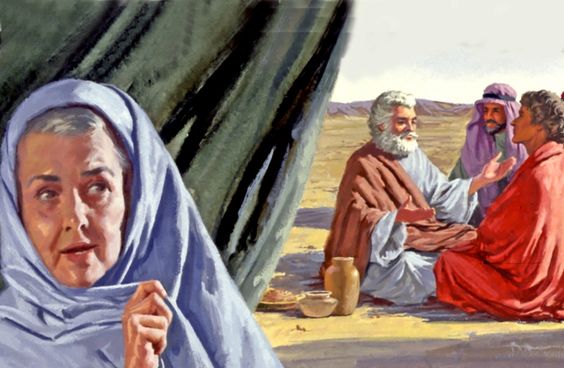
Not long after the events of Genesis 17, Abraham sees three visitors passing through and he rushes to receive them. Hospitality was one of the most important virtues in the ancient world. So Abraham runs to these guests, bows low to the ground in an act of humility, and invites them to receive his hospitality. He runs to the tent and tells Sarah that they have company; then he runs to command a young herdsman to prepare a calf for a great meal. And the Bible says that Abraham joined them under a great shade tree while they ate, ready to tend to their needs. Then the guests ask Abraham a question.
They said to him, “Where is Sarah your wife?” And he said, “She is in the tent.” The LORD said, “I will surely return to you about this time next year, and Sarah your wife shall have a son.”
Genesis 18:9-10
Over the course of this interaction, it becomes evident that these aren’t ordinary guests. One of them is the LORD himself. The first evidence of this is that the guests call Sarah by her new name. Sarai was known for her beauty, known as the wife of the wealthy Abraham. But the guests know her new name — because one of them is the one who gave her that name.
And Sarah was listening at the tent door behind him.
Genesis 18:10
Sarah is in the tent listening and she overhears the LORD when He promises that she will have a son of her own when He returns in a year’s time. And this is Sarah’s response:
Now Abraham and Sarah were old, advanced in years. The way of women had ceased to be with Sarah. So Sarah laughed to herself, saying, “After I am worn out, and my lord is old, shall I have pleasure?”
Genesis 18:11-2
Sarah’s response is the same as her husband’s; she laughs! And like Abraham, her laughter is incredulous, even a bit sarcastic. “Ha! Yeah, right! Now that I’m 90 years old, I’m going to have a baby? That’s a good one!” After all these years of disappointment, Sarah is jaded. She can’t even go there, can’t even get her hopes up — so she does the same thing so many of us will do; she armors herself with snarkiness and cynicism. She scoffs and laughs and says, “Yeah, right.”
I wonder how many of us are disillusioned like Sarah. I’ve been there before; bitter and jaded. When that happens, it’s so easy to armor up with snarkiness or sarcasm — we do this to protect ourselves. Cynicism is just someone projecting their own hurt out upon the world. Etymologists tell us that our word “sarcasm” derives from an ancient word which literally means “to tear the flesh off.” Maybe that’s why we talk about snarky comments that “cut” so deeply. The snarkiest person you know is simply covering up their own deep wound.
And the same thing applies in our relationship with God. When we reach the point of being disillusioned with God, we’re definitely in the danger zone. But the root of our disillusionment is often disappointment. We’ve lost something and we blame God for it. So we mask our disappointment with bitterness and sarcasm.
When we respond to the promises of God the way Sarah and Abraham responded — with incredulous laughter — “Yeah, right!” — think about how much that must hurt Him.
The LORD said to Abraham, “Why did Sarah laugh and say, ‘Shall I indeed bear a child, now that I am old?’ Is anything too hard for the LORD? At the appointed time I will return to you, about this time next year, and Sarah shall have a son.” But Sarah denied it, saying, “I did not laugh,” for she was afraid. He said, “No, but you did laugh.”
Genesis 18:13-15
The LORD calls Sarah out for her laughter — and this frightens her. And this seems appropriate: it seems we ought to be fearful whenever we laugh in the face of the living God. When she denies this, God corrects her and says, “Oh, no. You definitely laughed.”
But I’m most struck by something else God says here. When Sarah scoffs, God says, Is anything too hard for the LORD? In response to her jaded, bitter laughter, God asks this question — which is ultimately the question of faith. Do you trust that I am able — that I am capable — that I am mighty to keep my promises? Is anything too difficult for me? Is anything impossible for me? This is the question we all face. Is anything too hard for the LORD?
Interestingly, there is another way of reading this statement. It can fairly be translated in the way we just read: Is anything too hard for the LORD? But this Hebrew word also means “wonderful” and “extraordinary.” That gives some helpful nuance to God’s question. Is anything too wonderful for the LORD? Is anything too extraordinary for the LORD? Is there anything too extraordinary for the God of creation?
This is His question to Sarah — but to us as well: Is anything too wonderful for the LORD? Is anything too extraordinary? Is any situation beyond His power? Is any obstacle great enough to keep Him from achieving His purposes? Is anything too difficult for Him?
The LORD visited Sarah as he had said, and the LORD did to Sarah as he had promised. And Sarah conceived and bore Abraham a son in his old age at the time of which God had spoken to him. Abraham called the name of his son who was born to him, whom Sarah bore him, Isaac.
Genesis 21:1-3
Even while we laugh, God remains faithful. He keeps His promise to Abraham and Sarah; He returns to find the old couple holding their son in their arms. Picture Abraham beaming with pride — “Look, Lord. Here he is! My son, Isaac!” Picture Sarah with tears of joy streaming down her cheeks saying, “You’ve given me good reason to laugh now!” We can only imagine Abraham and Sarah’s laughter — not incredulous but joyful. “Who would believe it? The old couple having a baby!”
I wish I could tell you that it’s as simple as this: just believe in God and you’ll get everything you’ve ever wanted. But that’s just not the way faith works: not for Abraham’s descendants who would spend over 400 years in captivity in Egypt; not for Paul who pleaded with the Lord to remove the thorn from his flesh; and not even for Jesus who cried out in the Garden of Gethsemane. We know that faith isn’t nearly as simple as the health and wealth preachers make it out to be: “just believe and God and you’ll have everything you’ve ever wanted.”
And furthermore, I think Abraham and Sarah would push back on any simplistic reading of their story. I think they would remind us that theirs was a story 25 years in the making. And as we’ll see next week, it’s a story with another very important chapter.
But this much we can say: Abraham and Sarah’s experience points us toward a God who waits until there is no other possibility to act. Because our God is the God of the extraordinary.
Sarah scoffs and asks, “Are you going to bring life out of my old and barren womb?” And God says, “Is there anything too extraordinary for me?”
Elsewhere the Bible tells us of a young unmarried woman — Sarah’s opposite in so many ways. But she too receives the promise of life from God. And Mary asks, perhaps incredulously, “How can this be, since I am a virgin?” And God says, “Is there anything too extraordinary for me?”
And when Mary’s child is crucified, the crowd laugh at Him. The Bible records their jaded, incredulous mocking: “He saved others; let Him save Himself.” But He doesn’t save Himself. And after He dies, they put Him in the grave — a place just as devoid of life as the wombs of Sarah and Mary; the 90-year-old and the unmarried virgin. And as we stare at that tomb, we might ask — maybe even a bit incredulously — “Are you going to bring life out of death?” And God says, “Haven’t you learned by now? Is there anything too extraordinary for me?”
Years ago, a friend of mine told me he was thinking about running for public office. I honestly thought he was joking, so when he said this to me, I laughed and said, “Yeah, right.” And then there was that split second in our interaction, just the slightest pause on his part…and I realized that he wasn’t kidding. And I realized that I had hurt him deeply with my incredulous laughter. I tried desperately to salvage the discussion, but the damage was already done.
We remain friends to this day, but he’s never spoken to me again about his dream of running for office.
This kind of incredulous laughter — the “Yeah, right” kind of laugh — seems to be commonplace today. We scoff because in a world like ours, it’s harder than ever to distinguish between earnest and sarcastic. Rampant cynicism often leaves us jaded and disillusioned…so we laugh and say, “Yeah, right.”
And that sort of cynicism can really undermine our faith. How do you think God feels when, after hearing about His promises, we laugh and say, “Yeah, right?”
As Genesis 17 opens, Abraham is 99 years old. He has been walking with God for many years, living with the promise that someday God would give him descendants as numerous as the stars in the heavens. The Lord appears to him and changes his name from Abram to Abraham, indicating that his circumstances are about to change as well. This is what God says:
Behold, my covenant is with you, and you shall be the father of a multitude of nations. No longer shall your name be called Abram, but your name shall be Abraham, for I have made you the father of a multitude of nations.
Genesis 17:4-5
The name Abram means, “exalted father” but the name Abraham means, “father of a multitude.” And this is what God promises Abraham — descendants too numerous to count.
But as we said last week, this promise doesn’t simply impact Abraham; it also concerns his wife, Sarah. And God changes her name as well.
And God said to Abraham, “As for Sarai your wife, you shall not call her name Sarai, but Sarah shall be her name. I will bless her, and moreover, I will give you a son by her. I will bless her, and she shall become nations; kings of peoples shall come from her.”
Genesis 17:15-16
God changes Sarah’s name because her circumstances are about to change as well. After 24 years, God is finally ready to fulfill His promise to Abraham and Sarah. But look at Abraham’s response:
Then Abraham fell on his face and laughed and said to himself, “Shall a child be born to a man who is a hundred years old? Shall Sarah, who is ninety years old, bear a child?” And Abraham said to God, “Oh that Ishmael might live before you!” God said, “No, but Sarah your wife shall bear you a son, and you shall call his name Isaac.”
Genesis 17:17-19
When God says He is ready to fulfill His promise, Abraham laughs! And the context shows us that it wasn’t the “I can’t believe it’s finally happening!” kind of laughter — but more of the incredulous, “Yeah, right,” kind of laughter. We can see this because when God tells Abraham what He plans to do through Sarah, Abraham brings up Ishmael. He’s essentially saying, “I think you mean Ishmael, Lord. May he live before you!” And God has to correct Abraham’s faulty assumption here: No, Sarah will bear you a son.
Abraham laughs because what God says here seems, frankly, impossible. And that seems to be one of the underlying themes of Abraham’s story. It seems as if God decides to wait until there is no other possibility — and that’s when He chooses to act. He’s not going to fulfill His promise on a technicality or a loophole; He’s not going to use a surrogate like Hagar. “No,” God says, “I’m going to use 99-year-old Abraham and 90-year-old Sarah.” And God even names this unborn child. And you shall call his name Isaac — which means, “he laughs.”
God reacts to our incredulous, jaded laughter with a little bit of laughing of his own. “Oh, you think I can’t do this? Just you wait, Abraham. I’ll give you something to laugh about.”
We will return to Abraham and Sarah’s story next week and the way God resolves His promise to them. But before we get to that part of the story, we need to look at another woman who struggles to be seen and heard. This is Hagar, Sarah’s Egyptian maidservant.
So after Abraham had been living in Canaan ten years, Sarai his wife took her Egyptian maidservant Hagar and gave her to her husband to be his wife. He slept with Hagar, and she conceived. When she knew she was pregnant, she began to despise her mistress.Then Sarai said to Abram, “You are responsible for the wrong I am suffering. I put my servant in your arms, and now that she knows she is pregnant, she despises me. May the Lord judge between you and me.”
“Your servant is in your hands,” Abram said. “Do with her whatever you think best.” Then Sarai mistreated Hagar; so she fled from her.
Genesis 16:3-6
Hagar is little more than a pawn in Sarah’s plan. Sarah views her as a means to an end, as her proxy for providing Abraham a child. In this regard, Sarah doesn’t truly see Hagar. Hagar is simply a servant, a non-person in Sarah’s eyes. There’s irony here: even though Sarah doesn’t feel truly seen, she is simultaneously guilty of not really seeing Hagar, of overlooking her as someone made in the image of God. To Sarah, Hagar is a thing to be used rather than a person to be loved.
Sarah’s plan shows us that one of the most unloving things we can do is use another person for our own purposes. When we don’t see others as fellow image-bearers, we’re liable to use them, to treat them as objects, as non-persons. This is one of the deep dangers of pornography — the objectification of another image bearer, reducing a person to simply an object used for gratification. The same could be said of gossip and slander when we reduce someone to a “thing” to be talked about rather than a person to be treated with dignity. Sarah is guilty of this same kind of reduction of Hagar. She simply uses her.
But Sarah’s plan backfired…because it actually worked, at least insofar as it provided Abraham with a son. Abraham takes Hagar as his wife, which elevates Hagar’s status considerably. Now she answers not to Sarah but to Abraham. And in a typical case of the oppressed becoming the oppressor, the Bible says that Hagar despised Sarah once she became pregnant. In this context, to despise means “to look down upon.” Hagar becomes arrogant: “I have a child and you don’t; I have done what you could not.” And this is Hagar’s great mistake. She vindictively looks down upon the one who never truly saw her.
And at this point, things spiral quickly: Sarah complains to Abraham about Hagar; Abraham demotes Hagar back to servant status, putting her under Sarah’s charge; and Sarah mistreats Hagar. The word “mistreat” is an interesting one. The deeper meaning here is this: “to degrade.” It is the same word that is used in Exodus to describe the terrible conditions of slavery the Israelites faced in Egypt. Here in Genesis, Sarah mistreats and degrades Hagar, the Egyptian; by the time we reach the Exodus story, the tables will have turned yet again as the Egyptians will mistreat the children of Israel. As a result of this mistreatment, Hagar decides to run. And then something remarkable occurred.
The angel of the Lord found Hagar near a spring in the desert; it was the spring that is beside the road to Shur. And he said, “Hagar, servant of Sarai, where have you come from, and where are you going?”
“I’m running away from my mistress Sarai,” she answered.
Genesis 16:7-8
Shur was a place in the wilderness on the way to Egypt. It seems that in her distress, Hagar has decided to return to her homeland. Picture this pregnant woman all alone out in the wilderness trying to make it back to Egypt. She has already traveled many miles and she has many more miles to go before she makes it back home.
What do you think was going through Hagar’s mind at this point? Her life has taken a dramatic turn because of this plan Sarah concocted. Did anyone ever consider what Hagar wanted? She never asked to be married to Abraham. What if there was someone else — one of Abraham’s herdsman, perhaps — that she hoped to marry? What if she wasn’t ready to be a mother just yet? No one in the whole story seems to show even the slightest interest in what Hagar wanted. She is simply a means to an end. And the minute her circumstances changed, she started dishing it right back to Sarah only to find herself back on the bottom again.
I wouldn’t blame Hagar if she was asking, “Does anyone truly see me?” I would guess that’s why she chooses to return home, “Maybe back home they’ll see me and hear me.”
And this is where the angel of the LORD finds her.
Then the angel of the Lord told her, “Go back to your mistress and submit to her.” The angel added, “I will so increase your descendants that they will be too numerous to count.” The angel of the Lord also said to her: “You are now with child and you will have a son. You shall name him Ishmael, for the Lord has heard of your misery. He will be a wild donkey of a man; his hand will be against everyone and everyone’s hand will be against him, and he will live in hostility toward all his brothers.”
She gave this name to the Lord who spoke to her: “You are the God who sees me,” for she said, “I have now seen the One who sees me.”
Genesis 16:9-13
The angel of the LORD is an interesting character in the Scriptures. This is the first of 48 references to the angel of the LORD in the Old Testament. The word “angel” simply means “messenger” and it seems that this messenger is often dispatched on special assignments throughout the Old Testament. But there are signs that he is more than simply an angel. This special messenger is often identified with God Himself as we see in this passage. That leads many people to believe that the angel of the LORD is a pre-incarnate version of God the Son — or the form that Jesus took in the Old Testament, to put it simply. That’s what I believe. This is no mere angel, but a full-fledged member of the Godhead standing before Hagar.
And the messenger of the LORD calls Hagar by name. This woman who feels as if no one sees her, no one cares for her, no one stands up for her and her well-being — the messenger of the LORD, Jesus himself, calls her by name.
Hagar the Egyptian has her own experience of the God of Abraham here. The same God who called Abraham now calls Hagar to go back to Sarah and to submit to her. The way forward with God is always the way of submission. But the real question God seems to be asking Hagar is less about submitting to Sarah and more about submitting to Him. God’s question to Hagar is the same question we discussed last week — the controlling question for her, for Abraham, and for all of us today — It’s God’s question: Do you trust me?
God promises that Hagar will also have numerous descendants — and even though the history of those descendants is somewhat checkered throughout history, that does nothing to negate the fact that God chooses to bless this pregnant woman all alone in the wilderness. And Hagar’s response, at least in this episode, is the correct one. She submits to the will of God. She trusts the One who seeks her out in the wilderness. And Hagar comes away with a new awareness: “God sees me.” Even if no one else sees me, God sees me. She names her son Ishmael — “God hears me.” And she gives God a new name: El Roi, “You are the God who sees me.” The God who calls me by name. The God who loves me.
Maybe today you feel like you’re one of the ones who is easily overlooked. Maybe you’re like Hagar: your life has been radically altered by the decisions of someone else. Someone used you, viewed you simply as a means to an end. Maybe you can relate to Hagar the Egyptian — you’ve never felt as if you really had a place among the people of God. Maybe you feel like she feels — you’re a long way from home, alone in the wilderness of loneliness and isolation. You feel unseen, unheard, and unloved.
Let me ask you this: What would it do for you if you could hear Jesus call you by name? What would it do for you to know that Jesus truly sees you — He doesn’t see you as an object, as something to be used, as a means to an end. But instead, He sees you for who you are. He sees you because you were made in the image and likeness of God. That means He can’t NOT see you — because when He looks at you, He sees a reflection of the divine, a reflection of Himself.
What if today, in this text, Jesus intends to confront you — to call you by name — to let you know that He sees you?
Have you ever felt as if you weren’t really seen? When was the last time you felt ignored, overlooked, and forgotten — lost in the crowd? Have you ever felt as if you weren’t really being heard — as if your voice didn’t seem to matter?
Research has shown that when we are perpetually ignored and overlooked, our health suffers — our emotional health and even our physical health. That’s because we have an innate longing to be seen, to be heard, to be known.
As we continue our Genesis study, we come to Genesis 16 and the story of two women who share in this struggle: the struggle to be seen and heard.
The first of these two women is Sarah, Abraham’s wife. As we discussed last week, God promised to bless Abraham with descendants as numerous as the stars in the heavens. And month after month, year after year, Abraham and Sarah live with that promise. But month after month, year after year, their circumstances remain the same. They remain without a child. By the time we reach Genesis 16, Abraham is 85 years old and his wife Sarah was 75. And the possibility of having a child seems to grow more remote with each passing day.
We need to acknowledge that we are treading into some delicate territory here. Over the years, I have listened to many people who share in Sarah’s heartache. It is their deepest desire to have a child of their own and yet, for whatever reason, it just hasn’t happened. For some of our sisters and brothers, this is their most painful and most personal prayer. The last thing I want to do is add to that pain. But I do believe that God speaks a word to us today through Sarah’s story, painful though it might be. I believe Sarah’s story is a testimony to a God who meets us in our pain, who chooses to stand with us in our pain.
Abraham and Sarah remain without a child, so Sarah comes up with a plan.
Now Sarai, Abram’s wife, had borne him no children. But she had an Egyptian maidservant named Hagar; so she said to Abram, “The Lord has kept me from having children. Go, sleep with my maidservant; perhaps I can build a family through her.” Abram agreed to what Sarai said.
Genesis 16:1-2
In the ancient world, barrenness was the greatest source of shame for a woman. For example, Mesopotamian marriage contracts from this time period contained clauses obligating a wife in these circumstances to provide her husband with a surrogate so that he might have a family. We can only imagine the social pressure Sarah felt to provide children for Abraham.
It’s not difficult to imagine Sarah pleading with God. “Lord, have you forgotten about us? Did you forget your promise to me? You asked us to leave home, to follow you to this land you were going to give us — and we did just as you said. And you promised to bless us with a child, with descendants as numerous as the stars. When are you going to keep your end of the bargain?” It’s not hard to imagine the ways that Sarah feels overlooked and ignored, even by God. Sarah is a woman who doesn’t feel seen; she doesn’t feel heard.
After ten years of waiting on God to deliver on His promise, Sarah decides that she’s tired of waiting. Sarah doesn’t feel as if she’s being heard, so she decides to make her voice heard, even if that means altering the plans of Almighty God.
This, of course, is a mistake. Sarah’s failure here is a failure to trust. Personally, I understand why she did what she did — I have that same tendency to want to take matters into my hands as well. But this mistake has repercussions for Abraham and his descendants for years to come.
Sarah follows the custom of the day rather than trusting in God to keep His promises. She decides to “help” God along by offering her maidservant to Abraham. Of course, God needs no help in keeping His promises. He needs no loophole in order to remain faithful to His word. But Sarah pulls Abraham aside and tells him her plan: he is to take Hagar, Sarah’s handmaiden, as his wife and produce a child with her.
V2, Abram agreed to what Sarai said. Literally, it reads, “he obeyed Sarai’s voice.” This is the same phrase found in Genesis 3:17 when God says Adam obeyed the voice of Eve rather than trusting in God. And here we see Abraham’s mistake. Sarah is not the only one at fault here. Abraham is a willing accomplice in Sarah’s plan. He, too, is guilty of “helping” God keep His promise.
To listen to any voice other than the voice of God is a failure of faith.
In Genesis 12:1-3, God speaks of the great blessing He will bestow upon Abraham. In fact, God uses the word “bless” five times in His call of Abraham.
Now the Lord said to Abram, “Go from your country and your kindred and your father’s house to the land that I will show you. And I will make of you a great nation, and I will bless you and make your name great, so that you will be a blessing. I will bless those who bless you, and him who dishonors you I will curse, and in you all the families of the earth shall be blessed.”
Genesis 12:1-3
Jewish interpreters see this as a deliberate counter to the fivefold occurrence of the word “curse” in Genesis 1-11:
Genesis 3:14, The Lord God said to the serpent, “Because you have done this,cursedare you above all livestock…”
Genesis 3:17, And to Adam he said…”Cursedis the ground because of you…”
Genesis 4:11, “And now you arecursedfrom the ground, which has opened its mouth to receive your brother’s blood…”
Genesis 5:29, …and he called his name Noah, saying, “Out of the ground that the Lord hascursedthis one shall bring us relief…”
Genesis 9:25, “Cursedbe Canaan; a servant of servants shall he be to his brothers.”
Five blessings, five curses. Interesting coincidence? Or is something more going on here?
I think it is pretty obvious that God is at work, through Abraham, to bless His creation. God promises to bless Abraham so that he will be a blessing to others. In fact, through Abraham and his descendants, all the families of the earth will be blessed. Starting with Abraham, God sets in motion His plan to make right all that is wrong in the world. This blessing begins with covenant faithfulness and trust. This is one of the deep truths of the biblical story. As we have already seen, rebellion is the problem. Human sinfulness is active rebellion against God — it distorts the image of God in us and damages our relationships with one another and with God. This is the great curse that we read about in the first chapters of Genesis — and sin is a curse that is still at work in our world today.
But here in Genesis 12 we see the solution to this problem: faithfulness — in the form of God’s promise to bless. God’s faithfulness to His promises is the key to overcoming the power of the curse. Abraham’s response to God’s promises is instructive for us — he trusted God and God counted it to him as righteousness.
And today, the key question looms for us, the same question God posed to Abraham: Do you trust God?
It needs to be said that trust didn’t always come easily for Abraham. And I take some comfort in that because trust doesn’t always come easily for us either. It’s certainly not as easy as preachers sometimes make it sound. There are times in Abraham’s story when he tries to take matters into his own hands — all that business with Hagar and Ishmael, for instance. On more than one occasion, he lies to a king by saying that Sarah is his sister rather than his wife.
This is not to say that Abraham was necessarily unfaithful, only that exercising faith can be a bit of a challenge sometimes. And Abraham’s failures are usually the result of his own impatience. He grows tired of waiting on the Lord. God doesn’t always operate quickly enough for our tastes. I guess that’s one of the dangers of entering into a covenant relationship with an eternal being — His sense of timing is rarely going to square up with ours.
But through it all, God seems to say to Abraham, Do you trust me?
And despite his flaws and his failures, Abraham keeps answering back, Yes, Lord, I trust you.
In the hands of an interpreter like Paul, we learn that Abraham is the template of faith for us as well. In Galatians, Paul reaches back to the covenant agreement God made with Abraham and notes that it was founded upon trust. Speaking of Abraham, Paul quotes Genesis 15:6, And he believed the Lord, and he counted it to him as righteousness. Then Paul goes on to say:
Know then that it is those of faith who are the sons of Abraham. And the Scripture, foreseeing that God would justify the Gentiles by faith, preached the gospel beforehand to Abraham, saying, “In you shall all the nations be blessed.” So then, those who are of faith are blessed along with Abraham, the man of faith.
Galatians 3:7-9
Paul is able to see the fullness of the blessing that began when Abraham took that first step out of Haran, away from his father’s house and toward an unknown land. What began that day has truly become a worldwide blessing, Paul says, for now it is those of faith who are the sons of Abraham. The true children of Abraham have likewise responded to the call of faith. Specifically, they have put their trust in Jesus as God’s Messiah — for He is the means through which God is acting to bless.
Yet we know that a person is not justified by works of the law but through faith in Jesus Christ, so we also have believed in Christ Jesus, in order to be justified by faith in Christ and not by works of the law, because by works of the law no one will be justified.
Galatians 2:16
The blessing God brings to the world through Abraham is the faithful, trusting obedience of His Son, Jesus, the Messiah. Jesus is the culmination of Israel’s story. Like Abraham, Jesus left his father’s house; he became a wanderer in a foreign land. Throughout His ministry, Jesus will say, “The Son of Man has no place to lay His head.” At the critical hour, Jesus faced the same temptation Abraham faced — the temptation to take matters into his own hands. In the Garden of Gethsemane the night before His crucifixion, Jesus asks, “Father, would you remove this cup from me?” The kind of trust God requires doesn’t always come easily, even for Jesus
But this doesn’t make Jesus unfaithful — not anymore than it made Abraham unfaithful. In Jesus we find faithfulness and trusting obedience modeled perfectly and completely. In that all important moment in the Garden, as Jesus asks His Father to remove this cup from Him, we can only imagine the dialogue between them. But somewhere in there, I wonder if the question came from the Father to the Son, the question that defined that moment in Gethsemane just as it defined Abraham’s life, just as it is the controlling question for you and for me.
Do you trust me?
And Jesus replied, Yes, Father. I trust you. Not my will but Yours be done.
How about you? Do you trust Him?
The greatest blessings of all come when we place our trust in Jesus, the One who completes the will of God — the One whose trusting obedience is counted to us as righteousness. In Him we find redemption, the forgiveness of our sins, and the promise of life both meaningful and eternal.
In our Genesis study, we’ve spent the last two weeks talking about A God Who Creates and A God Who Makes Promises. Today we want to build on that by looking at the extraordinary power of trusting in God. Today we’ll focus on the story of Abraham in Genesis 12.
Now the Lord said to Abram, “Go from your country and your kindred and your father’s house to the land that I will show you. And I will make of you a great nation, and I will bless you and make your name great, so that you will be a blessing. I will bless those who bless you, and him who dishonors you I will curse, and in you all the families of the earth shall be blessed.” So Abram went, as the Lord had told him…
Genesis 12:1-4
Abram — later known as Abraham — was 75 years old when this happened. Abraham and his people were originally from a place called Ur; they later settled in a land known as Haran. But God comes to Abraham and tells him to leave the security of his family and this familiar place to set out for a land unknown to him. In asking him to leave Haran, God is asking Abraham to leave the land where his father was buried. Put yourself in Abraham’s place just for a moment. What questions would you have if you heard what he heard?
Where are we going?
How long will it take to get there?
How will I make a living when I get there?
What language do they speak there?
Most importantly: What am I supposed to tell my wife? Do they have a Target and a Starbucks there? (Questions my wife would be asking?!?)
Abraham surely had his own version of questions such as these. But none of his questions are voiced here in the text. Instead, the question that undergirds the whole episode doesn’t even come from Abraham, but rather from God. By calling him in this unique way, God seems to be posing one simple but essential question for Abraham — and it’s the same question God puts to us as well.
God’s question to Abraham is His question to everyone.
Essentially, God is asking Abraham to trust Him. “I know you have questions, but here’s my question: Do you trust me? Because I’m going to be right there with you on this journey.”
And this is how Abraham responded:
So Abram went, as the Lord had told him…
Genesis 12:4
Because of this, Abraham is known as “the father of faith.” He demonstrates that his ultimate allegiance is with God. In our world, we might think nothing of moving across the country to take a lucrative position with another company. We might think, “What’s the big deal? Abraham left home.” But it didn’t work this way in the ancient world. To leave the security of family and friends often meant becoming a defenseless wanderer in hostile, unknown territory. To set out like this without “your people” was to be an exile on foreign soil.
But that’s what Abraham does. He leaves behind the security of the familiar, setting out into the unknown, to follow the call of the Lord. In response, Abraham says, Yes, Lord, I trust you.
In our modern times, faith is often defined in terms of belief. In fact, the two are synonymous for most of us. But biblical faith is much more than what you believe to be true at an intellectual level. Biblical faith is always action-oriented. It is just as much about what you do as a result of that belief. What we call “belief” is certainly a part of that, but so is loyalty and allegiance and — in my opinion, this is the best word of all — trust. Because trust is a relational term.
The Bible tells us that Abraham trusted in God rather than the false gods of his family. Centuries after Abraham, Joshua delivered this word from the Lord to the people of Israel.
And Joshua said to all the people, “Thus says the Lord, the God of Israel, ‘Long ago, your fathers lived beyond the Euphrates, Terah, the father of Abraham and of Nahor; and they served other gods. Then I took your father Abraham from beyond the River and led him through all the land of Canaan, and made his offspring many.’”
Joshua 24:2-3
There’s a contrast here between Abraham and his family. God says that Abraham’s father and brother served other gods. In that regard, they were like most of the people in their day. But the text seems to be contrasting Abraham, implying very strongly that God chose him because he broke from the tradition of his father and worshipped the One True God alone. As God would later say, “You shall have no other gods before me,” — and Abraham is the template for this kind of faithfulness.
And here we see a primary feature of biblical faith — trusting in God, even when it seems we are standing alone.
Trusting in the One True God means forsaking a lot of false gods — all false gods, actually. And the Bible is honest about this: that’s not always going to be popular. Like Abraham, you might feel like a defenseless wanderer in hostile territory, an exile on foreign soil.
But when we trust in God, He promises that we are never alone. Never will I leave you, nor will I forsake you. God makes that promise in both the Old Testament and the New Testament in our Bibles so that we will understand His unwavering faithfulness to us when we trust in Him. When it seems we are standing alone, we are actually standing with the One True God who believes in making and keeping His promises (as we said last week).
So we’re back to this idea of trust as a relational term. Abraham demonstrated faithfulness — not simply because he believed the right things about God, but because he put his trust in him. There’s a big difference there.
To put it differently, Abraham went out not knowing where he was going. But this wasn’t blind faith because Abraham knew God. His act of trust was rooted in his relationship with the Lord.
The Scriptures never call us to what is often referred to as “blind faith.” But over and over again, in times of uncertainty, the biblical story gives us glimpses of people putting their trust in God. Even though Abraham sets out for an unknown land, we cannot call this blind faith. Do you know why? Because even though Abraham didn’t know where he was going, he knew the One who called him and promised to guide him. Abraham could say, “I don’t know exactly how all of this is going to go but I know the One who says He’s going to go with me on the journey.” He could say as Paul would later say in 2 Timothy 1:12 (words that are echoed in the classic hymn), But I am not ashamed, for I know whom I have believed.
That’s true biblical faith. It’s putting our trust in God, trusting that He joins us on the journey.
And so, God says to Abraham, Do you trust me? And in word and in deed, Abraham says, Yes, Lord, I trust you.
Through these words, the one God is saying the same thing: Do you trust me? How will you answer?
So last week, we added the College Football Championship Game to our picks. Everyone picked LSU except Sunny, so here are the updated standings.
Joshua: 8-1
Jason: 7-2
Sunny: 5-4
Abby Kate: 5-4
Jackson: 4-5
So there are only three games left and Joshua has a one game lead on me. I have to make up some ground on him this weekend. Here are our picks:
Joshua is taking the Titans and the 49ers, so I’m going Chiefs and Packers. Sunny takes the Packers and Titans. Abby Kate and Jackson are taking the Titans and 49ers. I need to go 2-0 to win this thing.