
In the Bybee family, we have a tradition of decorating for Christmas on the day after Thanksgiving. The boys and I get in the attic and bring down all of the Christmas boxes and while Sunny puts out all of the decorations, we set up the Christmas tree. And once the tree is up, I have this weird thing where I have to be the person to put the ornaments on the tree. To be honest, I’m kind of obsessive about it. I lay out all of the ornaments on the kitchen table and then I strategically place them where I want them to go. And I won’t let anyone else help.
There are a few reasons for this. For one, you have to consider the aesthetics when it comes to the placing of these ornaments. For example, we have quite a few St. Louis Cardinals ornaments we’ve collected over the years. So I have a very particular way of spreading out these ornaments around the tree. You don’t want them all clumped up together in one spot: some need to go on one side, some on the other side. It’s about balance.
Then there are sentimental reasons for the ornament placement. There are certain ornaments I want to feature prominently on the front of the tree, at eye level where everyone can see. These are ornaments we bought on family trips over the years or ornaments given to us by our friends or ornaments the kids made when they were little. These have sentimental meaning to us and I want them to be front and center on the tree.
But the final reason I’m so obsessive about the ornaments is because I also want to make sure that some of them always go on the back of the Christmas tree. Because honestly, I don’t like looking at them. I think these ornaments are kind of ugly but Sunny doesn’t want to get rid of them. She wants them on the tree but I don’t want to look at them. So every year, I make sure to put them on the back of the tree where I don’t have to see them.
Here’s an example of one of these ornaments:


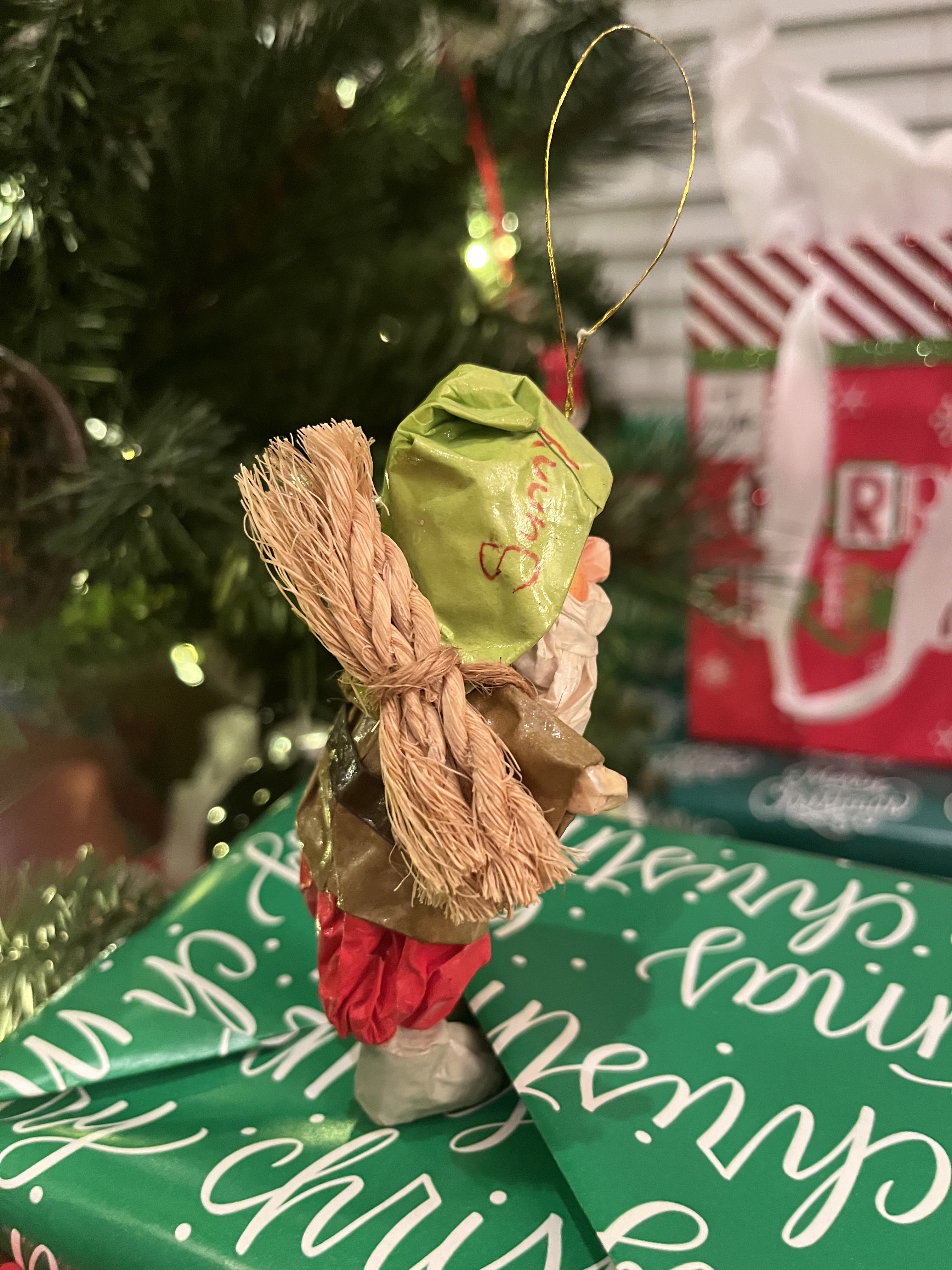
Sunny has had this ornament since childhood. There’s no sentimental backstory to this ornament, at least not one that she can remember. She has no idea how she ended up with this ornament, but she’s always had it. I think he’s supposed to be Santa — except for the fact that he’s wearing a green hat and he’s carrying a yoga mat on his back or something. Others say he’s a gnome. Either way, I think he’s ugly.
And Sunny agrees that he’s ugly, although as we were talking about it, she also said, “He’s so ugly, he’s kinda cute.” We’re guessing somebody gave him to Sunny in 1981 since that’s the year written on his hat. But she would’ve been three years old that Christmas, so she has no idea where it came from. So she’s kept it all these years and she always wants me to put it on the tree — but every year, I take Ugly Green Hat Yoga Santa Gnome and hide him back there on the backside of the tree where he belongs.
I’m telling you this because it reveals something about us. The impulse which drives us to hide certain ornaments on the backside of the Christmas tree is the same one that compels us to hide certain parts of our lives from view. The fact that I tuck away these ornaments back there where no one can see them reminds me that there are certain parts of my life I’d just as soon not see, parts I hide from others or even from myself. And you do the same thing.
It could be a mistake from the distant past: some moment of indiscretion when you did something or said something that was really out of character for you. And even though it was significant, rather than dealing with it, you just hid it back there where no one could see and you just hoped it would go away.
It could be an ongoing addiction, a struggle you’ve had for a long time, one that continues to this day.
Maybe there’s a part of your life nobody else even knows about and you’ve worked so hard to keep it tucked away but you’re finding out just how exhausting that can be. That’s one thing Satan will never tell you: how exhausting it is when you have to maintain the lie: to remember the last lie you told and to make sure your story remains consistent. You have to expend SO MUCH energy trying to keep things hidden — that’s why it eventually comes out. Your sin will find you out, according to the Bible. You can only do this for so long.
You and I have shameful parts of our stories that make our faces turn as red as Rudolph’s nose. And those are the parts of our lives we want to hide away like the ornaments on the back of the Christmas tree.
And all of this points beyond itself to the reason Jesus was born. Our impulse to hide those parts of our lives is the reason Jesus came to earth.
The angel appeared to Joseph in those days and said unto him:
“Joseph, son of David, do not fear to take Mary as your wife, for that which is conceived in her is from the Holy Spirit. She will bear a son, and you shall call his name Jesus, for he will save his people from their sins.”
Matthew 1:21
God tells Joseph that something holy is happening here. This child will be named Jesus, which means “the Lord saves.” And Jesus will live up to this name because He will save us from our sins. The word for “sin” in the Bible simply means to miss the mark. It’s a term that was often used in archery circles to describe missing the target. So all of these parts of our lives which bring us shame — all of those sinful choices we’ve made, each time we’ve missed the mark — Jesus came to save us from those sins.
That means He doesn’t view you the way I spoke of these ornaments on the back of the tree — ugly, needing to be hidden away. That’s not how Jesus sees you. No, He sees you as possessing great inherent value. You are precious to Him, so precious that He chose to die to reconcile you back to God.
This is the heart of the Good News: Jesus comes to save.
And Matthew frames this story in a unique way. Just a few verses earlier, he begins his Gospel with the family tree of Jesus. This might seem like an odd way to begin this story, but Matthew is very purposefully recording the lineage that led up to Christ’s birth. He mentions all of these generations from Abraham to David to Joseph, generations who lived and died with the hope that God would one day fulfill all that He had promised to Israel.
I want to show you just a portion of this family tree, highlighting a few names in particular:
Abraham was the father of Isaac, and Isaac the father of Jacob, and Jacob the father of Judah and his brothers, and Judah the father of Perez and Zerah by Tamar, and Perez the father of Hezron, and Hezron the father of Ram, and Ram the father of Amminadab, and Amminadab the father of Nahshon, and Nahshon the father of Salmon, and Salmon the father of Boaz by Rahab, and Boaz the father of Obed by Ruth, and Obed the father of Jesse, and Jesse the father of David the king. And David was the father of Solomon by the wife of Uriah…
Matthew 1:2-6
This is the lineage of Jesus from Abraham to David. I just want to point out a few things about some of Jesus’s ancestors:
Let’s start with Abraham, who is called the father of faith. Paul says he is an example of how we are justified by faith apart from the law. But Abraham’s story was not perfect. He had some ornaments on the back of his tree. As you read his story, you see that he has a hard time telling the truth. It seems like he’s always lying to somebody about Sarah, his wife, telling people that she’s his sister instead. Abraham also agrees to Sarah’s plan to take her handmaiden as his wife, which is an attempt to “help” God fulfill His promise to give them a son. These parts of Abraham’s story would have been the things he would have wanted to cover up, but they’re right there in the Bible.
Then there’s Jacob. If Abraham had a hard time telling the truth, Jacob takes this to a whole new level. He’s a swindler and a cheat, a lying son and a lousy brother and a father who plays favorites with his children.
There’s Rahab, a former prostitute. She’s the great-great-great grandmother of Jesus? Really? That ornament definitely goes on the back of this family tree! Same goes for Ruth, who was originally from Moab, Israel’s longtime enemy.
Jesus is descended from David, which sounds good except for the scandal involving Bathsheba. Do you remember the story? David takes Bathsheba into his bed and then he has her husband killed. Just to make sure we don’t forget, Matthew doesn’t include Bathsheba’s name in this genealogy, referring to her instead as “Uriah’s wife.” I don’t think he means to slight Bathsheba. I honestly think he’s calling to mind David’s scandalous actions by mentioning Bathsheba’s murdered husband by name. Even this “man after God’s own heart” has some ornaments on the back of the tree.
And then there’s Judah and Tamar, which is one of the most risque and sordid stories in the whole Bible. Go read it sometime (Genesis 38) and let it sink in that this story is part of the lineage of Christ.
These parts of the story are scandalous and shameful. These are the stories we would want to cover up, to hide away on the backside of the family tree. We would NEVER tell these kinds of stories in our families! But these names are right there in the opening chapter of Matthew’s Gospel. It’s as if Matthew is saying that these people and their stories are essential to understand why Jesus was born.
These are real people with real stories of real sin and real consequences.
And with this family tree, Jesus is saying to us, “These are my people.”
“These are the people from whom I have come.”
“And these are also the people for whom I have come.”
People like you and me.
People with sin in their lives.
People living with the baggage of bad decisions.
People who are heavy laden with guilt and shame and regret.
People who need to be saved from their sins.
And he shall be called Jesus, for he will save his people from their sins.
This is the reason He was born.
— Christmas Eve 2024
 already & not yet