The Story: To Cut a Covenant

Abram’s response to God’s call is only the beginning of his story. God initiates a deeply personal covenant with Abram, as expressed in the text of Genesis 15.

The word of YHWH comes to Abram in a vision, “Fear not, Abram, I am your shield; your reward shall be very great,” (v1). But this news does little to assuage Abram’s anxiety: “O Lord GOD, what will you give me, for I continue childless…you have given me no offspring, and a member of my household will be my heir,” (v2-3). As a way of assuring Abram of His faithful intentions, YHWH makes a request: “Bring me a heifer three years old, a female goat three years old, a ram three years old, a turtledove, and a young pigeon,” (v9). Abram obeys and the animals (with the exception of the birds) are cut in half, laid out each half against the other.

Then, Abram waits.

He waits so long that the vultures start to circle, swooping down at the scent of death. But Abram shoos the birds of prey, protecting the scene for what comes next.

Darkness.

“As the sun was going down, a deep sleep fell on Abram. And behold, dreadful and great darkness fell upon him.” (v12)

Jewish translations of the Hebrew text use the word “terror” here. At night’s darkest hour, terror seizes Abram. Perhaps he feared what other predators were laying in wait; perhaps he feared the darkness itself. But I wonder if his fear ran deeper. What if God doesn’t keep His promise? What if He can’t? Then what? Miles from the land of his youth, Abram, in the terrifying shadow, ponders the promise of God to bless. Has He forgotten me? Will I have a true heir? As the weariness of his years accrues, so too his doubts.

But there, in the darkness of his terrors, Abram meets the Lord.

“When the sun had gone down and it was dark, behold, a smoking fire pot and a flaming torch passed between these pieces,” (v17). A fire, illuminating the night. A clear separation, as in the beginning, between light and darkness. And in these flaming emblems, God passes through the torn animals, an ancient form of covenant making.

The Hebrew expression for covenant making is lichrot brit, literally “to cut a covenant.” In the Ancient Near East, covenant ceremonies involved the shedding of blood and the passing between animals much like the scene here. In essence, God is saying, “May I be like these animals, torn limb from limb, if I do not keep My promise to you, Abram.” This same word, avar in Hebrew, is used to describe yet another “passing through” centuries later. This event, known now as Passover, is yet another demonstration of God’s covenant nature.

But all of that comes later. In this moment, Abram’s trusting faith in God is ceremonially consecrated. The oft-quoted passage serves as the basis of the covenant that follows: “And he believed the LORD, and he counted it to him as righteousness,” (v6).

Posted in Devotional, Faith, God, Scripture, Theology | Tagged , , , , | Leave a comment

Podcast: John 3

And here’s the link to the podcast for John 3. For those of you who followed us along in our Project 3:45 last year, this is simply an audio recording of the same content.

John 3.

Posted in Devotional, Podcast | Tagged , | Leave a comment

Podcast: John 2

Click on the link below for the latest edition of my podcast. I’m using our Bible Study material from last year and posting it in audio form. You can also download / subscribe through iTunes by searching for “Mayfair Project”. Thanks, guys!

John 2.

Posted in Devotional, Podcast | Tagged | Leave a comment

The Story: Blessed

He emerges from the line of Shem, the son of Terah in the land of Ur. From among the people in the world, God selects one man, Abram, to receive a special call. Information about Abram’s life is scant prior to these landmark utterances from the lips of YHWH:

“Go from your country and your kindred and your father’s house to the land that I will show you. And I will make of you a great nation, and I will bless you and make your name great, so that you will be a blessing. I will bless those who bless you, and him who dishonors you I will curse, and in you all the families of the earth shall be blessed.” (Genesis 12:1-3)

If Genesis 1-11 casts the backdrop of human history in cosmic, universal terms, Genesis 12 counters with a story of a particular man at a particular time in history receiving a call from a particular God — YHWH, the name of Israel’s covenant God, the name revealed to Moses centuries later in the form of a flaming bush. This call by God elevates Abram to exemplar status.

The word “bless” is used five times in v1-3, directly countering the fivefold curses of Gen. 1-11 (3:14; 3:17; 4:11; 5:29; 9:25). Abram is promised the blessing of land, lineage, and favor with YHWH. But this blessing is much more than divine reward for obedience. Through Abram’s faithful response to this call, God intends to bless the entire earth. All humanity will experience the reverberations of one man’s faith, the particular impacting the universal. God’s missional impulse is to work through the faith of one man, Abram, to bring fulfillment to the Gen. 3:15 promise of redemption and hope.

This is the focus of Abram’s choosing, the purpose of his election.

You have been blessed in order to be a blessing.

God is not turning His back on His universal creation by narrowing his concern to Abram.

In Abram, God is seeking to bless all peoples.

For it is through Abram that the ultimate promise will find fulfillment.

Posted in Devotional, Faith, God, Missiology, Scripture, The Story, Theology | Tagged , , , | Leave a comment

The Story: And the Rains Came Down

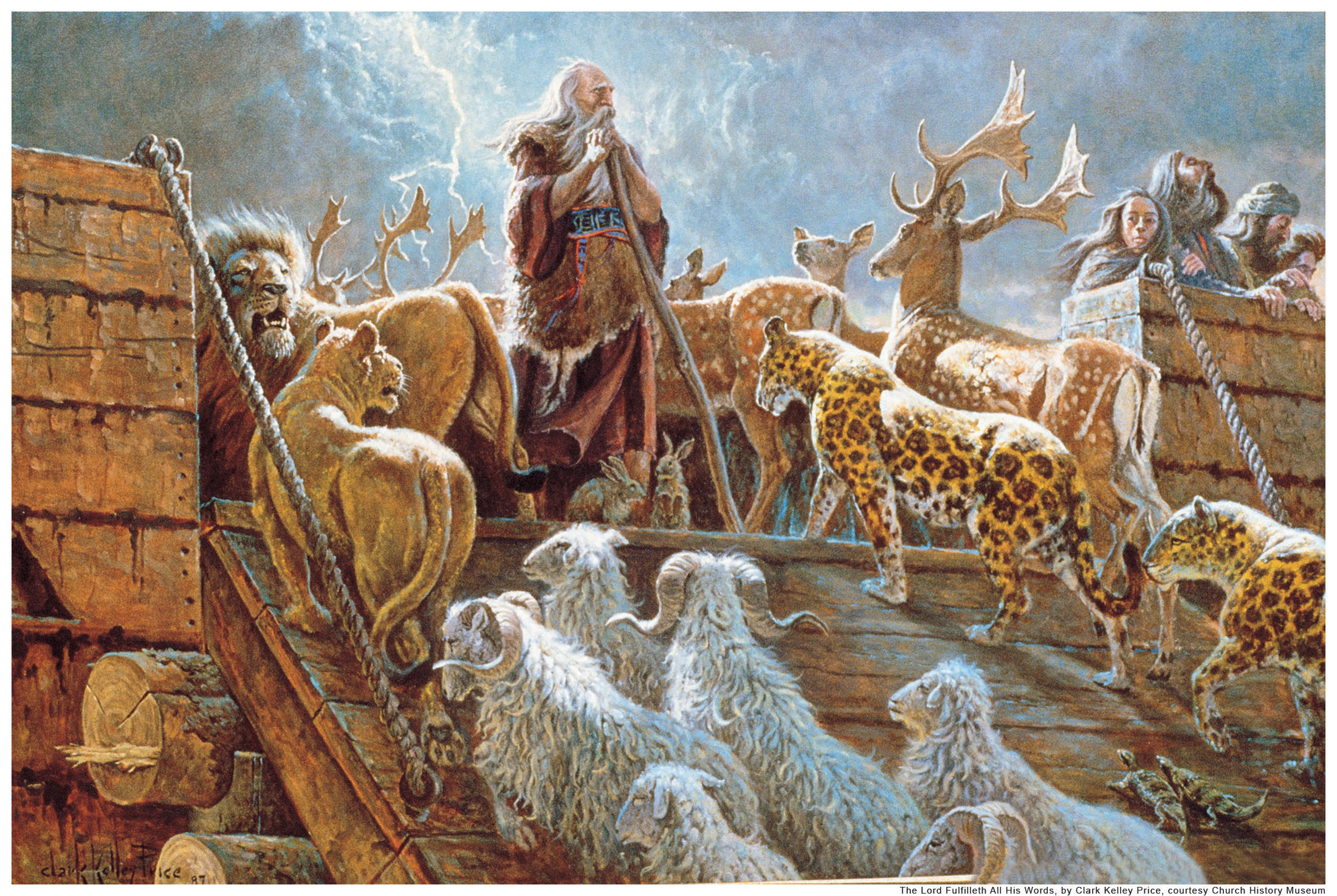
Noah and the ark

Noah and the ark

The story of Noah and the ark is one that many of us have heard our whole lives. I can still picture the flannel-graph my teacher would use in Sunday School, a picture of Noah standing outside the ark, pairs of animals boarding in a single file line.

It’s interesting that there are no flannel-graph pictures of the actual Flood. No raindrops. No rising water. No drowning people or animals. We always fast-tracked that part so we could get to the ending with the dove and the rainbow.

The reality is that the Flood is a gruesome story. When we really stop to think about it, we might reconsider using Noah as the poster boy for our next Vacation Bible School.

si.cover.dec29.2008Do you remember Michael Vick? Do you remember the public outcry when the truth came out about the role he played in that underground dog-fighting ring? Vick was absolutely crushed in the media. But as horrifying as the Vick story was, the Flood account raises the bar a hundred-fold. The loss of animal life here is extreme. Only a handful of animals survive. And the Bible says this is not the work of a sadistic “animal hater”. It is the work of God Almighty.

And that’s to say nothing of the incredible loss of human life here. Only one family survives the deluge. Is gopher wood thick enough to block out sound? Can gopher wood absorb the drowning screams of nearly every person you know? I don’t know. Only Noah can answer that one for us.

I’ll ask again: why exactly do we tell this one to our children?

When Adam and Eve were expelled from the Garden, they took the fruit of their disobedience with them. Beginning of the Noah story shows the far-reaching effects of sin in the world. In Genesis 4:7, God says that sin is crouching at the doorstep. By the time we get to Genesis 6, sin has kicked down the door and taken over the whole house.

Genesis 6:5-6, The Lord saw how great the wickedness of the human race had become on the earth, and that every inclination of the thoughts of the human heart was only evil all the time. The Lord regretted that he had made human beings on the earth, and his heart was deeply troubled.

And the Bible says God regrets making humanity; He is grieved, deeply troubled in His heart.

Regret.

That’s a word you never want to hear in connection to you and God.

It might be odd for us to think of God “regretting” something. But the Biblical writer is clear. Things aren’t going according to plan. God has patiently tolerated sin until He can take it no more. He regrets that He’s made humanity.

So God decides to “uncreate”, choosing to destroy all flesh on the earth (Gen. 6:18, “Everything that is one the earth shall die.”) The Flood is like a cosmic “do over”, God taking the Etch-A-Sketch and shaking away what was previously drawn there. The Flood is destructive, a great undoing of what God had fashioned in creation.

But even with these words of judgment, there is hope. One man, Noah, is said to be righteous in his day (Gen. 6:9). And Noah finds favor in the eyes of the LORD.

God regrets making humanity, but He can’t just wipe them out. Why? Because He made a promise, a promise we looked at last week: Gen. 3:15, the promise of redemption and hope. Someday the woman’s offspring will crush the head of the serpent even as the serpent strikes at his heel. One commentator has noted that in Gen. 3:15, God is declaring war on Satan and evil, refusing to let them have the last word.

So even though sin has run of the store, God chooses to purge the earth of wickedness, delivering Noah and his family as fulfillment of His earlier promise. In the Flood, we find the first allusion to cleansing through immersion. God could have easily chosen a variety of means if He simply intended to bring destruction to the earth. But in the Flood, God chooses to put to death an old way of being and bring to life a new world, a new possibility.

We might say the Flood was an enormous purifying bath, purging the world so something else could exist, something mentioned in Genesis 6:18: I will establish my covenant with you.

The word “covenant” occurs 286 times in the OT. If you’re looking for major themes in Scripture, this is one of them. A covenant is a commitment, a pledge of loyalty and fidelity. And the first of these 286 occurrences is found here in the Noah story.

It’s worth noting that God is the one who initiates this covenant with Noah. Both prior to and following the Flood, God uses the language of covenant as a way of fulfilling His earlier promise.

And so the rains came down…

And after 40 days of rain and 150 days of flood waters, it says in Genesis 8:1, “But God remembered Noah…”

Prior to the Flood, God regretted His decision to make humanity.

But after the Flood, God remembered His promise to one righteous man.

In Noah, we have one who is declared righteous, a man of deep faith who enters into covenant with God and experiences salvation.

As we will see in the coming weeks, covenant is God’s pattern for dealing with humanity. In Abraham, we will also see one who will believe God and it will be credited to him as righteousness (Gen. 15:6; Romans 4). And God’s covenant with Abraham will provide the basis for our understanding of Jesus and the New Covenant He inaugurates through His death and resurrection.

As a sign of this covenant, God establishes the rainbow in the sky.

A double-Alaskan rainbow

A double-Alaskan rainbow

Gen. 9:13-15, “I have set my rainbow in the clouds, and it will be the sign of the covenant between me and the earth. Whenever I bring clouds over the earth and the rainbow appears in the clouds, I will remember my covenant between me and you and all living creatures of every kind.”

With the rainbow, God has moved from regretting to remembering. God says the rainbow is there to remind Him of His promise — not just to Noah, but to all creation. As Gary said last week, God never gives up on His creation. The rainbow is God’s reminder of this.

And at the end of the Story, John catches a glimpse of heaven, the throne of God. And what we see here should come as no surprise:

Revelation 4:2-3, “At once I was in the Spirit, and there before me was a throne in heaven with someone sitting on it. And the one who sat there had the appearance of jasper and carnelian. A rainbow, resembling an emerald, encircled the throne.”

According to John, there’s a rainbow in heaven, hanging above the heavenly throne as a constant reminder of God’s covenant love for His creation.

God never gives up on His creation.

In heaven, He has a constant reminder of this promise.

The Flood is a reminder of God’s prerogative to judge. It is a reminder of the grief and regret God feels over the effect of sin — both in us and in creation.

But the ark is a reminder of grace even in the face of judgment. The ark is a vessel of salvation for Noah, his family, and the animals. And the rainbow stands as a reminder of God’s covenant — a reminder to us as well as God — a reminder of His covenant love.

And that’s a story worth telling to our children.

Posted in Devotional, Faith, God, Scripture, The Story | Tagged , , , , , | Leave a comment

The Story: A World Gone Bad

Every great story is a redemption story.

The Bible is at heart, a rescue story. It is the story of God’s redemptive activity on our behalf. In short, it is a Story of salvation.

But before we can talk about the “Good News” of God we find in Jesus, we must first acknowledge the “Bad News”. On this point, the Bible is brutally honest.

This is the story of Genesis 3, the beginning of the “Bad News”. Adam and Eve succumb to the temptation to be like God. Rather than being content with bearing God’s image, they stretch too far, overstepping the boundaries of the created, longing instead to become Creator.

It was one simple command: do not eat of this fruit. But that which is forbidden is often the most difficult to ignore. Desire festers and when the opportunity is ripe, the tempter approaches.

Did God really say…?” The seductive question lingers in the air, working its dark magic. “Perhaps God is holding out on you,” the serpent whispers. “Don’t you want to be like Him? Did He really say you’d die when you eat of this fruit?” Playing on their pride, the serpent plants the seed of doubt in Adam and Eve’s heart.

By taking the fruit, Adam and Eve implicitly say to God, “I don’t care what You’ve said. I’m doing this my way.” This simple act of disobedience sets in motion a chain of events: first recognition, then shame, then vulnerability, and finally blame. Sin enters the world like cancer entering the bloodstream, working systemically to corrupt God’s good creation.

And so Genesis 3 is a game changer, the story of a world broken, a world gone bad.

What transpired in that garden so many ages ago is played out even today across the world. Look at our news headlines today:

  • Trouble in the Middle East.
  • Terrorism and violence, hostages held against their will as pawns in some madman’s cruel game.
  • Sports heroes fabricating relationships and lying for years about their use of performance-enhancing drugs.
  • Murder, infidelity, corporate scandal and abuse.

But really, we need look no further than our own lives for proof of “Bad News”, for sin and disobedience lead to the same deep death in you and me.

The world is broken, yes.

But we are broken also.

Adam & Eve’s rebellion is ours, too. Each time we sin, we willfully separate ourselves from God, choosing a false sense of autonomy over communion with the Creator God. And God acquiesces to this desire for autonomy: He casts Adam and Eve out of the garden of provision into a world of their own choosing, a world of pain and toil, strife and grief. And we would do well to see sin in much the same light, a “less than” existence that pales in comparison to the riches of life with God.

But even here, amid all this tragedy and rebellion, we find promise. To the serpent, God says:

And I will put enmity between you and the woman, and between your offspring and hers; he will crush your head, and you will strike his heel. — Gen. 3:15

Some have called this the protoevangelium, the first reference to a coming Redeemer. The “Bad News” has already been established: Eden has been lost, and with it, humanity’s relationship with God. But here we also find hope, a promise that God will not easily give up His creation.

Evil does not get the final word.

God will choose to engage, to enter the fray, on behalf of His good creation.

And this brings to mind another garden, many years later.

A garden where another choice was hanging in the balance.

Only this time, the response amounted to a complete reversal of Adam & Eve’s garden experience.

Rather than saying, “We’re doing this my way,” He prayed, “Not my will, but Yours be done.” (Luke 22)

Rather than reaching out for forbidden fruit, He did not consider equality with God something to be grasped (Phil. 2).

And in this second garden, God set out to put the world back together, to repair that which was broken — in creation, but even more, in me, in you.

And even in the midst of all of this “Bad News”…

God saw fit to counter with a word of “Good News”.

His name is Jesus.

Posted in Devotional, God, Gospel, Jesus, Scripture, The Story, Theology | Tagged , , , , , , , | Leave a comment

The Story: Just Right

Then the Lord God said, “It is not good for the man to be alone. I will make a helper who is just right for him.” — Genesis 2:18

Genesis 1 offers a cosmic view of creation, beginning with the heavens and earth and crystallizing with image-bearing humanity, the crescendo of creation.

Genesis 2 is a bit less “lofty”, and a little more “earthy”. Literally.

In Genesis 1, God creates by the power of His spoken Word. In the creation narrative of Genesis 2, God rolls up His sleeves, gets dirt under his fingernails, molding man out of the dust of the ground. He breathes His breath / wind / spirit into the man, who becomes a living creature.

But Adam longs for something more, a “suitable helper”. Despite having meaningful work to do, despite having a sin-free relationship with God, Adam still yearns for something more, a communion of like flesh. And so God reaches deep into Adam’s rib and when he awakes, he finds another, a companion, a “just right” relationship, the loving gift of God.

In His essence, God is a community: three differentiated persons bound together in eternal love. We stretch the bounds of language to describe God as Father, Son, and Spirit. And this communion is paralleled in the sacrament of marriage, a covenant of love binding three persons (wife, husband, God) as a unity. The Hebrew word for marriage ceremony also means sanctification; to enter into this avowed relationship is a holy matter, if for no other reason than it illuminates the very character of the Triune God.

In other words, this picture is “just right” to show us the heart of God.

I find it interesting that in the telling of the Story, none of Adam’s speech is recorded until the creation of Eve. Now, again, Adam’s relationship with God is sin-free; at the very least, I can say his devotional life is better than mine. But nothing is recorded of this interaction between Creator and created, as rich as it must have been. But at the sight of Eve, something bursts forth in Adam’s heart and the words fall from his lips like poetry:

“This at last is bone of my bones and flesh of my flesh; she shall be called Woman, because she was taken out of Man.”

Last week, a friend of mine shared a sobering statistic with me. An attorney in the Dallas / Fort Worth area told him that 40% of the divorce papers filed in the DFW area contain the word “Facebook”. For 40% of these couples, something as seemingly innocuous as Facebook has become a detrimental force in their marriage. Does this mean Facebook is “evil”? Of course not. But it only proves the point that Genesis 3 will reinforce: Satan will use anything in his power to lead us astray. We would do well to be on guard against such threats, particularly as it regards the sanctity of marriage.

In these early chapters of The Story, we find the ultimate cause for all things. The world doesn’t begin with a bang, a cosmic accident, or a pre-evolved amoeba crawling out of the primordial sludge. All things find their origin in the heart of a loving Father, one who fashions humanity in His own communal image and gifts us with tools for relationship.

He gives us language.

He gives us emotion.

He gives us each other.

He gives us Himself.

As the curtain draws on the second chapter of Scripture, the setting is blissfully rendered: “And the man and his wife were both naked and were not ashamed.” The next chapter, we know, is the beginning of the end. Our blissful utopia unravels at the seams as sin works its systemic dark magic. This tragic turn will color all that will follow, necessitating a promise of someday, a day when God will bellow forth in triumph: “Behold, I am making all things new,” (Rev. 21:5).

All of this will follow.

But here, at the end of Genesis 2, it is enough for us to take in this scene one last time.

A scene of loving communion between husband and wife, covenantally bound to one another and to God.

And this communion is perfect.

Sweet, even.

Or, we might say…just right.

Posted in Devotional, Marriage, Scripture, The Story | Tagged , , , | 4 Comments

The Posture of Blessing

May the LORD bless you and keep you… — Numbers 6:24

why-we-sneeze-new-study_58222_600x450

This picture completely grosses me out.

Today I sneezed.

A lady across the room said, “Bless you.”

Really profound place to start, right?

But it led me to think about something deep and mysterious: the notion of blessing. Maybe the concept is near ubiquitous, at least in our language:

“Bless you.”

“I”m so blessed.”

And my personal favorite: “Bless his heart,” the precursor to all kinds of malicious talk (at least in the South!).

But the biblical concept of blessing is so rich — we would do well to reflect on it.

The Hebrew word for bless is “barak” which carries a dual meaning. It certainly means “bless” but there is also a connection with the knee, “berekh” in Hebrew. So the word also carries the meaning of kneeling, bowing. And this is where our understanding deepens.

blog-praying-man

Let us kneel before the Lord, our Maker… — Ps. 95:6

The Hebrew language concretizes this concept of blessing in the image of one kneeling, a posture of humility. In seeking out a blessing, one humbles himself before one he considers to be blessed. This is what is implied with the Hebrew prayers, many of whom begin with “Barukh atta Adonai eloheynu melekh ha’olam,” — Blessed are you, Lord our God, King of the universe. To seek blessing is to present oneself before God and the only fitting posture for this is humility.

Are you seeking true blessing?

Bow before the King of all things.

Think about that the next time you sneeze.

Posted in Blessings, Devotional, Scripture | Tagged , , | Leave a comment

The Story: In the Beginning…Let There Be

In the beginning…

Every story has a great beginning. The Story of God is no different.

But then again, this story is quite different. This is the ultimate opening scene, the beginning of all things. From the very first words of Scripture, we see the grand scope of this Story: cosmic, universal, with implications for the entire created order.

Postmodernity is incredulous toward these kinds of “meta-narratives”. Our culture tells us that universal truth is nothing but a myth, that truth is like beauty: “It’s all in the eye of the beholder.”

But the Story flies in the face of such concepts, affirming what the world has long wanted to deny. We are presented with a sweeping narrative, one that begins with history itself.

“In the beginning.” It doesn’t get any grander than this.

In the beginning, God…

The first sentence of the story has one subject: God.

The first sentence has one main character: God.

And in all that follows, God remains the subject of more verbs than anyone else. For there can be no more main or primary character than the God of this story, the God who preexists time and space and everything we know.

Notice the Story does not begin with humanity. It doesn’t begin with you or with me. That comes later. In the beginning, there is only God.

God is subject, author, beginning to end, Alpha and Omega and all that comes between.

Creation is the result of this first sentence, a sentence with God as its subject.

In the beginning, God created.

Here we find the Bible’s first verb: create. His Spirit moves over that which is empty and formless and dark (Gen. 1:2) before speaking the most gracious words ever spoken: “Let there be.” When God speaks, creation follows.

And create He does: heavens and earth and light and land and seas and vegetation and trees and sun and moon and stars and fish and birds and wild animals. He creates and names these things, for they belong to Him. Psalm 24 – “The earth is the Lord’s, and everything in it.” Revelation 4:11 – “You are worthy, our Lord and God, to receive glory and honor and power; for you created all things, and by your will they were created and have their being.”

This world was created by God.

This world was created for God.

We might ask: “What compels God to create?” And the answer is love. God is under no compulsion to create; He doesn’t create to fill some sort of emotional void or some need — as if God is somehow deficient in Himself. God creates solely and purely out of His great love.

Creation is a free, loving act of God.

God says, “Let there be…” and it is so.

This first verb is an artistic verb.

God is an artist.

He’s a painter —- just look at the sky at sunrise or sunset, God’s palette bursting forth with hues of orange and pink and purple and blue and gold. Psalm 19:1 – “The heavens declare the glory of God; the skies proclaim the work of his hands.”

And this first verb is an intentional verb.

God is an architect.

Look at the way He has fashioned the world with tremendous order and rhythm. The same pattern emerges throughout: “And there was evening and there was morning, the first day; and there was evening and there was morning, the second day.” Psalm 104:3, 5 – “He lays the beams of his chambers on the waters…He set the earth on its foundations, so that it should never be moved.”

With great intention, God creates all that we know. And he calls it good.

But as grand as this Story might be, the opening scene of Scripture crystallizes on one crowning achievement, the crescendo to this creative work: Gen. 1:26 – “Let us make man in our own image.”

It is not enough to praise God as the Master Artist, or even the Grand Designer.

For this first verb is in the end a loving verb.

God is a loving Father, creating mankind as His children, borne to bear His image in the world.

This means human life is created with great sacredness.

And so we create…

And we love…

And we bear the image of our Father and Creator.

In the beginning, God said “Let there be.” And it was so.

This is how The Story begins.

And, believe it or not, this is how your story begins.

For years ago, God artistically and intentionally and lovingly spoke you into existence. He created you to bear His image.

But along the way, we’ve all chosen something else, forsaking this image for something much less grand, much less meaningful. The Story is honest about this, as we’ll see next week.

But today, this is a word for those whose lives are “without form and void” (Gen. 1:2). Without God’s Story, your story is hollow, shallow, meaningless even.

In Jesus, God transforms our emptiness and brokenness and redeems it, replacing it with something beautiful and intentional and good.

So today, will you hear His word? Will you hear Him as He speaks His “Let there be” over you?

Posted in Imago Dei, Kingdom Values, Sacred / Secular Divide, Scripture, The Story | Tagged , , , , , | 2 Comments

The Hall of Fame Debate: Part 2

With the national championship game pretty much over, I spent a little time tonight catching up on some other reading. I came across this excellent piece by Jayson Stark over at ESPN. Stark writes about how difficult it was for him to fill out his Hall of Fame ballot this year, since Cooperstown arbitrarily limits voters to 10 names, 10 “yes” votes. With a logjam of PED suspects clogging up the ballot, this makes for quite a quandary for every HoF voter.

Here are Stark’s 10 players he voted for:

  1. Barry Bonds
  2. Roger Clemens
  3. Mike Piazza
  4. Craig Biggio
  5. Curt Schilling
  6. Sammy Sosa
  7. Jeff Bagwell
  8. Tim Raines
  9. Jack Morris
  10. Dale Murphy

Stark makes no bones about how painful this vote was for him. Can we feel great about the inclusion of each of these players, many of whom have either directly admitted to steroid use or have at the very least have a cloud of suspicion hanging over them? Not hardly. And how can we confidently vote for, say, Sosa, and not also cast a vote for fellow Congressional questionees Mark McGwire and Rafael Palmeiro? It gets complicated, doesn’t it? So what do we make of this mess?

I appreciate Stark’s honesty and you can tell he takes his vote seriously. At first blush, I had a few objections to his vote, particularly with Jack Morris and Dale Murphy. I know everyone bandies about the “ace” term with regard to Morris, and he owns an impressive resume, including those All-Star starts and his vintage performance against Smoltz in ’91. But no matter how you cut it, the dude has a lifetime ERA of nearly 4.00. That’s less than excellent, no matter the era. To me, he’s one of those borderline guys that will probably get in and when he does, it’ll be fine. Heck, if Bert Blyleven is a Hall of Famer, then so is Jack Morris. Most of his peers will attest to the fact that they never wanted to face him. But the National League would’ve said the same thing about Tim Lincecum prior to 2012, too, so the anecdotal stuff doesn’t quite hold for me.

But Stark makes a great point about Dale Murphy. He points to his dominant stretch, roughly an eight-year stretch in the early-to-mid 80s, and the fact that he was a two-time MVP. But he says that the character and integrity argument that is so often used against Bonds and Clemens and the rest should also be weighed positively in favor of a stand up guy like Murphy. And he’s right. I’ve contended for a long time that Murphy probably belongs in the Hall of Good, But Not Great. But after reading Stark’s piece — and realizing this is Dale’s final year of eligibility — I’m more inclined than ever to say he’s deserving of this vote. I doubt he’ll get in — in fact, it wouldn’t surprise me if nobody is elected this cycle — but for the first time, I’ve heard a compelling argument for his inclusion. Here’s hoping the nice guy finishes strong.

As for the others on the ballot, I think Biggio has the best chance of election. In my mind, there’s no doubt he’s Hall-worthy. If he’d played his career in the glare of New York, we’d be speaking of him in the same Jeter-esque tone probably. More hits than any 2B not named Collins or Lajoie. More doubles than any RH hitter ever. Moved around the diamond and became a Gold Glove infielder. He’s a lock to get in and soon.

I’d love it if he and Bagwell could go in together. Simply put, Bags is one of the most dangerous hitters to ever man the 1B position. His numbers are staggering. The PED cloud is strong, but then again, what are we to do? Do we make a judgment on what we think he’s guilty of doing, without concrete evidence? Same with Piazza, the best-hitting catcher of all time. We have to make a judgment here and we’re working with the information available to us.

Which brings us to Bonds and Clemens. If the Hall is the benchmark for greatness, it’s going to be impossible to keep these guys out. Hall voters are notoriously stingy in doling out the “first ballot” moniker and I think there’s no chance these two make it in this year. But once again, how can we judge an entire era with incomplete information? Bonds was HoF worthy prior to his PED use and the same was probably true of Clemens. Statistically, these two rank as arguably the greatest at their respective positions. But how much weight do we ascribe to “character”? How much weight can we ascribe? I mean, have you looked at the Hall of Fame recently? Not exactly chock full of Sunday school teachers.

In the end, the BBWAA voters are all doing what Stark is so transparently describing here: attempting to parse out judgments based on statistical greatness, empirically verifiable, but checked against off-field allegations and a hazy cloud of uncertainty. More power to them.

If I had a ballot, here’s who I’d vote for:

  1. Biggio
  2. Murphy
  3. Tim Raines — should’ve been garnering more votes all along
  4. Bagwell
  5. Piazza
  6. Bonds
  7. Clemens

I’d give serious consideration to Fred McGriff and Edgar Martinez, too. As of right now, I couldn’t see myself voting for Sosa, even with all the homers. But then again, there’s an argument to be made (as Stark does so well).

I guess we’ll all find out on Wednesday.

Posted in Baseball, Sports | Tagged , , , , , , , , , , | Leave a comment