because the Lord has anointed me to proclaim good news to the poor.
He has sent me to bind up the brokenhearted,
to proclaim freedom for the captives and release from darkness for the prisoners,
to proclaim the year of the Lord’s favor and the day of vengeance of our God,
to comfort all who mourn, and provide for those who grieve in Zion —
to bestow on them a crown of beauty instead of ashes,
the oil of joy instead of mourning,
and a garment of praise instead of a spirit of despair.
Isaiah anticipated a coming day of the Lord comprised of good news for the poor and liberation for the captives. The heavy burdens of the brokenhearted will be lifted, he says; those who mourn will find comfort. In dramatic fashion, Isaiah piles up images of reversal: God’s people will be adorned with songs of praise rather than despair as the ashes and sackcloth of sorrow are exchanged for a glorious crown. Such promises have funded Messianic expectation for each successive generation of God’s people throughout the ages.
In Luke 4, Jesus claims to be the fulfillment of all that is promised here. Those who heard his words in the synagogue in Nazareth were scandalized, as evidenced by their attempt to kill him for heresy. But the bold claim stands to this day: those who claim Him as Messiah and Lord are anointed in the oil of joy instead of mourning.
This is not to say that we will not mourn. “In this world you will have trouble,” (John 16:33). But the work of Jesus is redefine our understanding of suffering in light of eternal hope. “I consider that our present sufferings are not worth comparing with the glory that will be revealed in us.” Much of the work of the Holy Spirit is to groan alongside of us — alongside creation itself — as we are confronted with the sorrows and troubles of this world. But in that groaning, fruit is also born, the fruit of love and joy and peace. And this necessarily bears witness.
How can people be loving and joyful and peaceful amid atrocities like murder and apartheid and genocide and torture? One option is to be blissfully ignorant, to “tiptoe through the tulips” with the proverbial rose-colored glasses — which prove to be no glasses at all. This amounts to sticking one’s head in the sand and ignoring the plight of the disenfranchised and the brokenhearted. This type of easy convenience is indicative of a certain level of privilege in the world.
The other option — the approach favored by Jesus and His followers — is to hold space alongside the people mentioned in Isaiah 61: the poor, the grieving, the prisoner, the brokenhearted. These terms are simply shorthand for all who find themselves on the margins. The down and out. The vulnerable. The downtrodden. In Jesus’s words, “the least of these.” Jesus never overlooks the reality of brokenness in us. He sees our pain and does not flinch. In the words of the prophecy, He binds broken hearts. We may bear the scars of our past pain, but every scar tells a story of healing and redemption.
And when this happens, we experience the kind of joy Isaiah anticipated all those centuries ago. And the overflow of this joy is — inevitably — ministry. Glory be to God.
I believe that your greatest ministry as a follower of Christ will come out of your deepest pain. Not that any of us are necessarily looking for a ministry. I would be willing to bet most of us would still consider trading that ministry if it meant we never had to endure the pain. But nevertheless, ministry flows out of this place of pain because it’s the place where we’ve experienced the most redemption. This is the redemption story you can tell with the most credibility. Every scar tells a story.
In Tyler Staton’s excellent book on the Holy Spirit, The Familiar Stranger, he talks about how the Spirit uses our wounds to mold us, making us “wounded healers” (borrowing the phrase from Henri Nouwen). In the words of another ancient Jewish prophecy, God’s Spirit animates these dead places in our lives like dry bones being brought back from the grave (Ezekiel 37). As a pastor, I have heard the stories of people who have endured the most heartbreaking of circumstances: crippling anxiety; years of infertility; sexual abuse; abandonment; slander; domestic violence; the sudden death of a loved one. But there is a glorious transfiguring that the Spirit often works here, bringing something redemptive into the world — if not as a direct result of the tragedies, then by the faithful witness of the ones who have endured them.
Staton quotes from Brennan Manning in Ruthless Trust:
Anyone God uses significantly is always deeply wounded. We are, each and every one of us, insignificant people whom God has called and graced to use in a significant way. On the last day, Jesus will look us over not for medals, diplomas, or honors but for scars.
I like that image: a Savior who looks us over for scars.
With every scar there is a story.
And with Jesus, every scar tells a redemption story.
Weeping may last for a night, but joy comes in the morning.
Psalm 30:5
Martyn-Lloyd Jones was a famous preacher in Great Britain during the 20th century. As he was dying of cancer, a physician friend tried to offer him a sedative to make him more comfortable. But Lloyd-Jones, who by this time was too feeble to speak, simply shook his head “no.” He wanted nothing that would dull his mind or his senses. The doctor commented that it really grieved him to see his friend so “weary, worn, and sad,” quoting a line from an old gospel hymn. That was too much for Lloyd-Jones, who mustered all of his strength to whisper an adamant protest: “Not sad!” he said. “Not sad.”
A few hours later, just before his death, he scribbled out a note to his wife and children. It said, “Do not pray for healing. Do not hold me back from glory.”
This is someone who understood the gospel truth that weeping may last for a night, but joy comes in the morning. He understood the promise of Jesus when He says, I am the resurrection and the life.
John 11:1-4
Now a man named Lazarus was sick. He was from Bethany, the village of Mary and her sister Martha. (This Mary, whose brother Lazarus now lay sick, was the same one who poured perfume on the Lord and wiped his feet with her hair.) So the sisters sent word to Jesus, “Lord, the one you love is sick.”
When he heard this, Jesus said, “This sickness will not end in death. No, it is for God’s glory so that God’s Son may be glorified through it.”
According to Jesus, Lazarus’s sickness will not end in death. Rather, it will end in glory. Keep that word in mind.
Before Jesus can make it to Bethany, Lazarus passes away.
John 11:17-27
On his arrival, Jesus found that Lazarus had already been in the tomb for four days. Now Bethany was less than two miles from Jerusalem, and many Jews had come to Martha and Mary to comfort them in the loss of their brother. When Martha heard that Jesus was coming, she went out to meet him, but Mary stayed at home.
“Lord,” Martha said to Jesus, “if you had been here, my brother would not have died. But I know that even now God will give you whatever you ask.”
Jesus said to her, “Your brother will rise again.”
Martha answered, “I know he will rise again in the resurrection at the last day.”
Jesus said to her, “I am the resurrection and the life. The one who believes in me will live, even though they die; and whoever lives by believing in me will never die. Do you believe this?”
“Yes, Lord,” she replied, “I believe that you are the Messiah, the Son of God, who is to come into the world.”
Jesus claims to be the resurrection and the life for those who believe, for those who have faith. But as language scholars have pointed out, the noun form of the word “faith” doesn’t occur in the original Greek of John’s Gospel. John uses the verb form of the word, which means hat according to John’s Gospel, faith is not something you have; faith is something you do.
This meaning is conveyed if we were to paraphrase these verses this way:
Jesus said to her, “I am the resurrection and the life. The one who faiths in me will live, even though they die; and whoever lives by faithing in me will never die. Do you faith this?”
And Martha replied, “Yes, Lord, I faith that you are the Messiah, the Son of God.”
Faith is the way to the resurrection life of Jesus. Faith is the way to glory.
John 11:38-44
Jesus, once more deeply moved, came to the tomb. It was a cave with a stone laid across the entrance. “Take away the stone,” he said.
“But, Lord,” said Martha, the sister of the dead man, “by this time there is a bad odor, for he has been there four days.”
Then Jesus said, “Did I not tell you that if you believe [if you faith], you will see the glory of God?”
So they took away the stone. Then Jesus looked up and said, “Father, I thank you that you have heard me. I knew that you always hear me, but I said this for the benefit of the people standing here, that they may believe [that they may faith] that you sent me.”
When he had said this, Jesus called in a loud voice, “Lazarus, come out!” The dead man came out, his hands and feet wrapped with strips of linen, and a cloth around his face.
Jesus said to them, “Take off the grave clothes and let him go.”
Weeping may last for a night, but joy comes in the morning.
Can you imagine the shouts of joy from the crowd when Lazarus comes walking out of that tomb? It’s the dawning of a new day, as new life takes the place of death. It is as David goes on to say in Psalm 30:11, You turned my wailing into dancing; you removed my sackcloth and clothed me with joy.”
And I love that Jesus calls him by name: “Lazarus, come out!” With these words, Jesus commands a powerful moment of new creation — God’s glorious future breaking into the present.
Jesus says, “Did I not tell you that if you faith, you will see the glory of God?”
When Jesus says, I am the resurrection and the life, He is pointing beyond the raising of Lazarus to His own resurrection when God the Father will call Him back from death and breathe the breath of life into His battered body once more. This statement anticipates the fact that God will choose a graveyard to be the location of His greatest miracle. On that beautiful resurrection Sunday, Jesus will rise victorious over sin and death and the devil himself. His heart will start beating again, never to stop. He lives to this day and He is calling your name just as He called the name of Lazarus.
And by faithing in Him, we participate in this same glorious resurrection life. We become new creations. In the place of our failures, Jesus reigns victorious. Death becomes the place for new life as darkness gives way to His light.
According to God’s promises, it all ends in glory. The story of God ends in the glory of God for the people of God. For those who faith, it all ends in glory.
Weeping may last for a night, but joy comes in the morning.
Jesus says, “Take off the grave clothes.” A living person shouldn’t be wrapped in a shroud. Grave clothes won’t do — not when you’ve been raised from the dead. Not when you’re in the presence of the One who says, I am the resurrection and the life.
Take off the grave clothes. When He says this to you, what does He mean?
Is He talking about the grave clothes of some kind of sin? Could He be talking about the grave clothes of lust or anger or greed? Could He be talking about some secret sin you’re keeping to yourself, that secret no one knows?
Is He talking about your pride? Your inability to humble yourself and accept responsibility for your decisions? Maybe your grave clothes are the clothes of your own success. Isn’t that ironic?
Maybe you’re wrapped up in the grave clothes of self-loathing. Maybe it’s been so long since anyone believed in you that you don’t even believe in yourself — and Jesus is begging you to take off that cloak of self-judgment.
Maybe it’s something like bitterness or resentment. You’ve been holding on to that grievance for so long that you don’t even realize how much it’s weighing you down. But the stench is unmistakable — it’s nothing but reeking death.
Maybe the grave clothes for you would be some old way of life that you want to leave behind.
If you’re clothed in Christ’s resurrection victory, there’s no room for grave clothes. That person doesn’t exist any more. You’re a new creation!
Do you hear him calling you by name today? What grave clothes need to be removed in order for you to be clothed in His resurrection victory?
A few years ago, our family took a trip to Israel. While we were there, we visited the Church of the Resurrection in the village of Abu Ghosh. This church is over a thousand years old, built in a predominantly Muslim community that is one of the possible locations for the biblical village of Emmaus. I had a powerful experience in the lower level of this church. Our group was upstairs in the main chapel and we were taking in the history of this beautiful place. I noticed some steps leading downstairs so I decided to slip away from the group to see what was down there. Little did I know I was actually entering a crypt. The lower level of the church functioned as a crypt for many years.
Isn’t that the way death operates? We slip into its arms gradually and slowly, often without warning. The enemy is the master of lulling us into death, all the while letting us think we’re pursuing life.
After going downstairs, I was immediately aware that this place was probably supposed to be off limits. But I figured I was already down there, I might as well look around. The downstairs area was almost completely dark, but as my eyes adjusted, I was able to notice a few things.
The church was built on top of an old Roman cistern, so when you go downstairs into the crypt, you’re actually in the area of the original pool that would have served the garrison stationed here until the 3rd century. In the middle of the floor, I saw a rectangular water tank the Romans built to collect water from the nearby spring. After the Romans abandoned this garrison, the church was eventually built on top of it. But the spring continues to fill the cistern with water to this day.
I thought to myself, “What an odd thing to find in a crypt. Water is a source of life — and here it is in this place of death.” And Jesus said, Whoever believes in me [faiths in me] … out of his heart will flow rivers of living water, John 7:38.
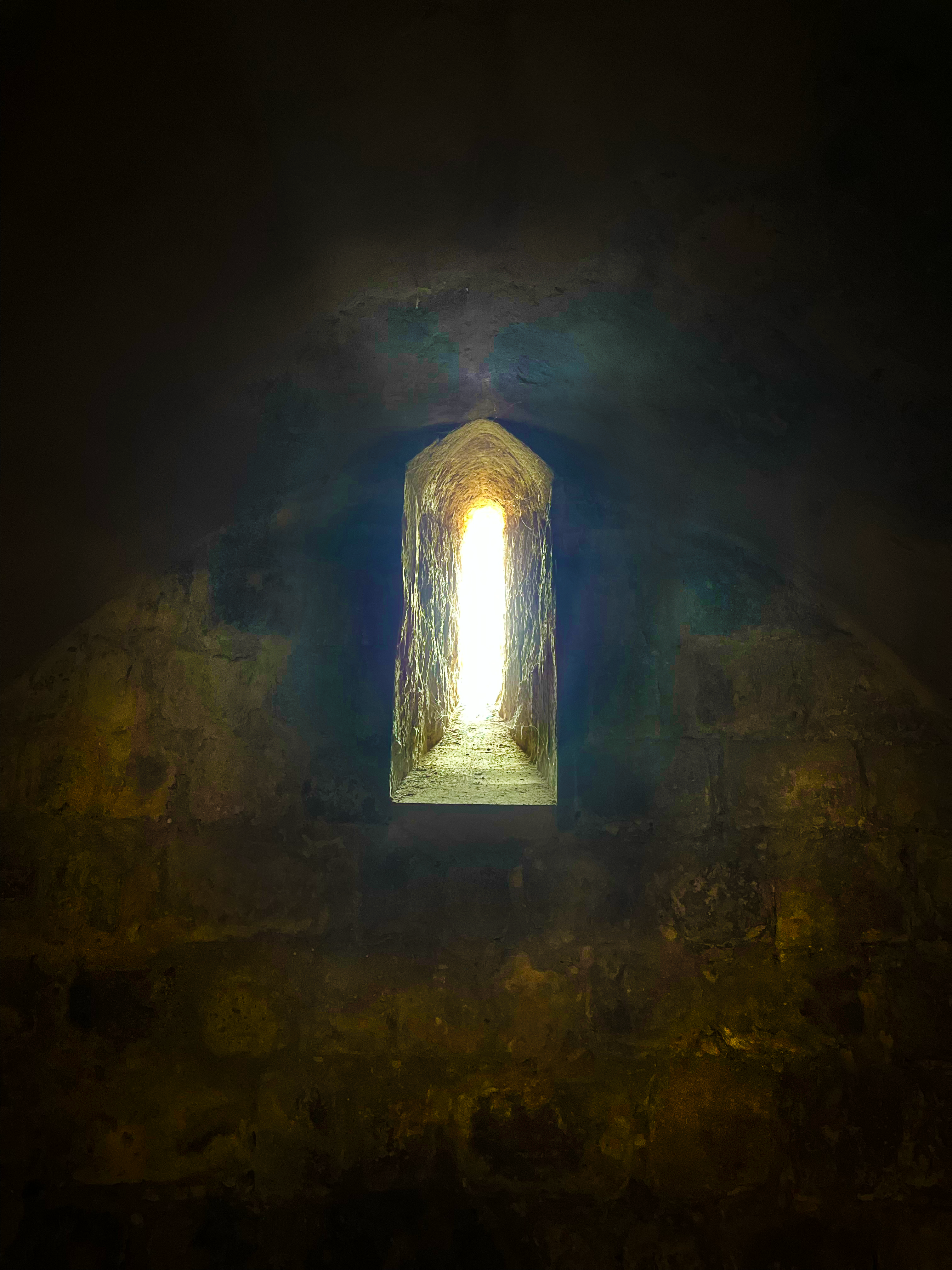
There is also a small window cut out that allows a sliver of light to flow into the crypt. It struck me as so powerful that I had to take a picture of it. Here I was, enveloped in darkness, in this place of death — and yet, I was drawn to this beacon of light and life. I was overwhelmed with a feeling of connection with Jesus. There in that tomb, looking at the glorious light pouring into the darkness, I had a deeper appreciation for the resurrection of Christ. Like Lazarus, I felt the Lord calling to me. It was the most worshipful experience I had in my entire time in the Holy Land — and it occurred in the darkness of a tomb. As our group was upstairs, singing praises in the beautiful chapel above, I was below in the crypt, weeping and giving thanks.
In all my time in Israel, this was where I most fully experienced the hope of glory, the Risen One.
My prayer for you on this Easter Sunday is that you would have your own experience of the hope of glory. I hope that you will find Him in your own darkness, in whatever tomb might have taken you in at the moment.
The empty tomb declares to us that it all ends in glory — the story of God ends in the glory of God for the people of God. Remember: we’re talking about a God who raised a dead man back to life. Wouldn’t you like to have that same resurrection power at work in your life?
Do you hear him calling your name today?
He’s saying, “Take off the grave clothes, my child.”
Become a new creation. Be raised to walk in newness of life by being washed in the living water of Jesus!
Weeping may last for a night, but joy comes in the morning.
In the name of Jesus Christ, the Sovereign Lord who makes all things new, he who has ears, let him hear.
James Keating has some great thoughts on the practice of Lent from his book Crossing the Desert: Lent and Conversion. Here are a few excerpts:
The word “lent” originated in Middle English and means “springtime.” By turning from sin and embracing moral goodness, by this act of denial, we experience a moral “springtime.”
It is a call to discipline the selfish part of the self and develop selflessness. This selfish part of the self needs to fast and do penance by visiting the “desert” of Lent and thus foster a growing dependence upon God.
Throughout Lent we either do things or refrain from doing things in order to become detached from the selfish self and attached to God alone.
Will we give up our agenda when love and moral goodness require it? Or will we cling to the selfish self out of fear that our own demands will be unmet?
The need to trust God is so paramount to moral and spiritual growth that a powerful religious symbol developed and became enshrined in Scripture to characterize this trust. This symbol is the desert. the desert immediately brings to mind aridity and aloneness – a vast, dry, isolated experience. It is this symbol, however, that carries the strongest of all claims: if you dare to come into the desert and open your heart to God – invite God to be God in God’s full providence – you will know salvation. The desert becomes the stage for God to woo us, to call the Church into union with God’s own self.
The season of Lent becomes a desert experience for us so we will come to depend upon God.
God’s providence does not depend upon our ability to provide for ourselves and / or control the activities of others or ourselves. It only demands that we be available to God working in us.
Lent asks whether we trust in God alone. Can we abandon the illusion of human self-sufficiency and live in obedience to God alone?
In Lent, God encourages the beloved to look again, to feel again, to trust again. ‘You will lose nothing by seeking me and being with me. All of your heart’s desires will be satisfied; just abide with me now in trust.’ What appears at first as barren to the desert entrant, soon discloses itself to be filled with blooms of new life. Hence the paradox of the spring-desert image of Lent. Here is the power of God in its utmost: Where one thought there was no life, God brings life.
In this way, the desert is the end of self-sufficiency and the beginning of communion.
If I had to pick one word to capture the heart of the gospel, I don’t think I could do any better than the word “sacrifice.” Sacrifice encapsulates the whole of the biblical story: from the call of Abraham to the law of Moses, from the death of Jesus on the cross to the cruciform life we are called to live as His followers.
But sacrifice requires selflessness. It requires surrender and submission and dying to self.
And this runs contrary to the way of the world.
The world preaches a gospel of selfishness that’s all about your rights and your entitlements, getting what you want and what you deserve. The self has become our highest ideal, our highest pursuit, our highest priority, and the controlling mechanism behind our every decision. And the evangelists of this gospel proclaim the good news of self-actualization and self-gratification and self-love.
It’s hard to imagine Jesus preaching this kind of good news. It’s hard to picture Jesus prioritizing the “self” in this way. That’s because Jesus lived a life of utter selflessness. He freely surrenders the pursuit of selfish desires when He says, The Son of Man came not to be served but to serve and to give His life as a ransom for many. He preached — and more importantly, He lived — a gospel of sacrifice, a gospel of DYING to self rather than LIVING for it.
And that kind of Gospel has always been at odds with the way of the world.
The writers of the gospels tell of the time when James and John, two of Christ’s closest followers, asked to sit at His right hand and His left hand when He entered into His Kingdom (Mark 10:35-45). At one level, this is a statement of faith. I mean, you don’t ask this unless you truly believe Jesus is the Messiah and that He has a Kingdom. But it is a failure because it shows that they don’t truly understand what kind of Messiah He will be. Their expectation – like many of the Jews of their day – seems to have been that Jesus would eventually march into Jerusalem, be crowned as Israel’s Messiah King, and then get about the business of purging Israel of Roman occupation. And James and John jockey for positions in His administration. They want high-ranking cabinet positions on that day.
In this way, James and John are proxies for all of us because they have an inordinate attachment to a particular view of power and success. Death – especially death on a cross – doesn’t exactly look like victory. Sitting with Jesus in glory on His inauguration day? Now THAT looks like victory! And in worldly fashion, James and John default into thinking selfishly.
Which is why Jesus scolds them so harshly. “After all this time with me,” He says, “you still don’t get it.” He reprimands them for thinking as the Gentiles think. The word for “Gentiles” means “the nations.” We also translate it as “the world.” Jesus is literally saying, “This is worldly thinking! You’re being selfish!This may be the way of this world, but it is not the way of My Kingdom!”
The implication is clear. Here are two different gospels about two different Kingdoms with two different ways of being. Which one will you choose?
In the early centuries of Christianity, the desert fathers and mothers left what they considered to be a godless society full of selfish passions to go and live solitary lives in the wilderness. But even there, selfishness proved to be the ultimate temptation.
The story is told of one of these younger brothers who had been insulted by another hermit. The younger brother came to one of the older Desert Fathers who was his mentor and he told of how he had been insulted. The young man said, “I am set to avenge myself, Father.” The old man begged him to leave vengeance to the Lord, but the young man said, “I will not stop until I have avenged myself!” So the old man said, “Well, let’s at least pray about it before you go and get your revenge.” And he got up and prayed, “Lord, we just wanted to let you know that you are no longer necessary to us, so you don’t have to worry about us any longer. For as this brother has said, we know better than you do. We are willing and able to avenge ourselves. Amen.” And when the younger man heard this, he fell at the old man’s feet and asked him to pray once again, asking that God would forgive him for his selfishness and his arrogance. And he contended no more with the man who had insulted him.
The way of the world says you’d better get even. Fight fire with fire.
But the way of Jesus says it is better to forgive. This is the kind of sacrifice Jesus asks us to make in remembrance of Him, the One who prayed from the cross, Father, forgive them, for they know not what they are doing.
Jesus lived His whole life in sacrificial submission to the will of the Father. It was never about Him and always about the will of God. The 17th century writer Madame Guyon pointed out that Jesus was just as faithful on the Mount of Calvary as He was on the Mount of Transfiguration. Whether in the glory of the Transfiguration or the agony of the cross, Jesus never wavered in His submission to the will of the Father. Jesus was just as submissive to the will of God on the mountain of agony and suffering as He was on the mountain of exaltation and glory.
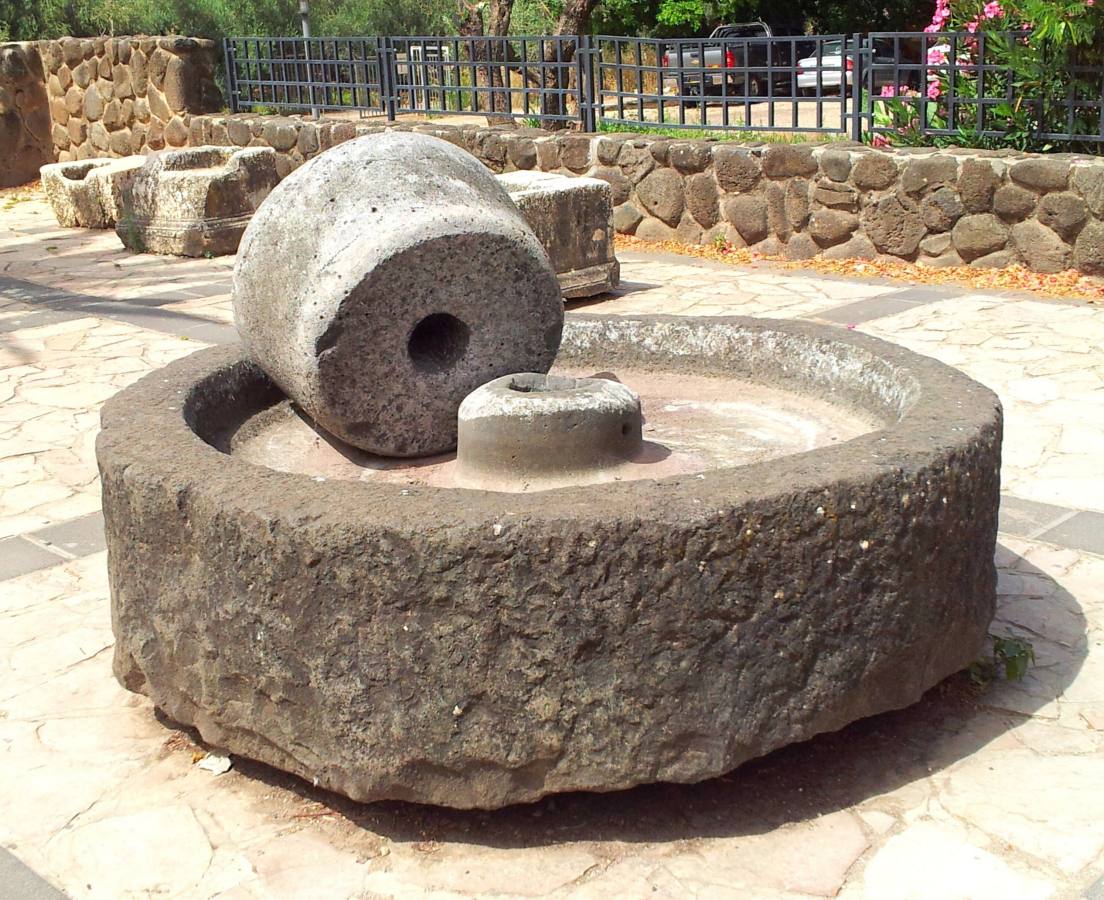
In season 4 of The Chosen, Jesus witnesses some of His followers working an oil press (Season 4, Episode 4). This is, of course, a fictionalized part of the story. We don’t have a biblical record of Zebedee and Mary Magdalene operating an oil press as the scene depicts. But it’s a realistic way to introduce something that would have been commonplace in Jesus’s day. These kinds of olive presses were used throughout the land of Israel in the first century. And it serves a purpose in the story of The Chosen. It foreshadows what must happen to Jesus. It points to His sacrifice.
Olives must be pressed in order for oil to be produced. This oil was used for cooking, but also for anointing the body, for medicinal purposes, and as a source of light used in the oil lamps at night. Oil was essential for many things in Jewish life of the first century. But in order for the oil to be produced, the olives had to be repeatedly crushed and pressed.
This foreshadows the way in which Jesus will be “pressed.” His blood will be shed under the weight of our sin at the cross – and just as this oil was essential for life in Israel, His blood will be essential in order for us to have eternal life.
And this scene points to what will happen in the Garden of Gethsemane, which is located on the Mount of Olives. You may not know this, but the word “Gethsemane” means “oil press.”
Jesus literally goes to the “oil press” and prays, “Not my will, but Yours be done, Father.”
Does that speak to your heart? Do you see what kind of selflessness Jesus embodied? Do you feel the weight of that sacrifice?
This is the heart of the gospel: Jesus sacrificed Himself so that we might have life.
But Jews came from Antioch and Iconium, and having persuaded the crowds, they stoned Paul and dragged him out of the city, supposing that he was dead. But when the disciples gathered about him, he rose up and entered the city, and on the next day he went on with Barnabas to Derbe. When they had preached the gospel to that city and had made many disciples, they returned to Lystra and to Iconium and to Antioch, strengthening the souls of the disciples, encouraging them to continue in the faith, and saying that through many tribulations we must enter the kingdom of God. And when they had appointed elders for them in every church, with prayer and fasting they committed them to the Lord in whom they had believed.
Acts 14:19-23
In a matter of one verse, the crowd turns on Paul.
In Acts 14:18, it’s all Paul and Barnabas can do to keep the crowd from worshipping them and making sacrifices in their honor.
By the end of the next verse, the crowd has shifted their opinion of Paul so much that they stone him.
There are so many unanswered questions here. What did these Jews from Antioch and Iconium say to incite the crowd? Was Paul simply “playing possum” here? And what about Barnabas? Where was he? The text doesn’t say.
What is clear is this: the crowd is always fickle. One moment, they’re calling him “Hermes,” and the next thing you know, they’re pelting him with stones and leaving him for dead outside the city. Sounds eerily similar to the crowd’s treatment of Jesus during Holy Week.
After moving on to Derbe, Paul and Barnabas get to work making disciples there and the text indicates that this work was quite fruitful. And after a period of time, they return to Lystra (where Paul was stoned) and also to Iconium and Antioch (the home of these Jews who had incited the crowd in Lystra to turn against them). This is incredible. How many of us would boldly return to a place where a mass of people tried to take our lives? Do you know what kind of courage that would require? And yet, Paul is undeterred. Furthermore, he also marches straight into the hometown of the people who were responsible for goading the mob into such violence. And he proclaims the same gospel message about Jesus that apparently had these Jewish opponents foaming at the mouth in anger in the first place.
The only way to explain this is to remember that Paul has had an encounter with the risen Christ. When you’ve been personally called by a man who has been raised from the dead, it changes the way you view hardship and persecution, even when the crowd wants to kill you. Paul’s message to the brethren conveys this: Acts 14:22, “It is necessary to go through many hardships to enter the Kingdom of God.”
Paul and Barnabas have a faith that leads them to take risks. They return to the scene of the crime where their lives were nearly taken. They go to these places where they aren’t safe, places where they aren’t in control. But that’s the nature of faith. There’s always an element of risk involved.
On the heels of these stops, Paul and Barnabas return to Antioch, declaring that God had opened a door of faith for the Gentiles (Acts 14:27).
Coming to the end of Acts 14, the question that comes to mind for me is this: “What are you risking by faith?”
I’m sure if you told Paul and Barnabas that the healing of the man who had been crippled from birth would prompt the crowd to worship, they would have said, “Great! That’s a good thing!”
But the problem occurs when the crowd moves to worship Paul and Barnabas instead of the God who has been revealed in Jesus.
Worship has never been our problem. Even the most irreligious among us is a worshiper. It’s what we were created to do.
Our problem is the object of our worship.
Wealth.
Pleasure.
Status.
Fame.
Social standing.
Sexual fulfillment.
Nationalism.
Tribalism.
The self.
We worship all sorts of things — because we were made for worship. The word “worship” literally means “to ascribe worth.” And everyone ascribes worth to something. You’re building your life around one pursuit or another, deeming some cause to be ultimately meaningful. Even if you haven’t darkened the door of a church in decades, you’re worshiping something.
The problem is that there is only ONE being worthy of your worship. This is where the crowd in Lystra gets it wrong. And we can relate, because this is where we often times get it wrong, too.
The priest of Zeus shows up to make sacrifices. I wonder if he’s trying to claim some sort of credit for the miracle. I don’t know — there’s no indication from the text that this is the case. Maybe he is representative of the kind of person who has no other category for divine handiwork other than the cliche spiritualism of his day. These people naturally assume that Zeus (or some other “god” from their culture) is the one responsible for the change in this man’s fortunes.
But Paul and Barnabas encourage the crowd to come to know the living God — and in so doing, to reject their worthless idols. I suspect this is the reason for the crowd’s swift turn against them.
It should be noted that Paul and Barnabas possess that rarest of all ministry traits: humility. I’ve known a lot of ministers over the years – many of them very gifted. They love the church and deliver beautiful homilies. They preside over weddings and funerals. They nurture the flock faithfully.
But not many are humble.
Paul and Barnabas, like John before them, refuse to accept even an iota of credit here that should instead be directed toward the Lord.
Huntsville is a beautiful city and I’m grateful to call this our home. Tonight, Sunny and I had a chance to spend some time downtown in Big Spring Park before seeing Mamma Mia at the Von Braun Center. We had a great time! Grateful that she’s still my girlfriend!