But in your hearts revere Christ as Lord. Always be prepared to give an answer to everyone who asks you to give the reason for the hope that you have. But do this with gentleness and respect…
1 Peter 3:15
I’m writing this to my Christian sisters and brothers.
We have a unique opportunity to live out our calling. In the days of COVID-19 and quarantine, our interactions with neighbors and loved ones have been curtailed severely. But we still have contact — thanks to telecommunication and video conferencing technology. If you’re like me, most of those conversations with loved ones center on the current crisis we’re facing and speculation about when things will “go back to normal.”
And that’s to be expected. But I’m reminded of something I believe from the depths of my soul: followers of Christ are to be the most hopeful people of all. And these present circumstances provide us with an opportunity to demonstrate the kind of living hope that Simon Peter references in the opening lines of the letter we call 1 Peter. It’s living hope based upon the resurrection of Jesus.
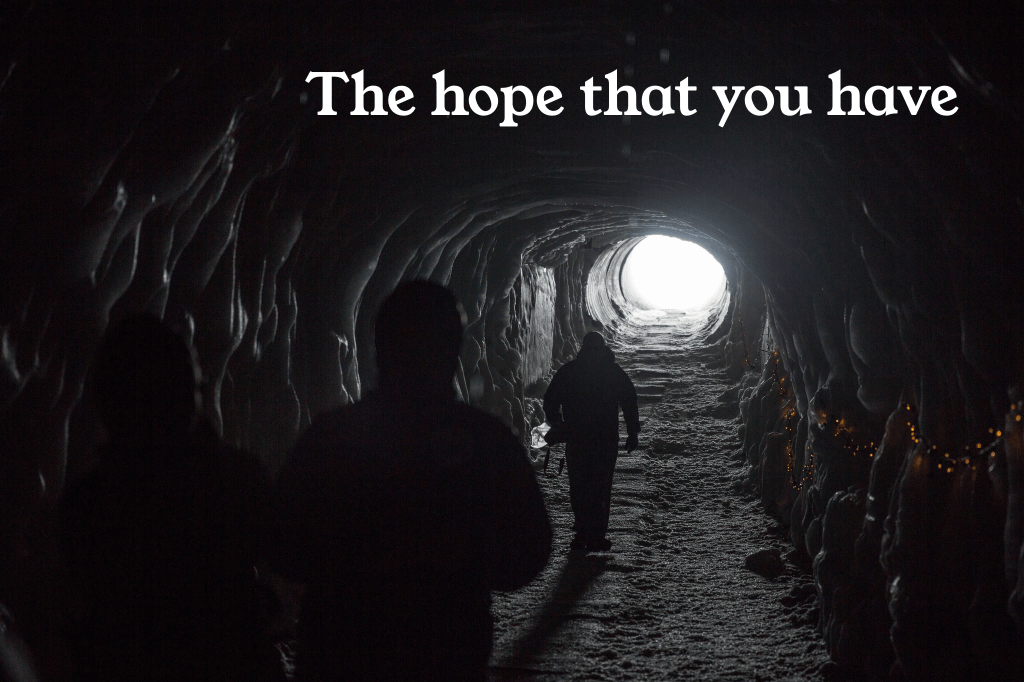
And when Hope comes alive in us, people will inevitably notice and ask questions.
And we will have an opportunity to talk about the hope that we have.
What a tremendous moment of ministry for us! Lord, give us eyes to see the eternal significance of this moment we’ve been given.
One important distinction: hope is not the same thing as optimism. It’s easy to confuse the two, especially today. And optimism is en vogue. I mean, check out John Krasinski’s “Some Good News” posts if you don’t believe me — each one has garnered millions of views. But optimism alone tends to be sort of naive if you ask me — banal assumptions like “people are good” or “the world is good” may make for viral viewing, but that’s not really Christian hope.
Christian hope rejects simplistic positivity in favor of a more sobering view: people usually AREN’T good and neither is the world. The world is often a dark, cold place. It will hit you in the mouth and steal your lunch money. The way of Christian hope leads first to the cross, a recognition of all that is broken and messed up in this supposedly “good” world of ours.
But it’s precisely in the midst of such darkness that Christian hope flourishes. Philosophically, optimism posits that we live in the best of all possible worlds. Christian hope affirms that we do NOT live in the best of all possible worlds — but such a world is on its way through God’s Messiah, Jesus. This is the only thing that makes us good — the transforming power of a God who is capable of restoring all creation, including humanity, to His originally good purposes.
This is our living hope, the hope of glory.
God’s world is on the way.
Until it comes, may we hasten it’s arrival by living out our hope amid these hopeless days.
Bad news. It seems as if that’s all we hear these days. The COVID-19 pandemic has claimed over 20,000 American lives — and we’re told the worst is still yet to come. For many of us, the rhythm of life has been disrupted and we find ourselves in the midst of a new normal that seemed unthinkable just a few weeks ago. Now, “social distancing” and “flattening the curve” are phrases that will surely haunt us for decades to come.
As a church family, we will be celebrating Easter Sunday tomorrow — but that celebration isn’t quite what any of us anticipated. Instead of gathering together at 1095 Carl T. Jones Drive, we will be worshipping in our homes tomorrow. And while that creates some unique opportunities for us as families, this new reality can also be disappointing, especially on a morning like tomorrow. No Easter dresses; no egg hunts; no lunch at grandmother’s…those are just a few of the things we’ll be missing tomorrow.
And more importantly, we’ll be missing each other tomorrow, just as we have for the past several weeks. We miss our church family so much right now. We miss the joy of fellowship with our sisters and brothers; we miss hearing your laughter; we miss joining our voices together in praise; we miss our seat on the third row; we miss praying together with one heart; we miss communing together and studying together and sharing meals together….all of these things that are a part of our life together as a community.
We want you to know that our hearts ache with you and the unique challenges you’re facing in these days. Our hearts ache for the young parents who are working from home while also helping their children stay on task with their schoolwork. We ache for caregivers unable to be near their loved ones in hospitals and care facilities. We ache for the small business owner who faces some difficult financial decisions. We ache for the new Mommies whose playdates have been interrupted — we know those dates were as much for you as they were for your babies! We ache for those who are quarantined alone, whose homes are much quieter than they wish.
We weep with those who are weeping right now, just as you have always joined us in our own seasons of lament.
And yet, we remember that this is a season of hope, a season of Good News.
We remember that the resurrection of Jesus — the most glorious event in human history — burst forth in the midst of hopeless circumstances such as these. Good News audaciously announced in a graveyard, of all places.
We want you to know that just as surely as our hearts ache with you, our hearts also hope along with you. Our hearts are full of hope that someday soon, we will be gathered together again under one roof. And what a day of celebration that will be! Until that day comes, we take heart in the movements of the people of God. Day after day, we are blown away by the stories we are hearing about the things you are doing in your communities in the name of Jesus. So much ministry has taken place in the last month — more than we can even recount. It’s simply enough to say, “Thank you, Lord,” for the opportunities He’s given us to be the hands and feet of Christ through simple, everyday acts of kindness and compassion.
And we take heart in the actions of those in our community — those who continue to work and serve in spite of these circumstances. We give thanks for our health care professionals, our first responders, our police officers and fire and rescue crews and utility teams and countless others whose selflessness reminds us of the selfless character of Jesus — whether they profess His name or not.
We take heart that although we seem to have lost much in the last few weeks, what we have gained might be even greater. Many of us have a better perspective on what really matters as we’ve been forced to adapt to a simpler way of life. Our neighborhoods are filled with people walking and waving at each other — from a safe distance, for sure, but we seem to have returned to a spirit of neighborliness. Many families are sharing time around the table more often — perhaps as many as three times a day. At our home, our dishwasher has been running constantly and we are certainly grateful for that.
In this difficult time, we simply wanted to remind you that Easter has never been about pretty dresses and egg hunts and lunch at grandma’s — as great as those things might be. More than anything else, Easter is about hope — the hope of glory, Jesus Christ. It is about an empty grave laughably exposed by a man who wouldn’t stay dead. It is about the hope that even in this present darkness, God will find a way. Because the empty tomb declares that He always finds a way.
From the darkness of this Saturday night, we join in the refrain of all creation: Sunday is coming! For He is risen! And nothing in heaven above or hell below will ever change that. Therefore we keep hope alive. For this is the unchangeable truth of eternity: Jesus Christ is the Sovereign Lord who makes all things new — time without limit, world without end. Amen.
I have a confession to make: I am really struggling with a scarcity mindset right now.
A few nights ago, I went out to the store to get some bread. When I got there, this is what I found:
I’ve never been to the store and seen completely empty shelves! It reminded me of Who-ville after the Grinch has come through and taken the last can of Who-Hash! And it wasn’t just one store that was like this — I couldn’t find bread anywhere in town.
Maybe you’ve had a similar experience this week. In times of uncertainty, the fear of scarcity — not having enough — can drive us to stock up and horde things. The scarcity mentality causes us to act in ways we wouldn’t normally act. A friend of mine mentioned that she saw people actually taking items out of other people’s shopping carts when they weren’t looking. Another friend told of someone who stole a pack of toilet paper out of their car in the parking lot of a grocery store. When we see empty shelves at the store, the scarcity mindset kicks in and fear does its worst in us.
At the beginning of 1 Kings 17, we learn that a severe drought has come upon the land of Israel. This is actually brought about by God and his prophet, Elijah.
We might ask why God would do such a thing. Well, the Canaanites believed Baal was the god of rain and fertility. Throughout the Old Testament, the children of Israel would be tempted to worship Baal — to ask him for rain, for healthy crops, for healthy children, etc. In the time of Elijah, the people were turning to Baal and asking for his blessing of rain upon the land. So Elijah’s announcement of the drought serves to demonstrate that it isn’t Baal but the LORD who controls the rain. HIS power is supreme.
God provides for His prophet by giving him water from this brook and directing the ravens to supply him with bread and meat, both in the morning and in the evening. We don’t have any other details, but this story shows God providing sustenance for Elijah. And this is a key point for what comes next: Elijah, in turn, will provide sustenance for someone else in a time of scarcity.
Then the word of the LORD came to him: “Go at once to Zarephath in the region of Sidon and stay there. I have directed a widow there to supply you with food.” So he went to Zarephath. When he came to the town gate, a widow was there gathering sticks. He called to her and asked, “Would you bring me a little water in a jar so I may have a drink?” As she was going to get it, he called, “And bring me, please, a piece of bread.”
“As surely as the LORD your God lives,” she replied, “I don’t have any bread — only a handful of flour in a jar and a little olive oil in a jug. I am gathering a few sticks to take home and make a meal for myself and my son, that we may eat it — and die.”
1 Kings 17:8-12
God sends Elijah to a place called Zarephath, north of Israel. This was a place where Baal worship was even more rampant. And it seems that the drought has extended to this region as well. But there is a widow in Zarephath and God directs Elijah to go to her. “She will supply you with food,” God says. But that’s only part of the plan. God intends for this widow to meet Elijah’s needs and for Elijah to meet the needs of the widow and her son. This is how the abundance of God is demonstrated in a time of scarcity.
Elijah asks the widow for some bread and her reply is heartbreaking: “I don’t have any bread — just a handful of flour and a little oil.” The shelves in her home pantry are barren. She tells Elijah that she’s gathering wood for a fire so she can go home and prepare one final meal — a last supper — for her and her son. They have no one looking out for them and they have nothing to spare. Scarcity has become a death sentence for the widow of Zarephath.
The widow says something interesting when she speaks with Elijah: As surely as the LORD your God lives. Even though she lives in the land of Baal, she knows something of Israel’s God — enough to refer to Him as “the Living God.” This sounds like an expression of faith. She’s lived long enough to know that all those prayers and sacrifices to Baal amount to nothing. “No graven image can help me,” she says. “Only a living God.” But she’s reached the end of the line — “I’m going to go home, fix a final meal for my son and myself, and then we’ll die.” Her deprivation has made her despondent. But this is precisely where God does His best work. He specializes in bringing abundance out of scarcity.
Elijah said to her, “Don’t be afraid. Go home and do as you have said. But first make a small loaf of bread for me from what you have and bring it to me, and then make something for yourself and your son. For this is what the LORD, the God of Israel, says: ’The jar of flour will not be used up and the jug of oil will not run dry until the day the LORD sends rain on the land.”
She went away and did as Elijah had told her. So there was food every day for Elijah and for the woman and her family. For the jar of flour was not used up and the jug of oil did not run dry, in keeping with the word of the LORD spoken by Elijah.
1 Kings 17:13-16
Elijah replies to her by saying, “Don’t be afraid.” Those are the same words we talked about last week — words that are always spoken within the context of God’s presence. Elijah promises that God will be miraculously present to her and her son through the abundance of their flour and oil. Elijah tells her, “The jar of flour will not be used up and the jug of oil will not run dry until the day the LORD sends rain on the land.” Elijah brings her in contact with the world of God’s great abundance.
Let’s look at the way God uses faithfulness in this little story:
God uses the widow to meet the needs of Elijah by faith. (It was an act of faith on her part to use her resources to make bread for Elijah.)
God uses Elijah to meet the needs of the widow and her son — also by faith. (It was an act of faith on Elijah’s part to journey where the LORD directed him to go.)
At any point, fear might have derailed these faithful actions. But trust in the active presence of the living God sustained these acts of faith.
This story teaches us some really important things that we need to remember in times like this:
First, in times of scarcity, it’s good for us to recognize that the scarcity mentality doesn’t come from God. Baal is the one who traffics in scarcity. The whole enterprise of Baal worship in the ancient world was predicated on the idea of scarcity. Baal declares, “Worship me or you won’t have enough.” And that prompts people to do crazy things — like steal toilet paper out of someone else’s car!
No, the scarcity mentality doesn’t come from God because (secondly) our God is a God of abundance. Even during this drought in Elijah’s day — which God brought about — the drought was intended to help Israel realize the abundance they already have in God. And faith is living out of God’s great abundance.
Finally, this story teaches us that the people of God can counter scarcity through sharing and through serving. According to the Scriptures, God sent Elijah to the widow and God sent the widow to Elijah. They overcome the scarcity of their circumstances by sharing with one another and by serving one another. That’s precisely where the miraculous power of God shows up in this story.
And I believe God has given us an opportunity to do the same thing right now. I believe this is an opportunity for us to be sent out to the people in our communities — much like God sent Elijah to the widow and God sent the widow to Elijah.
This is a great time to check on your neighbors; the people who live closest to you. There was a time when we knew our neighbors and we would rely on them if we needed to borrow a tool or a few ingredients. I can’t tell you how many times my Mom sent me to the Nortons next door to borrow some margarine or some brown sugar. And they would borrow from us all the time. That doesn’t happen very much anymore, but since we will be spending more time in our neighborhoods, this is a great opportunity to reach out to your neighbors, see what they need, and share out of your own abundance.
There might be someone just like this widow who is living on your street. Maybe he or she can’t get out and get some of the things they need right now. Maybe they haven’t been able to get out and get groceries. Could you share a bit out of your abundance? Or maybe they can’t get out and pick up their prescriptions. Could you serve them by making a trip to the pharmacy on their behalf? I’d ask you to be praying about that and see what God puts on your heart.
Scarcity impacts us in different ways. We’ve talked a lot about the run on food and supplies. But “social distancing” is a term that is being used now and although we understand why we’re being asked to take these precautions, there are some who are hurting emotionally as a result of this.
I’m thinking of a friend of mine who lives alone with no family nearby. Attending church is not only something they do out of obedience to God, but it’s also a social connection for my friend. So right now, her scarcity mindset is less about groceries and supplies — it’s emotional. My friend is just really, really lonely right now.
Maybe you know someone like that. During this time when our lives have slowed down a bit, would you make a note to reach out to that person? Could you help overcome the emotional scarcity he or she is feeling because of isolation and loneliness?
In times like this, I hope we can remember that our God is a God of abundance. We believe in a God of manna, a God of daily bread. Jesus tells us to ask for daily bread — and by sharing and serving, we can actually help to provide daily bread for the people around us — the hungry, the lonely, the overlooked. That seems to be God’s preferred way of countering the scarcity mentality — with His great abundance.
I just have a feeling that widow and her son found a way to share with the people in their community. Because that’s what happens when you experience God’s abundance.
And all of this points us to Jesus, who came years later declaring that the god of the scarcity mentality comes only to steal and kill and destroy. But Jesus says, I have come that they may have life, and that they may have it more abundantly. Jesus explains this further by declaring, I am the bread of life. Whoever comes to me will never go hungry, and whoever believes in me will never be thirsty.
In Jesus we come to know the abundance of God, the only God who can meet our needs, both physically and spiritually. At His table, our cup runneth over — and we can dwell in the house of the LORD forever, time without limit and world without end.
What were the do’s and don’ts in your house when you were growing up? Around our house, the list of “do’s” was pretty standard: brush your teeth, make your bed, clean your room, etc. Those were the things I was repeatedly told to do. But I heard plenty of “don’ts” as well:
Don’t talk to strangers.
Don’t disrespect your teachers.
Don’t you raise your voice at me.
One of the most common “don’ts” I heard was, “Don’t say that.” She would overhear me saying something that I shouldn’t — something crude or mean-spirited — and she would say to me, “We. Do. Not. Talk. Like. That!” I don’t know how many times she threatened to wash out my mouth with soap. I guess that got my attention, because as far as I can remember, she never had to follow through on her threat.
One of the most common “don’ts” in the Bible is do not fear.
In his book Fearless, Max Lucado points out that there are 125 direct imperatives delivered by Jesus in the Gospels — these are the direct commands, the “do’s and don’ts” of Jesus. Of these 125 commands, the most common one is, “Do not be afraid. Take courage. Fear not.” Jesus says this kind of thing over 20 times in the Gospels. And you find it throughout the Bible, from cover to cover, throughout the Old Testament as well as the New.
Do not fear.
But what do you do when you are afraid? What about in times like the present, when there is so much to fear? Does it make me unfaithful if I find myself afraid? Does it make me unfaithful if I’m afraid of COVID-19? Or cancer? Or bankruptcy? Or the future? Or any of a million other things that presently terrorize us? What do you do about all of that?
See, we could still meet in our churches and have a big religious pep rally and I could say something like, “The Bible says, ’Thou shalt not fear!’ Therefore we are not afraid!” And that might garner thunderous applause from some people — because some think this whole thing is no big deal, it’s all overblown hysteria. And the implication is easily drawn, the connection that faithful necessarily means fearless.
But there are some of us who are legitimately fearful — and no religious pep rally is going to change that. In fact, the pep rally actually works negatively in their lives. The pep rally actually can be a tool of Satan in them, because it merely induces shame. These are good people who don’t want to be fearful, but they find themselves afraid anyway. And so telling them that they shouldn’t be afraid does nothing to allay those fears; it simply deep fries those fears in a layer of guilt and shame.
I have a friend; we’ll call him Vincent. For the first 11 years of his life, Vincent wet the bed. He didn’t mean to wet the bed, but it happened every night. His parents would tell him every night, “Vincent, don’t wet the bed,” and every morning he woke up to a wet bed. Eventually his parents would say, “If you loved us, you wouldn’t do this.” But Vincent couldn’t help it. He said he went to bed every night in fear and he woke up every morning in shame.
I think Vincent’s experience is similar to what some of my friends are experiencing. They’re fearful — really afraid right now — and the message they’re hearing in some corners is essentially, “If you loved God, you wouldn’t do this.” And they feel shame on top of fear.
Does it make me unfaithful if I am afraid?
Absolutely not!
It doesn’t make us unfaithful if we’re afraid. We don’t become bulletproof when we come to the Lord. We’re not made of spiritual Teflon. We have feelings — and fear is a legitimate feeling. There are times in life when we will most definitely be afraid. So it doesn’t make us unfaithful if we’re fearful.
It makes us unfaithful if we don’t take our fears to the Lord. When we take our fears to God, we find that He is faithful to be present with us in those fears. The Gospel writers describe the experience of Jesus in the Garden of Gethsemane by using the following words:
He was deeply distressed and troubled. (Mark 14:33)
His soul was overwhelmed with sorrow to the point of death. (Matthew 26:38)
And being in an agony he prayed more earnestly; and his sweat became like great drops of blood (Luke 22:44).
But to whatever degree Jesus felt stress and overwhelming sorrow and agony and possibly even fear, He shows us the faithful way to deal with those fears. We take them to God. Jesus prays the ultimate prayer of humility when He says to the Father, “Not my will, but yours be done.”
Jesus also perfectly embodies one of the most well-known passages of Scripture, Psalm 23.
Even though I walk through the valley of the shadow of death, I will fear no evil, for you are with me; your rod and your staff, they comfort me.
Psalm 23:4
We serve a God who promises to sit with us in our fears, to join us right there in the darkest points of our lives, the valleys of deepest darkness. In these moments, we come to know the abiding presence of God. How can David say, I will fear no evil? Because he has learned that thou art with me.
But what if I don’t feel as if God is present? The reality of God’s presence is not bound by our feelings. He is there, no matter what.
God chose to make Himself known most fully in an act of death — the cruel execution of Jesus, executed by the state as a felon, even though He had done no wrong.
And Jesus quotes from Psalm 22 as He hangs there — My God, my God, why have you forsaken me? — as a way of identifying with us when we don’t feel God’s presence. And yet, God was present — Jesus is God in the flesh right there, dying on our behalf.
What I’m trying to say today can be summarized this way:
Does fear control my faith?
Or does my faith control my fears?
Taking precaution is not the same thing as acting in fear. God tells that one of the most important things we can do is to love Him with all of our minds. That doesn’t just mean Bible study — it means using our rational function to the best of our ability to make the best decisions possible.
Loving God with all of our minds also means that we fall back on what we know. We can’t control the circumstances of our lives, but we can control what we know.
Three things to remember when fear is at its strongest:
God is with us.
Jesus — the Scriptures refer to him as Immanuel, which means “God with us.”
He came to earth to be God “in the flesh.” God with us and God among us.
In John 1, it says that Jesus put on flesh and became one of us. John says He does this in order to be light shining in the darkness.
God goes before us.
God leads His people — He goes before us.
In the book of Exodus, God led His people through a pillar of cloud by day, fire by night. No matter the circumstances — day or night, good or bad — His presence was always with His people.
God goes before us in times of wilderness just as surely as He goes before us as we enter the Promised Land.
Whether times or good or bad, we can count on the presence of the God who goes before us.
God is on our side.
This is the best news of all. God is for us; He is on our side.
Romans 8:31, What then shall we say to these things? If God is for us, who can be against us?
We also need a way of reminding ourselves of what we believe when we find ourselves dealing with fear. Here’s what I do — I pray. We can’t control the circumstances of life, but we can control what we pray.
That’s why I’m such an advocate for breath prayers — quick, regular reminders of God’s power and what He has done. The prayers in the Bible are filled with some of the same phrases over and over again — I’m thinking of the classic line, “Give thanks to the Lord; for He is good. His love endures forever.” I’ve found that repeating some of these lines from Scripture can be a source of strength when I’m fearful.
Here’s one example: Psalm 94:19, When anxiety was great within me, your consolation brought me joy. I’ve started praying this when I feel fear beginning to creep in. I’ll shorten it to something like: “In my anxiety, console me with your joy.” The more I say that, I can feel the anxiety decrease, and I can feel God consoling me with His joyous Good News.
Other times, I simply pray, “Jesus Christ is my peace.” When I feel uneasy or when things seem to be spinning out of control in my life, I come back to this bedrock truth: “Jesus Christ is my peace.” That’s taken directly from the prophet Micah and the apostle Paul. But this prayer helps to remind me that even during times of chaos, I serve the One who commands the winds and the waves. Even the chaotic power of Death could not defeat King Jesus! He is our peace — the One who can calm our fears.
Psalm 27:1The LORD is my light and my salvation — whom shall I fear? The LORD is the stronghold of my life — whom shall I dread?
It’s not as if we somehow become bulletproof when we come to know the Lord. We still have to deal with fears. But with Jesus as our Lord, we have One upon whom we can place our fears. He faithfully joins us in the midst of our fears and brings light and salvation.
Earlier this month, I had the opportunity to attend the National Prayer Breakfast, an annual gathering in Washington D.C. hosted by members of Congress. It was a wonderful experience and I was grateful to receive the invitation. I was especially encouraged by the bipartisanship the event seemed to foster, as both Democrats and Republicans took the stage to read Scripture and pray together. But the highlight of the event for me was the keynote address delivered by Arthur C. Brooks, a social scientist, author, and Harvard professor. Brooks delivered a stirring monologue about our present culture of contempt and the ways in which it permeates our political discourse. This crisis of contempt and polarization, Brooks says, is tearing our society apart.
Perhaps you’ve noticed.
Brooks defined contempt with a quote from German philosopher Arthur Schopenhauer: “the conviction of the utter worthlessness of another human being.” For decades, psychologist and marriage researcher John Gottman has been touting contempt as the kiss of death for married couples. Contempt can be measured both verbally and non-verbally: interruptions, biting sarcasm, constant criticism, and eye-rolling are some of the usual suspects. When interrupting, sarcasm, criticism, and eye-rolling become common at home, you probably want to call a marriage counselor. But when they take place in the political arena, we televise the whole thing and call it a presidential debate.
Brooks noted that contempt has reached a toxic level in our culture. We seem to have lost the ability to disagree well, content to simply retreat into our our respective ideological camps which function quite effectively as echo chambers of like-mindedness. And because we don’t spend very much time among people with whom we disagree, it becomes all too easy to label those individuals as “evil” or “stupid.” Or worse.
I was fully tracking with Brooks as he delivered his address. Like most Americans, I bear a few scars resulting from fractious political conversations with friends over the years. And like most Americans, I can point to several relationship casualties, friendships that ultimately could not stand the freight of our political differences. And like most Americans, this grieves me.
I found myself thinking, “What does the way forward look like?” And as Brooks delivered his speech, I expected him to advocate for greater tolerance for one another. We basically live in the golden age of tolerance; it is hailed as one of our highest cultural ideals. But shockingly, Brooks said tolerance is not the answer. The problem of contempt can only be solved one way: through love. Brooks said, “Jesus in the Gospel of Matthew didn’t say tolerate your enemies, he said love your enemies.”
The way forward isn’t greater tolerance or civility.
The way forward is love.
The way forward isn’t disagreeing less.
The way forward is disagreeing better.
The antidote to contempt — according to Brooks but, more importantly, according to Jesus — is to love one’s enemies. What I loved about Brooks’ speech was his desire to maintain the relevancy of the words of Jesus, even amid a political climate such as ours. All too often, we rush to easy reductionism when it comes to the teachings of Jesus, particularly the Sermon on the Mount. “You can’t act that way in the real world,” we’ll say when Jesus tells us to turn the other cheek or go the second mile. We reduce the clear teaching of Jesus to the level of religious aphorism, as if whatever “spiritual” meaning we find there has no translation into tangible action. “Loving your enemies doesn’t work in the real world.”
Father, forgive us for presuming that we understand reality in a way that Jesus does not.
Father, forgive us for presuming that we understand reality in a way that Jesus does not.
I appreciated Brooks reminding us that if Jesus is truly Lord as we claim, then His words are resonant with relevance today. If Jesus is truly the Lord that we believe Him to be, then He is the one with the proper view of reality, not me. His call to love my enemies comes to bear precisely in the midst of fractious, contemptuous contexts such as our current moment. To paraphrase the old adage: If He isn’t Lord of this moment, then He isn’t Lord at all.
In the weeks since the National Prayer Breakfast, I have tried to be more aware of the dangers of contempt, especially among followers of Jesus. It would be a misnomer to identify political contempt in this country without also naming the spiritual analogue. I’ve been forced to examine my own heart for any traces of contempt, any temptation to treat another as if they were worthless. I have to fight the urge to retreat into my own ideological bunker, even among my sisters and brothers in Christ. And I’ve been reminded of something Jesus said a long time ago: that the way forward isn’t tolerance or civility, but love.
This week, we experienced some conflict in the church I serve. As a career churchman, I can say this conflict was of the standard issue, low level variety, but it was conflict nonetheless. And for the sake of full disclosure, I was simply an ancillary figure in the whole episode. But even from my vantage point in this conflict, I witnessed the power of disagreeing better in real time, and it was beautiful. Those who were offended voiced their concerns without accusation. The offender went directly to the individuals who were hurt and asked their forgiveness. Reconciliation flourished. Feelings were hurt, yes, but reactions were godly. The entire episode was handled with grace and truth, a reminder of the One who perfectly embodies both of these qualities.
As always, love is the way forward, the antidote to contempt.
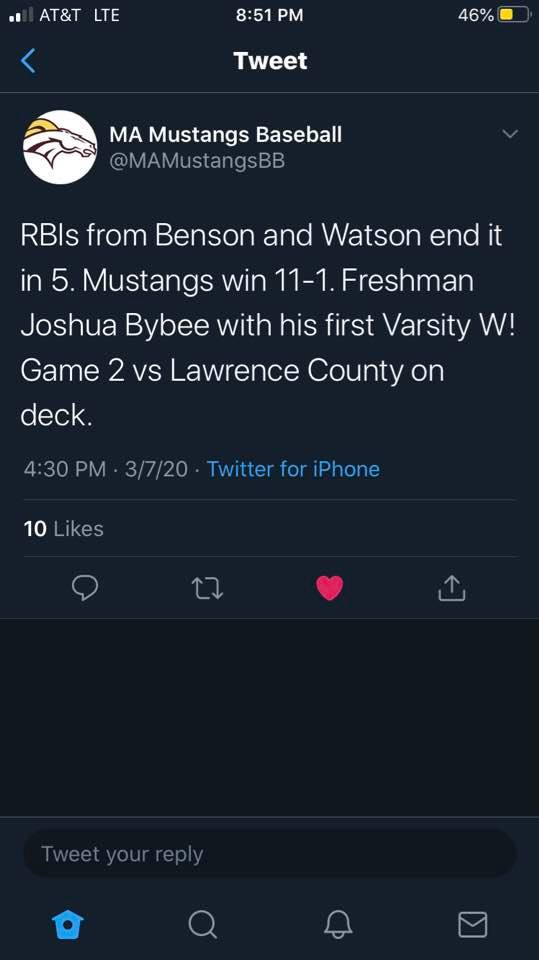
This kid. I have so much fun watching him play the game he loves. Today he was on the mound for the first time in this young season and he was rewarded with results to match all his hard work. He pitched 6.1 scoreless innings, giving up only one hit and striking out 16 batters. Best of all, his team won 1-0 on a walk off hit in the bottom of the seventh. Way to compete, #32!
In our study of Genesis, we have talked about a God who creates; a God who faithfully keeps His promises; a God who sees us, even when we feel overlooked. We have looked at the stories of Abraham, Sarah, Hagar, Ishmael, and Isaac. We’re now ready to move ahead in the story to the twin sons of Isaac and his wife Rebekah. These two sons — Esau and Jacob — are as different as night and day.
Esau was the firstborn and the Bible says that he came out red and hairy, kind of like Elmo I guess.At their birth, the younger brother, Jacob, was clinging to the heel of his older brother. In fact, his name is a take on the Hebrew word for “heel.” It also has the connotation of deception and shadiness. And Jacob will truly live up to his name as a “heel grabber” who can’t be trusted, right up until the moment he receives a new name and a new identity.
When the boys grew up, Esau was a skillful hunter, a man of the field, while Jacob was a quiet man, dwelling in tents. Isaac loved Esau because he ate of his game, but Rebekah loved Jacob.
Genesis 25:27-28
At this point in the biblical story, we come across a disturbing pattern of parents playing favorites with their children. Esau is a “man’s man” who likes to hunt and fish; we might picture him wearing camouflage and sporting a Duck Dynasty beard. And Isaac favors his oldest son because he was an expert marksman and Dad liked to eat the food Esau provides. But Jacob is quieter and he stays inside — some believe this means he was a scholar. He certainly comes across as more conniving than Esau. The differences between Esau and Jacob are like the differences between Mufasa and Scar or the differences between Sonny Corleone and Michael. Esau is the big, strong athlete of the family whereas Jacob is the academic. And these differences seem to divide their parents: Isaac favors Esau while Rebekah loved Jacob.
And as you might imagine, all of this created something of a rivalry between these two brothers.
One day, Esau comes back to camp after a long day of hunting and, understandably, he’s hungry. I guess the hunt didn’t go so well that day. He smells some stew Jacob is cooking — red stew, according to the Bible — and he tells his little brother to fix him a bowl. Jacob says, “Sure, you can have a bowl of stew…in exchange for your birthright.”
In the ancient world, the oldest son received extra blessing among the children. He was understood to be the one to carry forward the family name; he would inherit the lion’s share of the family estate. As the firstborn, Esau possessed this special status. Remember, God had made promises to bless the entire world through the line of Abraham. This blessing was passed through Abraham to his son, Isaac; and from Isaac to his firstborn, Esau.
If you were Jacob, would you resent the fact that only a few seconds separated you from this blessing? Would you resent your older brother for being the apple of your father’s eye? Every time someone called Jacob’s name, they were essentially saying, “Hey, heel grabber.” That means every time someone called his name, Jacob would be reminded of the fact that he was always in second place next to his brother, always subservient to Esau, always the one “grabbing the heel” of the one ahead of him in line. So when the opportunity arises, Jacob wrestles the birthright away from his older brother. The Bible says that Esau despised his birthright — meaning he treated this great blessing as if it were nothing at all. He was a slave to his desires. So he trades away something of great value for something as fleeting as a bowl of stew. And Esau’s story is a reminder to us of the dangers of being slaves to our desires.
How many times are we tempted to do the same thing? To forfeit something sacred and special for something fleeting and temporal? I imagine this is a regular temptation for many of us.
Jacob was not content with duping his brother; he goes on to take advantage of his blind father as well. With his mother’s help, Jacob tricks Isaac into giving him Esau’s blessing. These kinds of blessings were very important in the biblical story. Because they were essentially prayers addressed to God, they were viewed as helping to shape the future of those who were blessed. Can you think of anything more despicable than taking advantage of someone’s disability for your own personal gain? Yet that’s exactly what Jacob does.
When Esau discovers this, he is enraged; the Bible says he hated Jacob and made plans to kill him. And so Jacob, fearful for his life, goes off to the land of his mother where he lives for many years.
And the years go by: Esau and Jacob marry and have children of their own. Jacob does well in the land of his mother, building up his flocks and accruing great wealth. And in those days, the angel of the LORD appeared to Jacob in a dream and told him to return home.
And Jacob said, “O God of my father Abraham and God of my father Isaac, O Lord who said to me, ‘Return to your country and to your kindred, that I may do you good.’ …. Please deliver me from the hand of my brother, from the hand of Esau, for I fear him, that he may come and attack me, the mothers with the children.”
Genesis 32:9-11
Here we find Jacob wrestling with his past. He has been away for many years and he worries about how Esau will receive him when he returns. Is he still upset? Has my brother forgiven me? Or does Esau still want to take my life? Jacob’s servants tell him that Esau is coming out to meet Jacob…and he is bringing 400 men with him. Scholars say this was a standard number for a raiding party or a military regiment in the ancient world. Basically, Esau is riding out to meet Jacob and apparently he’s bringing an army. And the Bible says that Jacob was greatly afraid and distressed.
And we know what this is like. We all have those things in our past that cause us shame. Maybe it’s someone you once wronged. Maybe, like Jacob, you deceived someone or took advantage of them. You hurt them by betraying their trust and now you’d just as soon avoid them for fear of how they might receive you. Maybe it’s even progressed to the point of Jacob and Esau’s relationship — to the point where you worry that they might want to inflict harm upon you in retaliation for the way you once hurt them. Every one of us is familiar with this feeling of fear and distress over the things we’ve done or said.
And to my way of thinking, this is further evidence that the Bible is a word from God rather than man. Because the biblical story does not shy away from the areas of our lives that bring us shame. In fact, the biblical story almost always goes directly to those places of great pain and difficulty, to demonstrate God’s ability to reconcile and redeem. Even in the darkness of Jacob’s guilt and shame, God is at work.
Jacob asks God to deliver him from the mistakes of his past. And then he has an encounter that radically alters the course of his life.
The same night he arose and took his two wives, his two female servants, and his eleven children, and crossed the ford of the Jabbok. He took them and sent them across the stream, and everything else that he had. And Jacob was left alone. And a man wrestled with him until the breaking of the day.When the man sawthat he did not prevail against Jacob, he touched his hip socket, and Jacob’s hip was put out of joint as he wrestled with him. Then he said, “Let me go, for the day has broken.” But Jacob said, “I will not let you go unless you bless me.”And he said to him, “What is your name?”And he said, “Jacob.” Then he said, “Your name shall no longer be called Jacob, but Israel, for you have striven with God and with men, and have prevailed.” Then Jacob asked him, “Please tell me your name.”But he said, “Why is it that you ask my name?” And there he blessed him. So Jacob called the name of the place Peniel, saying, “For I have seen God face to face, and yet my life has been delivered.” The sun rose upon him as he passed Penuel, limping because of his hip.
Genesis 32:22-31
Jacob sends his family and his flocks and all of his possessions ahead of him to meet Esau. Maybe Jacob thinks the sight of his wives and children will cause Esau’s anger to relent; maybe he’s simply seeking to protect them by essentially saying, “If it’s me you want, fine. But please don’t hurt my family.” Either way, Jacob finds himself all alone in the wilderness in the middle of the night, awaiting his reckoning with his estranged brother.
And in the night, a man wrestles with him. Of course, by the end of the story, we learn that this is no mere man. Jacob himself seems to think he has encountered the living God in the middle of the night. Some believe that this might well be the angel of the LORD again, a pre-incarnate form of God the Son — and that’s what I’m inclined to believe, although none of that is specified here in the story.
But the story IS clear that Jacob wrestles with this mysterious being all night long. My oldest son wrestled for his high school team this year and I learned a lot about wrestling as a sport. Prior to Joshua joining the team, my only point of reference for wrestling was the WWF. I learned all about the points, the referee’s hand signals, what constitutes a takedown and a pin. I also learned that each round is two minutes long…and when you’re in the ring one-on-one, those are two of the longest minutes of your life. Two minutes doesn’t sound like a long time, but when the time runs out and the referee blows his whistle, the wrestlers go to their corners exhausted.
And yet this story gives us the impression that Jacob is able to wrestle this divine being for most of the night. Jacob may be a swindler and a deceiver, but he’s also tenacious. He hangs in there no matter what. As day breaks, Jacob’s opponent reaches out and touches his hip — and Jacob’s hip is immediately dislocated. This figure is clearly more powerful than Jacob. He says, “Let me go,” but Jacob refuses. Just as he refused to let go of his brother’s heel at his birth, he refuses to release his opponent here, even with a dislocated hip. He says, “I will not let you go unless you bless me.”
And here we get to the heart of the matter. More than anything else, Jacob desires a true sense of blessing. Jacob thought the good life would be found if he could just get his brother’s birthright, but he doesn’t appear to be any more content after acquiring it all those years ago. So in a sense, Jacob is wrestling with unmet expectations. He got what he wanted and found it to be lacking.
Has that ever happened to you? Have you ever worked so hard for something that it was your total focus — and then once you finally achieved it, it felt sort of hollow? Have you ever found yourself saying, “Is this it?”
Similarly, Jacob probably thought, “If I could just get Dad’s approval, then my life will be complete.” I wonder if Jacob ever received any affirmation from his father or if he was constantly overlooked because of Isaac’s love for Esau. So when Jacob deceives his father and receives the blessing, he finally achieves what has been elusive his entire life: status. He’s officially recognized as the legal head of the family. And yet, this doesn’t seem to satisfy him either. For all of his striving and grappling and wrestling, it seems that Jacob still hasn’t found what he’s looking for. And so he finds himself all alone with a heart full of regret and shame.
And that’s when God shows up.
Jacob’s story bears witness to the God who shows up when we least expect it — the God who shows up in the darkness, in the cold and lonely night when we are racked with shame and guilt. He shows up when we can see no way forward. He shows up here for Jacob just as he showed up for his grandfather, Abraham and his grandmother, Sarah. Surely Jacob had heard the stories growing up:
How God had promised his grandparents a child…but He waited until Grandpa was 100 years old to deliver that gift.
How God had then called Abraham to sacrifice Isaac, the child of promise…but He waited until the very last moment to stay Abraham’s hand and deliver Isaac.
But at some level, those were just stories for Jacob — just like at some level, those are just stories for us. It didn’t do for Jacob to simply hear about what God did for all of these other people. What Jacob was looking for was an encounter with the living God Himself. That is what our souls most deeply desire. As Augustine said, “Our hearts are restless until they find rest in you.” It is that encounter with the living God that made all the difference for Jacob — and for us as well.
God shows up in the darkness of Jacob’s shame. And He shows up to bless.
If you find yourself in the darkness today — alone, racked with shame, fearful and distressed — take heart. For these often seem to be the conditions God waits for before He acts. God Himself says as much when He asks Abraham and Sarah, Is anything too hard for the LORD? So many of these Genesis stories prove the same point: that God often chooses to wait until there is no other possibility…THEN He chooses to act. Because our God is the God of the extraordinary.
God gives Jacob a new identity — He names him “Israel,” meaning “he strives with God” or “he wrestles with God.” The tenacity Jacob has demonstrated his entire life is finally directed properly — directed toward God. God is willing to work with this flawed man because he refuses to let go.
But then we are forced to realize something else. Jacob is not the only tenacious one here. God likewise has refused to let go of Jacob. Through it all, God has been tenaciously and fiercely clinging to this heel grabber and the shame-filled deceiver — just as I believe He is tenaciously and fiercely clinging to you and to me.
In this, Jacob must realize that he had ALWAYS been blessed. God never let go of him. Jacob limps away from his encounter with God — which is a bit mysterious. Did he ever heal or was this injury permanent? We simply don’t know. But we do know this much: you cannot encounter the living God without being changed. And from this moment forward, Jacob is a changed man. He is now Israel, the namesake of the people of God.
As a postscript, Jacob returns home and finds that his brother Esau has had a change of heart. Their reunion is one of the sweeter moments in Jacob’s life. The one who wrestles is finally at peace.









 already & not yet