God’s Own Heart: Token

So David prevailed over the Philistine with a sling and with a stone, and struck the Philistine and killed him. There was no sword in the hand of David. Then David ran and stood over the Philistine and took his sword and drew it out of its sheath and killed him and cut off his head with it. When the Philistines saw that their champion was dead, they fled. — 1 Sam. 17:50-51

I’ve always wondered why David cut off Goliath’s head.

I’ll admit, I’ve always assumed that Goliath died when David struck him with the stone from the sling. That’s kind of the impression you get when you read verse 49:

And David put his hand in his bag and took out a stone and slung it and struck the Philistine on his forehead. The stone sank into his forehead, and he fell on his face to the ground.

Stone sinks into forehead, Goliath falls over, he’s dead. Right?

Some commentators argue that David was simply “making sure” when he decapitated Goliath. Makes sense. You’d hate for David to be standing there pumping his fist victoriously, only to have Goliath pop back up in cheap horror movie fashion. So I get the whole “finish the job” mentality.

Other commentators argue that the ancients believed that the head represented the seat of wisdom and power for either an individual or a people group. By cutting off the head of their champion, David was striking a blow at Philistine paganism specifically and more generally at any who would be so brazen as to defy the armies of the God of Israel. Or so the argument goes.

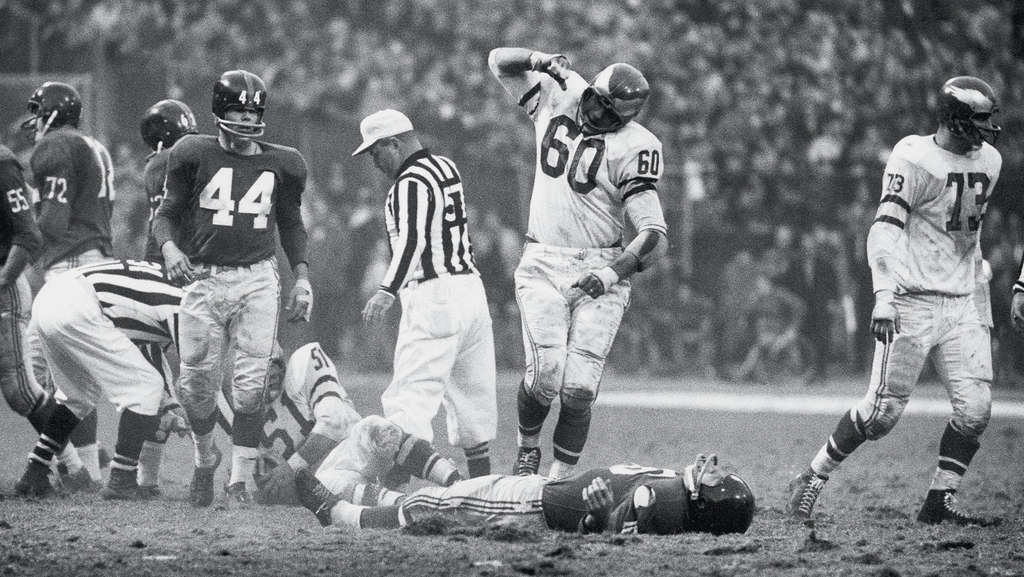
Others say David was simply taunting both Goliath and the Philistines, an ancient version of this:

UNITED STATES - NOVEMBER 20:  Football: Philadelphia Eagles Chuck Bednarik (60) victorious after making sack vs New York Giants Frank Gifford (16), Bronx, NY 11/20/1960  (Photo by John G. Zimmerman/Sports Illustrated/Getty Images)  (SetNumber: X7149)

UNITED STATES – NOVEMBER 20: Football: Philadelphia Eagles Chuck Bednarik (60) victorious after making sack vs New York Giants Frank Gifford (16), Bronx, NY 11/20/1960 (Photo by John G. Zimmerman/Sports Illustrated/Getty Images)

Ultimately, David made the head of Goliath a significant part of his future administration in Jerusalem:

And David took the head of the Philistine and brought it to Jerusalem… — 1 Sam. 17:54

But it would be years before David was enthroned in Jerusalem. So was the decapitation of Goliath some serious long range strategic planning on David’s part? Was it an “in your face” to the Philistine way of life? Was he simply making sure that Goliath was out of commission?

Maybe. Probably.

But I think there may be another reason David took Goliath’s head.

Now David was the son of an Ephrathite of Bethlehem in Judah, named Jesse, who had eight sons….The three oldest sons of Jesse had followed Saul to the battle. And the names of his three sons who went to the battle were Eliab the firstborn, and next to him Abinadab, and the third Shammah. David was the youngest. The three eldest followed Saul, but David went back and forth from Saul to feed his father’s sheep in Bethlehem.

And Jesse said to David his son, “Take for your brothers and ephah of this parched grain, and these ten loaves, and carry them quickly to the camp to your brothers. Also take these ten cheeses to the commander of their thousand. See if your brothers are well, and bring some token from them. — 1 Sam. 17:12-18

David’s father asked for a token, a pledge, an assurance of the security of Eliab, Abinadab, and Shammah. The root word here was used of the earnest money paid out in advance for a commodity. In business terms, such a pledge was a means of securing ownership. It seems that Jesse is asking for some assurance from the king that his boys are okay. “I need some guarantee,” Jesse says, “that my boys will be secure.”

I believe David presented Goliath’s head to his father as just such a token, a representation of YHWH’s provision and security and blessing. The text makes clear that what little provision Saul can provide is quite laughable. David refuses his armor and sword in favor of the provision of YHWH. Jesse’s plea is understandable. How many of us have asked for the same degree of security, some sort of ironclad guarantee, when it comes to our own children? And yet, we are consistently reminded that such guarantees simply don’t exist. That sort of provision isn’t offered to us.

Only David emerges here as one who understands the source of true security. Anointed in the mighty Spirit of YHWH (16:13), David is willing to enter the fray, to risk much, understanding that the crucible of conflict was the proving ground of provision. David steps fully into the moment armed only with his faith. The irony of it all is that a son of Jesse must risk it all in order to secure the safety of Jesse’s oldest sons.

The head of the giant represented a token for David’s father, Jesse, the man who cared deeply for each of his boys, especially the three on the front lines of the battle.

But the head of Goliath also represented a token from the Father, the God in heaven who called David and anointed him with the Spirit to lead Israel. This is the great lesson we learn from David.

The token for the father was a token from the Father.

I think that’s why David took Goliath’s head. I think he took it home to Jesse and said, “Your sons are safe, father.” This was the work not of the administration, but of YHWH, the One who was faithfully present as David ran to the battle line to meet Goliath (17:48). And for years afterward, Goliath’s head remained a token of YHWH’s provision, both for David and for Israel.

Interestingly, the Hebrew root word here is imported into the NT to describe another “token” from the Father, the same Spirit that empowered David so many centuries ago:

Having believed, you were marked in him with a seal, the promised Holy Spirit, who is a deposit guaranteeing our inheritance until the redemption of those who are God’s possession – to the praise of his glory. — Eph. 1:13-14

The Spirit is a token from the Father, a deposit guaranteeing his ownership, his seal of provision and security. Anointed with the Spirit, we — like David — can live in faith rather than in fear. We can walk in bold trust, confident in the promises of YHWH.

And we can look to this token and know that we are safe.

Posted in Devotional, Faith, Fathering, God, Scripture, Theology | Tagged , , , , | Leave a comment

God’s Own Heart: Anointed

Saul’s disobedience prompts YHWH to reject him as Israel’s king. Despite the fact that he “looks the part,” Saul’s ineptitude as Israel’s spiritual, political, and military leader is demonstrated through a series of tactical blunders and moral failures. Tasked with anointing Israel’s next king, the prophet Samuel travels to the home of Jesse in Bethlehem. One of Jesse’s sons is the Anointed of God.

You can imagine the buzz in Bethlehem at the news of this visitation. Samuel, a prophet in the manner of Moses, coming to make sacrifice! But such news also prompted fear. What have we done that requires such attention from YHWH’s servant? The text says The elders of hte city came to meet him trembling and said, “Do you come peaceably? (1 Sam. 16:4)” Saul’s great failure was defying the order of YHWH to exterminate Agag, king of the Amalekties. After censuring the king for his disobedience, Samuel hacked Agag to pieces before the LORD in Gilgal (1 Sam. 15:33). Easy to see why the elders of Bethlehem were nervous.

No doubt the sacrifice was a major event in Bethlehem. During the ceremony, seven of Jesse’s sons are presented and with each strapping young boy, Samuel awaits confirmation from YHWH. Yet YHWH selects according to His own criteria. Do not look on his appearance or on the height of his stature, because I have rejected him. For the LORD sees not as man sees; man looks on the outward appearance, but the LORD looks on the heart (1 Sam. 16:7). After seven sons of Jesse are presented and summarily rejected, Samuel asks, Are all of your sons here? And he said, “There remains the youngest, but behold, he is keeping the sheep,” (1 Sam. 16:11).

As the youngest son, David is nothing more than an afterthought in this episode. In fact, he’s not even present as the scene unfolds. This sacrificial feast is a BIG DEAL, the most significant thing to happen in Bethlehem in years…and David isn’t even invited to the party. The runt of the clan, he is relegated to watching the herd. David represents the marginalized, the uncredentialed, those without claim or clout. While everyone else gets dressed up for the ball, David is busy tending to his father’s flocks, a task that uniquely qualifies him to rule in the eyes of YHWH.

In the story of his anointing, David plays a passive role. In fact, he is not named until AFTER his anointing, at the end of the narrative. His selection at the feast confounds the social norms of the day. In the ancient world, eldest sons were favored; younger sons overlooked. But if we’ve been paying attention, the God of Israel has a surprisingly robust track record when it comes to disregarding such practices. Abel to Cain; Isaac to Ishmael; Jacob to Esau; Joseph to Rueben; Moses to Aaron…it seems YHWH prefers to use disenfranchised members of society to do his most significant work.

At his anointing, the Spirit of the LORD rushed upon David from that day forward (1 Sam. 16:13). The anointing is more than mere symbolism. In David’s life, the anointing with oil merely announced an even greater anointing, an outpouring of the Spirit of God that powerfully animates David. In the episodes that follow, David moves with the grace and fluidity of one propelled and prompted by the power of God’s own Spirit.

And David’s anointing provides a compelling type, a foreshadowing of the Anointed One from God who would be empowered with the same Spirit, filled with grace and truth.

Posted in Devotional, Faith, God, Obedience, Scripture | Tagged , , , | 2 Comments

God’s Own Heart: Jesse

I’ve been studying the life of David lately and I’ve decided to do a series about him entitled, “God’s Own Heart.”


For the past few years, I’ve been struck by something as I read the Bible: I have a hard time finding very many examples of good fathers in the Bible. Sure, there’s the BIG ONE, the Father in Heaven. But outside of Him, who comes to mind? Abraham? I’m pretty sure Ishmael wouldn’t give his dear ol’ Dad very high marks. And after Gen. 22, Isaac might not either. Speaking of Isaac, he’s clearly disqualified for playing favorites with his boys. Ditto Jacob. Although a great leader, the Bible portrays Moses as a neglectful father. Samuel’s sons accepted bribes and perverted justice. And let’s don’t even talk about that weird story with Noah and his boys.

In short, there aren’t a lot of examples of good fathers in the Bible. At least not as many as you’d like.

But my study of David leads me to one example, one I’d never considered simply because there’s so little actually written about him. But I’m willing to put him up against any other non-divine father in the entire Bible.

Jesse, the father of David, is the best Dad in the Bible.

My evidence? Acts 13:22. During Paul’s speech in Antioch, he speaks of David as a man after God’s own heart. Actually, Paul quotes the words of God, “I have found in David the son of Jesse a man after my heart, who will do all my will.” Strong words for David, but did you notice that Jesse gets a shout out, too? This is why I contend that Jesse might be the best Dad in the Bible. He raised a son whose heart beat in rhythm with the Father’s. And if you ask me, this is the task of parenting.

They say a child’s earliest conception of God is shaped by their relationship with their earthly father. When we read of the relationship David enjoys with the Father in heaven, we can only imagine the relationship he and Jesse shared. We can only imagine the long hours David spent watching as Jesse tenderly cared for the flock. We can imagine Jesse teaching young David the myriad uses for both rod and staff. We can picture the two of them walking through green pastures and beside still waters, mindful of the best places for the sheep to be rested and restored. You can imagine Jesse holding court on the selection of smooth stones and the perfect trajectory of a well-timed sling shot. Most of all, we can see David learning to pray at his father’s table, the words of blessing being spoken by the father and written across the heart of the son. In so many ways, David’s heart must have been shaped by his interaction with Jesse.

If you’re familiar with David’s story, you realize he was far from perfect. Adultery, murder, deception, lust, being too soft on his own children…David’s faults are plenty and the biblical account does not gloss over them. But isn’t it interesting that none of these shortcomings become the primary way David is characterized, either in Scripture or in our collective consciousness. Instead, David is remembered as one whose heart was a reflection of the heart of God.

In the ancient world, the heart was considered the seat of decision and will. To speak of one’s “heart” was to speak of their way of life: their values, their worldview, and the overall direction of their lives. For David, his understanding of reality is shaped by the personal Shepherd who guides him through life’s darkest valleys. David sees what others cannot: a God whose armies shall not be defied and whose name shall not be profaned. It is precisely because David’s heart beats for God that he can say of Goliath, “Let no man’s heart fail because of him. Your servant will go and fight with this Philistine,” (1 Sam. 17:32). It is David’s heart that leaps off of the page and arrests our imagination, inspiring us to live courageously with hearts full of faith, trusting in the provision of the Shepherding God above.

And quietly, off to the side, in the shadows where no one is looking, Jesse smiles.

Jesse smiles because he knows that all of his careful instruction, his persistent prayerfulness, and his quiet life of faithfulness in a dusty town called Bethlehem 3,000 years ago formed his son’s heart in ultimate and eternal ways. His son’s heart beats in rhythm with the Father’s heart.

As much as some parents don’t want to believe it, our job is NOT to raise perfect children. Your kids will screw up. A lot. Probably at least as much as you did / do. But thankfully, that’s not the barometer of good parenting, at least not in my book. Instead, we look to the heart, the direction of our children’s lives. And we recognize that, like Jesse, our task is to direct our children’s hearts toward God, to prompt their heart to beat in rhythm with the Father’s heart.

I hope to smile Jesse’s smile someday.

Posted in Devotional, Faith, Family, Fathering, God, Scripture | Tagged , , , , | Leave a comment

Praying for Harrison

11856285_10206175101484253_8385987366679386824_oThis young man is named Harrison. A few days ago, he was involved in an ATV accident. He suffered severe brain trauma and was life flighted to a hospital in Pennsylvania. He’s currently fighting for his life. I’ve never met Harrison, but I’ve come to love and appreciate his family over the past few years. I’m asking for prayers for Harrison, his wife Hayley, and his entire family.

If you believe in prayer, I ask you to lift them up today.

Posted in Faith, Prayer | Tagged | Leave a comment

Yeah, She’s a Model…


Posted in Family, Kids | Leave a comment

Things I Want to Remember, Vol. 29: Andrew McCutchen and Maroon 5

Proud parenting moment: I’m watching the Cardinals / Pirates game tonight and my 11-year old daughter walks into the room and immediately says, “Isn’t that Andrew McCutchen?”

Why, yes. Yes it is, sweetie.

Keep in mind that in years gone by, McCutchen would’ve been easily identified by his long dreadlocks. But that’s not the case in 2015, thanks to Cutch’s new look.

My daughter legitimately knows who Andrew McCutchen is.

We’re doing something right.

Maroon-5-band-facebookNot-so-proud parenting moment: my 11-year old son enters the room humming and singing a song.

I ask him what he’s singing.

He goes, “It’s called ‘Sugar.’ It’s by this band called Maroon 5. Have you ever heard of them?”

Have I ever heard of them?

My 11-year old. Already putting me in the old folks’ home. Putting me out to pasture.

To be fair, Maroon 5 isn’t really my jam. But still. It’s the principle of the thing.

HE asked ME if I had ever heard of a band.

Seriously?

Sigh.

At least I have Andrew McCutchen.

Posted in Baseball, Family, Fathering, Kids, Music, Sports | Tagged , | Leave a comment

A Season of Birthdays

June and July is a busy season for the Bybee family. From late May to early July, we go through a six-week birthday season in which we celebrate the birthday of Sunny, Jackson, Abby Kate, and Joshua. I wrote a birthday post for Sunny, but I decided to combine my thoughts about the children into a single birthday post.

2015-05-24 09.56.33 HDRFor Abby Kate

You’ve probably heard me say this many times, but I feel the need to always remind you: your name means “father’s pure joy.” And that is what you are. Seeing you always brings me such joy. There are so many things about you that make me proud. I love your concern for others; it shows that your heart is in tune with your Maker’s. You are such a voracious reader, too, and that makes me proud. You are sweet and kind, beautiful both inwardly and outwardly. We’ve joked around that you’ve been a teenager for years because you’ve always been so mature for your age. But as you continue to grow up, I hope you know that you’ll always be my little girl, too. Happy 11th birthday!

2015-06-04 19.37.10For Joshua

You are so strong, stronger than you probably even realize right now. People always say how similar we are and it’s true: we share the same blue eyes, the same love of sports (especially the Cards), the same mischief. But I see so much of your mother alive in you, too: from her servant heart to her drive and initiative. From the very beginning, you have been a ball of energy, a livewire of movement and laughter. I believe God has destined you to do great things in His name and I will always be here to encourage you to live into His call for your life. I am proud of you, Joshua Alan, and I cannot wait to see what God has in store for you. Happy 11th birthday!

2015-05-04 12.35.52For Jackson

You are my headstrong, independent, willful child. And I love you for that! It takes a strong person to be a sibling to twins but you have always been comfortable being your own person. Again, I love you for that! Your passion is one of your greatest strengths. You love to read, to climb, to use your imagination to build Lego’s and draw pictures. You have so many gifts and it excites me to think of the many ways you could use these gifts to bring glory to God. I see your willingness to stand for what you believe, even if it means standing alone. And that makes me so proud of you. One of the best things about my life is that I get to be your Daddy. Happy 8th birthday!

My minions

My minions

Abby Kate, Joshua, and Jackson, we love you so much and are so grateful to have you in our lives.

May the upcoming year be filled with the Lord’s favor as you continue to become everything He wants you to be.

Posted in Blessings, Family, Kids | Leave a comment

A Jealous God

For the LORD your God is a consuming fire, a jealous God. — Deuteronomy 4:24

I’m continually drawn back to the Scriptures for many reasons. Chief among them is this: the God I find here routinely defies my expectations.

jealousy picJealousy is not a becoming trait. It connotes insecurity, hatred, fear, and pettiness. We speak of jealousy as “the green-eyed monster” because it consistently wrecks so many of our relationships. Jealousy stems from some sort of perceived inadequacy, a feeling of rejection, an experience of isolation and exclusion. Producers of reality television bank on jealousy to drive the conflict of their supposedly “unscripted” dramas. Jealousy inevitably leaves you feeling angry, small, spurned, and insignificant.

And what I find so surprising is the number of biblical references to God as a “jealous God.” Here is a sampling of such passages:

  • Deut. 4:24, For the LORD your God is a consuming fire, a jealous God.
  • Deut. 5:9, You shall not bow down to them or worship them; for I, the Lord your God, am a jealous God, punishing the children for the sin of the parents to the third and fourth generation of those who hate me…
  • Deut. 6:15, for the Lord your God, who is among you, is a jealous God…
  • Deut. 32:16, They made him jealous with their foreign gods and angered him with their detestable idols.
  • Deut. 32:21, They made me jealous by what is no god and angered me with their worthless idols.
  • Joshua 24:19, “You are not able to serve the Lord. He is a holy God; he is a jealous God.
  • Ezekiel 16:38, I will sentence you to the punishment of women who commit adultery and who shed blood; I will bring on you the blood vengeance of my wrath and jealous anger.
  • Psalm 79:5, How long, Lord? Will you be angry forever? How long will your jealousy burn like fire?
  • Exodus 20:5, You shall not bow down to them or worship them; for I, the Lord your God, am a jealous God…
  • Nahum 1:2, The Lord is a jealous and avenging God; the Lord takes vengeance and is filled with wrath.
  • Zephaniah 3:8, The whole world will be consumed by the fire of my jealous anger.

And perhaps the grandaddy of them all, Exodus 34:14: Do not worship any other god, for the Lord, whose name is Jealous, is a jealous God.

The Scriptures are pretty clear in communicating the truth that Israel’s God is a jealous God. But the Exodus passage puts an emphatic point on it: when it comes to His covenant people, God’s very name is Jealous.

How do we make sense of this? How do we reconcile this teaching with our understanding of the word? Does all of this imply that God is insecure, fearful, and operating out of some sense of deficiency?

In his book, Old Testament Theology: Reading the Hebrew Bible as Christian Scripture, R. W. L. Moberly makes an important distinction:

YHWH’s requirement for Israel to be faithful is regularly spoken of elsewhere in terms of His being jealous…precisely because jealousy is a corollary of love when it matters that the loved one, especially if covenantally committed (as in marriage), should return the love and not faithlessly go elsewhere.

Moberly, p.46

We would do well to strip the term of all connotations of deficiency when referring to YHWH and instead adopt an understanding closely aligned with Moberly: an awareness of jealousy as a corollary of love. It matters to God when covenantal love is not reciprocated. We have emphasized our inability to match God’s gift to us — the theological point is not in question here. But perhaps we’ve let the pendulum swing too far from center. Perhaps we’ve emphasized God’s faithfulness and love to the exclusion of any mention of our reciprocal actions in covenantal relationship with Him. Is this not part and parcel to the understanding of covenant laid out in Deuteronomy 28 (blessings and curses)? Has God’s covenantal nature changed? Have his desires for relationship with his covenantal people been modified?

It should come as no surprise, then, that Scripture conveys the magnitude of God’s love in such stark terms. He is, indeed, a jealous God. It matters greatly to God when his covenant people engage in unfaithful dalliances with the competing and corrupting false gods of the world. James notes that such “friendship” with the world is adulterous, akin to enmity with God – the same God who jealously longs for the spirit he has caused to dwell in us (James 4:5).

God’s jealousy is a corollary of God’s love. And today I’m giving thanks for yet another unexpected pearl from God’s Word: the reality of a God who loves me enough to be jealous. It’s just like God to bring Good News in the most unexpected places (words).

Posted in Devotional, Faith, God, Scripture, Theology | Tagged | 1 Comment

MLB Franchise Four: Tampa Rays and Toronto Blue Jays

Another entry in my ongoing series on the MLB Franchise Four initiative. I’ll finish off the AL East with a look at the Rays and Jays.

Tampa Bay Rays Franchise Four

As one of the most recent additions in the majors, the Rays list of nominees isn’t nearly as impressive as most clubs, but here they are:

  • Carl Crawford
  • Scott Kazmir
  • Carlos Pena
  • Ben Zobrist
  • David Price
  • Evan Longoria
  • James Shields
  • Melvin Upton, Jr.

And here’s my ballot:

  1. Carl Crawford. Franchise leader in many significant offensive categories, including hits, runs, and steals.
  2. Evan Longoria. The current face of the franchise is also the team leader in HR and RBI. I suspect he’ll end up surpassing Crawford in hits and runs eventually.
  3. James Shields.
  4. David Price. Shields and Price rank #1 and #2 in most of the important pitching categories for this team. Pretty easy choices here.

Toronto Blue Jays Franchise Four

Here are the Jays nominees:

  • Roberto Alomar
  • Jose Bautista
  • Carlos Delgado
  • Dave Stieb
  • Roy Halladay
  • Tony Fernandez
  • George Bell
  • Joe Carter

An impressive list of players. I was a bit surprised to see Bautista at first, but he’s been racking up numbers for the past several seasons. Given my theory of recency bias, I’d be shocked if he isn’t recognized. And where’s Vernon Wells? He compiled some great numbers. Alomar is a great player, but his career was split among several clubs, so I couldn’t justify voting for him.

Here are the players I voted for:

  1. Carlos Delgado. He sits atop the team leaderboard in the power categories and he deserves to be one of the players recognized.
  2. Dave Stieb. Stieb is the pitching version is Delgado — the team leader in the starting pitching categories.
  3. Roy Halladay.
  4. Joe Carter. You could probably make a case for Fernandez, but I chose to recognize Carter primarily on the basis of the ’93 World Series homer. Plus, he had some great seasons in Toronto.
Posted in Baseball, Franchise Four, Sports | Tagged , | Leave a comment

My Girlfriend

Twenty years ago TODAY, I asked this girl to be my “girlfriend.”

Thankfully, she said, “Yes.”

Here’s to 20 more, Sunny! Love you!

10984214_10204586336072976_1147447691397313307_n

Posted in Sunny | Leave a comment