Nineteen

Myrna JasonOver the years, I’ve written quite a few tributes to my mother on this blog, most of them on Mother’s Day or on this date, the anniversary of her death.

Nineteen years ago, my mother journeyed from one life to another, bearing the promise of Jesus that death never has the final word for people of faith.

I wrote this 7 years ago on Mother’s Day. It is a truthful reflection of where my heart and mind are today.

When I was 15 years old, my mother and I signed up to work the nursery at church on Sunday mornings during the summer. It was a job she and I had done together several times. She enjoyed it more than I did, but I think it helped her to stay busy, especially after my father died.

I remember one Sunday morning in particular. A lady in the church came to pick up her child and as I handed their diaper bag to her, she looked at me and said, “Jason, you’re looking just like your mother.”

I turned red with embarrassment. There are fewer things a 15-year-old boy wants to hear than how much he resembles his mother. Since my father’s death 5 years earlier, I desperately wanted people to see him in me. As much as I loved my mother, I fiercely clung to my father’s image. He was the one I wanted to look like, talk like, act like. Being told I looked like my mother was terrible. I considered the comment an affront to my manhood. The truth is I didn’t want to look like my mother.

Fast forward another 15 years to my niece’s baptism. Sunny and I returned to Lebanon to be there as Hope, my sister’s daughter, was baptized. Afterward, as we were standing around talking with people, a dear sweet lady approached me, a friend of the family I’d not seen in years. After introducing her to Sunny and the kids, she looked right at me and said, “Jason, you look just like your mother.“

Her comment caught me off-guard. It’s been over 12 years since my mother passed away. I don’t live in my home town anymore and I’m very rarely around anyone who even knew my mother. I can’t remember the last time someone mentioned either of my parents in conversation with me. But her comment nearly brought me to tears. It’s not so much that I think she’s right (I actually don’t think I look much like my mother at all). I guess it just meant a lot to me to hear someone remember my mother. Today, I consider it a supreme compliment to be compared to my mother.

She taught me about compassion and faith, love for God and love for others.

She said, “When life gives you lemons, make lemonade,” a pithy saying when spoken tritely…a powerful testimony when lived out through adversity.

She saw the potential in me when others only saw an angry young man.

If she were still here, there are so many things I would say to her on this Mother’s Day.

Mom, because of you, I know how to love other people.

Because of you, I know how to deal with adversity with strength and dignity.

Because of you, I have great respect for those who would be mothers.

Because of you, I know Jesus.

On this Mother’s Day, know that you are remembered. I cherish the person you were; I cherish who you are even now to me.

If I bear any semblance to you, Mom, I’m the lucky one. I love you.
Jason

Posted in Blessings, Family, Mom | 1 Comment

The Story: Deborah and Jael

A few weeks ago, we looked at the beginning of Moses’ life and I told you that every heroic act that occurs in the first few chapters of Exodus is committed by a woman. Well, Judges 4 is a similar passage. Two women emerge in this period of Israel’s history: Deborah, the closest thing in the Bible to a female Moses; and Jael, the housewife who saved Israel.

Let’s look at the account of these faithful women and the three lessons we can learn from them.

V1 – After Ehud, the Israelites once again did evil in the sight of the Lord. This is the familiar refrain throughout the book of Judges, a reminder of human nature. Each generation must choose for themselves whom they will serve. As we mentioned in our study of Joshua 24 last week, each generation faces that same question that Joshua posed to the people. “Whom will you serve?”

Israel has made a choice to pursue evil, despite God’s direct command.

But here’s what we need to remember: God reserves the right to make certain choices, too. Israel chooses the way of evil and rebellion. So God turns them over to the hand of Jabin, king of Canaan (v2).

Judges 5 is Deborah’s poetic rendition of the history recorded in ch4. Judges 5:8 says When they chose new gods, war came to the city gates, and not a shield or spear was seen among 40,000 in Israel. This doesn’t happen by accident. Israel had been given God’s Law but they chose to ignore it.

So here is the first lesson we can learn from Judges 4: When you abandon the source of your strength, you’re vulnerable to attack.

God didn’t leave Israel; they left Him. So in Israel’s case, they’re now threatened by Sisera’s army of 900 iron chariots, a fearsome fighting unit back then. Chariots were the ancient equivalents of modern tanks. But we must remember, God never intended for Israel to be plagued by the Canaanite peoples. But through their disobedience to His command to wipe the people out, Israel has cut themselves off from their source of strength, thereby opening themselves up to attack.

This is also the story of Samson. The source of His strength was God and Samson’s obedience to the Nazirite vow not to cut his hair. He tells this to Delilah and it’s his undoing.

But is the same true of us? When we abandon the source of our strength, we immediately become susceptible to attack.

  • When we neglect our time in the Word, it becomes increasingly difficult for us to keep our mind from conforming any longer to the pattern of this world (Rom. 12:1).
  • When you go for long periods of time without praying regularly, it becomes hard to set your minds on things above.
  • I had a friend once who slowly started shutting herself off to every godly influence that was in her life. Began with her church family, friends, even her own family members. It wasn’t long before she found herself in seriously dire straits. I was talking with her through one of these difficult periods, and it was just so obvious to me: when you abandon the source of your spiritual strength, your susceptible to spiritual attack.

This is the situation in Israel at the time. Predictably, the Israelites cry out for deliverance and God raises up Deborah to save the people.

But this can also be a problem, as we’ll see.

God raises up Deborah, a powerhouse figure in the book of Judges. Whereas many of the other judges are represented as deeply flawed individuals, Deborah’s character is impeccable. She is called a prophetess, one of five such women in the OT (Miriam, Huldah, Isaiah’s wife, and Noadiah — the false prophetess — are the others.) A prophetess doesn’t come around very often. There are far more prophets than prophetesses in Israel.

And Deborah functions as more than just a religious leader. She also rules as a civil leader and a judge over the people, deciding cases in Ephraim. When you add all this up, her role sounds a lot like Moses’.

But this dynamic figure can also become something of a crutch, at least for Barak.

And this is the second lesson we learn here: Our strength rests in the Giver, not in the gifts.

Barak receives a command to take 10,000 men of Naphtali and Zebulun to oppose Sisera. But he says something troubling in v8:

If you go with me, I will go; but if you don’t go with me, I won’t go.

In this moment, Barak wavers, even threatens to blatantly disregard the direct command of God, unless Deborah goes with him. Barak has mis-prioritized the blessing of God. Barak should obey because God has told him to do so. Barak should rally these troops because he refuses to be fearful, trusting instead in the promises God has already made to His people. But instead, he treats Deborah like a rabbit’s foot, a good luck charm.

If you go with me, then I’ll go. His failure is in focusing too much of the gift of God — in this case, Deborah — and not enough on the Giver, the One who has issued this command, the One who promised to give this land to His people in the first place.

And this is a theme that repeats itself in Scripture:

Psalm 20:7 – Some trust in chariots and some in horses, but we trust in the name of the Lord our God. In later years, Israel would sing this as a wartime Psalm, always wanting to remind themselves that success was not contingent upon their technology or their weaponry; instead, success is directly correlated to faith. Let’s not let the blessings usurp the Blesser.

Barak finally gets it in gear here; routs the Canaanite armies, just as the Lord had said. Judges 5:20-21 tells us that a massive storm blew in and swept away the chariots in the river Kishon. But Barak doesn’t enjoy the glory that comes from catching Sisera. If this were a Hollywood movie, Barak & Sisera would have a final showdown in the movie’s last scene; just when you think Sisera is going to win, Barak shows an incredible dose of strength to steal victory from the jaws of defeat.

But they say truth is stranger than fiction.

Instead of a climactic shootout with Barak, Sisera is done in by a housewife with a carton of milk. And a tent peg and a hammer! You can’t make this stuff up!

Sisera, without his chariot, runs off on foot and he just happens to ring the doorbell of Jael, the wife of Heber the Kenite. Now, Heber is friendly with Jabin, king of Canaan. But the text also tells us that his clan is also distantly related to Moses. So Heber’s allegiance sways toward Israel.

Jael invites Sisera in and offers him sanctuary. With a belly full of milk, Sisera says in v20, “If someone comes by and asks you, ‘Is anyone here?’ say ‘No.’” The Hebrew word for someone is actually “a man”, which makes this even more ironic: Sisera thought that he had to fear a male, but it was a woman who took his life when he least expected it!

Our final lesson is this: No one is insignificant in the eyes of God.

God transforms this stay-at-home-Mom into a mighty warrior; prelude of what He’s going to do with Gideon. The question is: what will He do with you and me? Or better yet, what will we let Him do with us? The decision is ours.

Posted in Devotional, Faith, Scripture, The Story | Tagged , , , , | Leave a comment

The Story: As For Me and My House

Joshua 24:15 – “As for me and my household, we will serve the Lord.”

Joshua’s very famous and very public declaration of faith provides a powerful closing scene to the book that bears his name. It effectively rallies all of Israel to a renewal of their covenantal promises to YHWH. But it’s interesting to see how Joshua leads up to his appeal in the preceding verses.

Start with v1 – the scene occurs at Shechem, which is significant. There’s a story there. Shechem is an appropriate place to gather the people for this kind of speech. It was at Shechem that God promised Abraham that his descendants would inherit the land in Genesis 12:6-7. For Israel, Shechem represents the oldest promise God made to their great forefather. This is also the location of the altar Jacob built in Genesis 33:20, an altar Jacob called “mighty is the God of Israel.” So Shechem also represents the place where God demonstrated his mighty strength to Israel’s namesake.

History is important to Joshua. You can tell that by the fact that he assembles the people at Shechem. Joshua knows from whence he came.

Then, look at how he makes his appeal: he tells the story of Israel. Joshua starts in v2 and says, “This is what the LORD, the God of Israel says…” What follows is the story God is telling, the story God is speaking, the story God is authoring. It includes Abraham, Isaac, Jacob; Moses and Aaron. But Joshua doesn’t stop there. He keeps telling the story, bringing it right up to the present to include his own story and the stories of his audience. Joshua sees his story within this wide swath of God’s activity. The Story of God gives him the context for this moment.

Storytelling is an effective tool for covenant renewal.

Who are the storytellers in your family? Do you have someone in your family that always tells the stories? Maybe you start telling the story, but then they defer to them, saying, “Oh, you tell it better anyway.” Telling a good story is something of a lost art these days.

When Sunny and I were first married, we lived in East Tennessee for three years. We hadn’t been there long when we heard about the National Storytelling Festival held in Jonesborough, TN. This festival started back in 1973 when a high school journalism teacher and his students were driving in his car, listening to the Grand Ole Opry. Jerry Clower came on the radio telling stories about going coon huntin’ in Mississippi. And this teacher, named Jimmy Neil Smith, had a thought: Why not have a storytelling festival in East Tennessee?

Donald_Davis_478_-_Performance_Shot_Fresh_Air_Photo-478x268That fall, the Story Telling Festival began with 60 participants; now more than 10,000 attend every year. It ranks as one of the Top 100 Events in North America. People come from all over to hear these master storytellers spin their yarns. L.A. Times says, “What New Orleans is to jazz, Jonesborough is to story-telling.”

The success of events like this shows us just how hungry people are for good stories. We literally can’t get enough of good stories. We’ll watch them on our TVs, pay to see them on the movie screen, read them over and over. We find meaning in these stories.

The question we ask is: Why? Why are we always drawn to good stories? Why do we remember stories someone told us years ago, but we can’t remember any of the points from the preacher’s sermon last week?

It’s as if we think in terms of story.

It’s as if we’re wired for story.

That’s really interesting.

Well, Joshua understands this, and so he gathers the people together and he tells the story as a way of renewing the covenant between Israel and YHWH.

As parents and grandparents, I believe it’s our responsibility to be the storytellers in our families. I want to encourage you to tell your stories to your family members. Tell all kinds of stories. Funny stories. Ghost stories. Stupid stories. Meaningful stories. No matter who you are, you have a story to tell. But especially if you’re a parent or grandparent, I think we need to be telling the stories of Scripture and the stories of our family — and weaving the two together like Joshua does.

Those of you who are the older members of our families, you’re the link to our roots; you know the stories of where we’ve come from. You’re the ones who recognize the Shechems in our lives; you’re the ones who know why Shechem should be important to us. They say, “Those who cannot remember the past are condemned to repeat it.” Well, we can’t remember it if you don’t tell us.

And if you’re part of the younger generation, you need to sit down and listen to these stories. You need to respect these storytellers. Because you’ll miss them when they’re gone. You don’t get them back. I believe we miss this too often in our days. It is the height of arrogance for any generation to believe that they don’t need the wisdom of their elders. We need to restore some generational order as a people.

Joshua tells the story as a way of renewing the covenant with the people and God. Here we see the power of storytelling as a means of grafting new generations into the Story of God. When my children were born, I was adamant about being the first one to tell them about Jesus. It wasn’t just my responsibility; it was my privilege. Our twins spent significant time in the NICU after their birth. In fact, we couldn’t hold them at all that first day. But when the nurses weren’t looking, I’d open up the door to their isolettes and take their little hands in mine and I told my twins the story of Jesus. I wanted them to hear his name from my lips first. And I did the same thing with Jackson on the night of his birth. They’ve heard the story of Jesus many times since that day. But I wanted them to hear The Story from me first.

As for me and my house, we will serve the Lord.

Joshua ends with this climactic declaration of faith.

The question put before Israel is the same question put to us: whom will you choose to serve?

Posted in Devotional, Faith, Scripture, The Story | Tagged , , | Leave a comment

The Story: The Battle Begins

“Be strong and courageous. Do not be afraid, for the Lord your God will be with you wherever you go.”

In one form or another, Joshua hears these words from God on five different occasions at the end of Deuteronomy and the beginning of Joshua. And in other circumstances, the Lord will simply say to Joshua, “Do not be afraid.” It would seem that Joshua was in need of an extra dose of strength and courage in order to carry out his part in God’s Story.

As the book of Joshua begins, we find Israel at a critical juncture in her history. The great leader, Moses, has passed away. The people are poised on the brink of the Promised Land and they turn now to Joshua for leadership. The task is a challenging one: to occupy the land by purging the pagans who populate it. Deuteronomy 20:17-18 is God’s direct command to completely destroy these people and the task now falls to Joshua.

In order to fortify him for the days ahead, God makes some incredible promises to Joshua:
v3, “I will give you every place you set your foot.” All God requires is that Joshua step out in faith — He promises to take care of all the rest. Is God leading you to take some “first steps” today?
v5, “No one will be able to stand against you all the days of your life.” No foe should cause Joshua to waver, for God promises that Joshua will endure. Is it possible that God is saying the same thing to you in your circumstances?
v5, “I will never leave you nor forsake you.” God is saying He will never abandon Joshua. The Hebrew phrasing implies a sense of strength with regard to God’s hands. The idea of relaxing one’s hands is a sign of letting one’s guard down. And God is saying, “I will never do this with you, Joshua. I will never let my guard down. I will never relax my hands when it comes to you.” God is the God who always holds on, always keeps His promises.
v7-8, “Be careful to obey all the Law…meditate on it day and night.” Obedience to the Law of God is the key to success for Joshua. Victory here is not contingent upon military might but on obedience to the Word. Are there some of God’s Laws that you and I need to meditate on?
v9, “The Lord your God will be with you wherever you go.” God’s presence is mighty to sustain Joshua through these difficult days. In fact, it is God’s presence that is the source of all of Joshua’s strength.

As you move out from Joshua 1, you move into a very difficult section of Scripture. There’s no sugarcoating it — in several instances, God commands the people to completely destroy everything in the land. This isn’t Mr. Rogers’ stuff here. There’s a whole lot of bloodshed; a lot of corpses as you read through Joshua.

But here is where we close: Joshua’s story parallels another story, the story of another man named Joshua who was strong and courageous. But if the first Joshua’s story strikes you as a little bloodthirsty, then I hope you’ll stick around for the story of the second Joshua. Because rather than drawing blood, the second Joshua sheds His own. There aren’t as many corpses in the second story; there’s just one…and actually, that’s not even true. By the time it’s all said and done, there aren’t any corpses at all. That’s kind of the point.

Because the second Joshua had the same mission as the first — to bring us into the Promise Land.

Under Joshua’s leadership, Israel becomes a new creation: the slaves become heirs! And under the new Joshua’s leadership, you too can become an heir — an heir of eternal life!


Posted in Devotional, Faith, God, Jesus, Scripture, The Story | Tagged , | Leave a comment

The Story: Deliverance

Deliverance – Exodus 12:13

The Bible is, at the heart, a story of deliverance.

It’s the story of God’s people crying out from under the yoke of oppressive taskmasters. And it’s the story of a God who goes to great lengths to deliver His people from their bondage.

That’s the central story of the Exodus. But more than that…it’s the central message of the Gospel.

The descendants of Jacob made it to Egypt – that’s where we left off last week. Many years pass between the end of Joseph’s story and the beginning of our story; several hundred years, actually. A Pharaoh who knows nothing of Joseph comes onto the scene. The Bible says, “he knows not Joseph.” And because he doesn’t know the story of Joseph, he doesn’t know anything about the God of Joseph, the God of Jacob.

As we’ll see throughout this year, there is always great danger whenever the story is forgotten.

Maybe that’s why this story was told so often. From this point on, the OT is constantly looking back to this moment as a moment of identity. Who is Israel? They are the ones who were liberated from Egypt. Who is YHWH? He is the God who brought Israel up out of Egypt. Identity forming for both Israel and God.

But we’re getting ahead of ourselves. We were talking about Pharaoh and how he had forgotten the story. He doesn’t know about what Joseph was able to do for Egypt. Instead, he sees the Israelites as slave labor.

Exodus 1:11, ESV: Therefore they set taskmasters over them to afflict them with heavy burdens.
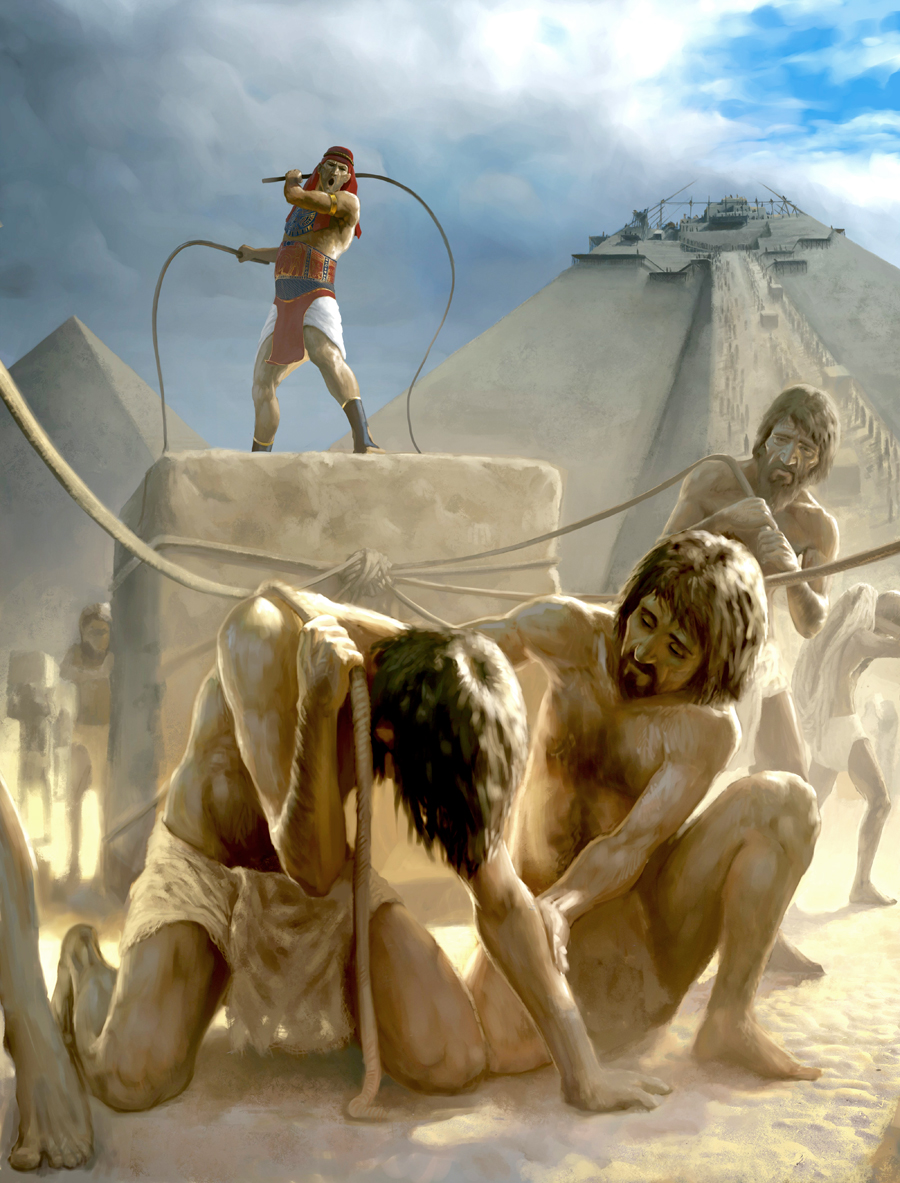
Taskmasters, agents of the empire

Taskmasters, agents of the empire

Taskmasters are icons of the empire, icons of oppression. Let me ask you a question this morning: Are you free? Are you really free? Or are you enslaved to something?

Oh, our knee jerk reaction is to say, “I’m free.” After all, this is the land of the free, home of the brave. Freedom is one of our most highly prized ideals. But are you really free? Are you sure there aren’t any taskmasters in your life?

Financial freedom? Maybe you’re having a hard time paying your bills; maybe that’s not you, maybe you’re doing quite well, better than you ever dreamed. And yet, you’ve found that financial freedom is something altogether different than financial prosperity. You used to think, “Boy, if I only made $XXX, then I wouldn’t have to worry about anything.” Only now that you’re there, you’ve found that your worries haven’t gone away; they’ve only changed. You find that your life is consumed with money market rates and securing your investments and the fact that the Dow Jones is picking up! That’s all well and good, but just ask yourself: Is this what freedom really looks like?

Or let’s talk about sex. Are you enslaved sexually? Is there a fantasy life that has become a taskmaster for you? A 2011 Newsweek study estimated some 40 million Americans log onto a pornographic website at least once a day. Have you gotten so caught up in this world that it’s become an all-consuming passion for you? If so, then you have a taskmaster.

Or we could talk about taskmasters that are less illicit, but no less damaging. For many of us, our relationships can become oppressive taskmasters, and we don’t even have the eyes to see it. Maybe there’s some guy you’re dating and that relationship has now taken up the prime space in your heart, space that’s supposed to be reserved for God alone.

Taskmaster.

You see, we live in Egypt, folks. We’re Israel. We’re surrounded by taskmasters. And like Israel, we cry out from under the yoke of these taskmasters, these things that enslave us. We cry out for deliverance. We long for true freedom.

Exodus 2:23-25 – The people of Israel groaned because of their slavery and cried out for help. Their cry for rescue from slavery came up to God. And God heard their groaning and God remembered his covenant with Abraham, Isaac, and Jacob. God saw the people of Israel – and God knew.

Four different Hebrew words are used to describe the crying of the people in these verses. Conveys a sense of intense, continuous agony. And how does God respond? God hears their cry; He sees the oppression; and, most comforting of all, it says that God knew — the idea is that God understands!

In our oppression, when we cry out for deliverance, we can take comfort that God sees, God hears, God knows.

NIV, last line of v25 – God was concerned about them. Word conveys intimate knowledge; same word is used elsewhere to describe the intimacy of the marriage relationship. So it’s not just that God has mild concern for the Israelites; God has intimate knowledge of their situation because He’s heard and He’s seen it for Himself.

So God calls one man to the task of liberating His people, to free them from oppression, from their taskmasters.

A man we know as Moses.

Moses is probably my favorite character in the Bible. When I was a kid, I would seriously beg my parents to read me the story of Moses every night. No joke. Halloween 1984 — all my friends dressed up as Michael Jackson or Luke Skywalker. Not me. I was Moses for Halloween. Wore this bathrobe and an old walking stick of my granddad’s. Ring the doorbell, instead of “Trick or Treat” I’d say (in my best Charlton Heston impersonation) “Let my people go!

It’d be really easy for us to be drawn in to the story of Moses here, to tell the story of Moses, because it’s fascinating. And he certainly has his part to play. But as fascinating as his story is, Moses doesn’t receive top billing here. What’s truly amazing is the heart of God for His people. Look in Exodus 3:7-10

Exodus 3:7-10

The Lord said, “I have indeed seen the misery of my people in Egypt. I have heard them crying out because of their slave drivers, and I am concerned about their suffering. So I have come down to rescue them from the hand of the Egyptians and to bring them up out of that land into a good and spacious land, a land flowing with milk and honey… And now the cry of the Israelites has reached me, and I have seen the way the Egyptians are oppressing them. 10 So now, go. I am sending you to Pharaoh to bring my people the Israelites out of Egypt.”

Key phrase: I have heard them crying…this prompts everything that follows. I have heard them crying out, therefore I’m going to deliver them.

Do you think it’s possible that God hears you crying out from the taskmasters of your life and that He wants to deliver you in much the same way?

God could’ve chosen any means possible to liberate His people. He could’ve instantaneously transported Israel back to the homeland; He could’ve just struck Pharaoh dead as soon as he refused to let the people go. But He chooses to act in a way that tells us a great deal about His character.

Look at the person God chooses to head up this operation. God could’ve chosen anyone He wanted for this task. But what does it say about God that He chooses an 80-year old shepherd with a rap sheet, a convicted felon with a speech impediment? “You’re the man for the job!”

To me, it says that God is really into redemption stories.

The people who say the Bible is just a bunch of man-made stories…you can’t make this stuff up. Only God would write a redemption story like this.

And so God sends Moses back to Egypt with a message: Let my people go! And the next few chapters follow the same pattern: God sends a plague upon the land and then Pharaoh says, “Okay! Just make this stop and I’ll let you go!” And Moses prays to God to stop the plague and when He does, Pharaoh double crosses him and says, “I’ve changed my mind.” Either that or sometimes these plagues come and it just causes Pharaoh to dig in his heels even more.

In fact, in several places, it says that God hardens Pharaoh’s heart.

Now why would God do a thing like that?

Exodus 11:9-10, The Lord had said to Moses, “Pharaoh will refuse to listen to you – so that my wonders may be multiplied in Egypt.” Moses and Aaron performed all these wonders before Pharaoh, but the LORD hardened Pharaoh’s heart, and he would not let the Israelites go out of his country.

I believe God hardened Pharaoh’s heart out of theological necessity. He hardened Pharaoh’s heart in order to liberate His people through the blood of the lamb.

God has one final plague to send, one final act that will fully liberate His people. And this is the critical part of the story for Israel.

The Israelites are told to slaughter a year-old lamb; take the blood of this lamb and spread it across the doorposts of their homes. Exodus 12:13, The blood will be a sign for you on the houses where you are; and when I see the blood, I will pass over you.

And so the story culminates in this dramatic scene: the Israelites eating in haste, with blood dripping down their doorposts. And on this night of nights, the Lord God moves through the land and the firstborn is slain in every home not marked by the blood. God passes over His people, delivering them into freedom as their oppressors suffer.

In the end, this is our story, too. It’s the story of the same God who liberates us from our bondage and our oppression, who frees us from the sin that so easily entangles. The Exodus story points beyond itself to something greater, to the story that would find fulfillment centuries later in the sacrificial death of the Lamb of God, the one who now cleanses us from sin.

Are you bound to certain taskmasters in your life? I believe we all are.

Is God trying to write a redemption story in your life? I believe so.

The blood has been shed for you. All you have to do is apply it.

It is His blood — it is only His blood — that is powerful enough to deliver you from these taskmasters that plague you.

Posted in Devotional, Faith, God, Kingdom Values, Missiology, Scripture, Theology | Tagged , , , , | Leave a comment

The Story: Behind Every Good Man

Behind Every Good Man – Exodus 1-2

Maybe you’ve heard the phrase: “Behind every good man there’s a great woman.” Closely related, but less well-known: “Behind every successful man is a proud wife and a surprised mother-in-law.”

I wonder how many of us have been influenced by the godly faith of a mother, grandmother, aunt, Bible school teacher. Some 2009 statistics say that most of us probably have been:

  • 86% of women are affiliated with a religion. Men? 79%
  • 77% of women have “absolute certain belief” in God. Men? 65%
  • 66% of women pray daily. Men? 49%
  • 63% of women say religion is very important. Men? 49%

It could definitely be said of Moses that his life was a testimony to the courage and faith of a few good women. Every significant hero in the story of Moses’ early life is a woman.

We’ll look at five of these women at the beginning of Moses’ story tonight:

  • Exodus 1:15-22 – Shiphrah and Puah

Egypt is the world’s superpower at the time. Pharaoh is the most powerful man in the world. And yet, his name doesn’t even register a mention. We don’t know which Pharaoh it was — “Oh, President what’s his name….yeah, he was in power at the time.”

But the names that ARE recorded? We have the names of two Hebrew midwives: Shiphrah and Puah. Pharaoh tells them to kill all the male Hebrew children when they’re born, but these two ladies say, “No.” They defy the direct command of the most powerful man in the world.

And the Bible says God rewards them for this. Gives them their own families. Scholars speculate that midwives were always barren women. In order to find their place in a culture that prizes family above everything else, they take up these responsibilities to help other women bring life into the world. God rewards them with families of their own.

These ladies understand that they answer to a law higher than Pharaoh’s. They base their actions on the law of God.

Without the courage and dedication of Puah, Shiphrah, and other midwives like them who chose to ignore the commands of the Pharaoh and do what they knew was right, Moses would not have survived to lead the children of Israel out of bondage. In fact, one could say that these women were the “first delivers” of Israel because they delivered the deliverer.

  • Exodus 2:1-10 – Jochebed, Miriam, & Pharaoh’s daughter

Around the same time, Jochebed has a healthy baby, Moses. Instead of letting him be murdered, she takes a basket and coats the bottom with tar, making it waterproof. She puts the baby in the basket and sets it among the reeds of the Nile River.

Again, we find the name of this brave woman, but no mention of the father.

Put yourself in Jochebed’s sandals for just a moment. Baby that you’ve nursed and held and loved; and now you’re just going to put his fate in this basket, put it out on the Nile River. Can you imagine the prayers you’d pray just before putting that baby out to sea?

In 1869, in response to the number of babies being abandoned in New York City, the Foundling Asylum was created to give safe shelter to unwanted infants. In its first two years, some 2,500 children were taken in.

These babies were often found on the doorsteps of the orphanage with a letter, many of which have been preserved by the New York Historical Society.

8077020980_07995e6aab_oFebruary 21, 1871

You will find a little boy, he is a month old to morrow it father will not do anything and it is a poor little boy it mother has to work to keep 3 others and can not do anything with this one it name is Walter Cooper…I have not a dollar in the world to give him or I would give it to him I wish you would keep him for 3 or 4 months and if he is not claimed by that time you may be sure it mother can not support it I may some day send some money to him do not forget his name.

Yours respectfully,

Mrs. Cooper

Perhaps some of the same thoughts were going through Jochebed’s mind as she placed her precious son into the basket and prayed that God would somehow watch over her son.

It must take an incredible amount of faith to turn your child over to God like this. Part of our role as parents, though, is to release them to the Lord’s care. Honestly, that can be a bit scary to those of us who are control freaks…especially with regard to our children. But Jochebed’s example is one that is convicting.

But as we know, that’s not where Moses’ story ends. He has a sister, Miriam, who watches what happens; she’s able to testify to what takes place next.

Pharaoh’s daughter, of all people, finds the baby in the river. She takes him out of the basket and says, “This is one of the Hebrews’ children.” Miriam might be wondering, Will she let the boy live or will she take his life?

Miriam speaks up and says, “I know someone who might be able to help nurse him.” And Pharaoh’s daughter agrees! So Jochebed receives her son back, gets to nurse him some more, raise him until he’s ready to move into the palace.

Miriam’s quick thinking helps to save the day. Once again, the deliverer has been delivered.

And think about this from the perspective of Pharaoh’s daughter. Dad has just made a federal law that all Hebrew baby boys are to be murdered…and she comes home with one! Imagine how strong she must have been, how persuasive she had to be, negotiating around the politics of it all. “Daddy, please, just look at him! He’s so cute! Can’t we take care of him!”

How many of you Dads heard the same line of reasoning when your kids wanted a puppy?

We can imagine the princess having to stand her ground, pleading with her father for the boy’s life.

In these early chapters of Exodus, Israel’s greatest enemy is a father; Israel’s greatest ally is this father’s daughter.

The Egyptian princess and a Hebrew slave-girl find sisterhood and seek justice together. They become family because of their connection to this baby, who grows into a man and liberates his people.

Another baby who will grow up to bring liberation as well, a Spiritual Exodus, a victory over the bondage of sin. And like Miriam and Pharaoh’s daughter, we find this to be great enough to overcome our differences.

Posted in Devotional, Faith, Family, God, Scripture, Social Issues, Theology | Tagged , , , , , , | Leave a comment

Weeping With Those Who Weep

weep-with-those-who-weepI’ve said it many times: I believe one of the greatest descriptions of the body of Christ is found in Romans 12:15:Rejoice with those who rejoice, weep with those who weep.” Paul encourages the Christ-followers in Rome to a practice of mutual empathy, a posture of equal parts jubilation and grief.

The Greek word for “weep” here is klaio; it is one of several words that would have been at Paul’s disposal in this writing. If he had intended to describe quiet, controlled shedding of tears, Paul would have used a different term entirely (dakruo). As it stands, klaio is descriptive of loud, audible weeping. It is lamentation, bewailing.

Once you hear a klaio cry, you never want to hear it again.

It’s a sound that rings in your ears for days.

It is the sound of a heart breaking.

Over the past few days, I’ve heard my fair share of klaio crying. That’s the thing about grief: no matter how many times you’ve been there before, you’re never prepared for his next visitation. It’s an awful, whole-bodied experience when grief takes you. All you can do is weep, tears without end. Gasping for air, gasping for life.

And this is precisely the place Paul asks us to go together.

When one of our number hurts, we all hurt.

When one of our own weeps klaio, we all shed these tears of sorrow.

And the impetus for this runs even deeper than the command of the apostle.

The reason we weep with those who weep?

Jesus.

In perhaps the most comforting narrative in the Gospels, Jesus receives news of Lazarus’ death in John 11. He arrives much too late; his good friend has already been laid in the tomb, Mary and Martha disconsolate, immersed in the weeping masses. Their cries are klaio, full-throated and fever pitch. It is this terrible, mournful sound that fills the ears of Jesus. It is this kind of cry that prompts his own tears to fall.

As Mary and Martha weep, so too does Jesus.

As the klaio tears stream down our cheeks, we have one who empathizes more than we know.

Weep with those who weep, for this is the very heart of God.

This week, we have been the klaio. We have wept, deeply. But we have also been greatly comforted. We are grateful for the blessing of community, for fellow sojourners who have immersed us in their own tears, in their prayers, in love and sympathy. You have wept with us, you have wept for us. You have become klaio along with us, a word of good news, Christ in our darkness.

Thank you.

Posted in Blessings, Devotional, Disappointment, Family, Gospel, Scripture, Theology | Tagged , , , , , | 2 Comments

The Story: A Victorious Limp

Have you ever wrestled with God?

I have.

My Dad died when I was 10 years old. I’ve wrestled with God.

My Mother passed away a few years later. And again, I wrestled with God.

And even now, this week, I’ve found myself in this same familiar place, wrestling with God.

My good friend says you can’t help but tell your story. He says if you listen long enough and listen hard enough, you’ll hear people telling you their story. We all tell our story.

Well, this story from Genesis 32 is “my story”. And I suspect, in your own way, you’ll find that this is your story, too. Because this story is a story of grace.

The story of the patriarchs — Abraham, Isaac, and Jacob — is a story of grace. For it is by grace that the womb of a 90 year-old woman finally bears life. It was God’s grace that made Isaac the son of promise. It was grace that stayed the hand of Abraham on Mt. Moriah when he was prepared to sacrifice this same son. By grace, Isaac crawls down off of the altar, replaced by the ram that the Lord provided. Again, these are stories of grace.

And the story of Jacob, Abraham’s grandson, is perhaps the greatest testimony to the grace of God in the entire Old Testament. For there is nothing — absolutely nothing — redeemable in Jacob’s character, at least not early on.

From the moment of his birth, he was attempting to usurp the position of his older, twin brother Esau. In the ancient world, being the firstborn was a really huge deal. Father’s blessing; receiving the birthright. And Jacob is THIS close to it…but he misses it. His name means “heel-grabber” and it comes to also be known as “supplanter” or “deceiver” or “trickster”. From this point forward, Jacob tries his best to supplant Esau as the recipient of the father’s blessing.

It says in Genesis 25:27, The boys grew up, and Esau became a skilful hunter, a man of the open country, while Jacob was a quiet man, staying among the tents.

Esau is a man’s man. He likes the outdoors, likes to hunt, wears camo, shops at Bass Pro, watches Duck Dynasty. Jacob is different; he likes to stay home and rearrange the furniture, watch Days of Our Lives.

Listen to the next verse, though: Isaac, who had a taste for wild game, loved Esau, but Rebekah loved Jacob. All kidding aside, that’s heartbreaking. I think that colors everything that happens in the rest of Jacob’s story; he’s just a kid trying to win dad’s approval.

Jacob acquires his older brother’s birthright; Esau sells it for a bowl of stew. Implication is that Esau isn’t a good steward of this tremendous blessing…exchanges it for something so temporal. Was this a calculated move on Jacob’s part? The Bible doesn’t explicitly say so, but given what follows, it at least seems possible.

The Bible says Isaac grew old; so Jacob deceives him by dressing up in animal hair, taking the blessing that rightfully belonged to Esau. And so Jacob flees, fearful of what his brother will do to him. He runs off to the land of Syria and falls in love with a beautiful woman named Rachel.

But her father, Laban, is a scoundrel, too and Jacob finally meets his match. The deceiver is deceived. Jacob agrees to work 7 years for Rachel’s hand; but on the wedding night, Laban pulls a switcheroo and sends Rachel’s older sister, Leah, to Jacob’s tent. And so Jacob is forced to work 7 more years for Rachel’s hand. And the Bible says that Jacob loved Rachel more than he loved Leah.

And Jacob has children with these wives. After all he’d been through with Isaac, you’d think Jacob would make an extra effort to treat all of his children equally, but he doesn’t. He dotes on Rachel’s children, which the rest of his sons immediately notice. One in particular, Joseph, receives a coat of many colors that we’ll talk to us about next week.

Jacob never forgets all that Laban put him through. So he eventually hatches a plan to swindle Laban, to increase his own flocks at the expense of his father-in-law.

So, if you’re keeping score, that makes Jacob…

  • a lousy son
  • a lousy brother
  • a lousy husband
  • a lousy father
  • a lousy son-in-law
  • and a lousy business partner

He plays favorites with his parents; he plays favorites with his wives; he plays favorites with his kids.

But, as I said before, Jacob’s life is a testament to the grace of God. This is where we find him in Genesis 32.

Jacob reaches a point in his life where his past starts to catch up with him. After 20 years of estrangement, he decides to return home. But first, he must face his brother. Because no matter how far you try to run to get away from your problems, there will always be a reckoning. So Jacob sends messengers ahead of him, tell Esau I want to see him and that I hope to find favor with him. They come back and say, “Esau is on his way. And he’s bringing 400 men with him.”

So Jacob decides to divide up his crew; sends all these animals ahead as a gift to Esau, hoping this will ease years of bitterness and rage.

What he doesn’t realize is that there is someone else he must face before he sees Esau.

The Bible says a “man” approaches Jacob in the night and wrestles him. As the story unfolds, we realize that this is more than simply a man. By the end of the encounter, Jacob himself will say, “I have seen God face to face, and yet my life has been delivered,” (Gen. 32:30).

What captures our imaginations is Jacob’s tenacity. Say what you will about his character, Jacob isn’t a quitter. He doesn’t give up. He wrestles though the night with this figure who proves himself to be God. And this tenacity opens the door for the transformation in Jacob’s character.

After wrestling through the night, this mysterious figure finally reaches down and dislocates Jacob’s hip with a single touch. Under typical circumstances, the wounded would cede victory as a result of this injury, but not so with Jacob. He refuses to release his grip until this mysterious figure imparts some word of blessing upon him. Once again, Jacob is tenacious about holding on until he receives a blessing. And, once again, Jacob receives a blessing that otherwise would not have come his way. Once again, there is grace.

The figure speaks: “Your name shall no longer be called Jacob, but Israel, for you have striven with God and with men, and have prevailed,” (Gen. 32:28). And for the rest of his days, Jacob is known as Israel. His name becomes synonymous with his descendants. The people of God, the descendants of the one who wrestled with God all through the night.

But we’d be remiss if we only talked about Jacob’s tenacity. In fact, maybe that’s not really even the point. You see, Jacob kind of grew up thinking the only way to receive the father’s blessing was to swindle it, to fight for it. And that seems to be the source of his tenacity. But that’s not the way it works with God.

Maybe this story isn’t so much about the fact that Jacob contended with God through the night without losing his grip. Maybe instead, it’s more about a God who wouldn’t lose His grip on Jacob. Maybe it’s about a God who engaged Jacob that night with the same ferocious tenacity He’d been using at every other point in Jacob’s life.

Up until this point in his story, Jacob doesn’t seem to possess much of a moral compass. And yet God is the One who continues to faithfully pursue Jacob. Who initiates this confrontation in Genesis 32? It seems like God does. And throughout his entire life, God has been the one holding on to Jacob, even when this grandson of Abraham didn’t know it.

You see, it’s not about how long you’re able to hold on; it’s never been about that. But it’s about a God who never lets go. Why? Because God always keeps His promise.

We can now see Jacob, a scoundrel of a man whose life has been transformed. Grace leaves an indelible mark on the human heart. For the rest of his days, Israel walked with a limp, a constant reminder of the night he spent with God that transformed his life.

We are Jacob’s descendants because, like him, there’s really nothing all that redeemable about us. And yet God hangs on to us anyway, keeps pursuing us anyway, transforms our hearts and gives us a new name anyway.

That is what makes this story my story, your story. This is OUR Story…a story of grace.

Posted in Devotional, Faith, God, Scripture, The Story, Theology | Tagged , , , , | 1 Comment

For Roger

They say you can’t take it with you, but I think that they’re wrong
‘Cause all I know is I woke up this morning, and something big was gone

— “Terry’s Song”, Bruce Springsteen

Monday morning, I woke to news that I still find difficult to comprehend: Roger Shates, my brother-in-law, passed away in his sleep, the victim of a massive heart attack. Roger was 32 years young.

I got to know Roger when I started dating his older sister, Sunny. I was a Senior in high school and Roger was a freshman. I have a few distinct memories of those early days. I remember picking Sunny up for our first date at the Mt. Juliet Babe Ruth baseball park because Roger was playing a game that Friday night. In a portent of things to come, we actually stuck around to watch an inning or two before we left for dinner. I remember giving Roger an Easton baseball bat, the nicest bat I’d ever owned. My baseball career ended after my Senior year, but I hoped Roger could coax a few more decent years out of the ol’ bat. I remember driving like a banshee down Hickory Ridge Road in my old Honda Accord on our way to Opryland, Roger sitting in the front seat grinning from ear to ear. I even remember catching him as he tried to spy on his sister and me as we “said goodnight” in the driveway, his mischievous crooked-smile shining back at us from upstairs.

Roger helped me load a U-HAUL truck and drive it to Kingsport, TN in the summer of 1999. I had just agreed to serve as the Youth Minister at the Northeast Church of Christ and I had exactly one day to take a load of furniture and clothing to our new apartment. Roger woke up at the crack of dawn, drove five hours with me to Kingsport, helped me unload all of our furniture, and rode back to Nashville with me when we were done. Quite a day’s work, and all he asked in return was a pizza. I know I came out on the better end of that deal. All told, Roger helped us move 3-4 more times after that. I always knew I could count on Roger because he was family. When I married his sister and officially became his brother-in-law, Roger was on the stage with me as one of my groomsmen.

Roger was the little brother I never had. Over the years, we had plenty of good talks. I knew how he felt about pretty much everything: politics, church, God, girls, music, work, his country. He and I could find almost anything to laugh about. One year for his birthday, I took him to Cedar Point to ride the roller coasters. We rode a ride called the “Millennium Force” in the very front seat; they say on a clear day, you can see across the Great Lakes into Canada from the top of this ride. Roger and I squealed like girls the whole way down, but as soon as it was over, there we were, running to the back of the line to ride again. We made that trip several times over the years. Most recently, we had been talking about taking our kids with us, but we both knew the truth: deep down, the amusement park trip was always about our sense of childlike wonder and joy, no one else’s.

One year, Roger went with our group to Winterfest in Galtinburg. During one of our devotional sessions, he came up to me with tears in his eyes. I asked him what was wrong and he said he’d begun to doubt God’s love for him. It was all I could do to wrap my arms around him — Roger was always a big kid; he was a starting lineman for his high school football team. As I prayed with him that day, I learned that our brotherhood was about much more than simply sharing this woman — his sister, my wife. We were drawn together by a tie that ran even deeper, the deepest of all bonds really, a bond forged by association with the blood of the Nazarene.

Roger’s life was made difficult by circumstance, some of which were the result of his own choices, but many of which were beyond his control. At another critical time in Roger’s life — which happened to coincide with the unloading of another moving truck outside my home — he confided in me once again that he was struggling with God’s love. And so once again we talked — not as minister and congregant, but as brothers. I told Roger that no matter what anybody had ever told him, the Gospel truth of his life was that he was loved: deeply, wholly, without condition. The enemy would have us believe the lie; he whispers in our ear that we’re damaged goods, that we’ve made one too many mistakes, that we’re just beyond the reach of God’s grace. But God counters this with an enduring love that cannot fail. This is what defines us: not our mistakes, but our acceptance of this love, a love that is the most powerful force in the world. And once again, our bond of brotherhood was fortified by this truth.

________________

So it is fitting now, in this present darkness, we turn once again to this truth. We turn once more to this message of enduring love and hope. I’m reminded of our talks, Roger, and now I’m the one in need of this word. Today you remind me of the belief we shared, a belief that love is more powerful than our mistakes. Today you remind me that although we shared so much — Sunny, Cedar Point, U-HAULs, our argument about “backstrip”, our love of movies and this family — our greatest bond was in Jesus. How ironic that you would be reminding me of these things today…in this hour when YOU are the one who is “moving on”.

_______________

Now, my brother.

Now you know.

Now you know how fully you have been loved all of your days.

Now you feel what I could only try to explain.

Now you experience what I could only attempt to describe.

Now you are basking in the warm embrace of that loving presence that once seemed so elusive to you.

Enter well into your rest now, dear brother.

And upon your remembrance, may our doubts recede back into the bowels of hell from whence they came.

Now, dear brother.

Posted in Blessings, Disappointment, Faith, Family | 1 Comment

The Story: The Akedah

The story of akedah (Hebrew for “binding) is found in Genesis 22. After the birth of Isaac, the child of promise, we don’t expect this kind of postscript. It is a chilling episode, offensive to modern sensibilities, counter-intuitive on every level.

Honestly, it’s a story I’d just as soon skip over.

But it’s there. And so we read it to be formed in faith.

Take your son, your only son Isaac, whom you love, and go to the land of Moriah, and offer him there as a burnt offering on one of the mountains of which I shall tell you.

At each turn in his story, Abraham seems bound to carry out the strange requests of his covenant-partner God. “Leave your home,” the Voice said, and Abram followed. “In your old age a son shall spring from your loins,” the Voice told him, and Abram believed. And now, at this final request — more than a request, a “test” according to v1 — Abraham once again responds in trusting obedience, chopping wood, saddling his donkey to leave at dawn’s first light (v3).

It’s probably no accident that there is no mention of Sarah in the text. The rabbis speculated that Abraham left early in the morning so as not to face Sarah’s inquisitive confrontation. Where are you going? When will you be back? Why are you taking Isaac? And what’s with all the wood?

In v2, we are introduced to a new Hebrew verb: ahava, to love. This is the first time we find this word used in the OT; Isaac, the only begotten, is the referent. Now, technically, Isaac wasn’t the only begotten. There was that whole matter with Ishmael and his mother, Hagar. But that was Abraham and Sarah’s idea, not God’s. According to YHWH, there is but one child of promise. It is through Isaac that God intends to bring blessing to the word — in particular, the blessing of love, ahava.

On the third day Abraham lifted up his eyes and saw the place from afar.

To those of us who are followers of Jesus, we note the time stamp. The “third day”. The words ring in our ears, singing of a truth that is ultimate. Our understanding of this story is colored by another third day story involving the willful sacrifice of a beloved son.

But how could God call Abraham to commit such an act? What kind of test is this? These are the questions that rise to the surface for us. And Abraham seems complicit, at least by his acquiescence to the Divine Request. When God prescribed judgment for Sodom and Gomorrah, Abraham engages in tedious negotiations over the number of righteous souls needed to evade destruction. But here? As it regards his own son? Not so much as a single word of protest.

Rabbi Joseph Telushkin writes: “Abraham’s readiness to obey God’s command shows him to be ethically deficient by later standards, but not those of his age. True, God had revealed Himself to Abraham, but He had not made known to him the full ethical implications of monotheism. Since other contemporary religious believers sacrificed sons to their gods, God, in essence, was asking Abraham if he was as devoted to his God as the pagan idolaters were to theirs.” (emphasis added)

Abraham chooses the Giver over the gift.

He believed the LORD, and it was credited to him as righteousness.

He tells Isaac, “God will provide for himself the lamb for a burnt offering, my son.” And this prophetic utterance becomes the name for the mountain, the place where God stayed the hand of his servant and commended his faithfulness.

Abraham trusted in God. And this makes all the difference in his story.

And, as we will see, it also makes all the difference in ours.

Posted in Devotional, Faith, God, Jesus, Scripture, The Story, Theology | Tagged , , , , , | Leave a comment