The Story: Tempted

The Story: Tempted – Matthew 4:1-11

Virtue is not virtue if it be untested and unexamined.” – Origen
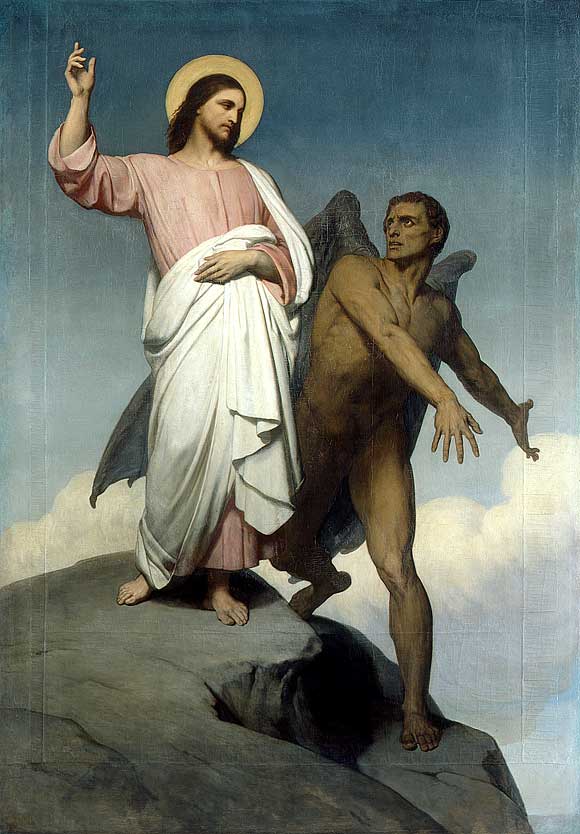
The Temptation of Christ

The Temptation of Christ

Immediately following his baptism, the Holy Spirit leads Jesus into the wilderness. The wilderness calls to mind Israel’s desert / wilderness experience in the aftermath of the Exodus. We mentioned this earlier in our study: Matthew understands Jesus as the fulfillment of Israel’s story. There are several parallels between Jesus and Israel here:

  • In the previous chapter, Jesus passes through the waters of baptism just as Israel crossed the Red Sea.
  • His 40 days of fasting parallels the 40 day fast Moses experienced on Mt. Sinai (Ex. 34:28).
  • The 40 days Jesus spends in the wild also matches the 40 years Israel spent wandering in the wilderness.
  • The wilderness is the place of Israel’s great failures. But where Israel fails repeatedly, Jesus succeeds.

In the wilderness, Jesus is tempted by Satan and a conflict of kingdoms ensues. Satan essentially asks Jesus, “What kind of Messiah will you be?” The temptations will reveal Jesus’ character and provide an answer to this question.

First Temptation: Stones to Bread (v3-4)

The Greek word translated “if” here is also translated “since” in many other places in Matthew’s Gospel. Satan isn’t trying to establish Jesus’ identity as Messiah or Son of God — that’s a given. Satan knows this. In the previous chapter, God just declared it to anyone within earshot. Instead, he’s tempting Jesus to express his identity in ways that run counter to God’s will. “In view of the fact that you’re the Messiah, why don’t you turn these stones into bread?

In this temptation, we can hear Satan whispering, “If you’re really God’s Son, surely he doesn’t want you to go hungry! Imagine what people will say: ‘God doesn’t even provide for His own Son! How will He provide for us?’” Satan’s initial temptation is a temptation of appetite; Jesus, in the midst of this period of fasting, is susceptible to this particular temptation because of His weakened physical state.

Has this ever happened to you? Does Satan know how to tempt you when you’re at your weakest? Absolutely, he does. Temptations of appetite often break down into three primary categories: food, sex, and money / possessions. These are natural appetites we have — which makes them natural points of attack for Satan and his minions.

Israel has been here before, hasn’t she? In the wild, struck with hunger pangs. After being liberated from Egypt, the Israelites began to grumble against Moses in Exodus 16: “You’ve led us out here to starve. At least in Egypt we had food to eat!” Israel failed her temptation of appetite, by not trusting in God’s provision.

And now, a similar temptation comes to Jesus: What kind of Messiah will he be? Will he be self-serving? Will He use His divine status to break the rules of nature and physics? Or will he wait for God to provide bread from heaven?

There’s something else deeper here, too: the Messiah is a public figure for Israel. So the stakes here involve the people as well. There are implications hanging in the balance if Jesus chooses to define his Messiah-ship this way. “Think of all the people you could feed. Think of all the needs you could meet.” If this is the kind of Messiah he chooses to be, then in one move, by turning those stones into bread, Jesus could wipe out hunger forever.

But he doesn’t do that.

Because his primary concern isn’t meeting your needs.

His primary concern is being faithful to the Father.

I think this is hard for us sometimes, because we’ve made such a big deal out of Jesus coming to meet our needs.

To be fair, He’s interested in our needs; over in Matt. 9, Matthew is going to tell us about a time when Jesus looked out on the people and it says he had compassion on them, for they were like sheep without a shepherd. So Jesus is concerned about our needs. But make no mistake: that’s not His primary concern. His primary concern is faithfulness to God. Your needs are important to Jesus, but not more important than faithfulness to God. This is one of the things that qualifies Jesus to be our model in all relationships: He shows us what it means to love God with all your heart, all your soul, all your mind, and all your strength.

Rather than simply meeting our needs; rather than becoming a welfare king; rather than settling for a physical feeding of the flock…Jesus replies with these words from Deuteronomy, Israel’s wilderness book: “Man does not live on bread alone, but on every word that comes from the mouth of God.”

Jesus is more than a benevolent king; He is God’s faithful Messiah. He teaches us to trust in God’s provision; to be sustained by the power of God’s Word; to wait confidently for bread from heaven. Jesus faithfully shows us what total dependence upon God looks like.

Second Temptation: High Point of the Temple (v5-7)

This temptation is yet another opportunity for Jesus to define His mission. Satan takes Jesus to the highest point of the temple. This time, the temptation goes like this: “Do something spectacular. Don’t you want these people to see who you are? If God is really with you, won’t He have to save you?” Satan really brings his A-game on this one, quoting from Psalm 91: “Doesn’t it say that ‘He will command his angels concerning you?’ If you’re truly God’s Son, wouldn’t He rush to rescue you if you were in danger?”

The second temptation is the temptation to test God. It’s the temptation to demand proof. It’s saying, “God, I want to see some results. Let’s see if you are who you say you are.” And this is antithetical to faith. Faith doesn’t have to see in order to believe. As Paul will say in 2 Cor. 5:7, “We walk by faith, not by sight.”

And again, there are implications for the people here, too. Jesus could show them His identity through some sort of miraculous display. He could give them the “Wow” factor to end all debate for all time. He could amaze them, leave them in awe, and in so doing, draw the curious crowd to himself.

But again, He doesn’t do that.

Because He’s not primarily interested in impressing you or amazing you or passing your test.

He’s primarily interested in passing God’s test.

Have you ever been tempted to do something simply to impress other people? This is one of those ever-present temptations. But in Jesus, we find someone who is less concerned with what others think and more concerned with what God thinks.

Satan quotes these verses as some sort of proof-texting for the idea that God must act to save His Son when He finds him in harms way. Little does Satan realize that God’s plan of redemption will require just the opposite — that Jesus will jump headlong into the abyss because he is convinced it is God’s will for him, willfully taking up the cross and offering himself as an atonement on our behalf.

And God will not save him.

Once more, Jesus responds with Deuteronomy: “It is also written: ‘Do not put the Lord your God to the test.‘” Jesus will be more than a wonder-worker Messiah; He will be God’s Faithful One. He shows us what it means to believe God with all your heart, soul, mind, and strength.

Third Temptation: The Kingdoms of the World (v8-10)

It seems as if the other temptations have been leading to this one. In this final temptation, Satan offers Jesus the kingdoms of the world. This temptation is a temptation of power. “In one move, Jesus, they could all be yours. You could coerce them to recognize you by setting up your own empire. You will be their Caesar, the King of Kings. All you must do is bow before me and give me your praise.

Satan says, “The end justifies the means. Look, I’ll give you what you want. These people will acknowledge you as lord, as long as you acknowledge me as Lord.” Satan is offering Jesus a chance to surrender; all He has to do is pledge allegiance to the Kingdom of Satan.

Interestingly, there is no “If you are the Son of God,” with this temptation — because the issue here is idolatry. This was Israel’s primary failing in the desert. Remember Exodus 32; while Moses is on the mountain receiving the commands from God, Israel is at the foot of the mountain making a golden calf. What’s fascinating about this text is that Israel worships this golden calf and then turns right around and has a festival for the Lord. They don’t totally reject their God; they simply compromise who they are by also incorporating worship to Baal.

Jesus refuses to compromise. Because the end never justifies the means. He won’t water down his commitment to the Father. As with the other temptations, we see in Jesus an ultimate and primary commitment to God that supersedes everything else.

Jesus won’t bend his knee or bow his head.

Because this is his primary concern: that we would have no other gods but God.

One final time, Jesus responds with the words of Scripture: “Worship the Lord your God and serve him only.”

In the temptations, Jesus gives us insight into these values of the Kingdom:

  1. Life is sustained by nothing but the Word of God. We are more than physical beings; we are spiritual beings created in the image of God. Just as God spoke creation into existence in the beginning by the power of His Word, so now does He sustain our existence through the power of the same Word.
  2. Believers must not put God to the test. Faith does not demand proof. Faith trusts in God’s presence, even when the circumstances don’t warrant it.
  3. The priority of the Kingdom is to worship God and God alone. There is only one God; all other allegiances are subservient to this primary truth.

As we learned early on in our study of The Story, a single temptation can be disastrous. Just ask Adam & Eve. And in each successive generation, we find the same thing to be true.

  • Think of Esau, selling his birthright to Jacob for a tempting bowl of stew.
  • Think of Moses, acting in rage to strike the rock rather than faithfully following God’s commands.
  • Think of David, lingering a little too long when he happens upon the bathing Bathsheba.

Through this study of The Story, we’ve found this truth to match the reality of our lives: temptation can be disastrous.

But here’s the good news: in Jesus, we find our champion. To be human is to experience temptation. But in Jesus, we find one who was victorious over temptation by being obedient to God.

Is there a temptation that is particularly troublesome to you? Is there a struggle that is persistent for you?

Maybe you’re struggling with a temptation of appetite in one of those three areas: food, sex, or possessions.

Maybe you’re tempted to test God, to demand proof because you feel overlooked.

Maybe you’re tempted to go your own way, to set yourself up as the god of your own little world.

If so, take heart, for in Jesus we have one who has been tempted in every way, just as we have – yet is without sin (Heb. 4:15).

He is the Faithful One.

Posted in Devotional, Faith, God, Gospel, Jesus, Scripture, The Story | Tagged , | 2 Comments

A Quiet Season

There hasn’t been much activity here on the ol’ blog lately. There are several reasons for this: I’ve been busy being a husband, father, student, minister, ball coach, etc. But the primary reason for the inactivity is something deeper. Simply put, I haven’t had anything to say. It’s been a season of quiet that I’m enjoying. After years of blogging in this space, I’m enjoying a little break. I’ll be back at some point, but for now I’m taking a bit of a break. See you soon.

Posted in Blogging, General | Leave a comment

Why I Love October

Cubs Cardinals Baseball.JPEG-09b73

Posted in Baseball, Sports, St. Louis Cardinals | Tagged , | 1 Comment

The Story: A King is Born, Part 2

3. Messiah

In Luke’s Gospel, he records the announcement of Christ’s birth in 2:8-12. In this text, Jesus is heralded as “Christ” or “Messiah.” The word “Christ” is simply the Greek translation of the Hebrew word for “anointed.” So the words “Messiah” and “Christ” mean the same thing: “God’s Anointed.”

The primary way of understanding the Messiah is this: He is anointed to be a king. He was expected to fulfill the promise made to David back in 2 Samuel 7, a promise that one of David’s descendants would reign on the throne forever. Over the course of time, many Messianic prophecies emerged; Jesus fulfills them:

  • He was to be born in Bethlehem (Micah 5:2)
  • He would be from the tribe of Judah (Gen. 49:10)
  • He would be preceded by a messenger (Isaiah 40:3-5)
  • He would be known as the Prince of Peace (Isaiah 9:6)
  • He would have the appearance of an ordinary man, be despised and rejected by others, pierced for our transgressions (Isaiah 53:2-5)

The Hebrew expectation in Jesus’ day centered on Rome – particularly the purging of Roman authority from Jerusalem, thus restoring the throne of David forever. But it seems the rabbis of Jesus’ day failed to put Isaiah 53 at the center of their expectations of the Messiah. The passage describes a servant – but the Messiah is supposed to be a king? What do we do with that? So when Jesus shows up as a lowly king, almost everybody misses it.

To say that Jesus is the Messiah is to say that He is the fulfillment of every prophecy, every promise that God has ever made to deliver His people. They all come to fruition here in the person of Jesus. Paul says it this way in 2 Cor. 1:20, “For no matter how many promises God has made, they are ‘Yes’ in Christ.” And the Hebrew writer extends this by saying that the covenant we now have in Jesus is superior because it is built upon better promises (Heb. 8:6).

So now, we begin to put all our names together: God Saves and God is With Us through His Anointed One, His Promised One.

But there is one more title the angels ascribe to Jesus in their announcement to the shepherds.

And it might be the most important one of all.

4. Lord

In Jesus’ day, there was only one person who held the title “Lord” in the minds of most people and that was Caesar. “Caesar is Lord” was the common parlance of the Roman Empire.

But along come these religious fanatics, these followers of a Galilean rabbi who was crucified for insurrection — and they have a different worldview. Instead of “Caesar is Lord”, they affirm that their deceased teacher is Lord — “Jesus is Lord.”

It might be difficult for us to imagine just how controversial this statement would’ve been in the ancient world.

Alexamenos graffiti

Alexamenos graffiti

This ancient work of graffiti, found in Rome, dates back to the early centuries of Christianity. On the left, we see a man raising his hands in adoration, worship, or prayer. The second man hangs on a cross, depicted with the body of a man and the head of an ass. The inscription derisively says, “Alexamenos worships his god.”

It is commonly believed that this ancient street art is ridiculing the Christian faith, a belief that brazenly defied the prevailing worldview of the day (“Caesar is Lord”) with the audacious claim that a Galilean peasant murdered for insurrection was actually somehow divine.

This is what Paul meant when he wrote: For the word of the cross is folly to those who are perishing, but to us who are being saved it is the power of God (1 Cor. 1:18).

The world has always been antagonistic toward those who would make the claim that Jesus is Lord.

In the year 155AD, an 86-year-old Christian by the name of Polycarp was brought before the Roman authorities and ordered to confess the lordship of Caesar. Here is his story:

When the soldiers went out to incarcerate him, they got to his home in the evening and he opened the door; he was a kind, gentle man, already well up in years, 86 years of age. He welcomed them into his home. He asked them, “Have you had anything to eat?” He offered them food and drink, and he said, “Please, allow me time to pray, it’s too late for us to travel back and I will go with you peaceably.” So Polycarp took care of his guards, and he went upstairs and he prayed fervently that night and then he came down.

And the next morning they went and stood before the proconsul. The proconsul who presided at his trial tried to persuade Polycarp, urging him to think about his advanced age, and told him to worship the Emperor. When Polycarp refused, the judge ordered him to cry, “Out with the atheists!” Now what you need to understand is that the accusation against early Christians was that they were atheists. The Roman Empire, with its worship of a hundred gods, thought it ridiculous for people to worship only one god and they thought that was something of an atheistic move. So when the proconsul urges Polycarp to say, “Out with the atheists,” he is as much asking Polycarp to say, “Out with the Christians.” To this, Polycarp responded by pointing at the crowd around him and saying, “Yes, out with the atheists.”

Again the judge insisted, promising that if he would swear by the Emperor and curse Christ he would be free to go, but Polycarp replied, “For eighty-six years I have served Him and He has done me no evil. How could I curse my King who saved me?” When the judge threatened him with burning him alive Polycarp simply answered that the fire that the judge would light would last only a moment; whereas the eternal fire would never go out. Finally, after he was tied to the post in the pyre, he looked up and prayed out loud, “Lord, Sovereign God, I thank you that you have deemed me worthy of this moment, so that jointly with your martyrs I may have a share in the cup of Christ. For this I bless and glorify you. Amen.

This is what it means to confess the lordship of Jesus!

Lord: it is the name by which all creation will someday know Jesus.

Therefore he has exalted him to the highest place and gave him the name that is above all names, that at the name of Jesus every knee will bow and every tongue confess that Jesus Christ is Lord to the glory of God the Father.

God Saves and God is With Us through His Anointed One. Will you make Him your Lord?

Posted in Devotional, Faith, Jesus, Scripture, The Story, Theology | Leave a comment

The Story: A King is Born, Part 1

There was quite a buzz this summer over the birth of a baby, a royal baby. Prince George Alexander Louis of Cambridge, born to Prince William and Kate Middleton. Prince George’s parents opted for a more traditional name as opposed to something with “21st century flair.”

Today, we look to the birth of another royal child – although his birth received far less press at the time. No camera crew, no paparazzi. This child was born in a manger, his birth announcement came to lowly shepherds. But his name carries more significance than any other name in human history. His name, of course, is Jesus.

Today I want to look at 4 Names or Titles given to Jesus in these birth stories we find on the first few pages of the Gospels:

1. Jesus

The name is found first in Matthew 1. In the opening scene of the New Testament, Matthew begins with a genealogy that carries us all the way from Abraham to Jesus. Why?

For Matthew, Jesus enters into history in order to complete Israel’s story. Matthew sees the entire Old Testament as pointing toward Jesus. This truth impacts the way he understands prophecy (which we’ll discuss shortly); this genealogy represents the unfolding redemptive plan of God from Abraham to Jesus.

After the opening credits roll, the New Testament begins with a scene predicting the birth of Jesus in Matthew 1:18-21. Mary and Joseph are betrothed, but Mary turns up pregnant. This, of course, is a big deal in Jewish culture, a sign of shame and dishonor. As a “righteous man”, one would expect Joseph to put Mary away quietly and preserve his hard-earned reputation. But an angel appears and tells Joseph the child is from God. Yes, Mary is pregnant, but what is conceived in her is from the Holy Spirit!

And this is where we are first introduced to the name: She will give birth to a son and you are to give him the name Jesus, because he will save the people from their sins.

Jesus is a Greek form of the Hebrew name Yeshua; in English, of course, this name is Joshua. It was a very common name in Jewish culture. It simply means, “God saves.” In the period that followed Alexander the Great, the Greek language dominated the Mediterranean world, which meant that the name appeared as “Jesus” in much of the literature of the day. This common name could be found adorning many ancient tombs and graves. Even others in the Bible shared this name: at Colossians 4:11, for instance, Paul speaks of a “Jesus, who is called Justus.”

But by the end of the first century, this extremely common name became rare as a personal name. By this time, the name came to be associated with one man to the degree that it was deemed to be uniquely his.

In Jesus, God is acting to save his people. Through Jesus, it will be possible for us to be saved from our sins. But Matthew tells us a little more about what the birth of Jesus means.

2. Immanuel

At Matthew 1:22-23, Matthew informs us that the birth of Jesus is the fulfillment of ancient prophecy. 700 years before Jesus, the prophet Isaiah was sent to King Ahaz to encourage him and tell him not to be afraid of Syria and Israel. God’s word through Isaiah to Ahaz was basically, “Be not afraid, for I am with you.”

But Ahaz wavers. Specifically, he looks to Assyria to help instead of looking to the Lord. And so, in Isaiah 7:14, Isaiah issues this prophecy: Behold, the virgin shall conceive and bear a son, and shall call his name Immanuel. And he goes on to say that before this child is old enough to choose between good and evil, the land of Israel and Syria will be deserted. This child’s birth will remind the people that God is still with them.

700 years later, Matthew understands this passage as primarily referring to Jesus. Although it had a meaning that was significant to the original audience in Isaiah’s day, Matthew sees the birth of Jesus as bringing this prophecy to the fullness of meaning, to “fill full” of significance these ancient words. Matthew receives this kind of understanding from Jesus himself, who taught that all Scripture ultimately pointed toward him:

  • You search the Scriptures because you think they give you eternal life. But the Scriptures point to me! (John 5:39, NLT)
  • Don’t misunderstand why I have come. I did not come to abolish the law of Moses or the writings of the prophets. No, I came to accomplish their purpose. (Matt. 5:17)
  • Then Jesus took them through the writings of Moses and all the prophets, explaining from all the Scriptures the things concerning himself. (Luke 24:27)

More than any other Gospel writer, Matthew seems to understand that all the ancient texts were, in one way or another, pointing toward Jesus. And he sees Jesus as the clear expression of God’s promise of Immanuel, a promise to be present with His people.

From the burning bush (Exodus 3:12) to the ministry of Joshua (Joshua 1:5), God’s promise was consistent: I will be with you. But the birth of Jesus signals the beginning of a new era. God has entered history in a personal way, wrapped in flesh, making it unmistakably clear that He is on our side, doing everything possible to save us.

There is tremendous comfort in knowing that you’re not alone, in knowing that someone promises to be with you.

Nearly every evening at bedtime, my youngest child still wants to be near us. We’ll tell him to go to bed and he’ll say, “But I just want to be with you and Mommy.” In a way, aren’t we all crying out like this? Aren’t we all afraid of being alone? If only this were something we grew out of as we got older…

Are you missing someone? Whether it’s military families dealing with deployment or Moms and Dads sending kids off to college, our lives are filled with estrangement; some inevitable, some uninvited. But this is the reality that Scripture testifies to: all creation is missing the presence of God. In Romans, Paul talks about how creation is groaning out, awaiting a coming day of redemption and renewal. Sin has violated the sacred relationship that once existed between Creator and created. But now, in Jesus, we have God taking the initiative to restore the relationship.

In Jesus, God is truly with us and for us; God on our side.

So here are our names so far:

Jesus = “God Saves”

Immanuel = “God With Us”

Posted in Devotional, Faith, Gospel, Jesus, Scripture, The Story | Leave a comment

Scot McKnight on the Story of Jesus

From The King Jesus Gospel by Scot McKnight:

We have to become a People of the Story…we need to immerse ourselves even more into the Story of Jesus. The gospel is that the Story of Israel comes to its definitive completeness in the Story of Jesus, and this means we have to become People of the Story-that-is-complete-in-Jesus.

Posted in Gospel, Jesus, Scripture, The Story, Theology | Tagged , | Leave a comment

Things I Want to Remember, Vol. 22

The night Abby Kate got to play goalie.

20130920-182903.jpg

Posted in Family, Kids | Leave a comment

The Story: The Return Home

Do unfinished projects bother you? I have to confess to you that unfinished projects drive me crazy. I tend to be more task-oriented; I love to cross things off the to-do list; so nothing irritates me more than an unfinished project.

I’ll never forget the first time I went with one of our groups on a mission trip to the Baja. You see all these houses up and down the Baja peninsula; just brick-o-block and rebar. They’re just sitting there, unfinished. I was later told that people build until the money runs out, then they move on, leaving behind all these unfinished structures.

11165013-largeDo you remember all the problems they had a few years ago when they built the new jail? Construction on the new Madison County high-rise jail began in April 2004. But construction problems, lawsuits, and cost overruns delayed its opening and caused the price tag to escalate. Final sticker price was $50 million OVER budget. And as some of these issues were resolved, the jail just sat there unfinished and empty for quite a while. At the time, Mayor Tommy Battle called it “the most expensive and challenging project in Huntsville history.”

We’ve reached the point in our study of The Story where the people of God might have felt a bit like an unfinished project. If our Story ended right here, that’d be a fair assessment. God’s people have a great foundation that has been laid: promises made to Abraham; leadership of Moses and Joshua; the reign of David.

But at this point, those all seem like a distant memory. For the past few weeks, we’ve been talking about the sad circumstances of idolatry and wickedness that led to the fall of the two kingdoms.

  • 722 BC – northern kingdom falls to Assyria
  • 586 BC – Jerusalem falls to the Babylonians

God’s people have been vacated from the promised land. They were told that a descendant of David would reign on the throne forever. But how do you explain this idea when your people are enslaved? “Are we an abandoned building, a forgotten project? Has God forgotten about us?”

It would be easy to understand if the Hebrew people were to ask these kinds of questions.

But after 70 years of exile, something happens that changes the fortunes of the Jews living in Babylon. The Persians overthrow the Babylonians and the new king, Cyrus, issues a decree.

Ezra 1:1-3, The Lord moves the heart of Cyrus, king of Perisa, who commissions the rebuilding of the temple in Jerusalem. A generation has passed; now is the time to return to Jerusalem and rebuild the temple of the Lord.

God is sovereign. He has not abandoned his “project”.

Ezra 3:1-6, Joshua and Zerubbabel begin to rebuild the altar of the Lord. V3, “Despite their fear of the peoples around them, they built the altar on its foundation and sacrificed burnt offerings on it to the Lord, both the morning and evening sacrifices.”

Fear was a reality. God’s people find themselves surrounded by those who are going to oppose their work. But the people of God never give in to fear. One of the most common commands in Scripture is the command for God’s people to not be afraid. Fear not. Be strong and courageous and never afraid.

Do you remember what comes next? For I am with you.

Yea, though I walk through the valley of the shadow of death, I will fear no evil. Why? How is that even possible? For you are with me.

Even when they’re surrounded by these foes, God’s people do not fall to their fears. Instead, they rely on the power and presence of God!

One of Satan’s greatest tools is fear. Plenty of unfinished spiritual projects stalled out because of fear. What about you? Are you an unfinished project? Has your spiritual growth stymied because of fear? Now, none of us has arrived; in a sense, we’re all a work in progress…that’s not what I’m talking about.

What I’m asking is this: Has fear stunted my spiritual growth? How is Satan using fear to keep you from becoming the man or woman he wants you to be?

God knew this would be a major issue for us; that’s why He talks about fear so much in His Word.

Look at what happens when these people lay the foundation of the temple:

Ezra 3:10-13, As the foundation to the temple is laid, the Levites sing, “He is good; his love to Israel endures forever.” God’s goodness and enduring love become the refrain for His people at this time.

V11, their song consists of praise and thanksgiving. We’ve already been told that the people were afraid. But they made a willful choice — made the choice to praise, made the choice to express thanksgiving.

When you fill your life with praise and thanksgiving, you have less time to fixate on your fears.

If Satan can’t get you with fear, then he’ll try some other tactics.

Look at Ezra 4:1-5, Enemies of Judah come and ask if they could help.

2 Kings 17:24-28 tells about how the king of Assyria sent people to populate the land of Samaria (the northern kingdom) after the Israelites were taken captive. But they didn’t fear the Lord, so God sent lions into the land, which devoured some of these wicked people. So the king sends back one of the prophets to go and teach the people about worship of God. But these people also worship false gods; considered “enemies” of true Judaism. Remember this later…Jesus is going to tell a story about a Samaritan that plays on this history.

The leaders of the rebuilding project reject the help of these Samaritans. V4 – “Then the peoples around them set out to discourage the people of Judah and make them afraid to go on building.” These adversaries sabotage the temple-rebuilding project. They hold it up for about 6 yrs; construction stops completely for another 10 yrs.

So for the next several years, the temple of the Lord sits unfinished. This unfinished structure is a testimony to the deadly combination of fear and discouragement.

We must understand why the temple was so important: it was the key symbol of Israel’s religious tradition. It represented everything that made Israel distinct. It symbolized their history and their faith. To cease rebuilding amounted to abandoning God’s restoration agenda. The people of God let a few naysayers derail God’s agenda to rebuild the temple and, more importantly, to mold Judah into the kind of people He wanted them to be.

How many great projects have fallen by the wayside because of discouragement?

How many Christian leaders never reach their potential because of discouragement?

How many of us never become who God wants us to be because we continue to carry around the residue of past discouragements?

Have you allowed discouragement to get the best of you? This has happened to God’s people. And we see it in our own lives, too:

Notice the progressive nature of discouragement:

When we’re discouraged, we’re easily disillusioned.

When we’re disillusioned, we’re easily distracted.

When we’re distracted, it’s easy for us to disengage.

What’s the counter to discouragement? It sounds simplistic, but the counter to discouragement is encouragement. Discourage – to have the heart taken out. Encourage – to put heart into, to pour courage into another.

At this moment in Judah’s history, God sends two prophets to be sources of encouragement for the people.

Haggai – the older prophet. He’s old enough to remember the former temple. He shows up in 520 BC and calls the people to finish the job of temple restoration.

Haggai 1:2-6, This is what the LORD Almighty says: “These people say, ‘The time has not yet come for the LORD’s house to be built.’ The word of the LORD came through the prophet Haggai: “Is it time for you yourselves to be living in your paneled houses, while this house remains a ruin?”

You focus on your own house while the temple remains unfinished? Their sacrificial devotion has been replaced by self-interest. They arrived back home with a profound sense of mission — but a bit of discouragement festered its way into their hearts.

Remember the progressive nature of discouragement?

–       Discouragement leads to disillusionment

–       Disillusionment leads to distraction

–       Distraction leads to disengagement

Haggai’s message jolts the people out of their apathy and energizes them to God’s presence once again.

At the same time, the prophet Zechariah begins to preach a powerful and vivid message. Whereas Haggai focuses on the need for Judah to trust God in the present by renewing the commitment to build the temple, Zechariah encourages the people to look to the glory of God to be revealed in future Messiah.

Zech. 9:9-10, Rejoice greatly, O Daughter of Zion! Shout, Daughter of Jerusalem! See, your king comes to you, righteous and having salvation, gentle and riding on a donkey, on a colt, the foal of a donkey….He will proclaim peace to the nations. His rule will extend from sea to sea and from the River to the ends of the earth.

Someday, one is coming who will fully complete the work of the LORD. God’s people will feel like an unfinished project until this Messiah arrives…the same Messiah who, at his death, will look to God and say, “It is finished.”

God is Sovereign. He doesn’t abandon His projects.

He has not abandoned you.

Posted in Devotional, Disappointment, Faith, God, Scripture, The Story | Tagged , , , | 1 Comment

2013 MLB Recap

Every spring, I try my hand at prognosticating the upcoming MLB season. Of course, every year I’m proven to be an awful Nostradamus, but it’s a fun little exercise nonetheless. Here is a quick recap of what I said back in April; once again, I had more misses than hits. But so did Babe Ruth. So there.

In the NL West, here’s how I handicapped things:

  1. Giants
  2. Dodgers
  3. D-Backs
  4. Rockies
  5. Padres

I thought the Giants would be much better, obviously. Their pitching kind of fell apart in places and the offense was simply not good. I didn’t think the Dodgers would stay healthy; and they didn’t, but it really didn’t matter. At the halfway point, LA caught fire and they’re still riding that wave straight into October. I’m still not convinced on Puig, but this is a deep club that has the look of a championship contender.

My NL Central prediction:

  1. Reds
  2. Cards
  3. Brewers
  4. Pirates
  5. Cubs

Well, I was right about the Cubs. I said it in the spring and I’ll say it again: Cincy is a championship-caliber club. I want no part of that single game Wild Card foolishness if it means playing either Pittsburgh or Cincinnati. Speaking of the Pirates, I love their story this year: finally breaking the streak and positioning themselves as one of the best clubs in the National League. Andrew McCutchen seems poised to win an MVP this year, which he deserves. The Cardinals have the top scoring offense in the majors, but I hope we get Allen Craig back soon; a deep October run will require his clutch hitting. Looking ahead, I think any one of these three clubs could make it to the World Series.

NL East:

  1. Nats
  2. Braves
  3. Philly
  4. NYM
  5. Miami

I almost nailed this one. I’ll admit, I thought Washington would be a little more dominant, Atlanta a little less so. But Atlanta’s pitching has propelled them to one of the best records in the majors and the now infamous Strasburg Shutdown last season looks even more foolish. I’m not sure if Atlanta is built for a deep October run, but at least they won’t have to contend with the one game Wild Card this year. Infield fly!

AL West:

  1. Texas
  2. LAA
  3. A’s
  4. Seattle
  5. Houston

I have to stop picking LA. Clearly they’re headed in the wrong direction. And how about the A’s? For the second straight season, these kids are ready to crash the postseason party. I don’t really know what to expect from these guys; offensively, they’re nothing to write home about, but their pitching is right near the top of the league. They might be short on experience, but there’s no denying the talent. Houston is simply an embarrassment. Wish they were still in our division.

AL Central:

  1. Tigers
  2. Royals
  3. CHW
  4. Cleveland
  5. Twins

The Tigers have had this division under wraps all summer and they’re my choice to represent the AL in the World Series for the second straight fall. I love that KC and Cleveland are still in the hunt, too. I said it in the spring: Tito would bring a winning culture to the Indians squad. He should garner a fair number of Manager of the Year votes. I’d love to see the Royals sneak into October, too. I love what Dayton Moore is doing over there.

And finally, the AL East:

  1. Toronto
  2. Tampa
  3. Baltimore
  4. NYY
  5. Bos

I really saved the worst for last, didn’t I? I’ll admit it: I had NO IDEA Boston would be this competitive. I’m still not sure how they’ve done it, but kudos to John Farrell and Ben Cherington. I’m equally baffled by Toronto’s season. Once again, we see the folly of constructing the “fantasy sports” type of squad; the numbers on the backs of the baseball cards don’t always translate. In fairness, who knew Josh Johnson would be this bad? (Other than those who were whispering about his decrease in velocity the past few years.) And who knew Jose Reyes would spend so much time on the DL? (I mean, other than anyone whose watched the guy play. Ever.) On a separate note, the job Joe Girardi has done this year should be textbook managerial curriculum. This is like McGyver building an atom bomb out of elbow macaroni and paper clips. Unbelievable that they’re still in it. Well done, Joe.

I haven’t thoroughly looked at it, but as of right now, with a week to go, here are my thoughts on the MLB Awards.

NL MVP: McCutchen, although I think you can legitimately make a case for what Matt Carpenter has done atop the Cardinals lineup. I’d vote for him before I’d vote for Paul Goldschmidt, even though I predicted Goldy’s breakout in the spring.

NL Cy Young: Have you seen what Clayton Kershaw has done this season? We’re talking historic numbers here, people. The kid is a stud.

NL Rookie of the Year: Puig hype makes this one a slam dunk. Which is a shame, because Jose Fernandez of the Miami Marlins would have my vote. Look at his numbers: 2nd in the league with a 2.19 ERA (at the age of 20!), 187 strikeouts before being shut down because of innings limitations, and 12 wins for the AAA equivalent Marlins.

NL Manager of the Year: Don Mattingly. Their best player (Matt Kemp) has missed two-thirds of the season and they still have a 10 game lead in their division. Since midseason, he’s been pushing all the right buttons.

AL MVP: Miguel Cabrera. He might go down as one of the most prolific hitters in MLB history and he’s exactly in the prime of his career. Enjoy the ride, folks. Chris Davis should also get some consideration.

AL Cy Young: If Max Scherzer could ever win his 20th, he’d have this thing locked up. As it stands, he probably still wins it easily, although Yu Darvish has actually been the most dominant pitcher in the league this year. If voters aren’t swayed by win-loss records (and recent history suggests they wont’ be), Darvish might actually have a shot.

AL Rookie of the Year: Wil Myers leads a cast of nominees who actually pale in comparison to their NL counterparts.

AL Manager of the Year: Francona / Girardi. I truly can’t decide between these two guys. I think they both have done masterful jobs. You also shouldn’t count out Farrell in Boston.

Posted in Baseball, Sports | Tagged | Leave a comment

The Story: The Kingdom’s Fall

The Kingdom’s Fall – Jeremiah 29:1-14 

Imagine two cities:

Big-CitiesThe first city is a bustling metropolis, full of frenzied activity. Think New York, London, Rome, L.A.. It’s a city that never sleeps, a city of constant sights and sounds and smells and movement. There are people bartering in the marketplace, money changing hands. The residents of this city speak a different language that you struggle to understand. Everything is different here: the fashion, the food, the industry. You’re a stranger here. You’re many miles from your home, the place where you’d rather be. You and your family live in a cramped little one-room shanty; you beg for food in the streets; your children sleep on the floor; and there aren’t enough mousetraps in the world to catch the rodents that crawl across your floor. Everyday you’re reminded that you don’t belong here, that you’re different, that you’re “other.”

Abandoned_House_by_mooredodgeThe second city is much quieter. In fact, to call it a city would be generous. It’s more like a ghost town. The place is practically desolate. Boarded up windows and unkempt lawns everywhere you look. You see the house where you grew up, or at least what’s left of it anyway. It’s really nothing more than a heap of ashes now. You see the charred nub of the tree your grandfather planted when your own father was just a baby. It was the tree you and your sister used to climb when you were kids. You spent many summer afternoons sitting under her limbs, enjoying a reprieve from the blistering sun. Under that tree, you would sit on Grandpa’s lap and he’d tell you the stories his grandfather told him – the funny ones but also the important ones. Now this special place has been desecrated; the tree has been chopped down and her limbs used as kindling when they burned down your childhood home. Now these places only reside in your mind and you grieve that your children will never know them.

These two cities aren’t simply figments of our imagination; they unfold on the pages of Scripture. The first is ancient Babylon, a city so wicked that John will call her “the great harlot” when he writes Revelation; we’ll get to that later this year. The second city is Jerusalem in the 6th century BC after the Babylonians ravaged her and took most of her inhabitants into captivity.

This is the point we’ve come to in our study of The Story. As you can see from our title, we’re talking about the fall of the kingdom of Judah. It’s a bleak chapter in The Story, but as is always the case when it comes to Scripture, there is a persistent message of Good News that trumps even the worst circumstances.

The prophet Jeremiah is one of the loneliest figures in Scripture. In Jer 16, God tells him that he must never marry; his singleness represents God, abandoned by His covenant partner, Israel. God calls him to the office of prophet — these are kind of like Hebrew whistle-blowers. The prophets expose the sins of those in power.

Listen to God’s call of Jeremiah:

  • Before I formed you in the womb, I knew you, and before you were born I set you apart; I appointed you a prophet to the nations. (1:5)
  • And here is the mission God gives Jeremiah: Go and proclaim in the hearing of Jerusalem, Thus says the Lord, I remember the devotion of your youth, how as a bride you loved me. (2:2) What fault did your fathers find in me, that they strayed so far from me? They followed worthless idols and became worthless themselves. (2:5)
  • Judah has forsaken her relationship with God, so Jeremiah is commanded to preach repentance. Call God’s people back to their first love. Tells them to abandon their wickedness, to repent.
  • The word “repent” is used over 100 times by Jeremiah; to turn back. For 40 years, Jeremiah preaches this message to the people.

Here is a sampler platter of the message of repentance God gave Jeremiah:

  • As a thief is disgraced when he is caught, so the house of Israel is disgraced – they, their kings, and their officials, their priests and their prophets. They say to wood, “You are my father,” and to stone, “You gave me birth.” They have turned their backs to me and not their faces; yet when they are in trouble, they say, “Come and save us!” Where then are the gods you made for yourselves? Let them come if they can save you when you are in trouble! For you have as many gods as you have towns, O Judah. (2:26-28)
  • Judah’s idolatry is a breach of covenant. Jeremiah compares Judah’s idolatry as spiritual adultery. God’s people have been cheating on Him.
  • But God continues to extend the possibility for reconciliation: Return, faithless Israel, declares the Lord. I will not look on you in anger, for I am merciful, declares the Lord. I will not be angry forever. (3:12)
  • Yet, Judah continues to refuse God’s pleadings. Therefore, God commands Jeremiah to say: Your ways and your deeds have brought this upon you. This is your doom, and it is bitter; it has reached your very heart. (4:18)

And so God sends his people into exile. And Jeremiah is there to watch the whole thing. Here’s a good way to think of Jeremiah: Jeremiah is the anti-Moses: whereas Moses’ 40 year ministry culminated in the people inhabiting the Promise Land, Jeremiah’s 40 year ministry culminates in their expulsion from the land.

And so we picture Jeremiah, weeping as he sees his own prophecies coming true.

Jeremiah weeps as the Babylonians completely level the temple of the Lord.

Jeremiah weeps as they burn down our houses.

Jeremiah weeps as they cut down the trees our grandfathers planted.

And Jeremiah weeps as God’s people begin their long walk toward Babylon.

In Jeremiah 29, we have recorded for us a letter that Jeremiah writes to the exiles in Babylon. It’s a dispatch from the margin, from the desolation of Jerusalem. But it’s written to God’s people who find themselves strangers in a strange land.

These are the words of the letter that Jeremiah the prophet sent from Jerusalem to the surviving elders of the exiles, and to the priests, the prophets, and all the people, whom Nebuchadnezzar had taken into exile from Jerusalem to Babylon. (29:1)

Thus says the Lord of hosts, the God of Israel, to all the exiles whom I have sent into exile from Jerusalem to Babylon: (29:4)

Jeremiah writes to the “surviving elders” – the ones who survived the journey; the ones Nebuchadnezzar hasn’t executed. V4 contains an important detail: Nebuchadnezzar wasn’t the one who did this. God did!

God deliberately sends his people to Babylon, of all places. What purpose could God possibly have for doing this? Let’s read on…

Build houses and live in them; plant gardens and eat their produce. Take wives and have sons and daughters; take wives for your sons, and give your daughters in marriage, that they may bear sons and daughters; multiply there, and do not decrease. But seek the welfare of the city where I have sent you into exile, and pray to the Lord on its behalf, for in its welfare you will find your welfare.

Isn’t this an odd thing to say? Build houses? Get married and have children? And start a garden? It reminds me of some of the same commands God gave Adam and Eve in the garden of Eden: to exercise dominion over the Garden of Eden, to tend it and cultivate it, to be fruitful and multiply. All of this is found in Genesis 1 right after we’re told that God has made humanity to bear His image.

It seems that God’s purposes for humanity haven’t changed. He intends for His people to live in much the same way as they did before. God’s desire for people living in exile is much the same as His desire for people living in the Promise Land. Plant new trees; have children; create new life; and live out your faith in a new context. Maybe being the people of God isn’t about occupying a particular space – maybe it’s about living a particular kind of life. Are we constituted as the people of God simply because we gather in this space every week? Of course not! It’s about something much deeper – a life that bears His image!   

But he continues with what had to be shocking news: seek the welfare of the city and pray to the Lord on its behalf. Seek the peace and prosperity of the city.  

The Hebrew word translated “welfare” is shalom. Peace; wholeness; success; completion. This is the standard Jewish blessing. It’s a way of saying, “I wish God’s very best for you.” Doesn’t get any better than shalom for the Hebrews. Gen. 12:2-3, God promised Abraham that his descendants would be a blessing to the nations of the earth. Jeremiah is reminding the people of God that they have an opportunity here to be a blessing to others, even the Babylonians, by seeking shalom in their midst.

God’s people are to seek shalom wherever they go.

This means being a light to the world.

This means loving our neighbors — all of them — as we love ourselves.

This means, as we have opportunity, let us to do good to all people.

What if God was trying to teach us this same lesson? You know, when you read Scripture long enough, you begin to identify with these people in exile. One of the clear points from this section of Scripture is this: God calls His people to live a life of contrast, a life that is at odds with the prevailing power systems of our day.

What if you woke up one day in Babylon — woke up without a voice, without representation, a stranger in a strange land?

What if you woke up one day and you were in the minority?

What if you woke up one day in a land of foreign gods, in a land where your values weren’t the norm?

Some of you are like, “I feel that way today!”

And that’s exactly the point. Historically, the people of God have not enjoyed the tremendous benefit of operating from the position of cultural power and influence that we have enjoyed as Christians living in the United States. Historically, the people of God have more often operated from the margins of Babylon. And if history is a good rule of thumb, it’ll probably happen again.

But even if it does, God’s call for His covenant people endures: live in a way that seeks to bring peace, wholeness, shalom wherever you are.  

But Jeremiah takes it to a new level when he tells the Hebrew people to pray for their enemies. Look again at v7.

 But seek the welfare of the city where I have sent you into exile, and pray to the Lord on its behalf, for in its welfare you will find your welfare.

This is the only time this idea of praying for one’s enemies is found in the OT. In the OT, you’re more likely to find Joshua rounding up the enemies to be killed; you’re more likely to find the Psalmist praying that God’s enemies would have their children dashed against the rocks.

But things are beginning to change here with this word from God.

Through Jeremiah, God says, “Love these people so much that their welfare becomes synonymous with your own.” Cultivate a posture of prayer where it becomes second nature to pray for your enemies. Jesus says it’s easy to love those who love you — even tax collectors can do that. My calling for you is to love your enemies enough to pray for them — or maybe it’s to pray for them enough that you love them!

We suffer no shortage of enemies these days. It is naïve to think otherwise. But this question convicts me deeply: Am I praying for them? Do I love these people enough to pray for them to find God’s shalom, the peace of God?

If there’s a particular person or people group you consider to be “the enemy” — if there’s a particular group that you find to be incredibly antagonistic toward you and your faith — God tells us what He expects us to do about it.

He doesn’t tell me to call my congressman.

He doesn’t tell me to picket and boycott.

He tells me to pray.

The funny thing about praying for your enemies is that you find it a lot harder to hate them. Which is a form of shalom — peace, wholeness — you begin to enjoy in your own life.

This is the kind of life God calls His people to live, a life of contrast from the margins. He says “Live in Babylon with Jerusalem in mind.”

Jeremiah closes his message to these exiles with words of tremendous hope.

For thus says the Lord: When seventy years are completed for Babylon, I will visit you, and I will fulfill to you my promise and bring you back to this place. For I know the plans I have for you, declares the Lord, plans for welfare and not for evil, to give you a future and a hope. Then you will call upon me and come and pray to me, and I will hear you. You will seek me and find me, when you seek me with all your heart. I will be found by you, declares the Lord, and I will restore your fortunes and gather you from all the nations and all the places where I have driven you, declares the Lord, and I will bring you back to the place from which I sent you into exile.

God says He knows the plans He has for His people. After 70 years, a group will return from exile and this remnant will begin the rebuilding process. Even in suffering and adversity, God cannot be thwarted. He is always working out His redemptive purposes. This is the message of the cross.

This was not accidental. This was part of God’s plan.

God knows the plans He made for Judah.

And God knows the plans He has made for you and me.

These are plans for prosperity – the word here is our word for the day, shalom. God’s plan will someday be made complete. It will come full circle.

spring-blooming-treesExile will end.

Jerusalem will be rebuilt.

Homes will be restored.

Trees will be planted once more.

This is the hopeful future Jeremiah writes about. It is a future that could be ours.

There is one key ingredient: We must seek God with our whole heart. We must repent; turn away from these false truths that would seek to enslave us. We must gird up our loins for the journey out of exile, for the return home is sure to be a long one.

But as we journey, we are sustained by God’s promise that if we call upon him, he will answer.

He will redeem.

He will restore.

Posted in Devotional, Faith, God, Scripture, Social Issues, The Story | Tagged , , , | Leave a comment