Soong-Chan Rah on Identification and Lament

In his seminal work Prophetic Lament: A Call for Justice in Troubled Times, Soong-Chan Rah writes about Jeremiah’s identification with the people of Jerusalem in the book of Lamentations. While Lamentations 1&2 describe the destruction of Jerusalem from a fairly dispassionate angle, the lament becomes deeply personal in Lam. 3. Jeremiah identifies with the suffering of the people — no doubt because of his personal experience of suffering along with the rest of Jerusalem’s inhabitants.

But what’s even more striking is the prophet’s communal identification with Israel’s sin and need for repentance. If anyone could claim innocence during this period of exile, it’s Jeremiah. He remained faithful to both YHWH and the covenant. And yet, the prophet maintains an empathetic identification with the people:

Let us test and examine our ways, and return to the Lord! Let us lift up our hearts and hands to God in heaven: “We have transgressed and rebelled, and you have not forgiven.” (Lam. 3:40-42)

Jeremiah could claim innocence, but he sets an example of the prophetic call to empathize with the people. He goes so far as to express individual culpability in the form of individual lament in Lamentations 3.

This prompts Rah to reflect:

Recently, I attended a conference on Native American theology. One of the white participants at the conference suggested that we do away with words like “Christian” and “evangelical” because they have too strong of a negative connotation. He claimed that we needed to reject the words and the baggage that comes with those words. A Native American theologian responded that doing away with those words would prove to be convenient for the majority culture. Not only would the words be wiped away, but the responsibility for the negative history of those communities could also be wiped away. Sin would not be accounted for.

Some want to do away with cultural differences and wipe away the long historical problem of race. With the election of Obama, America has supposedly moved toward a postracial world. But a robust dialogue on race requires a sense of personal culpability. There needs to be a personal connection to the corporate sin that has entered our culture. Our claims must first shift from the defensive posture of “I am not a racist” to “I am responsible and culpable in the corporate sin of racism.” We must move from “let’s just get over it” to “how do I personally continue to perpetuate systems of privilege?” Justice must move from the third person to the first person, from the abstract to the personal.

Posted in Books, Culture, Empathy, Kingdom Values, Race, Scripture, Social Issues | Tagged , | Leave a comment

A Quiet Season

It’s been a quite season here on the blog lately. Several reasons for that.

First, I’ve been crazy busy: I’ve spent much of the past few weeks on the road. Three weeks ago, I was visiting some missionaries in Scotland. I might try and post some pictures at some point. It was a great trip and I greatly respect my brothers and sisters in Europe. The religious landscape in Scotland is made up of more than 50% who identify themselves as “religious nones” — that is, those who self-identify as having no religious affiliation / leaning. In this kind of environment, it’s tough to be a Christian, let alone share Christ with others. But these brave believers keep on loving God and loving others, letting their light shine for Christ. That was a great trip.

Last week, I was in Dallas for a preaching conference. I also had the chance to catch up with some of my very best friends. It’s such a blessing to have so many good friends who also serve as my colleagues in preaching.

But also, as I said in my one post in October, this year has been tough. I’ve struggled to find meaningful vehicles to give voice to what I’ve been feeling. If this year has proven anything, it’s that social media is incapable of bearing the freight of timely, reflective dialogue. Social media has become nothing more than an echo chamber of like-mindedness; you’re only going to post / comment on articles that you agree with — anything that you might disagree with, you’ll either ignore or easily disregard. The casualty in all of this is respectful discourse. So in this tinder box environment, I’ve limited myself to conversations among trusted friends. There’s been much that I’ve wanted to talk about this year, but this just isn’t the format where those discussions could occur.

So that’s led to this season of quiet. We’ll see if I can find some time to write more consistently in the weeks to come.

Posted in Culture, Disappointment, Politics, Social Issues | Leave a comment

Nature’s Classroom

Nature's Classroom 2016

Nature’s Classroom 2016

I had a great time this week at Nature’s Classroom with the kids. We spent the week at a campground atop Lookout Mountain in Mentone. All three of us learned quite a bit and I’m super proud of the kids for the way they pushed themselves to do more than they even thought they could. I’m hoping I’ll have the chance to go again in three years when Jackson is old enough to go on this trip.

All week long, while witnessing the glory of God’s creation, Psalm 24:1 kept running through my mind: “The earth is the Lord’s, and everything in it.”

Posted in Blessings, Kids, Scripture | Tagged | Leave a comment

Things I Want to Remember, Vol. 32

Time for the latest installment of things I want to remember from these days with our young family.

The other day Jackson was talking to Sunny…I forget what he’d done, but she was taking a look at a place where he had a bruise or something. Anyway, he looks at her and says, “I think I functured my bone.” Fracture + puncture = functure.

UFO — he thought it was pronounced “oooh foe.”

Posted in Family, Kids | Leave a comment

A Ring, A Bumper Sticker and Gary

I wrote this post 10 years ago…and I’ve thought about it all week in light of the ongoing conversation about racial relations in this country.

Jason's avataralready & not yet

This is a picture of my high school ring. I haven’t worn it in years. In fact, I’ve hardly worn it at all. Apparently the whole point of having a high school ring is to give it to a girl. Soon after I got mine, I gave it to this girl I was dating. This somehow proved that she was “mine”. Looking back, the whole thing was pretty ridiculous. Anyway, I got it back from that girl and soon afterward I gave it to Sunny. She’s had it ever since.

I started thinking about my high school ring the other day. I was behind this truck going down the road and the truck’s bumper sticker caught my eye. The bumper sticker had a confederate flag on it and underneath the flag were these words: “I don’t need your permission to honor my ancestors.” Oddly enough, the same vehicle also bore…

View original post 792 more words

Posted in Culture, Race, Social Issues, Theology | Leave a comment

A Glimmer of Good News

2016 has been rough. So much bad news, so much confusion, so many instances where we’ve seen humanity at it’s worst. So many people I know are dealing with pain and loss. On top of that, this election is about to do me in. So I’m on the lookout for good news these days, maybe more than any time in recent memory.

So yesterday I was really encouraged by the lunch I shared with an old friend. Tobias (or Tobbes, for short) was a student of mine at when I worked as a campus minister / Bible teacher at the local Christian school over a dozen years ago. Tobbes came to the school as a foreign exchange student from Germany. My earliest memory of Tobbes was during the first few weeks of school. He had my class at the end of the day (8th period) and when we finished taking notes, he’d put his head on his desk and immediately fall asleep. After a few days of this, I asked him if he was okay; he replied that he was simply exhausted from the act of translation. He’d hear a statement in English, translate it into German, formulate an answer in German, and then have to translate it into English…and tens of thousands of these daily transactions were absolutely wearing him out.

Eventually the conversation became easier for Tobbes and we began to talk about faith. I can still recall some of our conversations after more than a dozen years. Following that year, Tobbes went back home to Germany where he studied at the university level. Thanks to Facebook, we’re able to stay in touch somewhat and he always gives me a call when he’s in the States.

Yesterday we caught up over TexMex (his dining choice, which was surprising) and I witnessed a vibrant faith in action, which struck me as good news for several reasons. For one, Tobbes is absolutely brilliant – he has graduate degrees in physics and aeronautics and is currently working on his PhD research in physics. In the highly academic environments in which Tobbes lives, faith is often viewed spuriously, yet Tobbes is unabashedly faithful. Also, much has been written about the Millennial exodus from the church, yet Tobbes sees much value in being a part of a local church. In fact, he teaches the discipleship / Christian growth class in his church. He was honest with me about some of his doubts — doubts that I hold as well — but none of these doubts were so great as to choke out the faith that holds his heart. Truly Christ is alive in my brother, fashioning him into a force for the Kingdom.

I needed that bit of good news today.

Posted in Blessings, Church, Culture, Faith, Friends, Jesus | Leave a comment

2016 MLB: Season In Review

Back in April, I made a post with my 2016 MLB predictions. Now that we’re winding down the final week of the regular season, it’s time to take a look back. This has been the most ho-hum September in recent memory, with only the NL Wild Card really holding any excitement as we enter the regular season’s final weekend. Here’s hoping October provides a little more drama.

In the AL East, I picked Baltimore to win, which wasn’t a bad choice. They’re in contention in the Wild Card and still might make a deep October run. I noted that the O’s could legitimately have 8 players with 20+ homers, which was close; they have 7 regulars with more than 15. I pegged Tampa Bay as a dark horse, though, and I was on the record saying I didn’t really like the Red Sox. 92 wins later, that looks like a lousy pick.

In the Central, I paid lip service to the Indians pitching staff, which has carried them to the division crown. But in actuality, I picked the Royals as the most complete team in the division and I really thought they’d be more competitive. This has to go down as a disappointing season for Royal fans.

Out west, I put my money on Texas, which turned out to be the right call. I also noted that they’d need to add some bullpen help in order to push toward October. A deadline deal helped address this need, putting the Rangers in contention for home field advantage throughout the playoffs. I also liked the M’s and their season has to go down as a success, too, even though they’ll just narrowly miss a Wild Card berth.

In the NL East, I went against the grain and picked the Nationals to win the division and the Mets for a Wild Card spot. After the Mets World Series run last year, they were the popular pick for a return trip to the Fall Classic. But it’s always dangerous to count on young pitching; the risks of injury and regression are high and the Mets experienced a bit of both this year.  As it is, I’m thinking the Nationals are the one NL club that could really challenge the Cubs in the NLCS.

NL Central: the Cubs. They’re the toast of baseball as well they should be. Of course, I won’t root for them, but they have to be the odds on favorite this October. They’re the best and most complete team in the majors. I played with my heart and picked the Cards to win the division and the Pirates to lock up the second Wild Card. While the Cardinals are still in the thick of the Wild Card chase, not picking the Cubbies was my worst call back in the spring.

In the NL West, I took the Giants, which was a solid choice. I still feel as if the Giants could make a deep run if they make it out of the Wild Card play-in game. But the Dodgers really separated themselves from the pack in the second half, coinciding with the Giants late season fade.

So in retrospect, I nailed a couple of picks and completely whiffed on a few others. Pretty typical.

My World Series pick was SF vs. KC, a 2014 rematch. Clearly that’s not going to happen, but that’s the fun of preseason predictions.

AL MVP: I went with Mike Trout (duh), which is always smart. And he might win another MVP this season, but personally, I’d give my vote to either Jose Altuve or David Ortiz. Altuve has asserted himself as one of the most complete players in the game, adding a power element to his already tremendous hit tool and game-changing speed. And Ortiz has had a season for the ages in his swan song. Don’t be surprised if voters award him with MVP honors.

NL MVP: I picked Paul Goldschmidt, but this is a no-brainer. Kris Bryant is the deserving choice. For a while there, I thought he and Rizzo might split the vote, but Bryant has really distinguished himself in the second half. This one might be unanimous.

AL Cy Young: I went with Chris Sale and he might end up winning the hardware. But this is one of the more wide open races. Honestly, voters might decide to reward Corey Kluber, Justin Verlander, or even closer Zach Britton for their excellence this season. Sale’s midseason temper tantrum might cost him the Cy Young.

NL Cy Young: I went with Madison Bumgarner and he still has an outside chance at the award. But this is another wide open field and Max Scherzer, Jon Lester, or even the recently deceased Jose Fernandez have rightful claims to the award.

AL Rookie of the Year: My choice (Byron Buxton) never asserted himself. Meanwhile, another AL Central rookie, Michael Fulmer, has pitched brilliantly all year. I think he’ll hold off the late charging Gary Sanchez to bring home the award.

NL Rookie of the Year: Corey Seager. Hands down.

Posted in Baseball, Sports | Leave a comment

Public Faith in Action

"Public Faith in Action" by Miroslav Volf and Ryan McAnnally-Linz

“Public Faith in Action” by Miroslav Volf and Ryan McAnnally-Linz

I just finished an insightful book entitled Public Faith in Action: How to Think Carefully, Engage Wisely, and Vote with Integrity by Miroslav Volf and Ryan McAnnally-Linz. This volume is a companion piece to Volf’s 2011 work A Public Faith: How Followers of Christ Should Serve the Common Good. In A Public Faith, Volf examines “the place and the role of followers of Christ in pluralistic societies” by arguing “against both exclusion of religions from public space and saturation of public space by a single religion,” (Public Faith in Action, p. ix). This companion piece is intended to spark critical civic-minded (and civil!) conversation among Christians, particularly in light of the looming election.

Although some of the positions Volf and McAnnally-Linz lay out here are bound to be understood tendentiously by those who disagree, I appreciate the theological consistency with which the authors approach these “hot button” topics. The text is laid out in three parts: an introductory section entitled “Commitments” that provides out a Christo-centric lens through which the ensuing dialogue is framed; a lengthier section called “Convictions” which provides the bulk of the text, focusing on a variety of public issues such as education, marriage, borrowing and lending, war, torture, and immigration; and a concluding section on “Character” which provides a brief treatment of five core virtues (courage, humility, justice, respect, compassion) for Christian engagement in the public sphere.

Volf and McAnnally-Linz provide theological and biblical underpinnings for their engagement with each of these topics. And although they do not shy away from drawing their own conclusions on these subjects, I believe they fairly recognize potential areas for continued dialogue as well. Each chapter concludes with a “Room for Debate” section for more nuanced engagement on the given topic.

I benefitted from reading this book and I believe most discerning Christians would as well. I would highly recommend this as a text to be read in community, either in a small group setting or with a few trusted friends. The conversation this text sparks will be a blessing.

Posted in Books, Culture, Politics, Social Issues | Leave a comment

A Discipling / Missional People

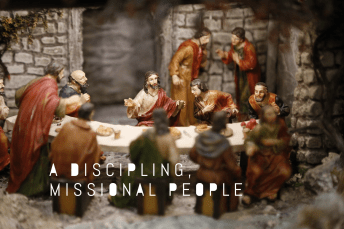
discipling-missional-peopleBefore His ascension, Jesus left His followers with a mission to make disciples. We’ve spent much of this year discussing what it means to be missional. When we talk about being missional, we’re not referring to one particular activity or church program. Rather, missional people orient their whole lives toward the mission of God. As Reggie McNeal puts it, “To think and live missionally means seeing all of life as a way to be engaged with the mission of God in the world.” Our mission is to be Good News people. Our mission is faith, hope, and love. Our mission is to love God and love others. These are concepts we worked through earlier this year.

But today we’ll be thinking specifically about our missional call to be a discipling people. The ministry of Jesus was a disciple-making ministry; and His followers participate in the same work. As we follow Jesus, we continue to lead others to follow Him as well through the power of our influence.

We make disciples when we share the Good News of Jesus with others. But we call others to discipleship when we share our lives with them as well. We see this in the video when the people go out of the church building and into their community, when we get into the lives of our neighbors. And we also see this in what Paul writes in 1 Thessalonians 2.

1 Thess. 2:6-8, We were not looking for praise from men, not from you or anyone else. As apostles of Christ we could have been a burden to you, but we were gentle among you, like a mother caring for her little children. We loved you so much that we were delighted to share with you not only the gospel of God but our lives as well, because you had become so dear to us.

Paul writes to these believers in Thessalonica to defend the truthfulness of the Gospel. Along the way, he gives us some tremendous insight into the nature of the church. Not only did he and his companions share the Gospel with the Thessalonians, they were also delighted to share their lives as well. One translation reads, “We were delighted to share with you not only the Good News of God but also our very souls…” Paul is one of the world’s foremost experts when it comes to Christian discipleship. And his discipleship pattern in Thessalonica is twofold: 1) share the Gospel and, 2) share life together.

We know that the church is a community shaped by the Gospel, but it is also a place where we share our lives with one another. J. Hampton Keathly writes, “To give the gospel without the willingness to give of ourselves to others … is a contradiction because the gospel is a message about the giving of God’s Son and the giving of His own life for us.

Two questions emerge that help shape us as a discipling, missional people:

  • Am I sharing the Gospel with others?
  • Am I sharing my life with others?

Discipling, missional people should be generous in sharing both the Gospel and their lives with others.

Discipleship is a life-on-life encounter with Jesus and with fellow disciples. That’s why I love this picture of Jesus around the table w/ disciples. In accordance with the common practice of the Jewish rabbis of his day, Jesus invites his disciples to share life with him, to live in community in order that they might learn from his example. (Think Simon Peter leaving his nets on the shore; Matthew leaving the tax collectors booth to follow Jesus.) More going on here than simply the dissemination of information from teacher to student. Jesus forms his disciples through holistic life-on-life encounters. Author Alan Hirsch notes that the discipleship model of Jesus occurs “in the context of life and for life.” The disciples of Jesus are transformed by their proximity to him rather than classroom lectures. As respondents to the call of Jesus, disciples are formed through what scholar Hans Weder calls “a life relationship to him.”

With Jesus at the center of Christian fellowship, His disciples share in life-giving relationships with one another as well. The “life relationship” we share with Jesus extends to our relationships with our fellow disciples.


In his ministry, Jesus calls the disciples into relationship with him and relationship with one another. In this way, discipleship flows from the two commands Jesus holds up as normative: love for God and love for neighbor. As a church family, we’ve committed to these principles in the form of our mission statement: We seek to follow Jesus by loving God and loving others.

Again, when we say we want to be a discipling, missional people, we’re saying we want our lives to be shaped by the Gospel but also that we share our lives together. But too often, that’s not our experience in church. Sure, we would agree that we share the Gospel of Christ in common. But I’m afraid too many of us are missing out on the lively experience of fellowship God intends for us to experience with our fellow disciples of Jesus.

____________________________

Science writer Hope Jahren shares an interesting fact about plants in her best-selling book “Lab Girl.” Jahren notes how a tiny seed starts to put down roots – the most essential thing for a plant’s survival. She writes:

No risk is more terrifying than that taken by the first root. A lucky root will eventually find water, but its first job is to anchor … Once the first root is extended, the plant will never again enjoy any hope of relocating to a place less cold, less dry, less dangerous. Indeed, it will face frost, drought, and greedy jaws without any possibility of flight.

She calls taking root a big “gamble,” but if the seed takes root it can grow down twenty, thirty, forty meters – and the results are powerful. The tree’s roots can “swell and split bedrock, and move gallons of water daily for years, much more efficiently than any pump yet invented by man.” If the root takes root, then the plant becomes all but indestructible: “Tear apart everything aboveground – everything – and most plants can still grow rebelliously back from just one intact root.” That’s how strong those roots can become once they’re anchored.

How anchored are you relationally? Your answer to that question is proportional to how much of your life you’ve been sharing with others.

One of the most powerful discipling tools God has given you is your life story. We know this because we know that we’re wired for stories. We love to watch, read, and hear good stories. Sermons that we remember — usually because there was a compelling story told. Last week — my microphone went a little haywire and for about 5-10 seconds, I sounded like I was demon-possessed. “I am Legion, for we are many.” We remember that sort of thing because it’s funny — it makes a good story.

Our relational roots grow deeper every time we share a part of our story with our brothers and sisters in Christ, particularly our spiritual story. I wrote my doctoral thesis on the efficacy of spiritual autobiography as a tool for discipleship – and I’m telling you, it’s one of our most potent resources. Not only does spiritual narration anchor us together more firmly, but it also draws us more closely to the center, to Christ.

When we share our lives together that means we can laugh together, we cry together, we join together in times of celebration and praise yet we also band together in times of tragedy and sorrow. For quite a while now, I’ve been drawn to Romans 12:15 as a way of thinking about life in the church: Rejoice with those who rejoice, weep with those who weep.

I’m a Christian today because of the influence of my parents. They taught me the Scriptures, taught me the Gospel – but I wouldn’t have believed it if they hadn’t also shared their lives with me. My mother was just the sweetest, most compassionate person I’ve ever known. And my Dad was just hilarious. He was a masterful story-teller. I’m a Christian today in part because of the way I saw them deal with adversity. They modeled faithfulness for me in seasons when we were doing okay but even more importantly, during those seasons when we weren’t doing okay. Their story continues to be a powerful discipling tool, an anchor that roots me deeply. To this day, God uses their story to shape me into a better follower of Jesus.

Who is discipling you?

And who are you discipling?

With whom are you sharing the Gospel?

And with whom are you sharing your life?

Posted in Church, Devotional, Discipleship, Faith, Gospel, Kingdom Values, Scripture | Leave a comment

A Grateful People

This post is part of a series on Mayfair’s Core Values preached in the summer of 2016.

In March 2004, the Cape Times reported a news story about a South African man who walked in to find nine men robbing his home. Eight of the robbers ran away, but the homeowner chased the final thief into his backyard and shoved the robber into his swimming pool. After realizing that the robber couldn’t swim, the homeowner jumped in to save him. The homeowner dragged the robber out of the pool and the wet thief laid there for a while, wheezing and gasping for air. Once he composed himself, the robber began yelling for his friends to come back and pulled a knife on the homeowner.

This is the quote the homeowner gave to the Cape Times: “We were still standing near the pool and when I saw the knife, I just threw him back in. But he was gasping for air and was drowning. So I rescued him again. I thought he had a cheek trying to stab me after I had just saved his life.”

The American essayist William George Jordan once wrote, “Ingratitude is a crime more despicable than revenge, which is only returning evil for evil, while ingratitude returns evil for good.”

grateful-peopleAs we continue our series on Mayfair’s Core Values, today we focus on being a grateful people. The elders have identified this as one of our Core Values, stating, “We are defined by an attitude of gratefulness for what God has done in our lives, and we share with the world what we have been freely given.” We want to be known as a grateful people.

Gratitude is the natural result of a life shaped by the Gospel. This is God’s word to us in Colossians 2:6-7: So then, just as you received Christ Jesus as Lord, continue to live in him, rooted and built up in him, strengthened in the faith as you were taught, and overflowing with thankfulness. To receive Jesus as Lord is to live “in him” – to be immersed in Jesus so fully that He becomes the focal point of your life. Our roots run deep “in Christ” which produces a strong faith. And one of the evidences of this faith is a sense of overflowing thankfulness. Our lives should be brimming with gratitude.

Are you stingy with your thankfulness? Or does gratitude overflow in your life?

I was talking to a friend of mine recently and he was telling me that one of his pet peeves is when he holds the door open for someone and they don’t acknowledge it by saying “Thank you.” Some people are just miserly with their thankfulness, doling it out only occasionally. But it shouldn’t be this way for followers of Jesus.

There is a recognizable link between gratitude and grace. Grateful people are deeply aware of the grace they’ve received and that awareness prompts them to be thankful. A grateful person recognizes the grace extended to them – as in, “I was drowning in a pool and the homeowner rescued me,” or “That gentleman is being very gracious by holding the door for me,” – and they respond in kind. There can be no awareness of grace without gratitude, no gratitude without an awareness of grace.

The Gospel of Jesus forms us into a people of overflowing gratitude. This is the teaching of this next passage of Scripture I’d like us to look at, Luke 17:11-19:

Now on his way to Jerusalem, Jesus traveled along the border between Samaria and Galilee. As he was going into a village, ten men who had leprosy met him. They stood at a distance and called out in a loud voice, “Jesus, Master, have pity on us!”

When he saw them, he said, “Go, show yourselves to the priests.” And as they went, they were cleansed.

One of them, when he saw he was healed, came back, praising God in a loud voice. He threw himself at Jesus’ feet and thanked him – and he was a Samaritan.

Jesus asked, “Were not all ten cleansed? Where are the other nine? Was no one found to return and give praise to God except this foreigner?” Then he said to him, “Rise and go; your faith has made you well.”

On his way to Jerusalem, Jesus passes through a border town and comes across a colony of ten lepers. In the ancient world, there was no known treatment for leprosy. Lepers were expelled from the community and often resided together, situating themselves near major thoroughfares to beg for alms. As Jesus approaches this village, the lepers cry out, Have pity on us! But this translation is a bit misleading. We use the term “pity” as a way of saying we feel sorry for someone. But more precisely, these lepers cry out, Have mercy on us! To have mercy is more than feeling sorry for someone; it is to relieve someone’s affliction, to alleviate the torment of another.

And this is precisely what Jesus does as He sends them to the priests. Leviticus 14 required that a priest examine a leper before declaring him to be clean. So this is really interesting: Jesus sends the lepers to the priests as if they are already healed; and in their obedience, this healing is actualized. As it says in v14, And as they went, they were cleansed. It’s as if Jesus sees not only their present affliction, but He also sees their future restoration. He sees these lepers for who they are already but for who they’ve yet to become as well. And I like to think that Jesus sees us in the same way.

If the narrative ended at v14, we would have a powerful word about Jesus’ power to heal even the worst of our afflictions, the things in our lives we are powerless to overcome.

But the passage continues, zeroing in on one of the healed lepers who returns to thank Jesus. Before we get to him, a word about the other nine. It seems that Luke intends for us to contrast this man’s actions with the inaction of the nine. When the one man returns, Jesus makes a point of noting that the other nine are nowhere to be found. He says, Where are the other nine?

We should note that this passage doesn’t indict the nine for being ungrateful. I try to put myself in their situation. Imagine that you have a highly contagious virus. The Center for Disease Control has quarantined you way out in the county somewhere. You’ve been ostracized from your loved ones for months, maybe even years. And one day, you’re suddenly healed. If I were in that situation, I’d be rushing to get home to my wife, my kids, to let my loved ones know that I’d been healed. And if that’s the case for any of the other nine, they have my understanding.

But that doesn’t change the fact that unexpressed gratitude is really no gratitude at all. No matter how you slice it, the other nine come off as ingrates here. If you’re truly thankful for what someone has done for you, that gratitude needs to find expression. You need to let them know. Gratitude is like good news or a great joke or Wifi…it’s meant to be shared. If our lives are to be overflowing with thankfulness as it says in Col. 2, then we should seize every opportunity to express gratitude to others. Don’t be miserly with your gratitude; instead, let it overflow from your recognition of the grace you’ve received.

This passage also reminds us that ingratitude abounds but gratitude is uncommon. So we probably shouldn’t be very surprised when we hold the door open for someone and they breeze right past us without any sort of acknowledgement. (The next time you rescue a thief from drowning and he tries to stab you, don’t be surprised!) Gratitude is an uncommon virtue. But it’s one we need to embody.

Let’s close by looking at the one man who returns to thank Jesus. It says that he comes back praising God in a loud voice. In an act of humility, he throws himself on the ground at Jesus’ feet, assuming the posture of meekness and servitude. And it says that he thanked Jesus. Luke uses the Greek word eucharisteo to signify this action, a word that was later used as a proper name for the Lord’s Supper. In the Eucharist, we give thanks for the body and blood of Christ. As we partake of the Lord’s Supper, we should think of ourselves as the healed leper, throwing ourselves before Jesus in humble gratitude.

From these simple actions, we find the recipe for gratitude. The ingredients for gratitude are praise, humility, and thanksgiving.

The best way I know to grow in gratitude is to start listing all the things for which you’re thankful. I say “start” listing them, because you’ll never finish with this kind of list. But I’ve found this to be a helpful exercise. It’s also biblical. Eph. 5:20, giving thanks always and for everything to God the Father in the name of our Lord Jesus Christ. One way to be faithful to this teaching is to list the things for which you’re thankful.

It’s the same idea communicated in that old hymn we sometimes sing, “Count Your Blessings”:

When upon life’s billows you are tempest-tossed,

When you are discouraged, thinking all is lost,

Count your many blessings, name them one by one,

And it will surprise you what the Lord has done.

There’s some real truth to these words. If you feel yourself lacking in gratitude, take some time to list your blessings and I’m willing to bet that you’ll respond with praise.

Humility is another key ingredient for gratitude. Of course, the opposite of humility is arrogance, pride, and entitlement. It was reported a few years ago that the San Francisco Giants were being sued for giving away Father’s Day gifts at the ballpark. Their crime: the gifts were given to men only. If that story is true, it demonstrates how ingratitude, arrogance, and entitlement are interrelated. At the other end of the spectrum, we find this healed man falling on his face before Jesus. When you’re aware of the grace that has been extended to you, humble gratitude is the natural response.

And the final of these ingredients, thankfulness, is practically synonymous with gratitude. Luke has a final bit of information about our healed man, but he saves it for the very end: v16, He threw himself at Jesus’ feet and thanked him – and he was a Samaritan. As a Samaritan leper, this man would rank at the very bottom of the Jewish social strata. Either of these conditions individually would have been enough for the 1st century Jew to view this man as vile and unclean. But to be both Samaritan and leper was to be subhuman, grotesque, freakish. Perhaps this is the reason our man returns. Perhaps he, more than anyone else, is aware of the magnitude of the gift he has received.

He cried out, Jesus, have mercy on me!

And he was made whole once more.

So he must return to say, “Thank you.”

Is that your story? Have you been made whole by the mercy of the Lord? If so, praise Him today! May gratitude overflow from your life!

Jesus says to the man, “Your faith has made you well.” Literally, the text reads, “Your faith has saved you.”

Are you grateful for the salvation that is only found in Jesus?

Posted in Church, Devotional, Faith, Kingdom Values, Scripture | Leave a comment