
I thought the “555” area code only existed in the movies. Guess not. This is an actual call on our caller ID at home.
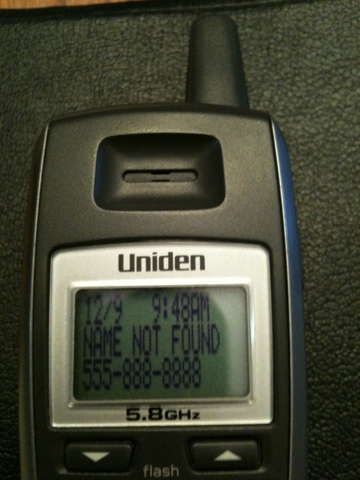
I just wish we’d have been home to answer the call! I think I’ll tell the kids it was a call from Santa.
I thought the “555” area code only existed in the movies. Guess not. This is an actual call on our caller ID at home.
I just wish we’d have been home to answer the call! I think I’ll tell the kids it was a call from Santa.
More link love: NPR Music fans, here is the year-end list categorized alphabetically. Enjoy.
With my time being what it is, I don’t get to surf around some of my favorite sites very often, much less take the additional step of posting links to my blog. But this article by Skye Jethani entitled “The Ten Commandments of Scripture Interpretation” was just too good to pass up. There are several helpful reminders here for the serious student of Scripture. Enjoy.
So every December, I humor my inner pop culture critic by taking a stab at the best albums, books, and movies I’ve listened to / read / seen this year. I’ll post the albums list a little later (still ironing out my selections), but as I was listening through some of the music released this year, I decided to post my favorite songs of the past year as a prelude to the album post. Whereas I limit the album list strictly to 2010 releases, the song list is a little more fluid. Most of these were released this year, but some are holdovers from last year that didn’t receive much airplay until this year. Anyway, on to the list:
Today, Jackson was asking to see a picture of my mother, so I got down an old photo album. In the back of the photo album, there was a stack of old papers. I started going through them: my old Little League team photo; various academic certificates — perfect attendance in 6th grade, an honor achievement in spelling, another for Bible; an issue of our old high school newspaper with a guest editorial by yours truly; some things I wrote between 1994-95 — short essays I wrote of my own volition in the wake of my mother’s death (which I may post here at a later date); and, best of all, a birthday wish from my Grandmother Bybee.

Grandmother Bybee with her brood: her granddaughter Tara (left); grandsons Chris (middle) and Jason (right)
As the baby of the family, my Grandmother Bybee always made me feel special. I remember going to visit her home for meals; my grandparents didn’t have much but it always seemed like we feasted at their table. Most likely, it was just the hospitality that made us feel “full” at their house. The only thing I dreaded at their house was the hugs and kisses my Grandmother would unleash throughout the visit; I used to think she was trying to squeeze the life out of me with her hugs. But again, you always knew where you stood with Grandmother. Her famous dinner table saying still lives on in our family: “If you don’t see it, don’t ask for it and if you leave hungry, it’s your own fault.” I miss her honesty.
Grandmother was also a poet. Before she died, I recorded some of her poems and writings on a cassette tape. One of these days, I’m going to type them and try and get them published. Nearly every birthday card I ever received from Grandmother had a little verse or two inside. Today, I came across this, the birthday letter she sent me on Nov. 2nd, 1993, my 17th birthday. Written in perfect script on a folded sheet of notebook paper, this was the last item tucked in the back of the photo album I came across today.
Dear Jason,
It’s love that holds our family close
In a very special way,
It’s love that fills each thought of you,
Today and every day.
And may the joy of God’s blessing,
Be with you today.
May His love be a light,
That will brighten your way.
May God gladden your heart,
And watch over you,
Not just on your birthday,
But all the whole year through.We love you very much. We are proud of you in so many ways. Have a wonderful day.
Grandmother and Grandaddy Bybee
What a treat to come across these words today, years after my Grandmother’s death. She passed away a few months after she wrote this. But I can still hear her voice as if she were speaking these words of love to me even today. Miss you, Grandmother.
I’m struck by the juxtaposition of Thanksgiving — a season of reflection and gratitude — and the ubiquitous commercialism of “Black Friday” and “Cyber Monday”. According to the National Retail Federation, American consumers spent over $45 billion shopping on Friday, an average of $365 spent per shopper. An estimated 106 million Americans made online purchases on “Cyber Monday”, capping off a four-day spending frenzy that further validates our cultural materialism.
Our culture tells us that one’s affection for another can best be measured by the metric of the dollar. Valentine’s Day is all about this: roses, chocolates, teddy bears, etc. The whole “holiday” is predicated on the idea that you have to show your love in financial terms. I guess there’s something to be said for making your loved one feel special and all. But when you take the cumulative view (birthdays, Christmas, anniversaries, etc.), how special do we really need to feel?
This year, Sunny and I went Black Friday shopping. We did the majority of our shopping for our kids at Target, braving the early hour cold and the crowds to secure a few “choice” items for our brood. As we were walking out, we noticed the receipt. At the bottom, in bold font:
Thank you for shopping at Target. Today you saved $________.
I thought to myself, “Wow. We really had to spend a lot to save that much money.”
In this season of excess, the people of God reject the false gods of consumerism and materialism and we embrace the economy of God’s Kingdom: an economy of faith, hope, love; the fruit of the Spirit; justice, mercy, humility.
In God’s economy, character and integrity are of greater value than your investment portfolio.
In God’s economy, our value is linked to our role as God’s image-bearer, not our net worth.
A 2004 study by Craig Blomberg revealed that if every church member in the United States actually gave 10% of their income to the church, this generosity would generate an additional $86 billion for world missions. How many hungry mouths could be fed with $86 billion? How many malaria nets could be purchased? How many Bibles could we distribute? How many homes could be built? How many communicable and water-born diseases could be prevented?
And we’re all too busy buying iPods and contentment.
When will we learn what Paul teaches in Philippians 4.11: I have learned to be content in all circumstances?
When will we learn to say what David confessed in the 23rd Psalm: If the Lord is my shepherd, I shall not want?
When will we look to those around us and say, “Your needs are greater than our wants”?
The gods of this age try to get us focused on the wrong kind of materialism during the holiday season. Greed, consumption, acquisition…all in an effort to build bigger barns. The great irony is that the season is truly about a different kind of materialism — the “materialism” of the Incarnation, Jesus come to earth, as John says, “The Word become flesh”. The Christian community celebrates this season brimming with hope, resplendent with the truth that God — our God — is once and forever with us in Christ Jesus. This is the materialism that really matters, God wrapped in flesh and in our midst.
I guess we all need to be a little more “materialistic” after all.
This post is just one more reason why I love my wife. If she were an 8th century Hebrew prophet, she’d be Micah. Do justice; love mercy; walk humbly. That’s my wife.
Tonight on Thanksgiving Eve, I’m thankful for a good many things. Lately, when my kids have been complaining about something, I’ve been telling them, “Most people in the world would love to have your life.” And that’s a good dose of perspective for my reflections tonight. I’m so incredibly blessed. Here’s an inexhaustive list:
I’m thankful for a level of provision that most of my fellow brothers and sisters across the world do not enjoy. Far too often, I take for granted a full pantry, a warm bed, and a roof over my head. Father, make me a faithful steward of these material blessings.
I’m also thankful for the quantity of my life. So many good people make up my sphere of influence. I’m especially grateful for the men and women I serve and worship alongside every day. I’m the beneficiary of their constant example and encouragement.
The nearest incarnation of Gospel truth in my life is found in the relationship I share with the four other people under my roof. Joshua, Jackson, Abby Kate and Sunny are conduits of God’s unreserved affection and unconditional love. I’ve done little to merit their devotion, yet they pursue me unrelentingly. Their presence in my life reminds me that I’m worth loving in spite of my many foibles.
All is gift
And grace
And gratitude among beggars
From the fount flowing, the fruit of our lips
Yet quiet still the hallowed halls, the haggard sojourn
Forgotten and dusty
Calloused
Until grace unbidden dawns
Gift of God
Yesterday, I was reminded to be thankful.
During worship yesterday, our church family participated in “Mission Thanksgiving”, an effort to provide a Thanksgiving blessing to some impoverished families in our community. The Mayfair family brought in enough canned goods to supply Thanksgiving dinner for nearly 400 families in the New Hope area. In addition, we raised $20,000 to purchase turkeys and Bibles to distribute to these same families. And all of this for the glory of our great God. I am proud to be a part of such a compassionate, generous, loving church family, a group of believers who always respond to the needs of others. For 60 years, this church family has been focused on doing the right thing in these circumstances. And for that, I’m thankful.
This morning, another reminder to be thankful…
At 8:00 this morning, our ministry staff and a group of volunteers loaded up all these Bibles and bags of canned goods and took them to New Hope Elementary School. One of our humble servants, Wilson Mann, met us at church in a New Hope school bus, the same bus he drives every morning and afternoon. Wilson knows firsthand the poverty that runs rampant in New Hope; he sees it up close every day. We loaded these “bags of blessings” onto the school bus and drove the 16 miles from our campus to the school. Our team of servants distributed these tokens of grace discreetly, mindful of the dignity of these families in need. Along the way, we heard gut-wrenching stories of students who only eat when school is in session; we heard stories of abuse, stories of neglect, stories of young boys and girls whose lives are filled with nightmarish horrors that I dare not record here. We were shocked and appalled to find such circumstances just a few miles from our church building. My prayer is that the bags we distributed — green beans & Bibles & turkeys — can in some small way bear witness to the goodness of God in the lives of these children, lives that are drenched in so much sorrow and negligence and perversity. As we loaded up to leave, I was reminded to be thankful for the good family I was raised in and the material provisions I have always enjoyed. Family has always been a safe haven for me. But for many of these children, that’s just not the case. This morning I was reminded that I have much to be thankful for.
And this afternoon, a final reminder to be thankful…
Over the last few weeks, I’ve come to love and appreciate the Spears family. Luke and Carol Spears have been a part of our church family for well over 40 years. Luke worked with NASA here in Huntsville and his sweet wife Carol was a gifted writer and poet, a good friend, a horse lover, a devoted mother and grandmother, and a faithful wife. For the past several years, Luke has been standing watch over Carol — “Elizabeth”, as he calls her — as Alzheimer’s disease gradually invaded her body, requiring constant care and attention. In the final weeks of Carol’s life, I had the chance to pray with Luke and listen to him speak of his great love for his wife. For years, his primary concern has been for Carol’s well being; her death a few days ago has ushered in a new reality for Luke. This afternoon, Mr. Luke and I sat in rocking chairs in his living room and I listened as he spoke even more about the love of his life. There’s a palpable mixture of emotions moving through Mr. Luke’s words. In one sense, he is overjoyed that Carol has found her reward, that she is no longer in any pain, safe in the arms of her Creator. And yet — sometimes in the same breath — Luke acknowledges how much he misses her now, his sorrow still so acute, so raw that he simply has to pause to compose himself when he speaks of his beloved Elizabeth. And so this afternoon, I walked away thankful for the faithfulness of this good man. Mr. Luke, your faithful covenant love for Carol is a parable for us, an expression of the unrelenting faithful love of our covenant God. As a young husband and father, I can say I’m a better man for having known you and your precious wife.
All in all, my heart is welling up with gratitude and thanksgiving tonight. Blessed be the name of the Lord.
I love listening to Jackson talk. He has all these little “Jacksonisms” that continually crack me up. When we’re driving home, he always asks if we’re going to “ours house”. If he cleans his plate, he asks if he can have “beezert”. He tells us what he “yikes” and what he doesn’t “yike”; he “yikes” to wear his pajamas all day but he doesn’t “yike” it when he has to wear khakis. Last night, as he and Sunny were cuddling before bed, he told her, “Mommy, I yike you da best.”
_______________
I want to remember how excited my kids get at the little things. Last Friday night, we took them to Krispy Kreme to pick out a donut. When I told them the news, the sound they made was louder than a Justin Beiber sighting at Claire’s. Today we drove through the car wash and they were SO pumped. Truth be told, I still enjoy driving through the car wash myself.
_______________
Last weekend, my mother-in-law kept the kids while Sunny and I attended a banquet in honor of a good friend. Nana was talking to them about prayer and she made the comment that God always answers our prayers. Abby Kate instantly spoke up and said, “Oh no, Nana. He doesn’t.”
“Why do you say that?”
“Well, I lost a toy the other day and I’ve been praying and praying that God would help me find it. And He hasn’t. So God doesn’t always answer our prayers.”
Looks like Abby Kate hasn’t learned that “No” still qualifies as an answer. Then again, I have a hard time with that one myself.

