A Snapshot of Postmodernity: Fake Empire

“We’re half awake in a fake empire.”

Tonight I realized something: “Fake Empire” by The National could qualify as the best snapshot of postmodern angst and disillusionment in my entire music collection. Beringer and Co. always seem to hone in on darker themes with their lyrics, but there’s a juxtaposition with this song’s tempo and lyrics that really resonated with me recently. I’ve always found the opening piano melody and ensuing percussion line to be off by about a half beat; “Fake Empire” is one of those songs that seems to always be elusive, just beyond the reach of the rhythm and pentameter of your typical rock song. And nowhere is all this half beat misfiring more prominent than in Beringer’s deliverance of the song’s thesis: half awake in a fake empire.

I love this song because I think that’s an apt description of the life many of us choose for ourselves. We live half-lives in these worlds of our own creation, these virtual universes where we stand as god-like figures, our every dream, desire, and fantasy finding gratification. Substance abuse, pornographic addictions, the gaming culture…our world is full of these tranquilizers that place us in these half-awake, half-comatose states of being, often times without our realizing it, real life passing us by while we watch a screen or shoot up. Is it any accident that The Matrix is one of the highest-grossing pictures of our time? Doesn’t the film’s box office prowess merely reinforce the point the filmmakers were trying to make? Wake up from your fake empire, your virtual reality, and embrace life to the full.

“When life gives you lemons, make lemonade.” Postmodernity’s take on this pithy saying might well add this rejoinder: “But it’ll go down a lot easier if you spike it.” Or, as the National say, “Put a little something in our lemonade and take it with us.” But all these efforts at numbing the pain are simply a waste. So too our Cinderella games, our playing dress-up, our Zip-A-Dee-Do-Dah flightiness, even some of our relationships — the greatest currency of our age; in the end, fake empires every one. With escalating guitars, blaring horns, and that incessantly squirrely piano, the closing cacophony sweeps through as if there is some meaning to be found here. But there isn’t. Only a discombobulated beat that never convalesces the way we’ve been trained to expect. How’s that for a great take on your theology of story? Who knew existential theory could be reduced to three minutes?

Simply put, this is a great song. Check out the live performance from Letterman a few years back.

Posted in Music, Theology, Video | Tagged , | 4 Comments

Why Rock Climbing and Thumbs Up Don’t Go Together

Posted in Kids, Video | Tagged | Leave a comment

The Sermon on the Mount 20

1 Beware of practicing your righteousness before other people in order to be seen by them, for then you will have no reward from your Father who is in heaven. 2 Thus, when you give to the needy, sound no trumpet before you, as the hypocrites do in the synagogues and in the streets, that they may be praised by others. Truly, I say to you, they have received their reward. 3 But when you give to the needy, do not let your left hand know what your right hand is doing, 4 so that your giving may be in secret. And your Father who sees in secret will reward you. — Matthew 6:1-4

The Kingdom Jesus envisions has no room for stuffy self-righteousness and congratulatory self promotion. We shouldn’t notify the press when we reach out in compassion; to do so is to receive one’s spoils in the flesh. Jesus might as well have said, “Let your light shine before men, but don’t go around patting yourself on the back for it.” Jesus seems to understand the intrinsic pull back from loudmouth proclamations of our own goodness. I’ve found that we do this almost effortlessly when it comes to mission work. I’ve been guilty of it myself, bragging about all the foreign mission points our church sponsors, even down to the exact dollar amount that we spend on expanding the Kingdom’s borders abroad. This work is all well and good, but it’s easy to get so caught up in the work and the (tiny) role we play and wholly neglect God as sustainer and energy-provider and vision-setter at large. As a result, we should resist efforts to market or package the Kingdom in a way that makes much of ourselves.

Compassion for the poor is always near to the heart of God, perhaps for this same reason. The poor have no basis from which to trumpet their spiritual exploits. Poverty is rich in humility. And humility, as we’ve seen, is the first step to entry in the Kingdom of Jesus. In line with the social justice thread of the Hebrew Scriptures, Jesus commissions a campaign of compassion where resources are shared with little fanfare. And why should this garner much attention? Isn’t this the kind of thing we all should be doing? Twice Jesus says When you give, not “If you give.” True discipleship sees no choice here, only command and example. And if we all lived according to this word, would it really be “stop the presses” news? Jesus seems to be stressing that this should be an everyday, ho-hum experience. “Another day of Jesus’ followers doing good things in his name,” the headline might read.

And yet, mustard seed demonstrations of faith become moments rife with eternal import in the economy of Jesus.

As always, Jesus gives what seems to be ordinary counsel for an otherworldly Kingdom.

Posted in Discipleship, Jesus, Poverty, Scripture, Sermon on the Mount, Social Issues | Tagged | 2 Comments

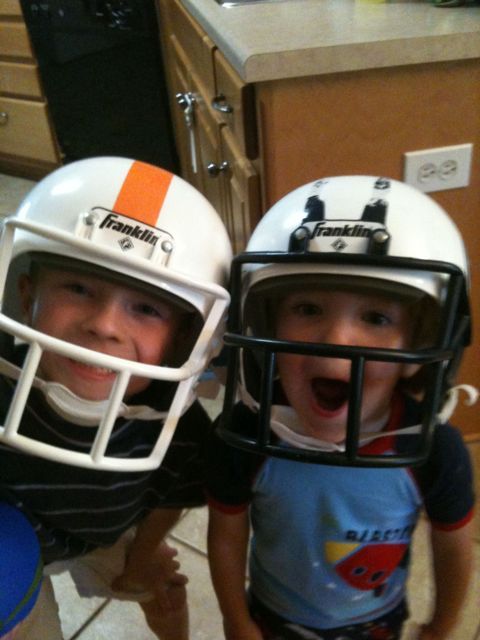
Football Time

You know it’s football time when the boys get the football helmets out.

Posted in Family, Kids | Leave a comment

LOST Season Six Rewatch: LA X

So I received LOST Season Six as a belated anniversary present (thanks, Sunny). Now I’m going back and re-watching and I’m noticing a lot of things that make more sense now. Thought I’d keep a running journal of these thoughts over the next few weeks / months as I slowly make my way through the discs.

And you only thought I was finished blogging about this show.

  • In the season premiere, Rose tells Jack he can “let go now”. Of course, in the moment, she’s telling the good doctor he can release his death grip on his seat’s armrests after the plane experiences turbulence after passing over the sea-floor-grounded Island. But clearly this phrasing is meant to foreshadow the series finale where Christian speaks those same words to Jack. In hindsight, I’m thinking Rose might already be “enlightened” at this point in the Sideways. In fact, I’m almost certain. She and Bernard are already together, indicating their “sync up” moment has already occurred in Sideways land. And there’s that comment Bernard makes later to Jack (when the doc is looking for Locke’s medical records): “I hope you find what you’re looking for.” Yup, they’re in on it already. Their inclusion in the church pretty much seals the deal on that one.
  • Sayid’s baptism / drowning in the murky pool of doom. Still troubles me a little bit. But I think it has something to do with the Island’s healing power. Sayid “dies” in the pool, presumably because the water has turned brown. Or maybe because he’s a torturing kid-murderer. Either way. Following his “death”, Jack attempts to perform CPR — the same move that miraculously saved Charlie way back in season one. It’s never been explained how Charlie’s salvation occurred exactly; just chalk it up to Island magic and Jack’s fix-it persistence. But this go round, Jack can’t save his friend. Yet, Sayid is reanimated, albeit only to join sides with Smokey for a while, but ultimately his resurrection serves a greater purpose: he must be raised in order to sacrifice himself on behalf of his friends on the sub in the season’s penultimate act. Remember how Charlie died? Same way. I think we’re supposed to be equating Sayid’s experience here with Charlie’s. Both of them were given new life by the Island in order to ultimately lay down that life for the other players. Same thing is true, to a certain degree, of Michael, although his sacrifice isn’t enough to keep him from Whisper-ville. Anywho, according to the paper in the ankh stuffed inside Charlie’s guitar case (yet another allusion to Charlie), Jacob says that if Sayid dies, the Temple folk are in a lot of trouble. This is true in the short term (Sayid will be Locke’s right hand man for most of the season), but ultimately Sayid’s death precipitates his Island resurrection and, ultimately, his redemption. This is either really convoluted or brilliant. I can’t decide.
Posted in Television | Tagged | Leave a comment

15 Essential Albums

I was tagged recently on FB to list my 15 “essential” albums. I guess these are the albums that I’d have to have with me on a desert island or something. A desert island with a limitless supply of MP3 listening devices and batteries I suppose. But I digress. This is the kind of thing you’re not supposed to put much thought into (thus, the “essential” component), so here are my 15 Essential Albums off the top of my head and in no particular order.

  1. No Line on the Horizon, U2
  2. Emotionalism, The Avett Brothers
  3. A Collision, David Crowder Band
  4. Michael McDermott, Michael McDermott
  5. Abbey Road, The Beatles
  6. White Ladder, David Gray
  7. If There Was A Way, Dwight Yoakam
  8. At Folsom Prison, Johnny Cash
  9. This, Lost and Found
  10. Viva la Vida, Coldplay
  11. Hold Time, M. Ward
  12. LOST (Original Television Soundtrack), Michael Giacchino
  13. In Rainbows, Radiohead
  14. Is This It?, The Strokes
  15. Bringing Down the Horse, The Wallflowers
Posted in Music | Tagged , , , , , , , , , , , | Leave a comment

The Sermon on the Mount 19

38 “You have heard that it was said, ‘An eye for an eye and a tooth for a tooth.’ 39 But I say to you, Do not resist the one who is evil. But if anyone slaps you on the right cheek, turn to him the other also. 40 And if anyone would sue you and take your tunic, let him have your cloak as well. 41 And if anyone forces you to go one mile, go with him two miles. 42 Give to the one who begs from you, and do not refuse the one who would borrow from you.
43 “You have heard that it was said, ‘You shall love your neighbor and hate your enemy.’ 44 But I say to you, Love your enemies and pray for those who persecute you, 45 so that you may be sons of your Father who is in heaven. For he makes his sun rise on the evil and on the good, and sends rain on the just and on the unjust. 46 For if you love those who love you, what reward do you have? Do not even the tax collectors do the same? 47 And if you greet only your brothers, what more are you doing than others? Do not even the Gentiles do the same? 48 You therefore must be perfect, as your heavenly Father is perfect. — Matthew 5:38-48

The Sermon on on the Mount is set apart by the transformative initiatives Jesus puts forth for his audience. The focus of this particular teaching is the elevation of the new way of Christ above the retaliatory violence commissioned under Mosaic law. Whereas vengeance may at least on some level satisfy our deep longing for justice in the world, Jesus commends a “higher law”, a way marked by peace and restorative action.

Do not resist the one who is evil is somewhat troublesome, at least as it has been popularly rendered. N.T. Wright translates v39 this way: “Don’t use violence to resist evil!” Stassen prefers: “do not retaliate revengefully by evil means.” It makes no sense that Jesus would teach us not to resist evil. In his own ministry, He resisted the evil of those who would oppose God’s work through Him. Contextually, we have a teaching on the systemic nature of vengeance and Jesus’ solution for breaking the cycle of violence. Paul teaches a similar sentiment in Romans 12.17-21: “Do not repay anyone evil for evil….Beloved, never avenge yourselves….If your enemies are hungry, feed them; if they are thirsty, give them something to drink….Do not overcome evil by evil, but overcome evil with good.”

A slap on the right cheek is either a backhanded slap — an insult, the kind of slap you give to a dog — or a slap with one’s left hand, the “dirty” hand used for bodily maintenance, unfit for touching another person. In either case, the way of Christ is clear: nonviolence. As with the civil rights movement in the United States a generation ago, the nonviolent initiative confronts injustice and, as Stassen puts it, “calls our adversary to a new level of consciousness of what he or she is doing.” Such is the intentionality of each of the creative examples Jesus cites.

N.T. Wright says of this text:

Jesus offers a new sort of justice, a creative, healing, restorative justice. The old justice found in the Bible was designed to prevent revenge running away with itself. Better an eye for an eye and a tooth for a tooth than an escalating feud with each side going one worse than the other. But Jesus goes one better still. Better to have no vengeance at all, but rather a creative way forward, reflecting the astonishingly patient love of God himself, who wants Israel to shine his light into the world so that all people will see that he is the one true God, and that his deepest nature is overflowing love. No other god encourages people to behave in a way like this!

To live in such a way requires courage, resolve, patience, and — not least of all — imagination. Imagination is required to engage the mind to creatively realize new responses to the problem of violence and the deep-seated desire for vengeance, opening up new possibilities for reconciliation rather than drawing on status quo retaliation. The world has seen enough of this. May the imaginative energy of the church be relentlessly focused on the only ministry left to us: the great ministry of reconciliation (2 Cor. 5).

Love without limit…

Kingdom without end…

Posted in Discipleship, Gospel, Jesus, Scripture, Sermon on the Mount | Tagged , , , , , | Leave a comment

Hawg Mollie

My son, the offensive lineman for the Mustangs. Who knew? He’s pretty small for a right tackle, but he’s all heart, baby.

Posted in Family, Kids | 1 Comment

Thoughts on Proverbs: Wisdom vs. Folly

I believe Proverbs 1.7 to be thematic for the entire text:

The fear of the LORD is the beginning of knowledge, but fools despise wisdom and discipline.

I’ve already written about the fear of the LORD in a previous post; but the latter part of this foundational passage emphasizes the competing ideologies of wisdom and folly.

The portrait of the fool emerges as a contrast to the one who seeks the wisdom of YHWH. Here are only a few of the references to folly in the Proverbs:

  • He dies for lack of discipline, and because of his great folly he is led astray. 5.23
  • In everything the prudent acts with knowledge, but a fool flaunts his folly. 13.16
  • Whoever is slow to anger has great understanding, but he who has a hasty temper exalts folly. 14.29
  • The heart of him who has understanding seeks knowledge, but the mouths of fools feed on folly. 15.14
  • Let a man meet a she-bear robbed of her cubs rather than a fool in his folly. 17.12
  • The devising of folly is sin, and the scoffer is an abomination to mankind. 24.9
  • Like a dog that returns to his vomit is a fool who repeats his folly. 26.11

The fool is an undisciplined scoffer of God and His wisdom. The fool in his folly is reckless in his anger — worse than a Momma bear on the prowl for her cubs! Even worse, he is proud of his foolishness, wearing it as a badge of honor, unaware that the cycle of folly is destroying him each time he returns to it.

Contrast this with the 60+ references to “the wise” in Proverbs alone. Again, this is far from an exhaustive list, but the character of the wise emerges with even a cursory glance.

  • The wise will inherit honor, but fools get disgrace. 3.35
  • Give instruction to a wise man, and he will be still wiser; teach a righteous man, and he will increase in learning. 9.9
  • A wise son makes a glad father, but a foolish son is a sorrow to his mother. 10.1
  • The wise lay up knowledge, but the mouth of a fool brings ruin near. 10.14
  • The way of a fool is right in his own eyes, but a wise man listens to advice. 12.15
  • One who is wise is cautious and turns away from evil, but a fool is reckless and careless. 14.16
  • The heart of the wise makes his speech judicious and adds persuasiveness to his lips. 16.23
  • A fool gives full vent to his spirit, but a wise man quietly holds it back. 29.11

The wise man exercises discernment and self-control, a distinct alternative to the reckless behavior of the fool. Wisdom is also the measured way of life, guarding against impulsiveness by counting the cost of one’s actions. He who is wise seeks counsel, is quick to listen, and is judicious in his speech.

All of this comes to a head in the personified narrative of Proverbs 9. Two women call out for the attention of a young man: “Come eat at my table!” they cry out to him. The first voice belongs to Lady Wisdom, the female personification of God’s wisdom in the Proverbs. This is the way of life that demonstrates fear of YHWH and obedience to His instruction. The second voice is Woman Folly, whose siren song tempts the young man with stolen water and food eaten in secret (9.17), symbolizing illicit activity and the fleshly appeal of sin. Each of these ladies live at the highest point of the city (9.3; 9.14), often the places of worship in the ancient culture. What at first blush appears to be a squabble between two women for the attention of the young suitor is properly understood as something much more significant: the young man’s decision is primarily a question of worship. Which voice will I heed? The path of folly is the way of excess, of indulgence, of immorality and sin. But the fear of the LORD prompts worshipful obedience to Wisdom’s call on one’s life.

The struggle between Wisdom and Folly defines not only the narrative of the Proverbs, but the narrative of our lives as well.

Posted in Proverbs, Scripture | Tagged , | Leave a comment

Ground Zero

This week, I’ve been following the news out of New York regarding the proposed construction of a Muslim mosque in the heart of Manhattan, just blocks away from “Ground Zero”, the site of the 9/11 attacks from 2001. Nearly 10 years after the attack, the wounds are still fresh for many Americans. According to a CNN/Opinion Research Corp. poll released August 11, nationwide opposition to the construction of this mosque is at 68 percent. This is understandable; nearly 3,000 Americans — mostly civilians — died on the morning of September 11th, the darkest moment in the national consciousness of most Americans today. Although there is certainly no law preventing the construction of such a facility, the wisdom of such a move — especially in light of the national attention this story is garnering — is questionable. Most Americans consider this action to be, as Howard Dean has said, “an affront to people who lost their lives.” One leader went so far as to say the construction of this mosque was akin to a Japanese war memorial at Pearl Harbor.

And yet, in moments like these, I’m also struck at how quickly the discourse devolves and unravels into vitriolic distinctions of “us” and “them”. The accusation has been made that some want to interpret freedom of religion as only being applicable to the Christian community. It’s easy to see how such an accusation could have merit. Are American Muslims not guaranteed the same freedom of religion under our Constitution? Do we hold the entire Islamic faith responsible for the actions of a handful of radical extremists? What would happen if the greater Christian community was judged in light of the actions of, say, extremists who attack and destroy abortion clinics, all in the name of Jesus? I understand this is an emotionally charged issue for many Americans, but I believe we’re all too quick to let those emotions cloud our judgment. A recent FoxNews report indicates that an inter-faith chapel at the rebuilt section of the Pentagon opens its doors to practicing Muslims, even allowing weekly periods of time (Monday through Thursday, 2 p.m.) for Muslim prayer. All of this a mere 20 steps from the impact of the 9/11 attack on the Pentagon. And yet, where is the national outrage? Is the Pentagon less “hallowed ground” than Ground Zero? These and a hundred other questions come swirling out of this controversial issue.

In times such as these, I find myself asking, “What does faithfulness to Christ look like here?” With such heated and passionate dialogue centered around the construction of this mosque, how does the Christ-follower engage in this dialogue faithfully? Thankfully, the New Testament is all kinds of helpful here:

  • Let your speech always be gracious, seasoned with salt, so that you may know how you ought to answer each person. Colossians 4.6
  • Let no one despise you for your youth, but set the believers an example in speech, in conduct, in love, in faith, in purity. 1 Timothy 4.12
  • But as you excel in everything—in faith, in speech, in knowledge, in all earnestness, and in our love for you—see that you excel in this act of grace also. 2 Corinthians 8.7

Paul seems to be arguing in favor gracious Christian speech, a nuanced act of truth-speaking and grace. Know how to answer each person; yes. But the path to such dialogue is gracious, seasoned speech, not caustic, spiteful language. Personally, I question the wisdom of the construction of this mosque. But in this situation, as in all others, the Christian community must be mindful of her high and holy calling: to bear the name of Christ in the world with faithfulness and grace, dignity and love. This is the way of Christ.

Posted in Discipleship, Gospel, Jesus, Scripture, Social Issues | Tagged | 7 Comments