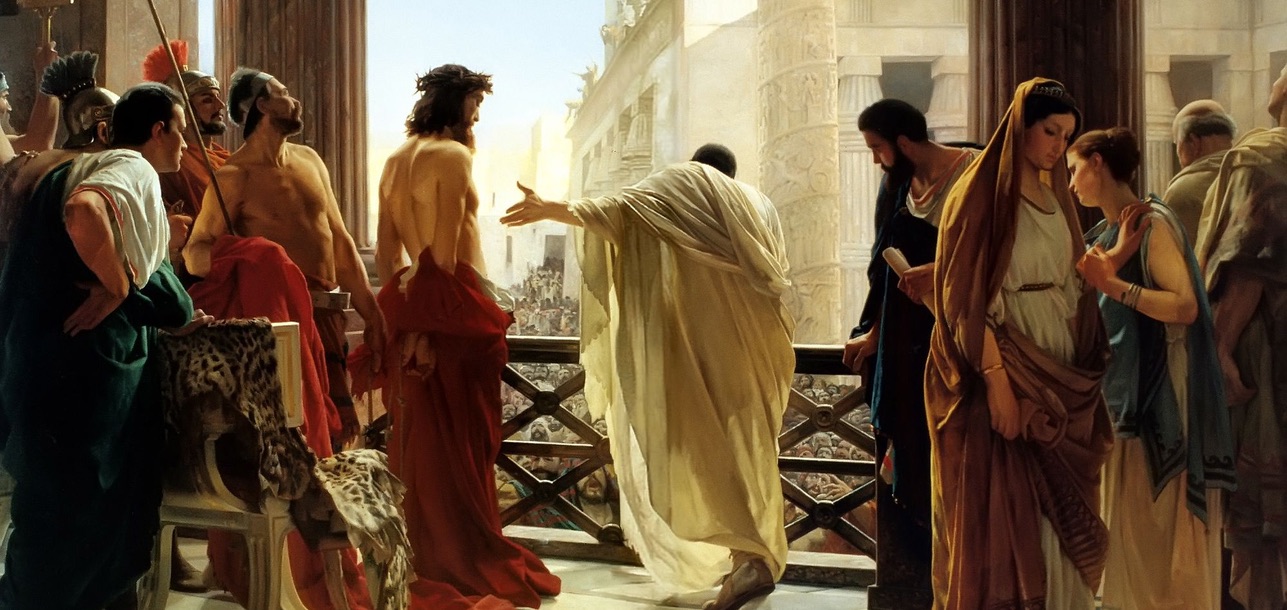
A New Day: The Year of the Lord’s Favor, Part 2

In the Year of Jubilee, debts were forgiven; captives were set free; land would lie fallow. (You can read all about it in Leviticus 25.)

Jesus is declaring that in Him, the Year of Jubilee has come. In fact, it has been fulfilled. The debt of sin and guilt and shame is being lifted. We no longer have to be slaves to fear and doubt — because our Liberator has arrived! When Jesus said, Today this Scripture has been fulfilled in your hearing, people understood EXACTLY what He was saying.

He was claiming to be the Messiah, the One who would usher in God’s Kingdom once and for all.

Understandably, people loved the first part of this sermon. Luke says that everyone was speaking well of Jesus; they marveled at His gracious words. They understood these to be words of good news.

They also said, “My, my, this is Joseph’s boy! He’s the next big thing!” But in doing so, they completely miss His identity. He’s not really Joseph’s boy. He’s someone else’s Son. Furthermore, Nazareth was the kind of backwater place where nothing ever happened. But with this new hotshot rabbi, some of the people of Nazareth were surely thinking that this might finally put them on the map. I’m sure the members of the Nazareth Chamber of Commerce were seeing dollar signs as Jesus was preaching! They had heard about the ministry of Jesus, how He had been doing great things in Capernaum. “Now it’s time to spread some of that magic around your own hometown, son.”

But Jesus had other plans. And the next part of His sermon does not go over as well as the beginning.

And he said to them, “Doubtless you will quote to me this proverb, ‘Physician, heal yourself!’ What we have heard you did at Capernaum, do here in your hometown as well.” And he said, “Truly, I say to you, no prophet is acceptable in his hometown. But in truth, I tell you, there were many widows in Israel in the days of Elijah, when the heavens were shut up three years and six months, and a great famine came over all the land, and Elijah was sent to none of them but only to Zarephath, in the land of Sidon, to a woman who was a widow. And there were many lepers in Israel in the time of the prophet Elisha, and none of them was cleansed, but only Naaman the Syrian.” When they heard these things, all in the synagogue were filled with wrath. And they rose up and drove him out of the town and brought him to the brow of the hill on which their town was built, so that they could throw him down the cliff. But passing through their midst, he went away.

Luke 4:23-30

What makes for a good sermon? Some might think a good sermon is one with a funny story or one that affirms everything we already believe. But if we take Jesus as our example, we see that the best sermon is one that gets under our skin a bit. The best sermon might actually upset me if it is a proclamation of the truth of God. So the best sermon is one that might challenge what I believe. And that’s exactly what Jesus does in the application portion of this sermon.

Jesus says to the people of Nazareth, “You’re probably thinking of the old proverb, ‘Physician, heal yourself.’ You’re probably wanting me to put on some awesome display of power, to heal someone or to feed a crowd or perform some miracle.” And honestly, could you blame the people of Nazareth for wanting to see a little of that power? Like we said, Nazareth is the kind of town where nothing ever happens. So, yeah, if I’m sitting in the synagogue that day, I’d probably want to see a little magic, too.

But Jesus refuses to give in to that expectation. In fact, he subverts that expectation with some really radical, even controversial statements. And when he makes these controversial statements, the hometown crowd becomes an angry mob — and they take him to the highest point in town so they can throw him down and kill him.

Now, every preacher I know has to deal with a little bit of criticism from time to time. You make a statement in a sermon that someone doesn’t agree with or you say something that is a little too controversial or whatever. It happens. You can’t have something to say week after week without this sort of thing coming up occasionally. It’s happened to me; it’s happened to every preacher I know. And people are usually kind about it; they’ll send an email asking if we can talk or they’ll kindly wait around after the sermon to ask for some clarification.

But in all my years of preaching, I’ve never had anyone take up to Monte Sano (highest point in Huntsville) on a Sunday afternoon so they could murder me for something I said in my sermon! But that’s what they try to do to Jesus here! Just look at how quickly things change: in the first half of the sermon, the entire crowd was speaking well of Jesus; but by the end, they want to have him executed.

If we’re reading Luke carefully, our question ought to be, “What does Jesus say that makes these people so angry that they want to kill him?” How is it that the same people who changed his diapers in the church nursery all those years ago now form a posse to have him executed?

Posted in Church, Faith, God, Isaiah, Jesus, Ministry, Scripture | Leave a comment

A New Day: The Year of the Lord’s Favor, Part 1

Today we continue our study of Isaiah, but we’re going to begin in the Gospel of Luke. Luke tells us how one of Isaiah’s prophecies came to be fulfilled. And even though Isaiah delivered this prophecy about 2,700 years ago, it is one that directly impacts the way we live out our faith today.

Today we look at Luke 4. To set the scene: Jesus has been baptized; at His baptism, the Holy Spirit descended upon Him and indwelled Him in a powerful way. Luke says that Jesus was full of the Holy Spirit and that He was led by the Spirit into the wilderness for forty days, being tempted by the devil (4:1). Sidebar: in a few weeks, we will return to this episode; immediately after Easter, we will launch a new series about resisting temptation. So be praying about that.

Everything about the ministry of Jesus reflects the Kingdom of God.

Following this time of temptation, Jesus begins His public ministry. Here’s how Luke describes it:

And Jesus returned in the power of the Spirit to Galilee, and a report about him went out through all the surrounding country. And he taught in their synagogues, being glorified by all.

Luke 4:14-15

So Jesus has officially launched His ministry which is powered by the Holy Spirit. We know that this ministry included healing and feeding and — most importantly — teaching about the Kingdom of God. Everything about the ministry of Jesus reflects the Kingdom of God. It reflects this new day that Isaiah envisioned all those centuries earlier.

When Jesus heals someone, He does so because the Kingdom of God is the place of ultimate restoration. When He feeds someone, it’s because the Kingdom of God is the place of true sustenance and satisfaction. He teaches the truth because the truthfulness of God’s Word is foundational to the Kingdom of God.

And His ministry takes place in public view. As Paul would later say to Festus and King Agrippa, these things were not done in a corner (Acts 26:26). Word begins to spread about the ministry of Jesus. And Luke says that Jesus was being glorified by all. People are saying a lot of good things about Jesus at this point.

The Year of the Lord’s favor

And then Luke records an incident that takes place in Nazareth, the place where Jesus grew up. And this is where we find the fulfillment of one of Isaiah’s most important prophecies.

And he came to Nazareth, where he had been brought up. And as was his custom, he went to the synagogue on the Sabbath day, and he stood up to read. And the scroll of the prophet Isaiah was given to him. He unrolled the scroll and found the place where it was written:

“The Spirit of the Lord is upon me, because he has anointed me to proclaim good news to the poor. He has sent me to proclaim liberty to the captives and recovering of sight to the blind, to set at liberty those who are oppressed, to proclaim the year of the Lord’s favor.”

And he rolled up the scroll and gave it back to the attendant and sat down. And the eyes of all in the synagogue were fixed on him. And he began to say to them, “Today this Scripture has been fulfilled in your hearing.” And all spoke well of him and marveled at the gracious words that were coming from his mouth. And they said, “Is not this Joseph’s son?”

Luke 4:16-22

After a successful teaching tour throughout Galilee, Jesus returns to Nazareth, His hometown; and He goes to the synagogue on the Sabbath day, according to Jewish custom. Synagogue services usually consisted of singing a psalm, several Scripture readings, and then a sermon. So Jesus has been invited to read the text and deliver the sermon in his “home church.”

Jesus reads from Isaiah 61. Isaiah envisioned a new day in this passage, a day when God’s Messiah would arrive. In the time of Jesus, this section of Isaiah was read frequently with a fervent hope that God would fulfill it sometime soon. The hope was that God would send His Messiah to kickstart the Kingdom of God here on earth.

But it’s interesting to note what Jesus read — and what part of this passage he did NOT read.

The Spirit of the Lord God is upon me, because the Lord has anointed me to bring good news to the poor; he has sent me to bind up the brokenhearted, to proclaim liberty to the captives, and the opening of the prison to those who are bound; to proclaim the year of the Lord’s favor and the day of vengeance of our God…

Isaiah 61:1-2

Notice that Jesus stopped just short of the line about the day of vengeance. We should ask, “Why does Jesus do this?” I think it’s simply because He wasn’t ready to fulfill the day of the Lord’s vengeance just yet. The fulfillment of that day will come later — at the second coming. But at this “first coming,” Jesus announces the availability of the Kingdom as “the year of the Lord’s favor.” He later says in John 3:17, For God did not send his Son into the world to condemn the world, but in order that the world might be saved through him. Instead of declaring the day of vengeance, Jesus proclaims the year of the Lord’s favor, which is connected with the Year of Jubilee in the Old Testament.

Posted in Eschatology, Faith, God, Gospel, Isaiah, Jesus, Ministry, Scripture | Leave a comment

400M Dash: New PR

Jackson had a big night earlier this week at his JV track meet. He set a new PR in the 400M Dash, shaving off three seconds and winning his heat. This is the first time he’s won a heat, which is a pretty big deal! Not too bad for a 7th grader! I love watching him run; it just seems effortless. Watch him take the lead on the final turn.

Posted in Family, Kids, Running, Sports, Track, Video | 1 Comment

A Good One to End On

Joshua was really starting to crush the baseball this spring…and then he slid into second base and dislocated his shoulder. Probably done for the spring. The good news is that he should be okay for summer ball after 6-8 weeks. But it still stinks.

Here’s a video of one of his last hits of the season, a solid line drive to center.

Posted in Baseball, Family, Kids, Sports, Video | Leave a comment

A New Day: You Shall Go Out in Joy, Part 2

Here’s the good news: God offers us the “something more” our souls are seeking. He offers that which truly satisfies the soul. From our text in Isaiah 55, God says, Listen diligently to me, and eat what is good… Incline your ear, and come to me; hear, that your soul may live. God offers nourishment for the soul. There is a deep yearning in our souls for connection, for intimacy, for meaning and purpose. Yet too often we seek to satisfy these soul cravings with the wrong kinds of things; some of which we discussed in the previous post. That’s why we’re so restless.

Too often, we settle for happiness. But happiness is fleeting. Instead, God promises an everlasting covenant. Just as man cannot live on bread alone, it is also true that the soul cannot live on happiness alone. We need something deeper, something even more meaningful. And here it is: we need joy. And that’s exactly what God promises here in the next verses.

Seek the Lord while he may be found; call upon him while he is near; let the wicked forsake his way, and the unrighteous man his thoughts; let him return to the Lord, that he may have compassion on him, and to our God, for he will abundantly pardon. For my thoughts are not your thoughts, neither are your ways my ways, declares the Lord. For as the heavens are higher than the earth, so are my ways higher than your ways and my thoughts than your thoughts.

For as the rain and the snow come down from heaven and do not return there but water the earth…so shall my word be that goes out from my mouth; it shall not return to me empty, but it shall accomplish that which I purpose, and shall succeed in the thing for which I sent it.

For you shall go out in joy and be led forth in peace…

Isaiah 55:6-12

This is the deeper invitation: seek the Lord while he may be found. There is an eternal yearning in every soul. Ecclesiastes 3:11, God planted eternity in the human heart. When we seek to satisfy that eternal yearning with something fleeting like happiness or sex or power or a boyfriend or a wife, we inevitably grow restless because these could never satisfy our eternal yearning. Only something eternal could satisfy an eternal yearning.

Isaiah counsels us to forsake our ways: to abandon these fleeting pursuits and to call upon the Lord while He is near. Return to the Lord, Isaiah says, and He will have compassion on you; He will pardon abundantly. God’s heart is overflowing with compassion and abundant grace. We need only to return to Him, which simply means to turn to Him in repentance.

God’s invitations align perfectly with our soul yearnings: He says, Come, all who are thirsty. Come, all who are hungry. Come, listen to my words, that your soul may live. And now again, God says, Come to me, that I might have compassion on you.

Look at the final two verses of the chapter:

For you shall go out in joy and be led forth in peace; the mountains and the hills before you shall break forth into singing, and all the trees of the fields shall clap their hands. Instead of the thorn shall come up the cypress; instead of the brier shall come up the myrtle; and it shall make a name for the Lord, an everlasting sign that shall not be cut off.

Isaiah 55:12-13

God says, You shall go out in joy and be led forth in peace. The picture here is certainly a joyous one: mountains and hills praising God for what He’s done, trees clapping their hands in worship. There is a great reversal at work here: thorns and briers have been replaced by cypress and myrtle. God transforms the desert space into a blooming garden. What an awesome God we serve!

Everyone is looking for this kind of joy — because joy is one of the deep yearnings of the soul. Do you see how this kind of joy is so much deeper than mere happiness? Whereas happiness is often dependent upon our life circumstances, joy is constant. And this is what God promises — to those who seek the Lord, to those who let themselves be led.

Isaiah envisions One who is out front, One who goes before God’s people and lead them in this joyful procession of worship:

  • He is the One who paid the price for those who cannot buy their own food. And no one can buy the kind of food He offers, the kind that truly nourishes the soul. It is given only by grace.
  • He is the One who transforms thorn and brier; by His grace, He turns the desert places into lush gardens.
  • The rocks and hills cry out His name; the trees of the fields clap in His honor.

His name is Jesus. And He invites us into His eternally joyous communion! You shall go out in joy! This is an invitation to something far greater than mere happiness. It is an invitation for your soul.

May you go out in joy today; may you be led forth in peace.

Posted in Culture, Devotional, Eschatology, Faith, God, Isaiah, Jesus, Kingdom Values, Scripture | Leave a comment

A New Day: You Shall Go Out in Joy, Part 1

“Do whatever makes you happy.”

This is one of the major philosophies people live by these days. It’s Pinterest-philosophy, the kind of Etsy-fied life mantra that we love to paint on pieces of repurposed wood to adorn our homes.

I read an article written by a woman who was raised in London but she and her husband moved to the United States a few years ago for work. She said the greatest difference she’s noticed since moving here is that Americans are obsessed with happiness. And she’s right. Not only do all of our fairy tales end with the words, “and they lived happily ever after,” but the phrase “the pursuit of happiness” is baked right into our Declaration of Independence.

But to be fair, this is not a uniquely American problem, nor is it exclusively modern. As far back as 300BC, Epicurean philosophy was teaching a form of the same thing: do whatever makes you happy. And philosophical hedonism dates back even further, all the way to ancient Egypt and Babylon and beyond. People have subscribed to this worldview for thousands of years.

But when you break it down, this saying isn’t quite as inspirational as it sounds. I think it’s just deep cover for doing any old selfish, indulgent thing you want to do. I am going to suggest to you that doing what makes you happy isn’t a lofty enough goal. Happiness stops just short of God’s invitation for our lives. He invites us to experience something much deeper than the pursuit of happiness. And we find this invitation from God in the prophecy of Isaiah.

Come, everyone who thirsts, come to the waters; and he who has no money, come, buy and eat! Come, buy wine and milk without money and without price. Why do you spend your money for that which is not bread, and your labor for that which does not satisfy? Listen diligently to me, and eat what is good, and delight yourselves in rich food. Incline your ear, and come to me; hear, that your soul may live; and I will make with you an everlasting covenant, my steadfast, sure love for David.

Isaiah 55:1-3

God begins with an invitation: Come, all who are hungry and thirsty. But He extends a special invitation to those who cannot buy their own food. And he who has no money, come, buy and eat! That’s a strange thing to say. How can one with no money “buy” anything? How can such a one eat? Only by grace. Only if the price has been paid by another. And I believe that’s the deeper meaning here. God is extending a gracious invitation that corresponds to a desire deeper than the appetite for food. God is speaking to us at a soul-level here.

And in the middle of this invitation is a critique: God says, Why do you…labor for that which does not satisfy? Can you relate to that? Have you ever wanted something so badly — something you thought would make you happy — but once you received it or obtained it, you realized that it didn’t really satisfy you?

I know a young man who recently lost his virginity. He and his girlfriend didn’t have the proper boundaries around their relationship and in a moment of weakness, they gave in to temptation. Afterward, this young man said he felt ashamed of what they had done. But in addition to being disappointed in himself, this young man noted that he was also disappointed in sex, too. He said that he had always heard of “sex” being talked about like it was this otherworldly experience. That’s certainly the way sex is glorified in our culture. But he said it didn’t deliver in the way he thought it would, which only compounded his feelings of guilt and shame.

I guess one point here would be that forbidden fruit is forbidden for a reason. That’s definitely true. But this also demonstrates how we tend to overexpect from so many things in this world. The kingdom of darkness is the worldwide leader in overpromising and underdelivering. It sells guilt and shame disguised as interest-free happiness. And we make that bad trade all the time.

What my young friend is really looking for is soul-level intimacy and communion; what he settled for was sex. And I’m not picking on my young friend. We’re all searching for the same thing. EVERYONE is looking for soul-level intimacy and communion. But like my young friend, we’re all capable of deluding ourselves into thinking that this soul-hunger can be satisfied by something fleeting and earthly.

We do the same thing in our marriages and our dating relationships. Relationship counselors have long pointed out that unrealistic expectations of our partners contribute to some of the greatest problems in our relationships. That’s because we listen to “Rabbi Hollywood” too much. We have been discipled by Hollywood’s ridiculous “you complete me” soulmate liturgy and we bring that expectation into our marriages. We expect our spouses to “complete” us, which creates an expectation that even the best husband or wife could never possibly meet. How could a flawed, sinful person ever bear the freight of “completing” you or bringing wholeness to your soul? That work could only be done by God. It’s not fair to put that expectation on your husband or wife.

C.S. Lewis famously said, “If we find ourselves with a desire that nothing in this world can satisfy, the most probable expectation is that we were made for another world.” This gets at the heart of the problem. I mean, if happiness is the ultimate goal in life, why are so many of us so miserable? I would say it’s because happiness is fleeting and our souls are longing for something more.

Posted in Culture, Devotional, Faith, Friends, God, Gospel, Isaiah, Marriage, Scripture | Leave a comment

Baseball Moms and Their Boys

Baseball Moms and sons bond this time of year
Posted in Baseball, Family, Kids, Sports, Sunny, Video | 1 Comment

Jackson’s New Blog

My youngest son has a blog he’s been writing for the past several months called Everything TV. He’s been writing about some of what he’s been watching, including several posts about Survivor and our family viewing of The Help in February as part of Black History Month.

Last night, he started a second blog, more of a personal blog and you can find it here. I think he’s planning to keep the Everything TV blog, but this new site will feature some of his other interests. For example, he’s started this new blog with a couple of posts ranking the albums of two of his favorite musical artists: Taylor Swift and Bon Iver. I love reading his thoughts about music and I’m looking forward to some of his future posts.

Check out his stuff if you have a minute. I think you’ll enjoy it!

Posted in Blogging, Family, Kids, Music, Television | 1 Comment

A New Day: Three Reasons You Don’t Need to Be Afraid, Part 3

But now thus says the Lord, he who created you, O Jacob, he who formed you, O Israel: “Fear not, for I have redeemed you; I have called you by name, you are mine. When you pass through the waters, I will be with you; and when you pass through the rivers, they will not sweep over you. When you walk through the fire, you will not be burned; the flames will not set you ablaze.”

Isaiah 43:1-2

Reason #3: Fear not, for I have redeemed you.

This is the ultimate reason that God’s people should not be gripped by fear. We have been redeemed. God demonstrates that He is with His people and for His people by acting to redeem His people.

In these verses, God reminds the people that He created and formed them.

  • For the people of Isaiah’s day, this would call to mind how God created Israel centuries earlier, how He redeemed them from the bondage of Egypt and entered into a covenant relationship with them. Even when they passed through the waters of the Red Sea and the Jordan River, God was faithful to guide them through to redemption.
  • And on this side of the cross and the empty tomb, we hear these words as a fresh promise for today. For God created and formed us as a people when He redeemed us through the death and resurrection of Jesus. We are bound together in a new covenant that makes us brothers and sisters together. And the sign of this covenant — baptism — is God’s promise anew: when you pass through the waters, I will be with you. I can’t help but think of this as a baptism text from this side of the empty tomb.

God is saying, “If you have been redeemed, you really have no need to be afraid.” And when those fears arise, we simply turn them over to Him.

Practically speaking, what does that mean? Well, for one thing, it means choosing not to fixate on those fears and releasing my right to worry about them. We can’t talk about fear without talking about worry; the two go hand in hand.

There is an old Native American myth. A grandfather is talking to his grandson and he is sharing a particular struggle. “It is as if there are two wolves warring within me, my grandson,” he says. “One wolf represents my desire to do the wrong; the other wolf represents my desire to do the right.”

The young boy is confused. “Which one will win?” he asks his grandfather.

The grandfather replied, “Whichever wolf I feed — that is the wolf that will win.”

Worry works this way. Worry is when we fixate on our fears — when we “feed” our fears, to use the wolf analogy. But worry is a choice. Rather than turning those worries over and over in our minds, Jesus calls us to forsake the path of worry. In the Sermon on the Mount, he says, Do not worry about your life, what you will eat or drink; or about your body, what you will wear. Is not life more? He goes on to say, Do not worry about tomorrow, for tomorrow will worry about itself. Jesus isn’t telling us to be naive, to stick our heads in the sand when it comes to the concerns of life. Instead, Jesus is telling us to entrust our fears and worries to Him.

Worry is kind of like a treadmill. There’s a lot of movement, but you’re not really going anywhere. Of course, spending time on a treadmill can actually be good for you. But worry doesn’t improve a single facet of your life. Gary Bradley, a preaching mentor of mine, once said, “If worry would do us any good, the Lord would tell us to do it.” But God never says that. In fact, it’s just the opposite. Not only is worry harmful to my physical health, it also damages my spiritual health. It keeps me from faithfully entrusting my fears to the Lord. It oftentimes sets itself up in opposition to my faith.

Worry is the self-inflicted choice that keeps me from becoming a person of fearless trust. But according to the Bible, when we follow Jesus, we learn how to take captive every thought that sets itself up against the knowledge of God.

Do you have some worried, fearful thoughts that need to be taken captive? Do you need to get off the treadmill? If you have been redeemed, then I hope you’ll heed this word from the Lord:

Reason #3: Fear not, for I have redeemed you.

Posted in Anxiety, Devotional, Faith, God, Isaiah, No Fear, Scripture | Leave a comment

A New Day: Three Reasons You Don’t Need to Be Afraid, Part 2

For I, the Lord your God, hold your right hand; it is I who say to you, “Fear not, I am the one who helps you.”

Isaiah 41:13

Reason #2: Fear not, for I am the one who helps you.

Not only does God want His people to know that He is with them; He also wants them to know that He is for them. He is holding them by the hand — which has to be one of the most comforting images in the entire Bible. He says, “I am the one who helps you.”

We all need help from time to time. “Help” is what we cry out when we are in danger, when we need assistance. We even have this phrase: “lend a helping hand.” Throughout the Scriptures, God says that He is the “helping” God; He is the God who “lends a helping hand” to His people.

There are two references to God’s hands here in this section of Isaiah — and both of them come with God’s promise to help His people. He says, I will strengthen you, I will help you, I will uphold you with my righteous right hand. God’s right hand is His hand of victory; it is His hand of strength. We might picture this as the “arm of the Lord” we spoke of a few weeks ago — the arm of God as the Mighty Warrior. But here God says, I hold your right hand. We’re back to the balanced view of God we’ve been talking about — this is the Gentle Shepherd holding the hand of His people through any adversity.

God is right there to lend a helping hand to His people, no matter our circumstances. Listen to the verses just before this one:

Those who strive against you shall be as nothing and shall perish. You shall seek those who contend with you, but you shall not find them; those who war against you shall be as nothing at all.

Isaiah 41:11-12

God says those who contend against you — your enemies — shall be as nothing at all. The literal translation of this verse refers to “the men of your lawsuit,” meaning “those who plead against you.” But God stands in to defend us — picture a defense attorney advocating for the defendant. This is a picture of our God.

When God says, “Fear not,” He’s not telling us it’s a sin to be afraid. That’s not it at all. Life is full of fear-inducing circumstances. Fear in and of itself is not sinful. Healthy fear prompts us to lock our doors at night and wear a seatbelt while driving. Rather, God is reminding us not to give in to our fears, not to be controlled by our fears. Instead of being controlled by fear, we are to be controlled by the Spirit. We are controlled by faith, hope, and love, not fear. Based on the number of Fear not statements we find throughout the Scriptures, it seems pretty obvious that God wants to help us become people of fearless trust.

And this is the ultimate point: God wants us to trust Him with our fears. He wants us to let Him help us with our fears. Fearless trust means there’s nothing I won’t entrust to Him. It means I won’t hold on to those fears; I won’t be miserly with those fears, hoarding them to myself. No, the way of faith is to entrust those fears to the Lord — to give them over to Him, to let Him help.

Do you need the help of God? Is there any problem beyond His ability to help? He promises to help us by the strength of His own hand; therefore, we need not be afraid.

Reason #2: Fear not, for I am the one who helps you.

Posted in Devotional, Faith, God, Isaiah, No Fear, Scripture | Leave a comment